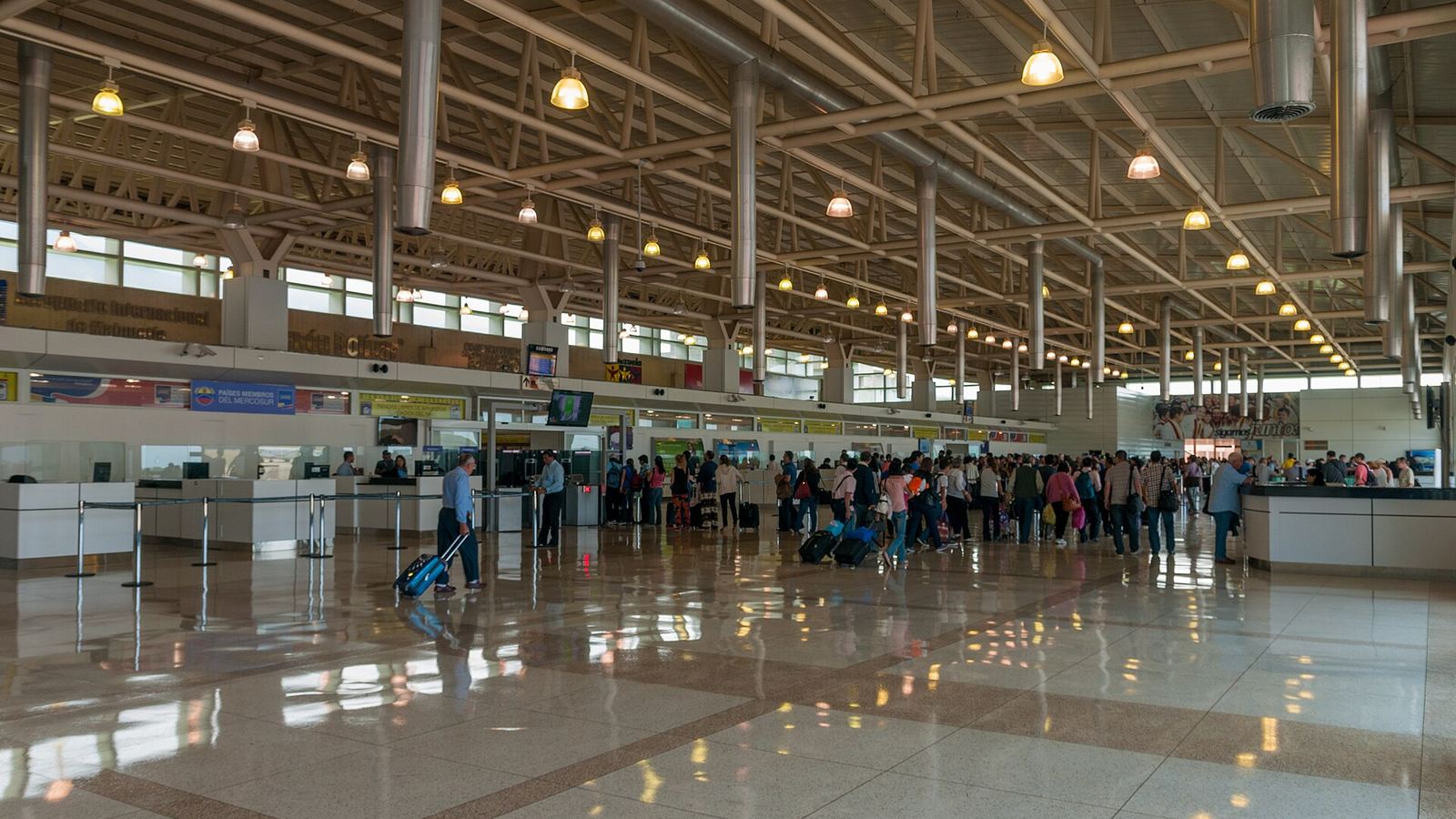
Have a Venezuela eSIM installed and active before your aircraft doors open at Maiquetia, because the airport you may be picturing does not currently exist. Simon Bolivar International, code CCS, took severe structural damage in the 24 June 2026 earthquakes, including fractured runways and damage to the control tower, and was shut for ten weeks. It reopened on 1 September operating out of four modular structures erected in its external car parks, covering somewhere over 10,000 square metres between them and running at roughly a quarter of the airport's former throughput.
Those temporary terminals are documented as holding ticketing, check in, baggage services, security, migration control, air conditioned waiting areas, toilets, medical facilities and a paid lounge. Carrier retail does not appear on that list. The three SIM counters older guides describe were in the permanent arrivals hall, which is out of service while reconstruction runs toward an early 2027 target. Treat a SIM desk here as something that might pleasantly surprise you rather than something to plan around.
What This Guide Covers
Jump to the section most relevant to you
What CCS Actually Is Right Now
Four modular buildings, put up in the outdoor parking areas, are the whole passenger operation. Access is from the lower airport level by designated ramps, with parking moved to the upper level beside the Gran Cacique hotel. There is a dedicated walkway between the domestic and international sides for anyone connecting. Aircraft are not reached by jet bridge: shuttle buses run passengers from the modular gates out to the stands.
Officials have put the installed capacity at 720 departing and 496 arriving passengers in the international area and 480 and 472 in the domestic one, working out at something over two thousand passengers a day. That is about twenty five percent of what the airport handled before June, with a stated ambition to get considerably higher by the end of the year. Because the buildings are small and the processing is manual in places, the airport asks international passengers to arrive three hours ahead of departure and domestic passengers two.
The SIM counter question, answered plainly
Before the earthquakes, Movistar, Digitel and Movilnet all had a presence in the arrivals hall, and the standing complaint was that their hours were erratic enough that a late evening arrival often found the shutters down. That hall is closed. No source describing the temporary terminals lists a mobile carrier among the facilities inside them. If you want a Venezuelan number, the reliable places are the carrier branches in Sambil Chacao or CCCT in Caracas, with your passport, during business hours.
WiFi Inside the Modular Terminals
WiFi is listed among the facilities in the temporary buildings, so there is something to connect to. What nobody has published is what it is called or how it is provisioned. The permanent terminals ran a network advertised as WIFIAEROPUERTO with sessions capped at 240 minutes, and it is reasonable to hope the same service was carried across to the modular structures, but that is a hope rather than a verified fact and this site is not going to print it as one. Look for whatever open network appears in your list once you are through migration.
There is a second reason not to lean on it. La Guaira, the state the airport sits in, was the last place in Venezuela to get back to full mobile and fixed service after the earthquakes, still at eighty eight to ninety two percent of customers connected by 10 July, and the submarine cable that ruptured offshore at Puerto Viejo in Catia La Mar, a few kilometres from the runway, took roughly half of the country's international bandwidth with it. A shared airport connection on a coastline in that condition is not the place to load a boarding pass you forgot to download.
Land with these already on the device
- Your onward booking, hotel address and driver's name as files or screenshots, not as links.
- An offline map covering La Guaira, the Caracas La Guaira autopista and the whole Caracas valley.
- Any VPN you intend to use, installed and signed in. Vendor download pages are widely blocked here.
- The eSIM profile itself, installed and switched on, so it attaches to a Venezuelan network on landing.
- Enough battery to survive a three hour check in queue on the way out, because seating and sockets are limited.
Maiquetia to Caracas: the Road and the Signal
The airport is on the Caribbean coast at Maiquetia in La Guaira state, roughly twenty kilometres north of Caracas but separated from it by the mountain wall of El Avila. Every route into the city climbs the Autopista Caracas La Guaira, through the Boqueron tunnels and across a series of viaducts, and there is no rail alternative and no metro line. That single road is the whole connection between the airport and the capital.
Its condition was the obvious question after June. The transport ministry inspected the viaducts in the days following the earthquakes and reported no structural failures, with all sections in normal operating and safety condition. Mechanical monitoring gauges were installed to track any daily movement, expansion joints were reconditioned, reinforcement work was started on viaduct three, and lighting was restored in the Boqueron I tunnel. Elsewhere in the same state the damage was far worse: the Caraballeda bridge and Jose Maria Espana avenue at Playa Grande both collapsed. The airport road held.
Coverage on the climb is what you would expect from a mountain motorway with tunnels in it. Good at the coastal end, gone inside Boqueron, intermittent through the cuttings, and steady again as you drop into the valley. The drive is normally in the region of thirty to forty five minutes to the eastern municipalities without traffic, and considerably longer with it. Arrange the car through your hotel or your airline rather than at the kerb, and have the address saved on the phone before you get in.
Why This Particular Airport Rewards Arriving Connected
The general case for sorting data out in advance is familiar. The case at CCS in late 2026 is more specific than usual, and it comes down to the fact that every fallback you would normally reach for has been damaged, moved or is unconfirmed.
What you get by landing already online
What arriving unprepared looks like
Buy the profile at home, add it to the phone the night before you fly, and check in your phone settings that it is set as the line for mobile data. When the aircraft lands and you take the device off flight mode it will attach to Movistar or Digitel on its own, which is the entire point.
What Data Costs Here, and What It Would Cost at a Counter
The usual airport comparison on this site sets a kiosk price against an eSIM price. That comparison cannot honestly be made at Maiquetia right now, because there is no confirmed kiosk to price. What can be compared is the eSIM against the realistic alternative, which is a carrier branch in Caracas the following day.
| Option | Data and validity | Price | Working when? |
|---|---|---|---|
| Nomad, on Digitel | 3 GB / 30 days | 19 USD | On landing |
| Nomad, on Digitel | 5 GB / 30 days | 27 USD | On landing |
| Airalo, on Movistar | 10 GB / 30 days | 39 USD | On landing |
| Airalo, on Movistar | 20 GB / 30 days | 49 USD | On landing |
| Airalo unlimited | 3 GB a day then 1 Mbps / 7 days | 41 USD | On landing |
| Carrier shop in Caracas | Local prepaid line plus a pack | Cheaper in bolivars, unstable in dollars | Next business day, with your passport |
| Maiquetia SIM counter | Not confirmed to exist | Do not budget for it | Do not plan on it |
The reason the local line looks vague in that table is that it genuinely is. Venezuelan carriers price in bolivars, and the bolivar had an official rate of 301 to the dollar in early January 2026, 467 by late March, and a parallel rate near 560 that most transactions actually use. The same pack costs different amounts to different people on the same day. Over a month or a season that variability is worth accepting for the savings. Over a fortnight it is not.
Holafly is absent from the table because it sells no Venezuela plan and does not include the country in its fourteen nation Latin America bundle either. If that is the brand you normally use, this is a trip where you need a different one.
Who Is Flying Again, and Why the Schedule Matters
The reopening on 1 September started small and deliberately: seven domestic and four international round trips on the first day, flown by Copa Airlines to Panama City and Air Europa to Madrid, with at least fourteen carriers expected back across the first weeks of the month. Avianca and LATAM restarted Bogota, American returned on Miami, Iberia and Plus Ultra came back on the Madrid route, GOL resumed Sao Paulo from the middle of the month, and Conviasa and LASER carried the domestic network to points including Valera and Porlamar. Qatar Airways is due to return in early November via Bogota to Doha, and United has a January 2027 date pencilled for Houston.
Why this belongs in a connectivity guide: a quarter capacity airport running out of temporary structures produces long processing times, fewer flights to rebook onto when something goes wrong, and a much higher chance that you will need to reach an airline, a hotel or a driver from inside the terminal at short notice. That is a data problem, not an airport problem, and it is solved before you leave home for the price of a three gigabyte plan.
The other scheduling detail worth knowing is that reconstruction of the permanent terminals is targeted at the first quarter of 2027. If you are reading this well after September 2026, the arrangements described here will have changed, and the arrivals hall with its carrier desks may well be back. Check before you fly rather than trusting a page.
Frequently Asked Questions
Can I pick up a Venezuelan SIM anywhere inside the airport today?
Not that anyone has confirmed, and the safe assumption is no. Simon Bolivar reopened on 1 September 2026 from four modular structures in its external car parks, and the published descriptions of what is inside them cover ticketing, check in, baggage, security, migration control, air conditioned seating, toilets, medical facilities and a paid lounge. A mobile carrier is not on that list. The counters that older guides describe, run by Movistar, Digitel and Movilnet, were in the permanent arrivals hall, which is closed while repairs continue toward an early 2027 reconstruction target. Buy an eSIM before you fly, or plan a trip to a carrier branch in Caracas with your passport.
What network will my eSIM attach to when I land at Maiquetia?
Whichever one your provider partnered with. Airalo sells Venezuela under the package name Aragua Mobile and routes through Movistar, listed on the product page as Telefonica Moviles Venezuela. Nomad routes through Digitel. Both cover the coastal strip around Maiquetia and the road up to Caracas, and both had rebuilding work to do in La Guaira after June, which is the state that took the worst of the earthquakes and was the last to return to full service. If you want the best odds on the coast specifically, Digitel lost the least capacity of the three national networks and recovered fastest.
Is the airport road safe and open, and how long is the drive?
The Autopista Caracas La Guaira is open and was inspected in the days after the earthquakes, with the transport ministry reporting no structural failures on the viaducts and all sections in normal operating and safety condition. Monitoring gauges were fitted to detect any movement, expansion joints were reconditioned, reinforcement work began on viaduct three and lighting was restored in the Boqueron I tunnel. Reckon on thirty to forty five minutes up to the eastern municipalities without traffic and longer with it. Arrange the car in advance through your hotel or airline. Signal drops out inside the tunnels and holds at either end of the climb.
Does the temporary terminal have usable internet while I wait?
There is WiFi listed among its facilities, so something exists, but no source has published the network name or the terms, and this page is not going to guess at them. The permanent terminals ran a service advertised as WIFIAEROPUERTO with four hour sessions; whether that survived the move into the modular buildings is unverified. Two other factors argue against relying on it: La Guaira was the slowest region in the country to return to full service after June, and the submarine cable that ruptured just offshore at Catia La Mar removed roughly half of Venezuela's international bandwidth, so anything hosted abroad can be slow even where the local connection is fine.
How much data should I buy for a trip that starts and ends here?
Three gigabytes covers a normal week in Caracas comfortably at 19 dollars from Nomad, and five gigabytes at 27 dollars is the version that leaves you room for a domestic hop and some video calling. Go higher only if you are working, in which case Airalo's 10 GB at 39 dollars or its unlimited week at 41 is the better shape. Do not size upward just because the trip is long: Venezuelan itineraries that take in Canaima, the Gran Sabana, Los Roques or the Andean paramo spend whole days outside any network, and data you cannot spend is data you should not have bought.