Buy Airalo for Bolivia, and buy it knowing it is the convenient option rather than the cheap one. Entel sells 15 GB over thirty days for 50 bolivianos, which after the currency floated in June 2026 comes to roughly four US dollars, while the best per-gigabyte rate any travel eSIM offers here sits around 2.45 dollars for one gigabyte. That gap is nearly tenfold and no amount of framing makes it disappear. What the eSIM actually buys you is the first ninety minutes on the ground: you walk off the aircraft at 4,061 metres with a headache building behind your eyes, the arrivals corridor at El Alto is short and crowded, and a passport-and-IMEI registration queue is the last thing you want to join while your body works out what to do about the oxygen. It also buys you a phone that works before you have found an ATM that will actually pay out.
The second thing to understand is which network you end up on. Entel is the state carrier with by far the widest reach into the altiplano, and it wholesales to none of the three brands this site tracks. Airalo connects through Viva, while Nomad and Holafly both terminate on Tigo. Those are city networks. Wherever you are going in the southwest, the eSIM will go quiet before an Entel handset does.
Quick Pick: the Best eSIM for Bolivia
Airalo (Bolivia 10 GB / 30 days): At 39 dollars for 10 GB over a month, Airalo undercuts Nomad by ten dollars for the same allowance and gives you a metered plan you can pace across a three week loop. Its 20 GB month at 49 dollars is the lowest per-gigabyte rate on sale for Bolivia. Buy it for La Paz, Sucre and Santa Cruz, and stop expecting anything from it once the road turns toward Uyuni.
Our picks
Best overall: Airalo. Lowest per GB: Airalo. Unlimited: Holafly. Or use the eSIM Finder.
Bolivia eSIM Plans Compared
Indicative pricing. Tap through for live rates.
| Provider | Plan | Data | Duration | Price | Network |
|---|---|---|---|---|---|
| Airalo | Bolivia 1GB | 1 GB | 3 days | $7.50 | Viva (Nuevatel PCS), plus partner networks |
| Airalo | Bolivia 3GB | 3 GB | 7 days | $21 | Viva (Nuevatel PCS), plus partner networks |
| Airalo | Bolivia 5GB | 5 GB | 30 days | $29 | Viva (Nuevatel PCS), plus partner networks |
| Airalo | Bolivia 10GB | 10 GB | 30 days | $39 | Viva (Nuevatel PCS), plus partner networks |
| Airalo | Bolivia 20GB | 20 GB | 30 days | $49 | Viva (Nuevatel PCS), plus partner networks |
| Nomad | Bolivia 1GB | 1 GB | 7 days | $8 | Tigo Bolivia (Telecel) |
| Nomad | Bolivia 3GB | 3 GB | 30 days | $19 | Tigo Bolivia (Telecel) |
| Nomad | Bolivia 5GB | 5 GB | 30 days | $29 | Tigo Bolivia (Telecel) |
| Nomad | Bolivia 10GB | 10 GB | 30 days | $49 | Tigo Bolivia (Telecel) |
| Holafly | Unlimited 3-day | Unlimited | 3 days | $19.90 | Tigo Bolivia (Telecel) |
| Holafly | Unlimited 5-day | Unlimited | 5 days | $30.90 | Tigo Bolivia (Telecel) |
| Holafly | Unlimited 7-day | Unlimited | 7 days | $39.50 | Tigo Bolivia (Telecel) |
| Holafly | Unlimited 10-day | Unlimited | 10 days | $46.90 | Tigo Bolivia (Telecel) |
| Holafly | Unlimited 15-day | Unlimited | 15 days | $63.50 | Tigo Bolivia (Telecel) |
| Holafly | Unlimited 30-day | Unlimited | 30 days | $111.90 | Tigo Bolivia (Telecel) |
Airalo Bolivia Plans
Airalo: Cheapest Here, and Cheaper Still if You Go Regional
Metered plans from 1 GB to 20 GB on Viva, plus a daily-capped unlimited range
The Bolivia ladder starts at 7.50 dollars for 1 GB across three days, which is priced for exactly the job most people need it for: landing, messaging, and getting to a hotel. Above that it runs 21 dollars for 3 GB over a week, 29 dollars for 5 GB over a month, 39 dollars for 10 GB and 49 dollars for 20 GB, both on thirty day validity. That last one works out at 2.45 dollars a gigabyte, the keenest rate on offer for this country from any of the three brands here.
There is a wrinkle worth exploiting. Airalo's Latin America regional package covers Bolivia and is priced lower than the Bolivia-only product at almost every size: 14 dollars for 3 GB over a week against 21, 22 dollars for 5 GB over a month against 29, and 36 dollars for 10 GB over a month against 39. Unless you specifically want the local package, the regional one is both cheaper and more useful, and it keeps working when you cross to Puno or Villazon. Airalo also lists unlimited durations for Bolivia, at 19.50 dollars for three days up to 99 dollars for thirty, but those carry a 3 GB daily ceiling before dropping to about 1 Mbps, so they are unlimited in the marketing sense rather than the literal one.
Strengths
Weaknesses
Holafly Bolivia Plans
Holafly: Unlimited on Tigo, at a Steep Premium
Duration-priced unlimited plans from three to thirty days, no gigabyte counting
Holafly does sell Bolivia, and its live product page confirms Tigo as the underlying carrier. Pricing is by duration: 19.90 dollars for three days, 30.90 for five, 39.50 for a week, 46.90 for ten days, 63.50 for a fortnight and 111.90 for a full month. There is no allowance to watch, which is the whole appeal, and the thirty day price is where the model stops making sense in a country this cheap.
Put that month against Entel's ILIM PRO 120, an unlimited local pack running thirty days for 120 bolivianos, under ten dollars at the September 2026 exchange rate. Holafly is asking more than eleven times as much for the same idea on a network with less reach. The case for buying it anyway is narrow but real: a short high intensity trip where you are working from La Paz or Santa Cruz for three to seven days, want zero admin, and would rather pay 39.50 dollars than spend half a morning in a Multicentro queue. Note also that the hotspot allowance is capped at roughly a gigabyte a day, so this is not the plan for feeding a laptop all week.
Strengths
Weaknesses
Nomad Bolivia Plans
Nomad: On Tigo, and Not the Bargain It Usually Is
Four Bolivia plans on the strongest urban network, priced above Airalo at every size
Nomad's Bolivia range is short and easy to read: 8 dollars for 1 GB over seven days, 19 dollars for 3 GB over a month, 29 dollars for 5 GB over a month and 49 dollars for 10 GB over a month. Line that up beside Airalo and Nomad loses on three of the four rungs, ties on the fourth, and never wins. The 10 GB comparison is the sharpest: 49 dollars here against 39 dollars for the same allowance and the same validity next door.
What Nomad does have going for it in Bolivia is the network. Tigo is the better urban carrier, faster and more consistent than Viva through La Paz, Cochabamba and Santa Cruz, so if your trip is a city-to-city run with flights rather than jeeps, the extra ten dollars buys a slightly better connection where you will actually be using it. The seven day window on the 1 GB plan is also more forgiving than Airalo's three day equivalent, which suits anyone arriving late, sleeping off the altitude and not really coming online until the second morning. Nomad's Latin America regional plan is worth a look too, at 39 dollars for 10 GB and 65 dollars for 20 GB over thirty days, both better than its own Bolivia pricing.
Strengths
Weaknesses
Mobile Networks in Bolivia
Three operators share the Bolivian market and they are not interchangeable. Entel, formally the Empresa Nacional de Telecomunicaciones, is state owned and carries roughly half the country's SIMs. It also has the widest physical footprint by a distance, which is what matters once a road leaves the department capitals and climbs onto the altiplano. Opensignal has repeatedly handed Entel its coverage award in Bolivia, and Entel is the only operator running 5G, on the 3500 MHz n78 band, though that layer is not open to prepaid customers.
Tigo, which trades locally as Telecel and belongs to Millicom, holds close to three in ten connections and is the network to have in a city. It wins on consistency and on speed in La Paz, Cochabamba and Santa Cruz, and it thins out noticeably once you are past the last suburb. Viva, run by Nuevatel PCS de Bolivia, is the smallest of the three and the most urban of the three, with a footprint that essentially traces the main population corridor.
The network you want is the one you cannot buy
Every travel eSIM sold for Bolivia lands on a city network. Holafly states plainly that its Bolivia product runs on Tigo, Nomad does the same, and Airalo's Bolivia package is provisioned through Nuevatel, which is Viva, with additional partner networks listed alongside it. Entel, the carrier with the small-town masts and the altiplano reach, sells no wholesale capacity to any of them. If your itinerary is genuinely rural, that is an argument for a local Entel card rather than for a different eSIM brand, because switching between Airalo, Nomad and Holafly does not change the underlying coverage problem.
Speed is rarely the constraint here. In La Paz, Santa Cruz and Cochabamba, 4G on any of the three is comfortable for maps, messaging and a video call, and you will notice the altitude long before you notice the bandwidth. What varies is whether there is a mast at all. Bolivia is enormous, thinly populated outside a handful of cities, and split between highland, valley and Amazon basin, so coverage maps here look less like a blanket and more like a set of islands strung along the highways.
One more piece of context that changes the arithmetic on this page. Bolivia held its boliviano at 6.96 to the dollar from November 2011 until 29 June 2026, when the peg was abandoned. The currency floated at around 9.73, and by early September 2026 the Banco Central rate stood at 12.26 with the parallel market a fraction under that. Local prices quoted in bolivianos have therefore become dramatically cheaper in dollar terms over a single winter, which is exactly why the local pack now looks so brutal next to an eSIM priced in dollars.
Coverage Across Bolivia
Coverage where travelers actually go:
| Area | Coverage | Notes |
|---|---|---|
| La Paz & El Alto | Excellent | Strong 4G from the airport plateau down through Sopocachi and Zona Sur, and inside every teleferico cabin on the way between them. |
| Santa Cruz, Cochabamba, Sucre | Excellent | The best speeds in the country sit in the lowland and valley cities, where Tigo is genuinely quick and all three networks overlap. |
| Uyuni town | Good | Reliable 4G around the plaza, the bus terminal and the tour agencies on Avenida Potosi, which is where you should send anything important. |
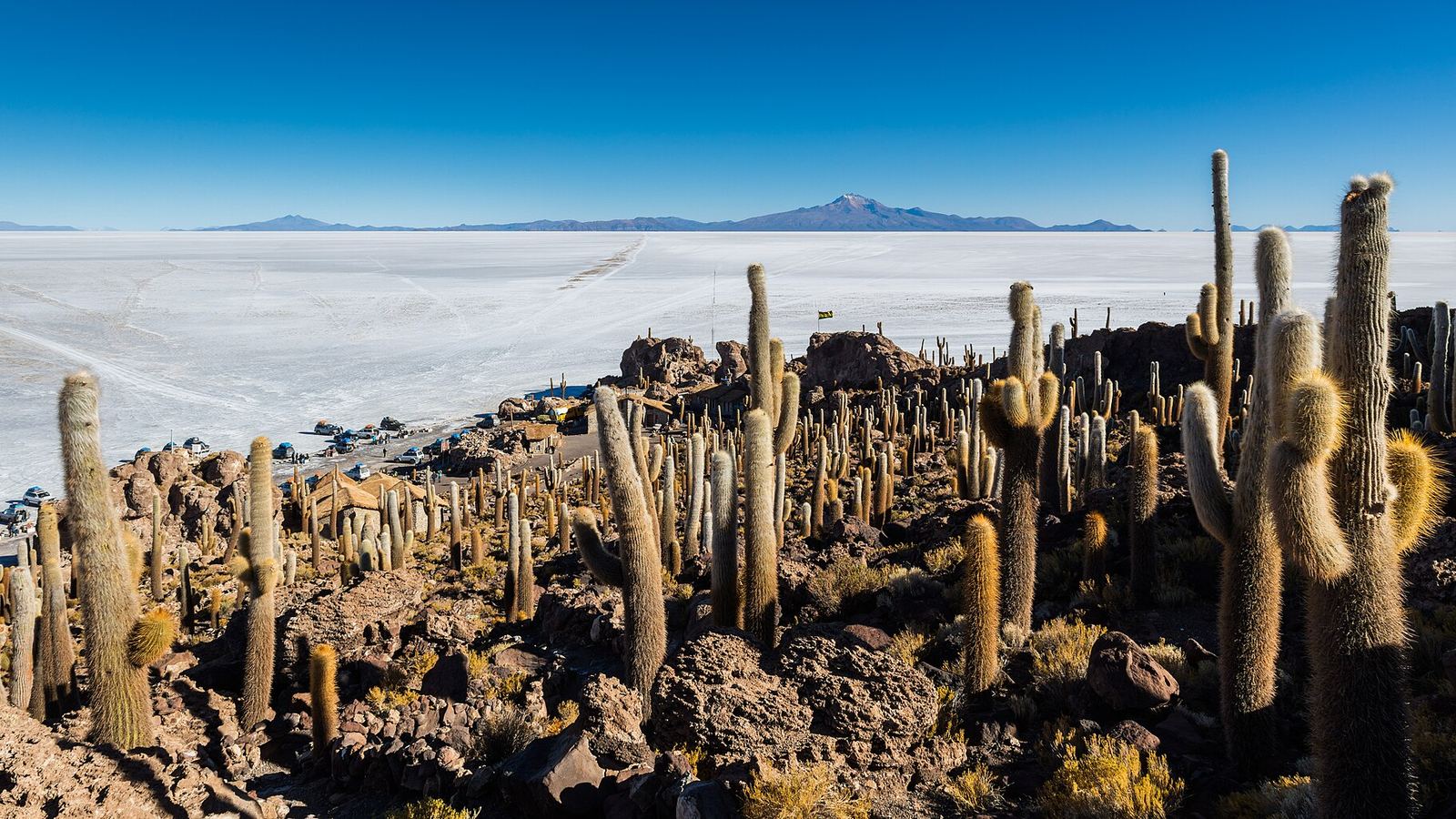
| Salar de Uyuni interior | Patchy to none | Colchani, the train cemetery and Incahuasi can hold a bar on a good day. Head for Tunupa or the far side and it is gone entirely. |
| Southwest lagunas circuit | None | The Eduardo Avaroa reserve, Laguna Colorada, Sol de Manana and Laguna Verde are offline on every network for 24 to 48 hours at a time. |
| Copacabana & Lake Titicaca | Good | Solid in Copacabana itself on Entel and workable on Tigo. Isla del Sol is thin, with signal mostly on the ridgeline rather than at the ports. |
| Rurrenabaque & Madidi | Town only | Basic 3G and 4G in Rurrenabaque. Jungle lodges and pampas boats have nothing at all for the three or four days of a standard tour. |
| North Yungas Road | Unreliable | Coverage flickers on and off along the descent to Coroico and cannot be trusted for navigation or for calling anyone from the road. |
How to Choose the Right Plan
Work backwards from your route rather than from your trip length. If Bolivia is a city itinerary of La Paz, Sucre and Santa Cruz with flights between them, any of the three will serve you and the decision is purely financial, which points at Airalo and specifically at its Latin America package, cheaper than its own Bolivia one at 3 GB, 5 GB and 10 GB. If you are working while you travel and would rather not think about it, Holafly at 39.50 dollars for seven unlimited days on Tigo is defensible for a short stay and indefensible for a long one. Nomad earns its ten dollar premium only if you specifically want Tigo and want it in one gigabyte for a week rather than three days.
If the trip has a jeep in it, change the question. For Uyuni, the lagunas, Rurrenabaque or anything in the Yungas, buy the smallest eSIM that covers your arrival and city nights, then get an Entel card once you are acclimatised. Fifty bolivianos buys 15 GB for a month on the only network with masts in the small altiplano towns, and roughly four dollars is not a sum worth optimising. Bring your passport to an official store, allow half an hour, and have the IMEI registered properly so the line survives the first week. Then, before you leave La Paz, download offline maps of the southwest, because that stretch is not a coverage problem any purchase on this page can solve.
Frequently Asked Questions
Is an eSIM actually worth buying when Bolivian data is this cheap?
For the arrival, yes. For the whole trip, that depends on how you value your time. Entel's MEGAS PRO 50 gives you 15 GB over thirty days for 50 bolivianos, about four dollars at the September 2026 rate, against 39 dollars for 10 GB on the cheapest travel eSIM. The counterweight is that buying local means finding an official store, handing over your passport, having the handset IMEI registered and waiting out the process, all of which is harder to face at 3,600 metres on day one than it sounds from home. A common compromise is a small eSIM for the first two or three days and an Entel card once you have acclimatised and found a Multicentro.
Which network do the travel eSIM brands actually use in Bolivia?
Holafly and Nomad both run their Bolivia plans on Tigo, the Millicom network that trades here as Telecel. Airalo provisions through Nuevatel, better known by its consumer brand Viva, with partner networks listed alongside. None of the three uses Entel. That matters because Entel is the state operator with the widest rural reach, so the coverage advantage most travellers assume they are buying is not on offer from any eSIM brand. Choosing between the three is a decision about price and plan shape, not about how far into the altiplano your signal will follow you.
Will I have any signal on the Uyuni salt flats?
Barely, and you should plan the day as though the answer is no. Uyuni town has proper 4G, and the edge of the salar around Colchani and the train cemetery often holds something. Incahuasi, the cactus island, is a coin toss. Push toward the middle of the flat or around to Tunupa and you will lose it, and the three day circuit south through the Eduardo Avaroa reserve has no coverage on any Bolivian network for a day or two at a stretch. Download offline maps, save your accommodation details as screenshots, and tell anyone waiting on you that you will be dark until the jeep comes back.
Do I need my passport to buy a Bolivian SIM, and what is the IMEI rule?
You need the physical passport, not a photocopy or a phone photo. Bolivian regulation requires prepaid lines to be registered to an identified holder, and a foreign handset needs its IMEI recorded against that line as part of the anti-contraband regime the regulator ATT administers. Cards sold from street kiosks without that step have a habit of going dead about a week later, which is the single most common complaint travellers have about buying local here. Go to an official Entel or Tigo store, allow twenty to thirty minutes, and you will get a line that lasts the trip.
Does the altitude affect mobile reception in La Paz?
Not in the way people expect. La Paz sits in a canyon that drops around 400 metres from El Alto on the rim to the Zona Sur at the bottom, and coverage is engineered for that geometry rather than defeated by it. What you do notice is shadowing: narrow streets in the old centre below Plaza Murillo, the steeper stretches of Calle Jaen, and the deep side valleys off the Achumani road can drop a bar or two. The cable car network is the opposite, offering an uninterrupted line of sight to half the city, which makes a teleferico ride one of the more reliable places to make a call.
Can one eSIM cover Bolivia along with Peru, Chile or Argentina?
Yes, and for a multi country Andes loop the regional plan is often the better buy even for the Bolivian leg alone. Airalo's Latin America package includes Bolivia and is priced below its Bolivia-only equivalent at most sizes, with 10 GB over thirty days coming in cheaper than the single country version of the same allowance. Nomad's Latin America plan does the same at 10 GB and above. If you are crossing from San Pedro de Atacama to Uyuni, or coming down from Puno to Copacabana, check the regional list before you buy the country plan, because here the wider product is not the more expensive one.