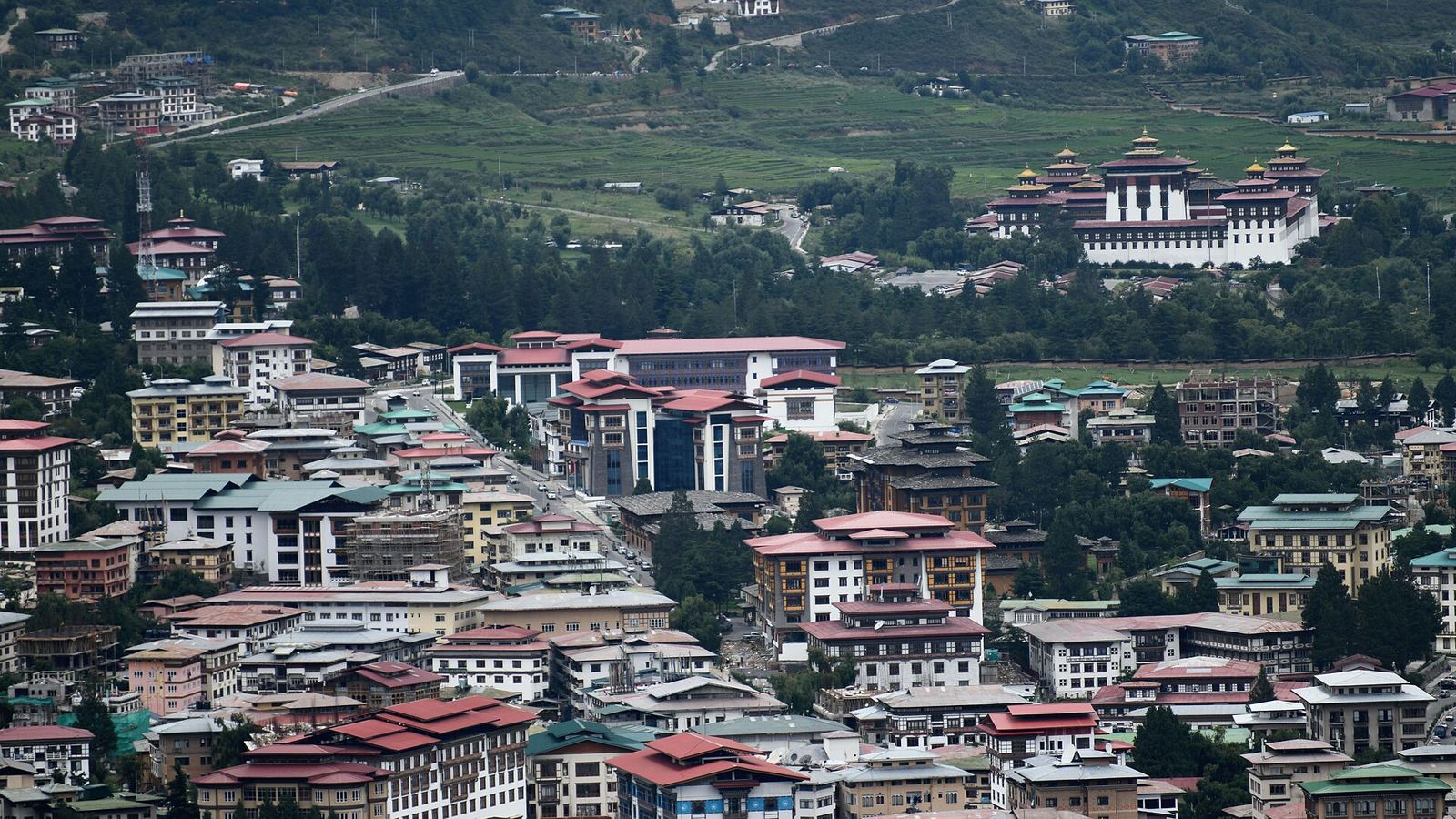
Thimphu is the only national capital on earth with no traffic lights, and the city works about as well as that fact suggests: small, orderly, tucked along the Wang Chhu at roughly 2,300 metres, with a population somewhere near 115,000 and a skyline capped by building codes that require traditional detailing on everything. Connectivity is one of the places where it quietly outperforms expectations. The valley floor from Babesa in the south up to Motithang on the western slope holds steady 4G on both Bhutanese networks, there are pockets of 5G around the centre, and the hotels a guided itinerary uses have functioning WiFi. What Thimphu does not have is any of the things travellers reflexively look for on arrival: no metro, no ride-hailing app you already have installed, no public transport map worth downloading, and no way for a visitor to use the QR-code payment system that everyone around you is tapping through.
What This Guide Covers
Jump to the section most relevant to you
Mobile Coverage Across the Thimphu Valley
The city occupies a north to south strip of valley floor about eight kilometres long, hemmed by forested ridges on both sides, and that geography does most of the work in explaining the signal. Down the middle, along the expressway and Norzin Lam, coverage is genuinely good: reliable 4G on both B-Mobile and TashiCell, with 5G appearing in patches around the centre since both operators launched it here at the end of 2021. Up the slopes, where the newer housing climbs toward Motithang and Changangkha, it is still fine but noticeably more variable, and behind the ridgelines it goes quickly.
The practical consequence is that Thimphu behaves like a city with excellent coverage and a handful of specific holes rather than a city with patchy service. The holes are worth knowing: the interior of Tashichho Dzong, where thick walls and a monastic complex do what thick walls always do; the wooded switchbacks up to the Buddha Dordenma viewpoint at Kuensel Phodrang; and the last stretch of road north toward the Cheri and Tango trailheads, where the valley narrows and the settlements stop.
What a travel eSIM connects you to here
Both eSIM brands that sell Bhutan run on B-Mobile, so an Airalo or Nomad profile gives you Bhutan Telecom coverage and nothing else. In Thimphu that is not a constraint worth worrying about, because B-Mobile is strong across the entire built-up valley. It becomes a real consideration only if you spend most of the trip out of the city. TashiCell is available to visitors only as a physical card bought inside the country, since neither operator sells tourists an eSIM profile of its own.
Navigating a Capital With No Traffic Lights
Traffic lights were installed at the main Norzin Lam junction in the mid 1990s and taken out again within weeks. Residents disliked them, the complaint being that a machine had replaced a person, and the white-gloved traffic officer went back into his painted wooden booth in the middle of the intersection, where he still is. He directs the whole junction with a set of trained hand signals that are worth watching for a few minutes before you cross.
For your phone, the relevant part is what fills the gaps left by the absent infrastructure. There is no metro and no tram. City buses run on fixed routes but are aimed at residents rather than visitors and are close to unusable if you cannot read the destination boards. Taxis are the default: plentiful along Norzin Lam, often shared, and negotiated rather than metered, so agree the fare before you get in. Domestic ride-booking apps exist and are used by locals, but they are tied to Bhutanese accounts and payment rails, so as a visitor you will be flagging a car down the old-fashioned way.
Maps behave oddly here, so plan for it
Bhutanese addresses are descriptive rather than numeric, and mapping data for Thimphu is thinner than the map's confident rendering suggests. Small lanes are missing, some businesses sit at the wrong pin, and building names carry more weight locally than street names do. Download the offline map for the whole Thimphu and Paro area before you arrive, and when you are lost, name the landmark rather than the street: the clock tower square, the vegetable market, the memorial chorten. Everyone knows those, and your taxi driver will get you there faster than a pin will.
The one navigation task worth doing on live data rather than offline is the walk between the clock tower square, Norzin Lam and the riverside, which is where most of a visitor's ordinary business happens and where coverage is strongest anyway.
Signal by Neighborhood: Norzin Lam, Motithang, Babesa
Norzin Lam and the city core. The central avenue, running north from the clock tower square past shops, banks, cafes and government offices. This is the best-served part of the country for mobile data, full stop: strong 4G on both networks, 5G in places, and enough cafe WiFi that you can work an afternoon without touching your allowance. It is also where both operators keep customer service offices if you want a local card.
Motithang and Changangkha. The western slope above the centre, where the hillside hotels and much of the newer residential building sits, plus the takin preserve where Bhutan's improbable national animal lives. Coverage up here is good but softer than on the valley floor, and it degrades as you climb toward the forest edge. Changangkha Lhakhang on its ridge has a signal outside and effectively none inside, which is the pattern for religious buildings across the country.
Babesa, Olakha and the southern end. The lower valley along the expressway toward the Babesa junction and Simtokha, more workaday, with garages, warehouses and the road out to Paro and Punakha. Coverage here is solid because it follows the main road corridor, and it holds all the way south to Simtokha Dzong, the oldest dzong in Bhutan and the last thing you pass leaving the city.
Where a signal simply will not be
Inside the big religious and administrative buildings, expect nothing. Tashichho Dzong, the Memorial Chorten's interior, and the assembly halls of the monastic complexes all cut out, and it is worth treating that as a feature rather than a fault: photography inside temple buildings is prohibited anyway, and phones are supposed to be away. Plan your calls around the visits rather than during them.
Hotel WiFi, Cafe WiFi and the Payments You Cannot Use
Hotel WiFi in Thimphu is better than in the rest of the country and still uneven. The larger city hotels a guided itinerary tends to use will give you a connection good enough for video calls in the evening. Smaller guesthouses and homestays run on shared connections that slow noticeably when everyone comes back from dinner at once. There is no reliable citywide free public WiFi network to plan around, so the practical model is hotel plus cafes plus your own data, in that order.
Cafes along Norzin Lam and around the clock tower square almost all have WiFi and will hand you the password with the coffee. Bhutan has a well-established cafe culture in the capital, and an afternoon in one is a legitimate strategy for keeping a small eSIM plan intact.
The QR codes are not for you
The single most surprising thing about paying for anything in Thimphu is how comprehensively digital it has become. Taxis, vegetable stalls, small shops and roadside sellers all display QR codes tied to the domestic banking apps, and Bhutanese customers scan rather than reach for cash. None of that is available to a visitor: the system is tied to Bhutanese bank accounts, so you are back to notes. Carry small ngultrum, keep some for taxi fares and entry tickets, and do not assume a card terminal outside hotels and larger shops.
Getting Online Your First Evening in Thimphu
Almost nobody arrives in Thimphu directly. The city has no airport of its own, so arrival means landing at Paro and driving the roughly 50 kilometres of valley road east, which takes about an hour on the expressway and considerably longer if your guide stops at the Chuzom confluence where the Paro and Thimphu rivers meet. By the time you reach the capital it is usually the middle of the afternoon.
The order that works
1. Land at Paro with a travel eSIM already installed and active so the arrival messages go out without you standing at a counter. The Paro Airport guide covers what is available in the hall itself.
2. Confirm with your guide on the drive whether the package includes a local SIM. If it does, it will usually be handed over at the hotel rather than the airport.
3. If it does not, ask to stop at a Bhutan Telecom or TashiCell office in Thimphu that same afternoon. Both are central, both are quick, and a data pack costs a couple of dollars.
4. Load a 5 GB pack at around Nu. 299 rather than the smallest one. The price difference is trivial and it lasts the whole trip.
5. Download offline maps for Thimphu, Paro and any valley you are heading to next, over hotel WiFi rather than over your data allowance.
If the itinerary has you leaving for Punakha or Bumthang the next morning, do all of this on the first evening rather than the second. Thimphu is where the shops, the coverage and the choice are. East of Dochula, none of that is reliably true.
Day Trips: Dochula, Cheri and the Punakha Run
Dochula Pass. The classic half-day out of Thimphu, about 23 kilometres east and 800 metres up, topping out near 3,100 metres at the 108 Druk Wangyal chortens built on the ridge. On a clear winter morning the eastern Himalaya lines up behind them. Coverage at the pass itself is usable, helped by the cafeteria complex and the constant traffic, so this is where the photographs get uploaded. The switchbacks on either side are another matter, dropping in and out on both networks as the road works through the forest.
Punakha. Continuing over Dochula and down to around 1,200 metres brings you to the Punakha valley, warm, sub-tropical and home to the dzong at the confluence of the Pho Chhu and Mo Chhu. It is a long day from Thimphu, two and a half to three hours each way, and the signal returns properly once you are down in the valley around Khuruthang and the dzong. Upriver toward the northern trailheads it thins again.
Cheri and Tango. North up the Thimphu valley, about 14 kilometres to the road head, then a climb on foot to two of the country's most significant monasteries. This is the day trip where you should expect to be offline. The valley narrows, the settlements stop, and the walk up is through forest. Tell someone your plan before you set off rather than relying on messaging from the trail.
Sizing a plan around the driving
Guided Bhutan itineraries use far less mobile data than travellers expect, because so much of the day is spent in a vehicle on roads with no coverage or inside buildings where phones stay in pockets. A 5 GB plan covers a typical week comfortably. If you want a second opinion on sizing before you buy, the eSIM Finder asks about trip shape rather than trip length, which matters more here than almost anywhere. And if you are wondering about unlimited plans, note that Holafly does not sell Bhutan at all, so the unlimited option here comes from Airalo's daily-allowance packages instead. The Bhutan eSIM guide lays out what each one costs.
Frequently Asked Questions
Is the data connection in Thimphu good enough for video calls?
Yes, in the central valley. Both Bhutanese networks run solid 4G along the Norzin Lam corridor and the expressway, with 5G in pockets of the centre, and a call from a city hotel in the evening is usually fine. The two things that will spoil it are altitude-adjacent geography, meaning a hotel tucked behind a ridge on the Motithang slope, and a shared guesthouse connection at the hour everyone comes back from dinner. If a call genuinely matters, take it from the city centre rather than the hillside, and use mobile data rather than the house WiFi.
How do I get a taxi in Thimphu without a ride-hailing app?
You flag one down, and it is easier than it sounds because taxis are everywhere along Norzin Lam and around the clock tower square. Fares are negotiated rather than metered, so agree the number before you get in, and expect the driver to pick up other passengers along the way since sharing is normal. Bhutanese ride-booking apps exist but run on domestic bank accounts that visitors cannot open, so the apps on your phone are of no use here. Your hotel front desk will call a car for you if the street is not producing one.
Will I have a signal at the Buddha Dordenma or inside Tashichho Dzong?
At the Buddha Dordenma, mostly yes. The statue sits on the Kuensel Phodrang hill above the southern end of the city, in line of sight of the valley, and the viewpoint area holds a signal even though the wooded road up is intermittent. Inside Tashichho Dzong, no. Thick walls, a working monastic and government complex, and the general expectation that phones stay away combine to make it a dead zone. That pattern repeats across Bhutanese dzongs and temples, so plan any call for the walk in or the courtyard rather than the halls.
Which network should I be on if I am based in Thimphu for a week?
For a week spent mostly in the capital, either works and TashiCell is often the keener price, with unlimited daily packages at around Nu. 99 a day and a 5 GB monthly pack at Nu. 299. It also has the better 5G presence in the city. Choose B-Mobile instead if the week includes long drives east or any overnight outside the western valleys, because Bhutan Telecom's rural build is the wider one. If you are on a travel eSIM rather than a local card, the decision is already made for you, since both providers that cover Bhutan use B-Mobile.
Can I pay for anything in Thimphu with my phone?
Effectively no, and this catches people out because the city looks so digital. Bhutanese customers pay for taxis, groceries and even street snacks by scanning QR codes tied to domestic banking apps, but those accounts require a Bhutanese bank relationship that a tourist cannot open for a short visit. International contactless works at larger hotels and some bigger shops and nowhere else with any consistency. Carry ngultrum in small notes, use the ATMs in the city centre where foreign card acceptance is most reliable, and keep cash for entry fees and taxis.