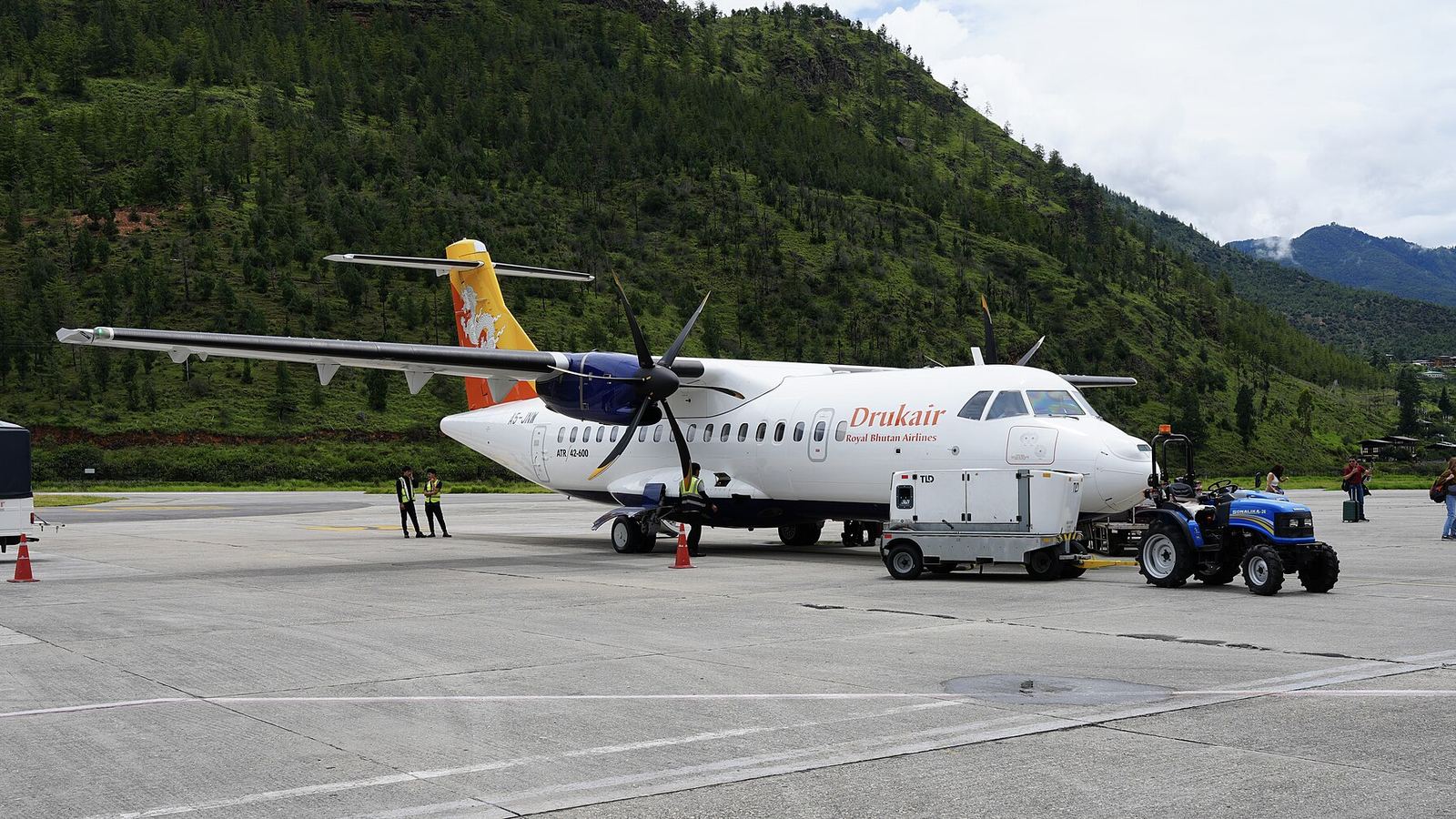
Paro is the only international airport in Bhutan and one of the most demanding commercial approaches anywhere. The single runway sits at 2,235 metres in a river valley walled by peaks rising past 5,000, the final descent is flown visually through a series of turns with the strip appearing only in the last moments, and the airport handles arrivals in daylight and reasonable visibility only. Roughly fifty pilots in the world hold the certification to do it, and two airlines fly here: Drukair, the national carrier since 1981, and Bhutan Airlines, which began as Tashi Air in 2011. All of that has one practical consequence for your phone. Schedules here are weather-dependent in a way most travellers never encounter, delays and diversions to Bagdogra or Kolkata are a real seasonal possibility, and being able to message a guide, an operator or an onward hotel from wherever you actually land is worth considerably more than the six dollars it costs.
What This Guide Covers
Jump to the section most relevant to you
Why the Approach Shapes Your Arrival Day
The numbers are worth understanding because they explain the shape of your first day. The runway is about 2,265 metres long, which is short for the aircraft using it, at an elevation where thinner air means longer takeoff rolls and less engine margin. The valley walls run to 5,500 metres. There is no conventional straight-in instrument approach to fly, so pilots follow the terrain visually through the turns and line up late.
What this means for your schedule
Arrivals and departures are daylight operations in visual conditions, so the flight schedule clusters in the morning when the valley air is calmest and the cloud has not built. Afternoon weather, monsoon rain between June and August, and winter fog all move flights around. Delays of hours are normal, same-day cancellations happen, and diversions to Bagdogra or Kolkata are part of the deal in bad weather. This is the single strongest argument for arriving with a working phone rather than planning to sort one out at the counter: the counter is at the airport you did not reach.
To qualify for the route a pilot needs an airline transport certificate, at least 1,500 hours total and more than 500 hours of mountain flying, followed by specific training on the approach itself. It is an unusual thing to be a passenger for. If you have the window seat on the left coming in from Kathmandu on a clear morning, the Himalayan wall including Everest and Kangchenjunga runs along the horizon before the aircraft drops into the valley.
SIM and eSIM Options in the Paro Arrivals Hall
The terminal is a single traditional building, timber-framed and hand-painted in the national architectural style, and it is small enough that you can see the whole arrivals hall from the door. Both Bhutanese operators keep desks in it: Bhutan Telecom, whose mobile service is B-Mobile, and TashiCell. They sell physical cards to arriving passengers, take a passport copy, register the line and load a data pack while you wait.
Two things limit how useful that is. The desks are staffed around flight arrivals rather than continuously, because there are only a handful of movements a day, so an off-schedule arrival can find them shut. And every passenger off your aircraft wants the same thing at the same moment, in a hall built for a fraction of the traffic a comparable international gateway sees, while a guide with your name on a sign waits outside.
The pragmatic sequence
If your operator has included a SIM in the package, skip the desk entirely and let them hand it over at the vehicle or the hotel. If they have not, the customer service offices in Paro town and Thimphu sell exactly the same packs at exactly the same prices with nobody in front of you, and your guide can steer the transaction. Bhutan Telecom also takes tourist SIM reservations through its own online booking portal before you fly, which removes the queue if you want the local number from the first minute. The Bhutan SIM card guide has the current ngultrum prices for both networks.
Neither operator sells tourists an eSIM profile, so a phone with no physical SIM tray has exactly one option in Bhutan: a travel eSIM bought before you leave home. Only two of the major brands cover the country. Holafly is not one of them and sells no Bhutan plan at all, which surprises people who have used it across the rest of Asia.
What the WiFi at PBH Is Actually Good For
Paro is a small airport with a modest passenger volume, and the wireless provision reflects that rather than the standard set by regional hubs. There is connectivity in the terminal, generally through the airport and the local operators, and it is adequate for a message rather than for anything substantial. Nobody should plan to download a film, upload a day of photographs, or run a work call on it.
The more useful observation is about where you will actually want a connection, which is not the terminal. It is the twenty minutes in the car park while your guide finds the vehicle, it is the roadside stop at the Chuzom confluence, and it is the hotel that turns out to be a different hotel from the one on your itinerary. None of those places have airport WiFi.
Reasonable to do on terminal WiFi
Do not rely on it for
Load the offline maps for Paro, Thimphu and Punakha before you fly. It is the one preparation step that pays for itself on every Bhutan itinerary, because the road east goes quiet long before your data plan does.
The Road to Thimphu and Where the Signal Goes
There is no rail link, no airport bus worth the name and no taxi rank in the sense you are used to, because essentially everyone arriving here leaves in a vehicle that was already booked for them. The drive to Thimphu is around 50 kilometres and takes about an hour on the expressway, longer if your driver stops, which they usually will.
What the hour looks like
1. Airport to Paro town, about 7 km. Flat valley road along the Paro Chhu, strong signal throughout, past the fields and the farmhouses that make up most people's first impression of the country.
2. Down the valley to Chuzom, about 25 km. The road follows the river to the confluence where the Paro Chhu meets the Wang Chhu, marked by three chortens built in Bhutanese, Nepalese and Tibetan styles. Coverage holds along this stretch because the road corridor is well served.
3. North up the Wang Chhu to Thimphu, about 20 km. The expressway climbs gently along the river into the capital. This is the fastest part of the drive and the signal stays usable.
4. Arrival in Thimphu. The city appears at Babesa, at the southern end of the valley, and from there you are in the best-covered few square kilometres in Bhutan. The Thimphu city guide covers what happens next.
If your itinerary sends you the other way, to Punakha over Dochula rather than into the capital, expect a very different afternoon: three hours or so, a climb to 3,100 metres at the pass, and long stretches on the switchbacks where the signal drops out completely on both networks. That road, rather than the airport, is where the difference between a decent plan and no plan actually shows.
Counter Prices at PBH Against an eSIM
Bhutan is unusual in that the local counter is much the cheaper option and the eSIM is still worth buying. Here is what each side actually costs, in ngultrum at roughly 95 to the dollar.
| Option | What you get | Price | Ready when |
|---|---|---|---|
| B-Mobile at the desk | Tourist SIM plus 1 GB for 7 days | About Nu. 199 | After the queue and a passport copy |
| B-Mobile at the desk | Tourist SIM plus 5 GB for 30 days | About Nu. 399 | After the queue and a passport copy |
| TashiCell at the desk | SIM plus 2 GB for 7 days | About Nu. 349 | After the queue and a passport copy |
| Airalo, 1 GB | 3 days, data only, on B-Mobile | 5.50 USD | As the aircraft door opens |
| Airalo, 5 GB | 7 days, data only, on B-Mobile | 17 USD | As the aircraft door opens |
| Nomad, 1 GB | 7 days, data only, on B-Mobile | 20 USD | As the aircraft door opens |
The counter wins on price by a factor of four or more, which is the opposite of what this comparison usually shows. What the counter cannot do is exist before you land, stay open at an odd hour, or follow you to Bagdogra when the cloud closes the valley. That is what the 5.50 dollar plan buys, and on a trip already costing 100 dollars a night in Sustainable Development Fee it is a rounding error. Note also that Nomad charges roughly three times Airalo's rate for the same B-Mobile connection here, so there is no reason to choose it unless you already hold credit. The Bhutan eSIM guide has the full verified ladder for both, and the eSIM Finder will size a plan around your itinerary.
Flying Out, and the Domestic Connections
Departures are subject to the same daylight and visibility constraints as arrivals, so the outbound schedule is heavily weighted to the early morning and your operator will have you leaving the hotel in the dark. The terminal is small, the security queue moves quickly, and the airside facilities are limited to a handful of shops and a cafe, so there is no reason to arrive four hours early and every reason to have something downloaded to read.
If your plans include a domestic flight
Bhutan has three domestic airfields, at Bathpalathang near Jakar in Bumthang, at Gelephu on the southern plain, and at Yonphula in the east. Drukair flies them from Paro on a limited schedule, and they are the alternative to two long days on mountain roads if your itinerary reaches central or eastern Bhutan. They are also weather-affected and prone to short-notice changes. If you are connecting through one, that is another argument for having data on arrival rather than after: a cancellation at Bathpalathang means a driver has to be found, and the person finding one will want to reach you.
One last thing to do before you leave the country. The ngultrum is not convertible outside Bhutan and cannot be spent in India despite the currency peg, so spend it down or change it back before you go through security. And if you are crossing overland to Phuentsholing and the Indian border at Jaigaon rather than flying out, a Bhutanese SIM stops being useful at the gate, because Bhutan and India share a currency arrangement but not a mobile network.
Frequently Asked Questions
Should I bother with the SIM desks at Paro or wait until Thimphu?
Wait, in most cases. The desks in the arrivals hall are genuinely there and they do sell registered tourist cards with data packs, but they open around flights rather than continuously, the whole aircraft arrives at them at once, and your guide is already outside. The same cards at the same prices are available at Bhutan Telecom and TashiCell offices in Paro town and across Thimphu, with no queue and someone who can load the pack properly. The exception is if you are travelling independently with no guide meeting you, in which case the fifteen minutes at the desk is worth it.
What happens to my connection if the flight diverts because of weather?
This is exactly why the small eSIM earns its place. Paro operates in daylight and visual conditions only, so monsoon cloud between June and August, winter fog and afternoon build-up can push a flight to Bagdogra or Kolkata, sometimes for the night. In that scenario you need to reach your Bhutanese operator, who is expecting you at an airport you did not reach, from a country whose SIM you do not have. A travel eSIM bought for Bhutan will not help you in India either, so the practical answer is to keep your home roaming enabled as a fallback and treat the Bhutan plan as the arrival tool it is.
How long is the transfer from the airport to Thimphu, and is there data on the way?
About an hour for the roughly 50 kilometres, and yes, the coverage along that road is good. The route runs down the Paro valley beside the river to the confluence at Chuzom, where three chortens in Bhutanese, Nepalese and Tibetan styles mark the meeting of the waters, then turns north up the Wang Chhu on the expressway into the capital. It follows populated valley floor the whole way, so a B-Mobile connection stays usable. Expect stops: drivers almost always pause at Chuzom and often at a viewpoint above the airport where you can watch an aircraft come in.
Is it true only a few dozen pilots can land here?
Yes, and the number usually quoted is around fifty worldwide. The approach is flown visually through a valley with peaks reaching past 5,000 metres, onto a runway of about 2,265 metres at an elevation of 2,235 metres, with the strip visible only in the final moments. Certification requires an airline transport licence, at least 1,500 flying hours and more than 500 hours of mountain experience before the type-specific training even begins. Two carriers serve the airport, Drukair and Bhutan Airlines, which between them account for essentially all scheduled traffic into the country.
Can I hike to Tiger's Nest on the day I land?
It is possible if you land early and you are already acclimatised, but most operators schedule Paro Taktsang for the end of the trip rather than the start, and they are right to. The monastery clings to the cliff at about 3,120 metres, some 900 metres above the valley floor, and the round trip on foot takes four to five hours with a cafeteria roughly halfway. Coverage is reasonable at the trailhead and the lower switchbacks, then unreliable higher up and absent inside the buildings themselves. Take a photograph of the trail map, tell your guide your pace, and do not count on messaging from the top.