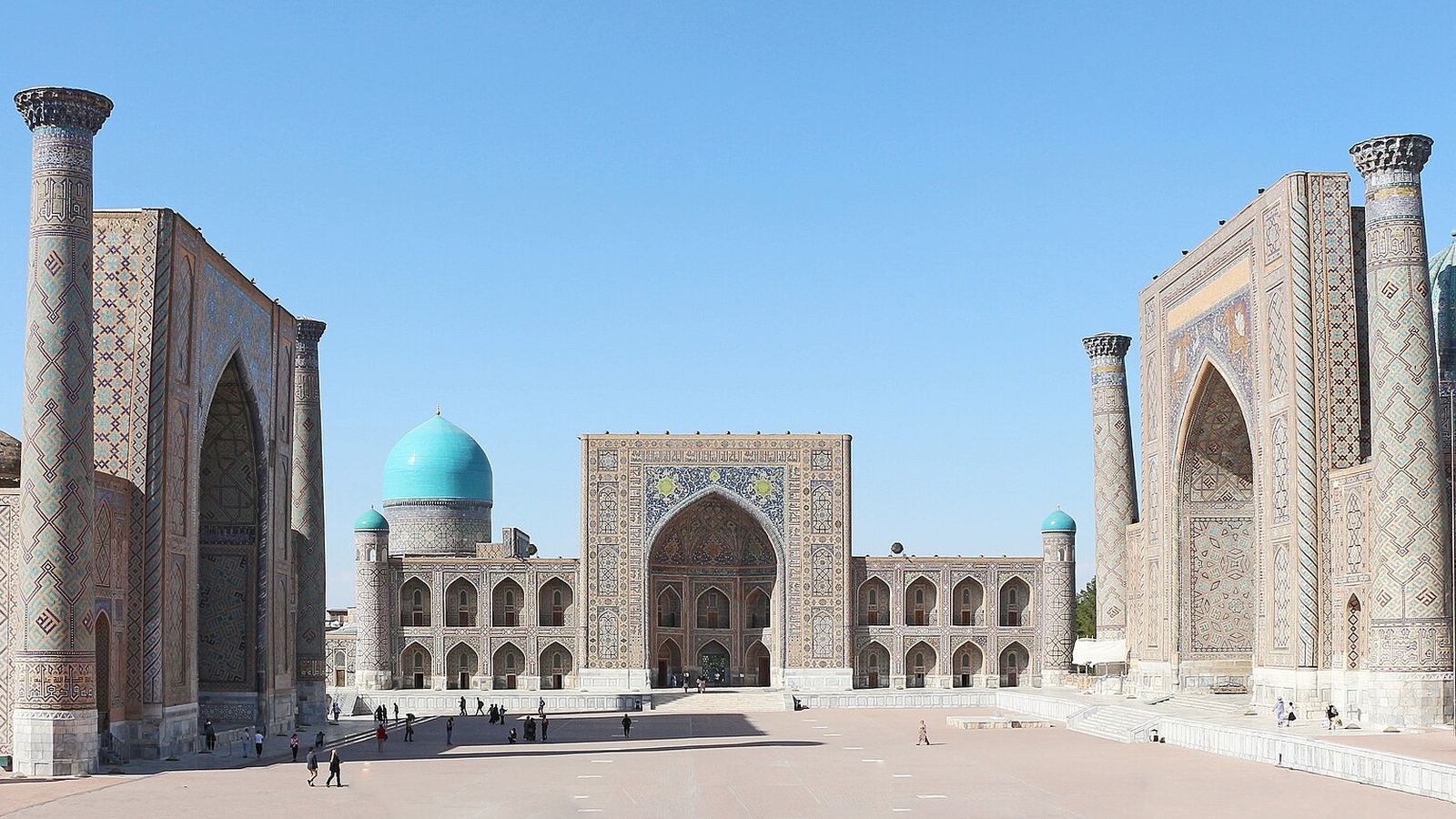
Every travel eSIM sold for Uzbekistan runs on the same carrier, which settles the argument that dominates most country guides before it starts. Airalo, Nomad and Holafly all connect through Unitel, the licence holder that trades as Beeline Uzbekistan, so your decision is about price and plan shape rather than signal strength. What is genuinely worth planning is the route. Almost nobody flies into Tashkent and stays put: the standard circuit runs Tashkent, Samarkand, Bukhara and Khiva, mostly aboard the Afrosiyob high-speed train, and it finishes with a long haul across the Kyzylkum desert where every Uzbek network thins to nothing. Size your data for the cities, download offline maps for the sand. Our pick is Nomad, which undercuts the field on identical coverage. Airalo costs a few dollars more and is the better piece of software, with a 3 GB tier nobody else offers. Holafly is the answer only if you want unlimited and will not miss a full hotspot. Not sure what a ten-day circuit actually consumes? The eSIM Finder will size it for you.
Quick Pick: the Best eSIM for Uzbekistan
Nomad (Uzbekistan 5 GB / 30 days): Fourteen dollars against Airalo's sixteen for the same allowance on the same Beeline network, tethering allowed, which is enough for a two-week Tashkent to Khiva loop with the train legs and the Yandex Go rides included.
Our picks
Best overall: Nomad. Lowest per GB: Nomad. Unlimited: Holafly. Or use the eSIM Finder.
Uzbekistan eSIM Plans Compared
Indicative pricing. Tap through for live rates.
| Provider | Plan | Data | Duration | Price | Network |
|---|---|---|---|---|---|
| Airalo | Uzbekistan 1GB | 1 GB | 7 days | $5 | Beeline Uzbekistan (Unitel) |
| Airalo | Uzbekistan 3GB | 3 GB | 30 days | $11 | Beeline Uzbekistan (Unitel) |
| Airalo | Uzbekistan 5GB | 5 GB | 30 days | $16 | Beeline Uzbekistan (Unitel) |
| Airalo | Uzbekistan 10GB | 10 GB | 30 days | $26 | Beeline Uzbekistan (Unitel) |
| Airalo | Uzbekistan 20GB | 20 GB | 30 days | $37 | Beeline Uzbekistan (Unitel) |
| Nomad | Uzbekistan 1GB | 1 GB | 7 days | $4 | Beeline Uzbekistan |
| Nomad | Uzbekistan 5GB | 5 GB | 30 days | $14 | Beeline Uzbekistan |
| Nomad | Uzbekistan 10GB | 10 GB | 30 days | $22 | Beeline Uzbekistan |
| Nomad | Uzbekistan 20GB | 20 GB | 30 days | $32 | Beeline Uzbekistan |
| Holafly | Unlimited 5-day | Unlimited | 5 days | $19 | Beeline Uzbekistan |
| Holafly | Unlimited 7-day | Unlimited | 7 days | $27 | Beeline Uzbekistan |
| Holafly | Unlimited 10-day | Unlimited | 10 days | $34 | Beeline Uzbekistan |
| Holafly | Unlimited 15-day | Unlimited | 15 days | $47 | Beeline Uzbekistan |
| Holafly | Unlimited 30-day | Unlimited | 30 days | $69 | Beeline Uzbekistan |
Airalo Uzbekistan Plans
Airalo: The Best App and the Only Mid-Size Tier
Uzbekistan data on Unitel, the network behind Beeline, with a 3 GB step nobody else sells
Airalo prices Uzbekistan at 5 dollars for 1 GB over a week, 11 dollars for 3 GB, 16 dollars for 5 GB, 26 dollars for 10 GB and 37 dollars for 20 GB. The 3 GB step is the interesting one, because no other major provider sells it for this country and 3 GB is close to what a five-day Tashkent and Samarkand trip actually consumes if your hotel WiFi is doing the heavy lifting in the evenings.
The connection itself is Unitel, the licence holder that everyone in Uzbekistan calls Beeline. That gets you solid service through the four Silk Road cities, along the Afrosiyob corridor and across the Fergana Valley, and it gets you the same thin, intermittent signal as everybody else on the desert run out to Khiva. Nobody sells a travel eSIM on Uzmobile, which is the state operator with the widest rural footprint, so no eSIM on the market solves the Kyzylkum problem.
Where Airalo earns the premium is administration. Topping up mid-trip is genuinely painless, the usage counter is accurate, and support answers when a profile misbehaves. If you have already got the app and a balance in it, the few dollars of difference against Nomad is not worth switching accounts over.
Strengths
Weaknesses
Holafly Uzbekistan Plans
Holafly: Unlimited, With a Tethering Cap Worth Reading
Flat-rate unlimited data on Beeline, priced for people who will not count gigabytes
Holafly asks 19 dollars for 5 days, 27 for a week, 34 for 10 days, 47 for a fortnight and 69 for a month of unlimited data. Compare the 15 day plan at 47 dollars against Nomad's 20 GB at 32 and the premium is real, so the question is simply whether you will burn through 20 GB in two weeks. Most people photographing tilework do not.
There is a specific case where it makes sense. If you are filming the Registan at dawn and uploading it before breakfast, running video calls back to an office, or using Google Translate camera mode across every menu and museum caption for a fortnight, unlimited stops the running arithmetic and the mid-trip top-up scramble.
Read the tethering line before you buy. Sharing is capped around a gigabyte a day, which is fine for pulling a laptop online in a Bukhara courtyard hotel for an hour but not a substitute for a hotspot plan if three of you are travelling on one connection.
Strengths
Weaknesses
Nomad Uzbekistan Plans
Nomad: The Cheapest Way onto the Same Network
Identical Beeline coverage to Airalo, priced two to five dollars lower at every size
Nomad charges 4 dollars for 1 GB over a week, 14 dollars for 5 GB, 22 dollars for 10 GB and 32 dollars for 20 GB, all on 30 days except the smallest. Set that against Airalo line by line and Nomad is cheaper every single time, by 2 dollars at the bottom and 5 dollars at 20 GB, while riding the identical carrier.
That is the whole argument, and in a country where the network question has only one answer it is a strong one. A 5 GB plan at 14 dollars comfortably covers ten days of maps, Yandex Go rides, translation and messaging across Tashkent, Samarkand, Bukhara and Khiva, with the train legs eating very little because you spend most of them looking out of the window at cotton fields.
The add-on system is worth understanding before you rely on it. Buy more data and it sits queued behind the plan you are using, activating by itself the moment the first one runs dry, which is the behaviour you want somewhere like Nukus where topping up in a hurry is not simple.
Strengths
Weaknesses
Mobile Networks in Uzbekistan
Uzbekistan has four mobile operators that matter, and roughly 33 million active mobile connections in a country of about 37 million people. Beeline Uzbekistan, run by Unitel under the VEON group, is the largest with somewhere near 8.2 million subscribers and it is the network every travel eSIM on this page connects to. Mobiuz, formerly Universal Mobile Systems, is close behind at around 7.8 million and spent 2025 and 2026 being prepared for privatisation. Ucell is the quality play: independent testing through early 2026 gave it the country's reliability award, and it is the operator that finished wiring the Tashkent metro with Huawei, putting 5G on the platforms and 4.5G inside the running tunnels. Uzmobile belongs to state incumbent Uztelecom and inherits its rural infrastructure, which makes it the one to have in Karakalpakstan and on the empty roads, and the one you cannot buy as a travel eSIM.
The practical consequence for a visitor is blunt. On the tourist circuit the differences between these four are academic, because Tashkent, Samarkand, Bukhara, Urgench and Khiva are all comfortably covered by all of them. The differences bite in exactly two places: the 450 kilometres of Kyzylkum desert between Bukhara and Khiva, and the far west around Nukus and the dried bed of the Aral. There, Uzmobile's state-built footprint is the strongest of a weak field, and since no eSIM provider sells access to it, the honest answer is that an eSIM will not keep you online out there and neither will most local SIMs.
5G, and where it actually exists
Uzbekistan switched on non-standalone 5G from 2022 and has since pushed it into every regional capital, with Uztelecom alone modernising more than 3,500 base stations. In Tashkent it is genuinely widespread, including underground, where Ucell measured throughput up to 142 Mbps on a moving metro train. Travel eSIMs here are provisioned for 4G/LTE first, which in the cities means a comfortable 20 to 60 Mbps, plenty for uploading a set of Registan photographs over lunch. Treat 5G as a bonus you may see in Tashkent rather than something to buy a plan for.
Coverage Across Uzbekistan
Coverage where travelers actually go:
| Area | Coverage | Notes |
|---|---|---|
| Tashkent | Excellent | Dense 4G with real 5G in the centre, and signal all the way through the metro tunnels, not just on the platforms. |
| Samarkand | Excellent | Strong across the Registan, Shah-i-Zinda and the Siyob bazaar, and steady on the road out to Konigil paper mill. |
| Bukhara & Kagan | Very good | Reliable through the old town and Lyabi-Hauz; the railway station sits 12 km out at Kagan and is covered too. |
| Khiva & Urgench | Good | Solid inside the walls of Ichan Kala and along the 35 km Urgench road, weaker on the farm tracks either side. |
| Kyzylkum desert road | Poor | The five-hour Bukhara to Khiva crossing drops to 3G or nothing for long stretches on every Uzbek network. |
| Fergana Valley | Very good | Kokand, Margilan, Fergana and Andijan are well served; the Kamchik Pass road in has intermittent gaps. |
| Nukus & Karakalpakstan | Variable | Fine in Nukus itself, thin to absent on the Moynaq road and out at the ship graveyard by the old Aral shore. |
| Chimgan & Charvak | Variable | Usable around the reservoir and the chairlift base, patchy on the ridges above the Ugam-Chatkal treeline. |
How to Choose the Right Plan
Because all three providers ride Beeline, the decision is arithmetic rather than geography. Work out your size first: 3 to 5 GB for a short Tashkent and Samarkand trip, 5 to 10 GB for the full four-city circuit over ten days to a fortnight, 20 GB or unlimited if you are working, filming or sharing a connection. Then pick on price, which means Nomad at every tier it sells. Go to Airalo if you want the 3 GB step it alone offers, if you already keep a balance in its app, or if you value support that answers quickly in an unfamiliar country. Choose Holafly only when unlimited genuinely earns its premium over 20 GB, and check the daily tethering cap before you commit. Whatever you choose, save an offline map of the Kyzylkum before you leave Bukhara, because that stretch is the one thing no plan on this page can fix.
Frequently Asked Questions
Do I have to register my phone's IMEI to use a SIM in Uzbekistan?
Not on a tourist trip of normal length. The UzIMEI system does require devices to be registered, but foreign visitors get 60 days from their first network event before it applies, up from 30 under the older rule that most travel forums still quote. Register after that and the fee is 103,000 som, or 82,400 som if you get in early. Crucially, registration is not required at all for devices that are only roaming, and a travel eSIM is roaming, so an Airalo, Nomad or Holafly profile never touches the system.
Will I have signal on the Afrosiyob between Samarkand and Bukhara?
For most of it, yes. The high-speed line runs through populated, irrigated country and your eSIM will hold a workable 4G signal with brief drops in cuttings and around Navoi. The onboard WiFi exists but is rationed at roughly 100 MB per passenger per journey, which is enough to check a booking and nothing more. If you plan to work on the 3 hour 40 minute Tashkent to Bukhara run, use your own data rather than the train's.
What happens to my data on the desert road to Khiva?
It largely stops. The drive from Bukhara across the Kyzylkum takes four and a half to five and a half hours and passes almost nothing, so coverage falls to weak 3G near the occasional roadside chaikhana and to nothing in between. Beeline gives you the best odds of an intermittent bar, which is what all three eSIMs on this page ride, but no provider genuinely solves it. Download the whole route offline and tell people you will be dark for an afternoon.
Local SIMs in Uzbekistan are dirt cheap, so why buy an eSIM at all?
They are cheap, and this page will not pretend otherwise: a Ucell tourist bundle at the Tashkent airport desk runs about 50,000 som, near 4 dollars, for 20 GB. The eSIM case is not price, it is friction. You land connected instead of queueing at a counter with your passport, you can book a Yandex Go before you reach the forecourt, and you stay outside the UzIMEI registration regime entirely. For a stay of a month or more, or for anyone who wants an Uzbek number, the local card wins on the numbers.
Can one eSIM cover Uzbekistan plus Kazakhstan or Kyrgyzstan?
Yes, and it is worth considering for a proper Central Asia run. Airalo and Holafly both sell regional plans that bundle Uzbekistan with Kazakhstan, Kyrgyzstan and Tajikistan on a single profile, which saves reinstalling at every border. The trade-off is the usual one: per gigabyte a regional plan costs more than a country plan, so for an Uzbekistan-only Silk Road loop the local option is better value.
How much data does a ten-day Silk Road circuit actually use?
Between 4 and 8 GB for most people. Uzbek hotels and guesthouses almost all have WiFi, which absorbs the evening streaming, and a lot of your day is spent inside monuments where you are photographing rather than uploading. The consumption comes from Yandex Go, Google Maps, translation and messaging home. Budget 5 GB if you are disciplined, 10 GB if you post as you go, and unlimited only if you are working while you travel.