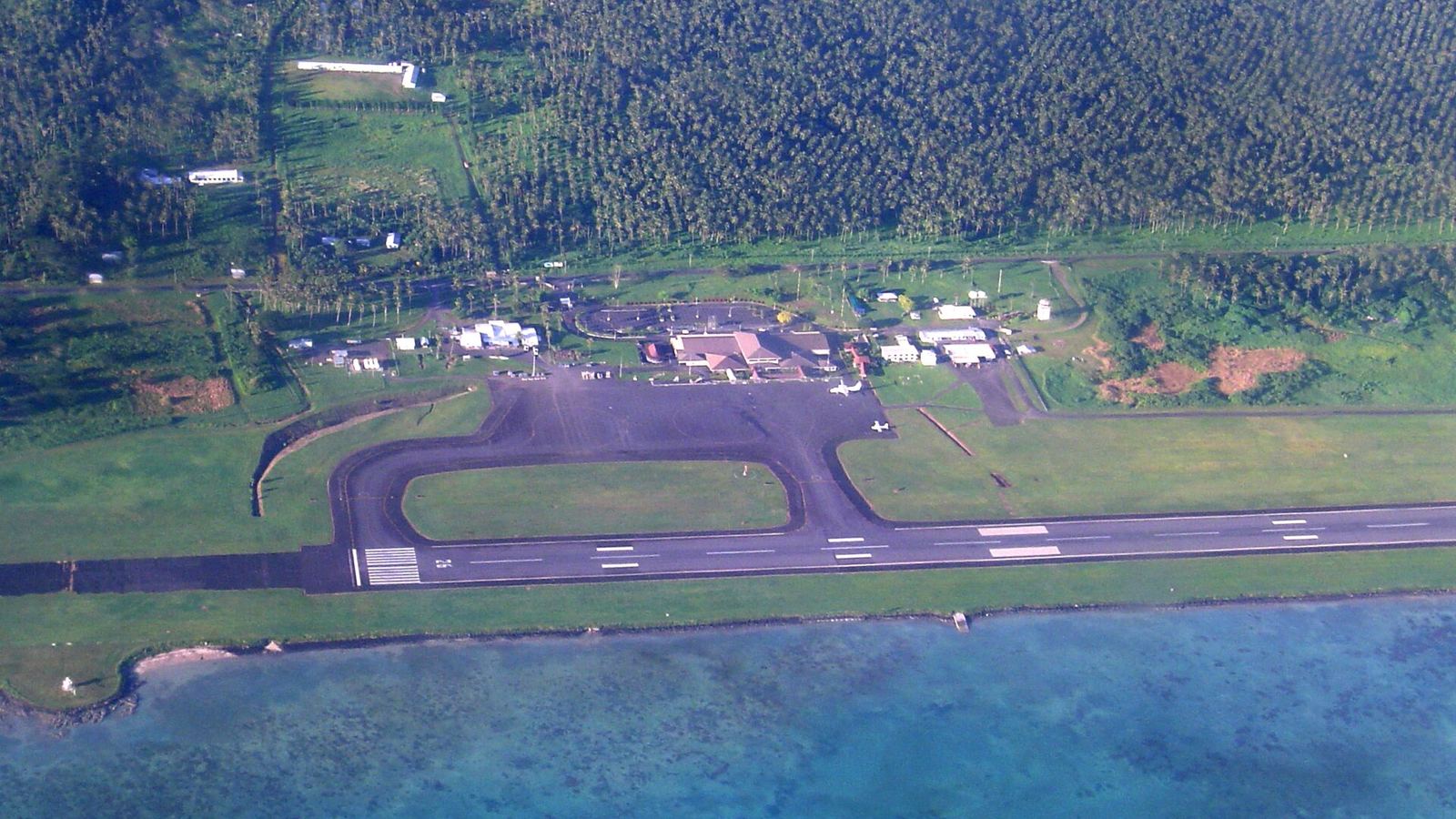
Faleolo International Airport is further from the city it serves than almost anyone expects. The terminal sits at Faleolo village on the western end of Upolu, roughly 35 kilometres and 45 to 60 minutes from central Apia, which is a proper journey rather than a hop. It is also only about five minutes east of Mulifanua wharf, so a meaningful share of arriving passengers turn west for the Savai'i ferry and never see the capital at all. Both Samoan carriers keep kiosks in the arrivals hall and Digicel gives visitors the SIM card itself for nothing, but the kiosks keep flight-driven hours and the Auckland and Sydney services have a habit of landing when the shutters are down. That combination is what decides whether you want data already working when you step off the aircraft.
What This Guide Covers
Jump to the section most relevant to you
SIM and eSIM Options in the Arrivals Hall
Faleolo has one passenger terminal, which keeps this simple. Once you are through immigration and the agriculture check, the arrivals concourse holds the car hire desks, a currency exchange and kiosks for both mobile operators. There is no separate domestic terminal to walk to and no shuttle to catch.
What is actually there
Digicel Samoa and Vodafone Samoa both staff kiosks in arrivals, opened to meet incoming international flights rather than run to fixed hours. Digicel's headline offer is the Visitor SIM, handed over free on production of your passport and your boarding pass, with data bought separately as a bundle on top. Vodafone sells conventional prepaid packs. Neither operator sells its own eSIM to visitors here, so the choice at the counter is a physical card or nothing.
The Visitor SIM is a genuinely good deal and worth knowing about before you arrive, because it changes the shape of the decision. You are not choosing between paying for a card and paying for an eSIM. You are choosing between a free card plus a cheap local bundle, and an eSIM that costs more but was already working when the doors opened. Ask for a Supa Seki bundle rather than accepting whatever is quoted first: Digicel's older standalone bundles are priced far above the Supa Seki tiers for identical data on identical towers.
The catch is the clock. Because the kiosks are staffed around flight arrivals rather than continuously, a delayed or overnight service can put you in the concourse with the counters closed. Red-eyes from Auckland and Sydney are the usual culprits. There is no vending machine backup at Faleolo, so if the kiosk is shut your options are the free airport WiFi, an already-installed eSIM, or waiting until you reach a Digicel or Vodafone shop in Apia the following morning.
Free WiFi at Faleolo and What It Is Good For
Faleolo does offer complimentary wireless in the terminal, and it is best described as available rather than good. Coverage is uneven across the building, throughput is modest, and it thins noticeably when a full wide-body has just disgorged three hundred people who all want to message home. Treat it as a tool for one specific job.
Connect while you are still landside of the exit
Join the airport network from the arrivals concourse rather than out by the taxi rank, where the signal falls away. If a captive portal appears, accept the terms; there is no password to hunt for.
Do the one thing that has to happen online
Message whoever is meeting you, confirm the accommodation, and if you bought an eSIM but have not installed the profile yet, install it now. Downloading a large map pack over this connection is optimistic.
Get your tala before you leave the building
The exchange desk and the ATM are in the terminal, and the taxi you are about to take will want cash in tala. This is a job the WiFi cannot do for you and one that a card-only traveller regrets missing.
Once you are in a car heading east, the airport network is behind you and the mobile network takes over. That transition is the reason the free WiFi at Faleolo settles arguments rather than winning them: it can activate a plan, confirm a pickup and prove your line is live, and it can do nothing at all about the next forty-five minutes.
The 35 Kilometre Run From Faleolo Into Apia
The road east follows the north coast of Upolu and is sealed the whole way. It is a pleasant drive and a long one by the standards of most island airports, so it pays to know what you are agreeing to before you agree to it.
| Option | Journey time | Typical fare | Practical notes |
|---|---|---|---|
| Taxi | 45 to 60 minutes | Around 60 to 80 tala, roughly $22 to $30 | Unmetered, so settle the number in tala before you load the bags; cash only in practice |
| Public bus | Longer, and it stops | Around 5 tala | Caught from the main road a short walk from the terminal rather than at the door; no timetable to consult |
| Hotel or resort transfer | 45 to 60 minutes | Fixed, quoted when you book | Included by some properties and an add-on at others; the only option that needs no cash and no data |
| Rental car | 45 to 60 minutes | Daily rate plus a temporary Samoan licence | Desks are in the arrivals hall; remember Samoa drives on the left |
Mobile coverage along this road is good on both networks for the entire distance. The route runs through a string of coastal villages with towers serving each of them, so navigation, messaging and a video call to reassure someone at home all work from the moment you clear the airport gate. If you are relying on your data for anything on this leg, this is not the stretch of Samoa that will let you down.
The fare spread is worth a word. Published guidance from the airport operator points at about 80 tala for the run into Apia while the tourism authority suggests 60 to 70, and both are right in the sense that the number is negotiated rather than fixed. Knowing the range before you start is the whole advantage, and it is a good reason to have a working line rather than to be looking it up afterwards.
West to the Ferry, or East to the City
This is the piece of Faleolo geography that guidebooks bury and that changes plenty of itineraries. Mulifanua wharf, where the car ferry to Savai'i departs, is only about nine kilometres west of the airport, roughly five minutes by road. Apia is thirty-five kilometres in the opposite direction. If your first stop is Savai'i, there is no reason to drive an hour into the capital and an hour back out again the next morning.
Straight from the terminal to the ferry
Samoa Shipping Corporation runs the Mulifanua to Salelologa crossing seven days a week and the passage takes roughly 60 to 90 minutes, with adult foot passenger fares in the region of 10 tala and vehicles a good deal more. Schedules are published a month or two ahead and sailings are not frequent, so the thing to check while you still have terminal WiFi or a working line is the next departure. Buy your data before you make that decision, not after: the middle of the Apolima Strait has no coverage on either network, and the car deck is a poor place to discover that the pickup on the far side was never confirmed.
Two smaller onward notes. Samoa's second airfield, Fagali'i, sits on the eastern edge of Apia and reopened in May 2023 after its runway was extended from 670 to 710 metres, and it now handles short inter-island hops. Flights to Pago Pago in American Samoa, meanwhile, run from Faleolo itself on both Samoa Airways and Talofa Airways. If Pago Pago is on your route, remember that it is a separate country for connectivity purposes with entirely separate carriers, so nothing you buy in the Faleolo arrivals hall will follow you there.
Whichever way you turn out of the airport, the practical conclusion is the same. Faleolo is not a place you can afford to arrive at, look around, and then work out your plan. The decisions that matter, ferry timings, transfer prices and which network you want, are all easier with a phone that is already online.
What the Kiosk Charges Against What an eSIM Charges
Samoa is unusual among the countries covered on this site, because the arrivals counter genuinely undercuts the international eSIM providers rather than the other way round. Here are both sides, with tala converted at roughly 2.7 to the dollar.
| Where | What you get | Price |
|---|---|---|
| Digicel kiosk, arrivals | Visitor SIM card, no data | Free with passport and boarding pass |
| Digicel kiosk, arrivals | Supa Seki bundle, 8 to 10 GB, 30 days | Around 50 WST, near $18 |
| Vodafone kiosk, arrivals | 750 MB plus local minutes, 30 days | Around 20 WST, near $7 |
| Airalo eSIM, bought before you fly | 1 GB, 3 days | About $6 |
| Airalo eSIM, bought before you fly | 5 GB, 30 days | About $23.50 |
| Nomad eSIM, bought before you fly | 3 GB, 30 days | About $14 |
| Airalo eSIM, bought before you fly | 10 GB, 30 days | About $42 |
The comparison is not subtle. Roughly the same eight to ten gigabytes costs about 50 tala at the kiosk and about 113 tala worth of Airalo, and Nomad prices its Samoa plans higher again. What the kiosk cannot sell you is time. It cannot give you a working line during the taxi negotiation at the door, it cannot help at all when the counter is closed for a two in the morning arrival, and it cannot be bought while you are still at home with a fast connection and a clear head.
The setup that suits most arrivals
Buy a small eSIM for the first day or two, land connected, take the taxi or the ferry without any counter involvement, and then pick up a free Digicel Visitor SIM with a Supa Seki bundle once you are settled and know how much data you are really using. You pay a few dollars for the convenience of the first evening and local pricing for everything after it. The Samoa SIM card guide has the bundle detail, and the eSIM Finder will size the eSIM half against your trip.
Sorting Your Line Before You Land
The case for buying an eSIM before departure is stronger at Faleolo than at most airports, and it has almost nothing to do with price.
Line already live on arrival
Sorting it at the counter
There is one Samoan quirk that catches people out on the validity side. The country sits at UTC+13, just west of the international date line, having jumped across it at the end of 2011 to line up its calendar with New Zealand and Australia. A flight from Auckland can therefore land on what feels like the wrong day, and a plan sold as three or seven days will count down against Samoan dates rather than the ones in your head. If you are buying a short plan for a cruise call or a single night, look at the expiry shown in the provider app rather than working it out from your departure date.
The other thing worth doing while you still have good internet at home is deciding which network you want for the whole trip, not just the airport. Every eSIM sold for Samoa runs on Digicel, which is the right network for Apia, the north coast and this airport road. If the bulk of your stay is on Savai'i, plan on adding a Vodafone Samoa card at some point, and read the Samoa eSIM guide for how the two networks split the map. The Holafly review is useful background on unlimited plans generally, though that provider has no Samoa product to sell you, and the capital itself is covered in the Apia city guide.
Frequently Asked Questions
Are the mobile kiosks at Faleolo open when my flight lands?
Probably, but not certainly. Digicel Samoa and Vodafone Samoa both staff kiosks in the arrivals hall and they open to meet incoming international flights rather than keeping fixed hours. The gap appears with delayed services and with the overnight arrivals from Auckland and Sydney, which can reach the concourse after the counters have closed for the night. Faleolo has no SIM vending machine as a backup, so if you land late your realistic choices are the terminal WiFi, a plan you already installed, or a shop in Apia the next day.
How far is Faleolo from Apia and what should the taxi cost?
About 35 kilometres, which works out at 45 to 60 minutes along the sealed north coast road. Taxis are unmetered, so the fare is agreed rather than calculated: the airport operator points at roughly 80 tala while the tourism authority suggests 60 to 70, and either end of that range is a normal price to settle on. Bring cash in tala, since card payment in a taxi is not something to rely on, and use the exchange desk or ATM in the terminal before you walk out to the rank.
Can I go straight from the airport to the Savai'i ferry?
Yes, and it is often the smarter plan. Mulifanua wharf is only about nine kilometres west of the terminal, roughly a five minute drive, while Apia is thirty-five kilometres in the other direction. Samoa Shipping Corporation runs the crossing to Salelologa every day of the week, it takes 60 to 90 minutes, and adult foot fares are in the region of 10 tala. Sailings are not frequent, so check the next departure before you leave the terminal, and note that the middle of the strait has no mobile coverage on either network.
Does Samoa require identification to buy a SIM at the airport?
Yes. Samoan prepaid lines are registered against an identity document by law, so your passport comes out at the kiosk even for the free Digicel Visitor SIM, which additionally asks to see your boarding pass as proof you are a visitor. The registration is free but it takes five to ten minutes per person and everyone in a group needs to be there with their own passport. That is the friction a pre-installed eSIM removes, and it is the main reason to consider one despite local bundles being cheaper.
Is it cheaper to buy data at Faleolo or to bring an eSIM?
The kiosk is cheaper, and by a wide margin. A Digicel Supa Seki bundle in the eight to ten gigabyte range costs around 50 tala, near 18 dollars, where the closest eSIM plan is about 42. What the eSIM buys is a working line the instant you land, which covers the taxi negotiation, the ferry timetable and any late arrival with the counters shut. Plenty of visitors do both: a small eSIM for the first day, then a free Visitor SIM with a local bundle once they have reached Apia or Salelologa.