Apia is a small capital and a well-covered one. Both Samoan networks, Digicel Samoa and Vodafone Samoa, give you solid 4G along Beach Road, around Matautu wharf, through the market quarter and up the hill to Vailima, and there is no meaningful coverage decision to make inside the city limits. What you do need to think about is that Apia is where you organise everything else: the ferry to Savai'i, the drive over the Cross Island Road, the taxi price you agree before getting in, and the beach fale that has a phone number but no email address and no WiFi. A working data line here is less about the city and more about the island you are about to arrange from it.
What This Guide Covers
Jump to the section most relevant to you
Mobile Coverage Across Apia
Apia is compact. The commercial centre runs for a couple of kilometres along the seafront from Matautu wharf in the east to the market and bus station at Savalalo in the west, with the government buildings and the Town Clock roughly in the middle. Behind it the land rises quickly through Vaimea and Vailima toward the ridge. All of it is covered, on both networks, at 4G speeds that will comfortably carry a video call to Auckland or Sydney.
Neither operator runs 5G in Samoa and neither has announced plans to. That is worth stating plainly because visitors sometimes read a weak-looking network map and expect trouble. The reality in Apia is the opposite: throughput is fine, latency to New Zealand is good thanks to the Tui-Samoa submarine cable landing here in the capital, and the only place in town you are likely to notice a wobble is deep inside a concrete-walled shop or in the lee of the hill on a wet afternoon.
Your eSIM is on Digicel whether you chose it or not
Both of the travel eSIM providers that sell Samoa run on Digicel Samoa, so there is no eSIM route onto Vodafone Samoa in this country. Inside Apia that makes no practical difference, since both networks cover the city equally well. It starts to matter about ninety minutes away, out on the far coasts and on Savai'i, which is why the Samoa SIM card guide makes the case for a cheap local Vodafone card as a second line rather than as a replacement.
Buses, Taxis and Data on the Move
There is no rail, no metro and no ride-hailing app operating in Samoa, so the connectivity question here is not whether your data survives a tunnel. It is whether you can look up a price and a route before you commit to either.
| Option | How it works | Typical fare | Data notes |
|---|---|---|---|
| Public bus | Painted wooden-bodied buses from the Savalalo terminal beside the flea market; they leave when full rather than on a timetable | A few tala for town runs, more for the far coasts | Full signal the whole way while you are still on Upolu's north side |
| Taxi | Unmetered, so agree the fare in tala before you get in; ranks by the market and the main hotels | Single-figure tala for short hops within Apia | Useful for showing the driver a pin rather than describing a village |
| Rental car | Needs a temporary Samoan licence obtained locally; almost all vehicles are right-hand drive | Daily rate plus fuel | Live maps matter most here, especially on the Cross Island Road |
| Hotel transfer | Pre-booked, meets you at the door or at Faleolo | Fixed, quoted in advance | The one option that needs no data at all |
The buses deserve a note because they are genuinely excellent and genuinely unschedulable. There is no app, no published timetable and no route map beyond the destination painted across the windscreen, so the way you use them is to walk to the Savalalo terminal, ask, and get on. Your data is not going to solve that problem, but it will let you confirm where you have ended up. Fares are paid in cash to the driver on the way out, and the tala needs to be in your pocket already.
For anyone driving, the single most useful thing a working data line buys you in Apia is turn-by-turn navigation on the Cross Island Road, which climbs steeply out of Vailima and drops to the south coast. It is well surfaced and entirely manageable, but junctions are unsigned in places and the villages along it are not laid out for strangers.
Beach Road, the Markets, Matautu and Vailima
Four parts of Apia account for almost everything a visitor does, and they read differently on a phone.
Beach Road and the Town Clock
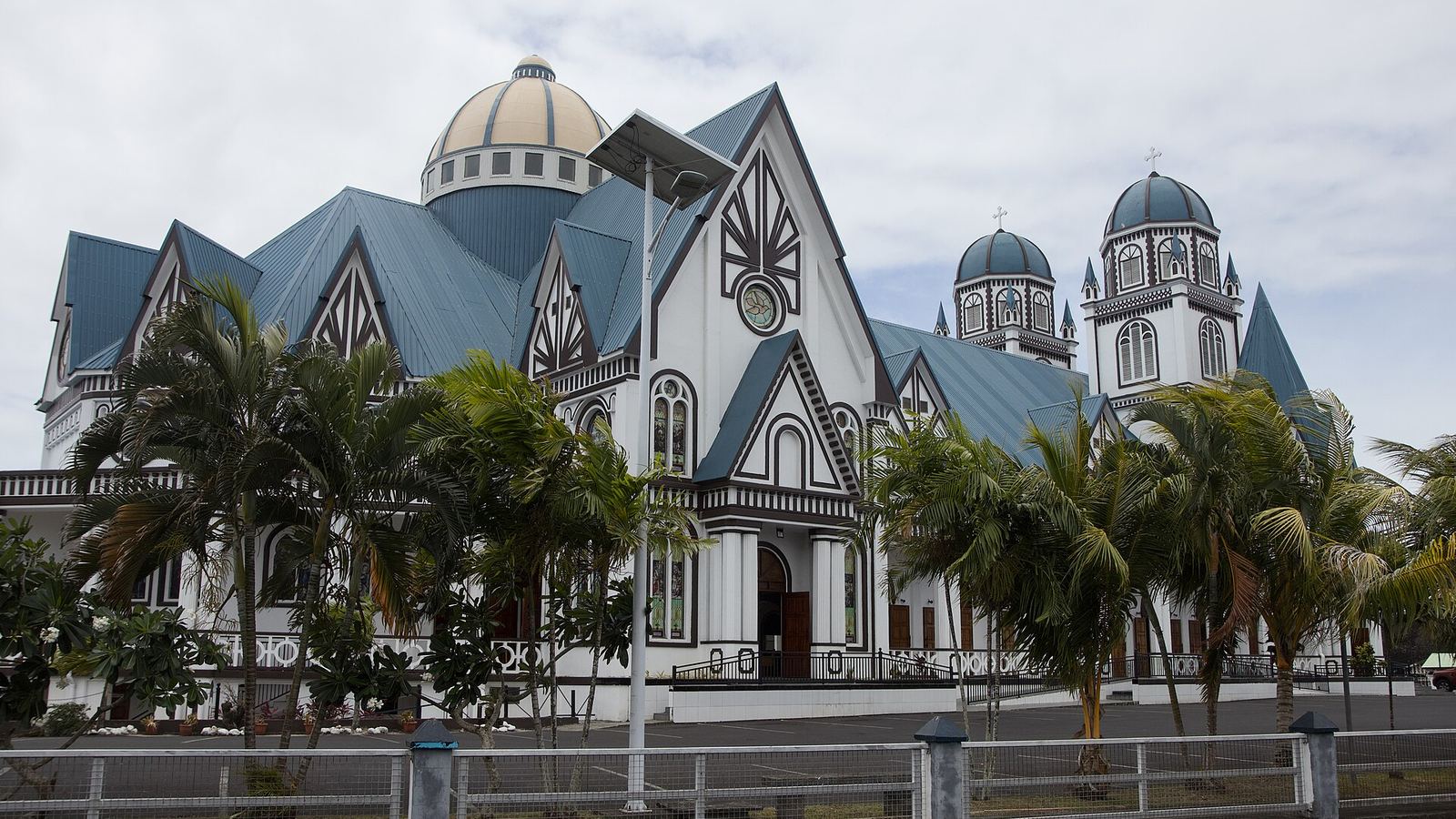
The waterfront strip with the government offices, the cathedral, the banks and most of the cafes, anchored by the clock tower at the middle. Coverage is at its strongest here on both networks, and this is where the reliable cafe WiFi lives if you need a second connection. It is also where both carriers keep their flagship shops, so it is the place to sort out a local SIM once you have found your feet.
Fugalei and the Savalalo flea market
Maketi Fou, the main produce market, sits at Fugalei, while the flea market and the bus terminal share a site at Savalalo nearer the water. Both are busy, both are cash-only in practice, and both are entirely covered. The useful thing about data here is the currency converter and the ability to check what something should cost before you agree to it, since almost nothing carries a price tag.
Matautu and the wharf
The eastern end of the harbour, where cruise ships berth and where the passenger boat to Pago Pago departs. Signal is good right to the quayside, which matters more than it sounds: this is where people off a ship discover their onboard package stops at the gangway and start looking for an alternative with a couple of hours of shore leave already spent.
Vailima and the hill
Up the Cross Island Road above the city sits Vailima, Robert Louis Stevenson's house and now the museum devoted to him, with adult entry around 20 tala and a guided walk through the restored rooms. Coverage holds all the way up and along the track toward his grave on Mount Vaea, though it thins in the gully sections under heavy tree cover. Download the walking notes before you start rather than partway up.
The short version is that there is no Apia neighbourhood where a visitor will be stranded without signal. The city is too small and too linear for dead zones, and both carriers have built for it.
Cafe WiFi, Hotel WiFi and the Beach Fale Problem
Apia has workable free WiFi in the places you would expect: the cafes and restaurants along Beach Road, the larger hotels, and a handful of the shops in the centre. It is fine for email and a browser and it is not fast. Nobody in Samoa should plan a working day around it, and it is not the reason to skip a data plan.
The connectivity fact nobody mentions until you arrive
Traditional beach fales, the open-sided thatched huts on platforms that are the classic Samoan place to sleep, frequently have no WiFi and quite often no mains power either. At Lalomanu on the south-east coast, at Manase on Savai'i, and at the smaller family-run places in between, the evening is lit by a generator that runs for a few hours or by nothing at all. A phone with 6 percent battery is offline no matter which network you chose or how much data you bought. Carry a power bank, charge it in Apia, and treat that as the actual constraint on your connectivity rather than coverage.
Two follow-on points. First, power cuts are not unusual in Samoa and they take the local WiFi with them while leaving the mobile network standing, since the towers have their own backup. That is an argument for a data plan rather than against one. Second, if you are booking fales as you go rather than in advance, you will be phoning or messaging owners directly, often on WhatsApp or Facebook Messenger, because many small properties have no booking system at all. A data-only eSIM handles those messages fine, but it cannot place a voice call to a Samoan number, which is a real limitation of every eSIM sold for this country. That is the strongest argument for carrying a local SIM alongside it.
Day Trips From Apia and Where the Signal Goes
Almost every visitor to Apia spends at least a couple of days out of it. Here is what happens to your data on the standard runs, all of them on Upolu unless the ferry is involved.
| Trip | Rough journey | Coverage | Notes |
|---|---|---|---|
| To Sua Ocean Trench | Over the Cross Island Road to Lotofaga on the south coast | Good, with thin patches | Entry around 20 tala, open through the day; signal is usable at the top of the trench but do not rely on it down the ladder |
| Papase'ea Sliding Rock | A short hop inland from Apia | Good | Close enough to town that you stay on the city cell most of the way |
| Piula Cave Pool | East along the north coast road | Good | The coast road holds signal well; the pool sits below a mission on the shoreline |
| Lalomanu and Aleipata | The south-east corner, past To Sua | Variable | Fine in the villages, patchy where the road tucks behind headlands; this is beach fale country, so plan for no power |
| Mulifanua for the Savai'i ferry | West along the north coast, past the airport | Good to the wharf, then gaps | The crossing takes 60 to 90 minutes and loses signal mid-strait; adult foot fares are in the region of 10 tala |
The Savai'i crossing is the one that catches people out, and it is worth taking seriously because it is the trip most visitors make. Signal from the Mulifanua side holds for the first stretch, disappears in the middle of the Apolima Strait where no tower reaches, and comes back on the approach to Salelologa. If you are arranging a pickup on the far side, do it before you board rather than from the car deck.
Once you are on Savai'i the coverage picture changes again. The sealed coast road around the east and north is reasonably served, but the west toward Falealupo, the interior tracks and the ground around the Saleaula lava fields are where Samoa runs out of towers on either network. The Samoa eSIM guide maps that out coast by coast.
Where to Count on a Signal, and Two Things That Will Disorient You
Two Samoan peculiarities regularly throw arriving visitors, and both have a connectivity angle worth a sentence.
Samoa drives on the left, and only has since 2009. The country switched sides in September of that year to align with New Zealand and Australia, which is where most imported vehicles and most of the diaspora come from. The legacy is a fleet with a mix of steering positions and a driving style that expects everyone to slow down for villages. If you are renting, live navigation is worth more here than the map you glanced at over breakfast, because unfamiliar side-of-the-road plus unsigned junctions is a poor combination.
Samoa sits just west of the international date line, at UTC+13. The country jumped the line at the end of 2011 to trade more easily with Australia and New Zealand, skipping a calendar day entirely to do it. Practically, this means Samoa is among the first places on earth to start a new day, that you are a day ahead of Honolulu despite being close to it, and that a data plan sold as three or seven days can expire on a date that looks wrong until you work out which side of the line you are on. Check the expiry in the provider app rather than counting on your fingers.
Count on a signal
Do not count on it
If you want to size a plan against that pattern rather than guess, the eSIM Finder will do it, and the Holafly review is worth reading as background even though that provider sells nothing for Samoa. Arrival logistics, including the kiosks and the 35 kilometre run into town, are covered in the Faleolo Airport guide.
Frequently Asked Questions
Is there any part of Apia where my phone will lose signal?
Not really. The city is a narrow strip along the harbour with a hill behind it, and both Digicel Samoa and Vodafone Samoa cover the whole of it at 4G speeds, from Matautu wharf at the eastern end through the Town Clock and the government offices to the market and bus terminal at Savalalo. The climb up to Vailima holds too. The only soft spots you are likely to meet are inside heavy concrete buildings and in the shaded gullies on the walk up Mount Vaea, neither of which is a coverage failure so much as physics.
Can I use a ride-hailing app to get around Apia?
No, there is no Uber, Grab or local equivalent operating in Samoa. Taxis are plentiful, unmetered and cheap for short hops within the city, and the rule is to agree the fare in tala before you get in rather than after. Data still helps, because showing a driver a dropped pin is far more reliable than describing a village or a guesthouse name, and because it lets you sanity check a quoted price. Cash in tala is what you pay with; card acceptance in taxis is not something to count on.
Do the Apia buses run to a timetable I can look up?
They do not, and no app will tell you otherwise. The painted wooden buses leave the Savalalo terminal beside the flea market when they are full, with the destination written across the windscreen and no published schedule anywhere. The system works perfectly well once you accept that, and asking at the terminal is faster than any search. Keep small tala notes for the driver, and use your data afterwards to work out where you actually are rather than beforehand to plan when you will leave.
Will my data work on the day trip to To Sua Ocean Trench?
For the drive and at the site, mostly yes. The Cross Island Road over the ridge from Vailima and down to Lotofaga holds a usable signal, with thin patches where the road runs behind terrain, and there is normally coverage at the top of the trench where the grounds and the mini-mart are. Once you are down the ladder in the pool itself, treat yourself as offline. Entry is around 20 tala per person, paid in cash, and it is worth having your route saved before you leave Apia.
Is hotel and cafe WiFi in Apia good enough to skip a data plan?
For a couple of days spent entirely in the city, possibly. For anything else, no. Beach Road cafes and the larger hotels have serviceable free WiFi, but it is slow, it drops during the power cuts that take out the local supply while the mobile towers stay up, and it stops completely at the edge of town. Since most of what people come to Samoa for is an hour or more outside Apia, and since traditional beach fales often have neither WiFi nor mains power, a mobile data plan is the connection that actually travels with you.