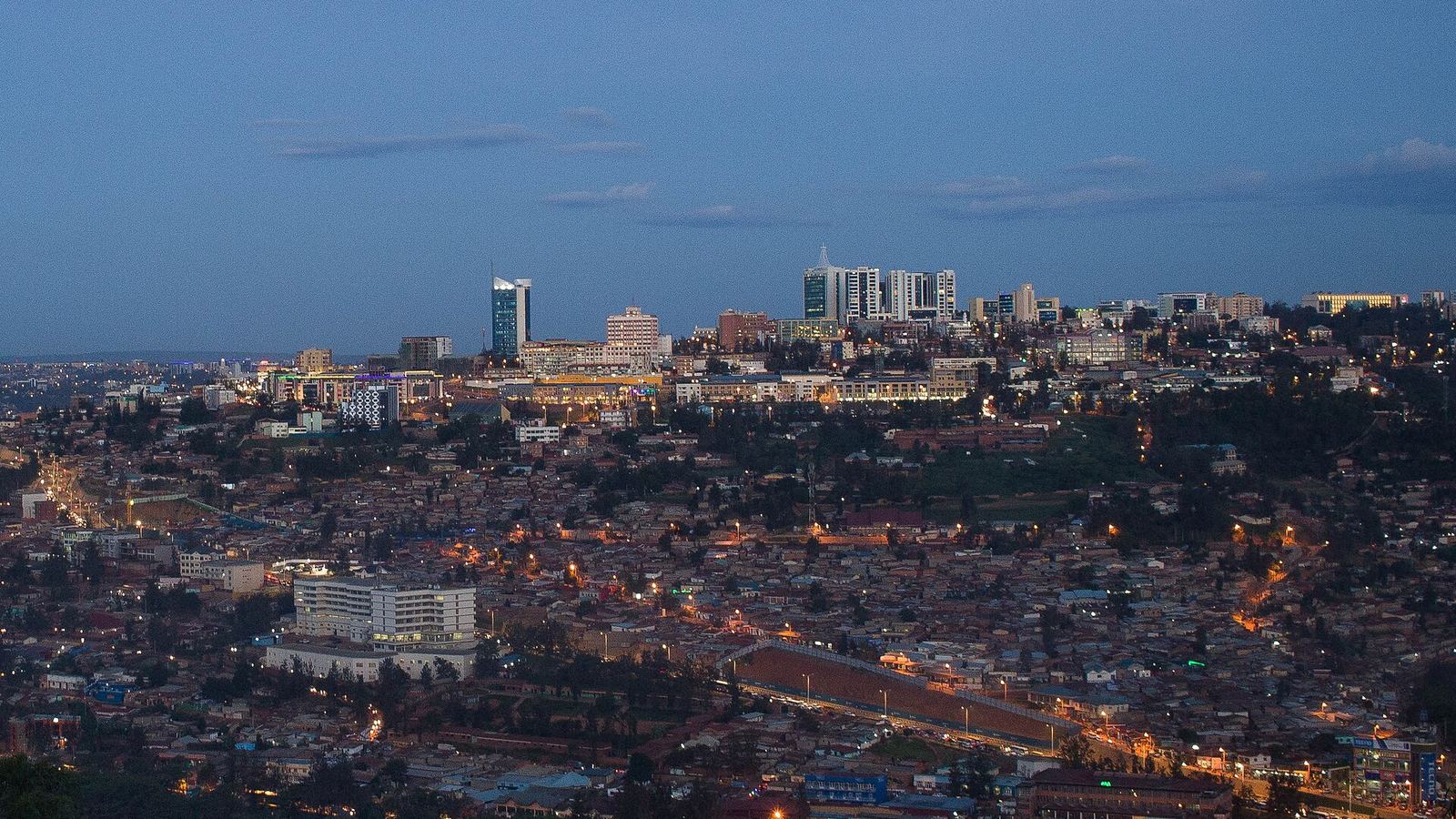
Rwanda is one of the few places in Africa where coverage is not the question. Price and paperwork are. The country is about the size of Belgium, it is folded into steep green hills, and the two operators have put masts on enough of those ridges that a phone keeps a usable signal on most roads you will drive, from the Kigali hills to the Musanze lava plain and the shore of Lake Kivu. So the decision comes down to two things. First, which network sits under the eSIM you buy: Nomad and Airalo both connect through Airtel Rwanda, while Holafly is the only one of the three on MTN, the larger network with roughly two thirds of the country's lines. Second, whether you will stand at an MTN counter long enough to be registered, because the local bundles are startlingly cheap: MTN's own price list puts 30 GB for thirty days at 10,000 Rwandan francs, under seven US dollars.
That number is the honest headline. No travel eSIM sold for Rwanda gets close to it, and on a trip of a week or more the counter wins by a wide margin. What the eSIM buys is a working phone from the moment the aircraft door opens at Kanombe, no fingerprint scan, no queue behind a full RwandAir flight, and no hunt for a service centre on a Sunday afternoon. For a short gorilla-trekking itinerary run by a tour operator, that is often worth the premium. For a fortnight that ends on the Congo Nile Trail, it usually is not. The eSIM Finder can show where the line falls for your dates.
Quick Pick: the Best eSIM for Rwanda
Nomad (Rwanda 5 GB / 30 days): Twenty-one dollars for 5 GB with a thirty-day window is the cheapest mid-sized plan sold for Rwanda, a quarter less than Airalo's equivalent, and it rides Airtel's 4G network, which is solid in Kigali, Musanze and along the main roads. If you want a bridge to an MTN counter instead, Nomad's 1 GB at 6 dollars is the smallest sensible buy.
Our picks
Best overall: Nomad. Lowest per GB: Nomad. Unlimited: Holafly. Or use the eSIM Finder.
Rwanda eSIM Plans Compared
Indicative pricing. Tap through for live rates.
| Provider | Plan | Data | Duration | Price | Network |
|---|---|---|---|---|---|
| Airalo | Rwanda 1GB | 1 GB | 3 days | $7 | Airtel Rwanda (listed as Tigo Rwanda) |
| Airalo | Rwanda 3GB | 3 GB | 7 days | $18 | Airtel Rwanda (listed as Tigo Rwanda) |
| Airalo | Rwanda 5GB | 5 GB | 15 days | $27 | Airtel Rwanda (listed as Tigo Rwanda) |
| Airalo | Rwanda 5GB | 5 GB | 30 days | $28 | Airtel Rwanda (listed as Tigo Rwanda) |
| Airalo | Rwanda 10GB | 10 GB | 30 days | $43 | Airtel Rwanda (listed as Tigo Rwanda) |
| Airalo | Unlimited 5-day | Unlimited | 5 days | $43.50 | Airtel Rwanda (listed as Tigo Rwanda) |
| Airalo | Unlimited 7-day | Unlimited | 7 days | $53.50 | Airtel Rwanda (listed as Tigo Rwanda) |
| Nomad | Rwanda 1GB | 1 GB | 7 days | $6 | Airtel Rwanda (4G) |
| Nomad | Rwanda 3GB | 3 GB | 30 days | $17 | Airtel Rwanda (4G) |
| Nomad | Rwanda 5GB | 5 GB | 30 days | $21 | Airtel Rwanda (4G) |
| Nomad | Rwanda 10GB | 10 GB | 30 days | $35 | Airtel Rwanda (4G) |
| Nomad | Rwanda 20GB | 20 GB | 30 days | $45 | Airtel Rwanda (4G) |
| Holafly | Unlimited 1-day | Unlimited | 1 days | $16.90 | MTN Rwanda |
| Holafly | Unlimited 3-day | Unlimited | 3 days | $32.90 | MTN Rwanda |
| Holafly | Unlimited 5-day | Unlimited | 5 days | $43.90 | MTN Rwanda |
| Holafly | Unlimited 7-day | Unlimited | 7 days | $53.90 | MTN Rwanda |
| Holafly | Unlimited 10-day | Unlimited | 10 days | $84.90 | MTN Rwanda |
| Holafly | Unlimited 15-day | Unlimited | 15 days | $128.90 | MTN Rwanda |
| Holafly | Unlimited 20-day | Unlimited | 20 days | $145.50 | MTN Rwanda |
Airalo Rwanda Plans
Airalo: Widest Range, on Airtel
Fixed plans from 1 GB to 10 GB, plus five unlimited options
Airalo sells more shapes of Rwanda plan than anyone else. The fixed ladder opens at 7 dollars for 1 GB over three days, then 3 GB over seven days for 18 dollars, 5 GB at 26 to 28 dollars depending on whether you want seven, fifteen or thirty days, and 10 GB at 41 to 43 dollars on the same three windows. The validity premium is tiny, so if you are unsure how long you will stay, take the thirty-day version for a dollar or two more.
Against Nomad, Airalo is dearer at every comparable size: 28 dollars against 21 for 5 GB over a month, and 43 against 35 for 10 GB. Its advantage is the unlimited range, which Nomad does not offer here. Unlimited runs 32.50 dollars for three days, 43.50 for five, 53.50 for seven, 79 for ten and 99 for fifteen. Read the fair-use line before buying: you get full speed up to roughly 20 Mbps for the first 3 GB each day, then a 1 Mbps trickle until the next twenty-four-hour cycle begins. That is plenty for a photographer uploading each evening from a lodge in Musanze, and not enough for anyone planning to stream.
The network under Airalo is Airtel, despite the Tigo label. That is fine in every town on a standard itinerary. If your route leans on Nyungwe or the far north of Akagera, weigh that against Holafly's MTN profile.
Strengths
Weaknesses
Holafly Rwanda Plans
Holafly: The Only MTN Profile, Priced Like It
Unlimited data by the day, from 1 to 20 days
Holafly sells Rwanda as unlimited data by the day, and it is the only brand of the three on MTN. Prices run 16.90 dollars for a single day, 32.90 for three, 43.90 for five, 53.90 for seven, 84.90 for ten, 128.90 for fifteen and 145.50 for twenty, which is the longest it will sell in one go. The curve jumps steeply after a week: ten days costs thirty-one dollars more than seven, so if your trip is eight or nine nights, price the daily options individually on the product page rather than rounding up.
Is MTN worth that much? For a Kigali-and-Kinigi trip, no. Airtel covers both well and Nomad does the job for a fraction of the cost. The case for Holafly is a long driving loop through Nyungwe, along Lake Kivu and out to Akagera, where you want the larger network and do not want to watch an allowance. At five days, Holafly and Airalo's unlimited plan are within forty cents of each other, and the deciding factor between them is simply which network you would rather be on.
Holafly is data only, so there is no Rwandan number and no MoMo, and tethering is restricted on its unlimited products. Do not plan to run a laptop off it in a Kigali co-working space.
Strengths
Weaknesses
Nomad Rwanda Plans
Nomad: Cheapest Per Gigabyte in Rwanda
Five Airtel-based plans, from 1 GB up to 20 GB
Nomad is the value pick for Rwanda by a clear margin. Its five plans are 1 GB over seven days for 6 dollars, 3 GB for 17, 5 GB for 21, 10 GB for 35 and 20 GB for 45, all of the larger ones running for thirty days. That last rung works out at 2.25 dollars a gigabyte, the lowest of any travel eSIM sold for this country, and the 5 GB plan at 4.20 dollars a gigabyte is a quarter cheaper than Airalo's equivalent.
The small plan earns a separate mention. Six dollars for a gigabyte over a week is the right size for the job a travel eSIM most often does here: covering the landing at Kanombe, the ride into Kigali, the first messages to a tour operator and a night of maps, until you decide whether to visit an MTN service centre. If you then buy an MTN bundle, you have lost very little.
Like Airalo, Nomad terminates on Airtel, and its product page labels every Rwanda plan as 4G only. Airtel is good across Kigali, Musanze, Rubavu and the main roads, so for a typical first trip this is not a compromise. The sixty-day activation window also lets you buy well ahead of a gorilla permit date.
Strengths
Weaknesses
Mobile Networks in Rwanda
Only two companies sell mobile service to the public here, and they are not the same size. MTN Rwanda held about 64 percent of active mobile subscriptions in the regulator's late-2025 figures, and it is the network the rest of the country is built around: MoMo, its mobile money service, is how a lot of Rwanda pays for a moto ride, a market stall or a bus top-up. Airtel Rwanda holds the remaining 36 percent or so. It is the product of a 2018 merger in which Airtel absorbed Tigo Rwanda, and the old Tigo identity still lingers in some network databases, which is why Airalo's product page names its partner network as "Tigo Ruwanda". Read that as Airtel. There is no third retail operator worth a visitor's attention.
For most of the last decade, 4G in Rwanda ran on a single wholesale network built by Korea Telecom Rwanda Networks, which the operators rented. That arrangement has since been unwound, and MTN and Airtel now run their own 4G layers. MTN went further in June 2025 with a commercial 5G launch of 51 sites across Kigali, concentrated in Gasabo, Nyarugenge and Kicukiro districts and pitched mainly at business, home broadband and industrial users. A travel eSIM will not reliably put you on that 5G layer. Nomad sells its Rwanda plans explicitly as 4G, and you should plan on LTE everywhere.
The practical split between the two networks is subtle in the places most visitors go. In Kigali, Musanze, Huye, Rubavu and along the national roads, both are good. The difference shows at the edges: the deep valleys of Nyungwe, the northern half of Akagera, the remoter stretches of the Congo Nile Trail and the border hills, where MTN's larger grid tends to hold a bar a little longer. That makes Holafly, the one brand on MTN, the cautious choice for a long-distance driving trip, and Nomad or Airalo on Airtel perfectly sound for a Kigali-and-gorillas itinerary.
The fingerprint rule at the counter
Rwanda's SIM registration regulation, issued by the regulator RURA in August 2024, is stricter than most of its neighbours'. A visitor must present the passport used to enter the country, the agent verifies a fingerprint against the immigration service's records, and a live photograph is taken and matched to the passport before the line is activated. A foreign passport can hold only one SIM per network, and nobody can register a line on your behalf, so a driver or guide cannot pick one up for you in advance. None of this is difficult, but it is in-person, it takes ten to thirty minutes, and it is the main thing a travel eSIM saves you.
Coverage Across Rwanda
Coverage where travelers actually go:
| Area | Coverage | Notes |
|---|---|---|
| Kigali | Excellent | Dense LTE on both networks across Nyarugenge, Kimihurura, Kacyiru, Remera and Nyamirambo, plus MTN 5G around the Convention Centre and Kigali Heights. |
| Musanze & Volcanoes NP | Very good | Strong in Musanze town and at the Kinigi park headquarters where treks are assigned. Holds on most of the lower slopes, fading in the bamboo and forest above. |
| Lake Kivu: Rubavu & Karongi | Very good | Reliable along the Rubavu lakefront and in Karongi. Near the Goma border, set your network manually so the phone does not wander onto a Congolese mast. |
| Huye & the southern road | Good | Solid in Huye and Nyanza and along the main road south, with brief gaps in the deeper valleys toward Nyamagabe. |
| Nyungwe National Park | Variable | The main road through the forest has long silent stretches. Expect a signal at Uwinka and near the lodges, but not on the trails or in the gorges. |
| Akagera National Park | Patchy | Usable around the southern entrance and the lakeside lodges. Thins out across the northern plains, where MTN tends to hold on longer than Airtel. |
| Congo Nile Trail | Variable | Villages along the lake shore keep a bar on most days of the walk or ride, with dead spots on the high ridges between Karongi and Nyamasheke. |
| Kigali to Musanze road | Very good | The two-hour drive north keeps a steady connection almost door to door, so passengers can work or stream on the way to a trek. |
How to Choose the Right Plan
Start with the length of your trip and who is driving. On a short operator-run gorilla trip of three to five days, the itinerary usually goes airport, Kigali hotel, Musanze lodge, trek, back to the airport, with little free time near a service centre. Buy Nomad: 3 GB at 17 dollars covers messages, maps and a few hundred photos, 5 GB at 21 dollars covers a heavier user, and both run on Airtel, which is strong on that whole route. On an independent trip of a week or longer, buy Nomad's 1 GB for 6 dollars as a bridge, then walk into an MTN service centre in Kigali with your passport and come out with 30 GB for 10,000 francs and a Rwandan number that can run MoMo. That combination is the best value in the country by a long way. On a long self-drive through Nyungwe, the Kivu shore and Akagera where you want the bigger network and refuse to visit a counter, Holafly is the only eSIM on MTN; five days at 43.90 dollars is fair, anything beyond ten days is not. Airalo is the right call if you already hold Airmoney credit or want unlimited data on Airtel for a few days, but on fixed plans Nomad beats it at every size.
Frequently Asked Questions
Is a travel eSIM worth it in Rwanda when MTN's bundles are so cheap?
For a short trip, often yes. For a long one, rarely. MTN's own price list sells 30 GB for thirty days at 10,000 Rwandan francs, under seven dollars, while the cheapest comparable travel eSIM is Nomad's 20 GB at 45 dollars. The eSIM's value is everything around the price: a phone that works as you walk off the aircraft, no fingerprint scan, and no dependency on a service centre's opening hours. A four-day gorilla trip arranged by an operator rarely leaves time for a counter visit, so the eSIM makes sense. Two weeks of independent travel does not justify the gap.
Which of the eSIM brands uses MTN and which uses Airtel?
Holafly connects through MTN Rwanda. Nomad and Airalo both connect through Airtel Rwanda, which Airalo's product page still lists under its pre-merger name, Tigo. In Kigali, Musanze and Rubavu you will notice no difference. In Nyungwe's valleys, the north of Akagera and the remoter border hills, MTN's larger network tends to hold a signal a little longer, which is the main argument for paying Holafly's higher price on a long driving circuit.
Will my phone have signal on a gorilla trek in Volcanoes National Park?
At the Kinigi headquarters, where groups are briefed and assigned, coverage is strong on both networks. On the drive to your trailhead and across the farmland at the base of the volcanoes you will usually keep a bar. Once you are inside the forest and climbing, signal fades and then often goes, depending on which family your group is visiting. Rangers and trackers carry radios, so this is not a safety issue, but download your offline map and anything you want to read before you leave the lodge.
Can a visitor buy a Rwandan SIM without a passport?
No. Under the regulator's 2024 rules a visitor must present the passport used to enter Rwanda, give a fingerprint for verification against immigration records, and have a live photo taken. Each foreign passport can hold one SIM per network, and proxy registration is prohibited, so a friend, driver or hotel cannot register a line for you. If you want a Rwandan number, budget twenty minutes and bring the passport itself, not a photocopy.
Does a travel eSIM get me MTN MoMo?
No. MoMo is tied to a registered MTN line and a Rwandan number, and travel eSIMs are data-only. In Kigali that rarely matters: hotels, restaurants, supermarkets and most tour operators take cards. Outside the capital, and for small purchases like a moto ride or a market stall, MoMo and cash do most of the work. If you plan to travel independently for a while, a registered MTN SIM in the second slot alongside your eSIM is the tidy solution.
Is the new Bugesera airport open yet?
Not yet. Kigali International at Kanombe remains the country's only international gateway. The new Bugesera International Airport, being built roughly forty kilometres south of the city with Qatar Airways as majority partner, has had its completion pushed back several times, and the government's current commitment is to have it operating by 2028. Until then every flight arrives at KGL, on the eastern edge of Kigali.