Asuncion is comprehensively covered by LTE and comprehensively short of usable public WiFi, which makes mobile data less optional here than in most Latin American capitals. The city has almost none of the municipal hotspot infrastructure that Bogota, Santiago or Buenos Aires have rolled out, cafe networks are hit and miss outside the northern barrios, and the two things a visitor most needs a phone for, ride-hailing and working out the bus system, both fall apart without a connection. The good news is that this is a cheap problem to solve: all three national operators blanket Gran Asuncion, and either a travel eSIM installed before you fly or a local prepaid pack bought the next morning will get you through. What Asuncion will not do is carry you on free WiFi the way a European city might, so plan on paying for data from the moment you land.
What This Guide Covers
Jump to the section most relevant to you
Mobile Coverage Across Gran Asuncion
Asuncion proper holds only around half a million people, but the metropolitan area that matters to a visitor stretches well past the city limits into Luque, San Lorenzo, Fernando de la Mora, Lambare and Nemby, and carries something over two million between them. All three operators build for that whole footprint, so you should expect a solid LTE connection from the airport in Luque all the way through to the Costanera and out along Mariscal Lopez and Espana.
The three networks reach the city differently in the detail. Tigo has the most sites and is the safe default. Claro claims the highest national population coverage at 98.5 percent and now holds Paraguay's 3.5 GHz 5G licence after the August 2025 tender, so it is the one where a modern handset in the centre might actually see something better than LTE. Personal sits between them and tends to be strongest in the older residential grid south of Avenida Espana. None of these gaps is big enough to worry about for a normal city stay.
Where the signal genuinely dips
Three places catch people out. Inside the older concrete government buildings around Plaza de los Heroes and the Palacio de Lopez, reception drops to a bar or two. In the lower riverside neighbourhoods below the Costanera, the Chacarita bajo in particular, the terrain and the informal building density both work against you. And the underground parking levels beneath the newer Villa Morra malls are dead zones on every operator, which matters more than it sounds when you are trying to summon a ride from one.
Buses, Ride-Hailing and Why Your Phone Is the Map
Asuncion's buses, the colectivos, are cheap and frequent and run on route numbers rather than anything resembling a published map. There is no metro, no tram and no comprehensible printed network diagram at the stops. What there is instead is live tracking through apps such as Moovit, which is the practical way a visitor works out that the 30 goes past their hotel. That is a data dependency, not a convenience.
Fares are paid electronically. The Tarjeta Multicolor and its equivalents are sold and topped up at the main terminals and at kiosks, and swiping the card is meaningfully cheaper than paying cash for the same trip. Get one on your first day if you plan to use buses at all, and top it up in person rather than trying to do it through an app you cannot register without a local number.
Ride-hailing is where most visitors end up. Uber, Bolt and the local MUV all operate in Asuncion, along with inDriver, and between them they cover the whole metropolitan area at fares that will feel low to anyone arriving from North America or Europe. All of them need a working data connection to hail, to track and to pay, and none of them will fall back gracefully onto a hotel WiFi network you have walked out of.
Transport data habits worth adopting
- Download the Asuncion area in Google Maps offline before you fly. It costs nothing and saves you the first time you lose signal in a basement car park.
- Keep two ride-hailing apps installed. Coverage and driver density between them vary a lot by barrio and by hour.
- Screenshot your hotel address in Spanish. Not every driver reads a foreign address dropped in a chat window.
- Buy the transport card early. Queues at the Terminal de Omnibus are worst in the late afternoon.
Barrio Notes: Microcentro, Villa Morra and Carmelitas
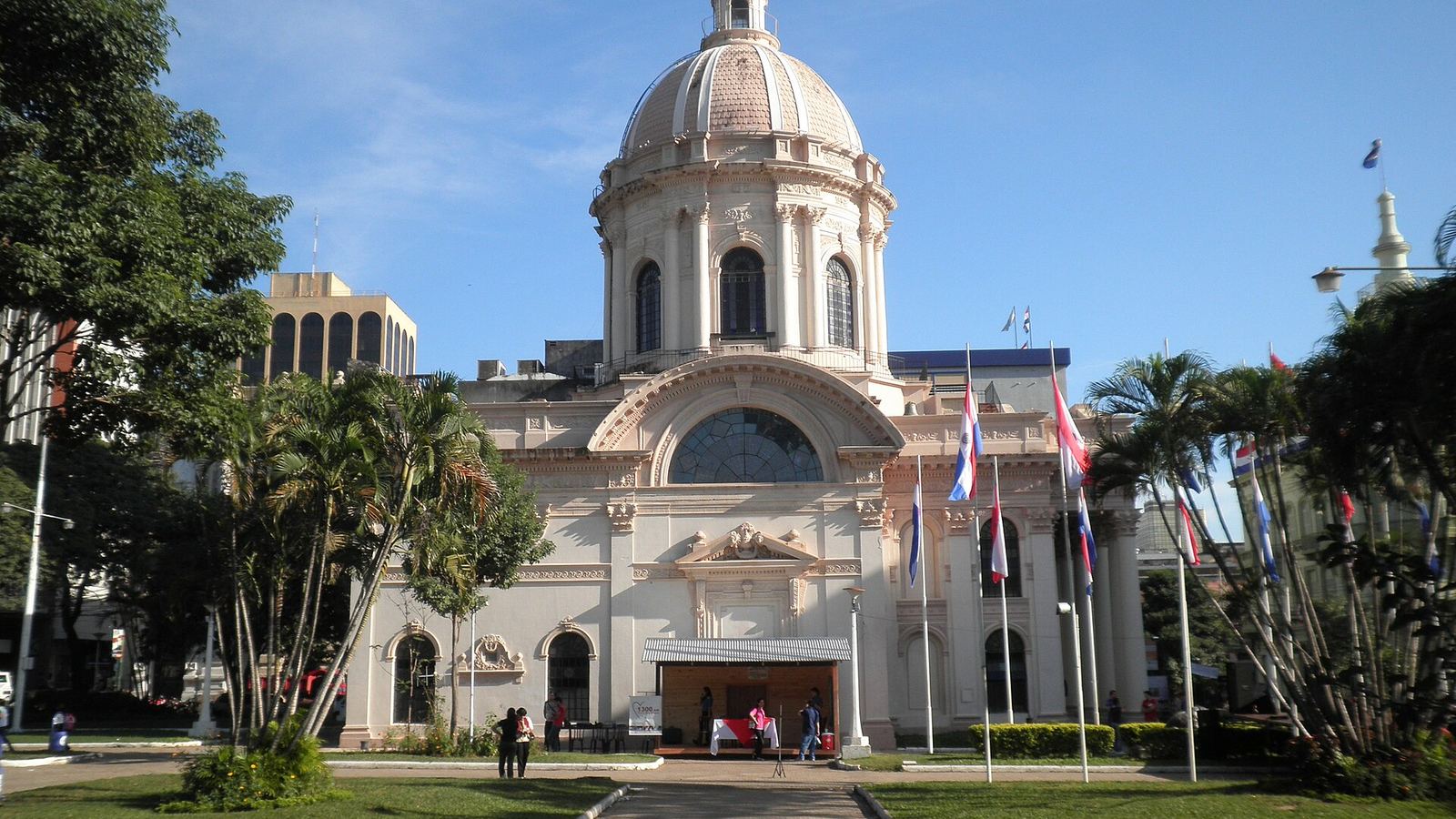
The microcentro is the historic core, the strip between Plaza Uruguaya, the Panteon Nacional and the riverfront where the Palacio de Lopez, the Casa de la Independencia and the old railway station sit. It is busy and commercial during office hours and empties out sharply after dark, which is the single most quoted thing about Asuncion and is broadly true. Signal here is strong outdoors and mediocre inside the heavier stone and concrete buildings. If you are staying in the centre for the architecture, expect a good connection on the street and a patchy one in a colonial-era hotel with thick walls.
Villa Morra is the modern business and shopping district a few kilometres east along Avenida Mariscal Lopez, built around Shopping del Sol and the newer towers. This is where most business hotels, the better restaurants and the fibre-connected apartment buildings are, and it has the densest small-cell coverage in the country. If you need a video call to work, do it here. It is also where the operator stores cluster, so it is the most convenient place in Paraguay to buy a local SIM.
Carmelitas, immediately north of Villa Morra, is the nightlife quarter, built around Paseo Carmelitas and the surrounding bars and terraces. Coverage is fine, but this is where you meet the other kind of connectivity problem: several hundred people in a small outdoor space all on the same cell, all trying to order a ride at the same time on a Friday night. Hail your car a few minutes earlier than you think you need to, or walk a block out before you try.
Two others worth knowing
Loma San Jeronimo is the painted hillside barrio above the bay, the one that shows up in every photograph of the city, and it has ordinary urban coverage plus enough visitors that it is well served. The Costanera, the reclaimed riverfront promenade running below the centre, is a genuinely pleasant place to walk in the evening and holds signal along its full length, though the further west you go toward the Chacarita the more it starts to fade.
Free WiFi in Asuncion: Do Not Rely on It
Asuncion has no meaningful city-run public WiFi programme. There is no equivalent of the free plaza networks you find in Buenos Aires or Mexico City, no branded municipal SSID to look for, and the handful of hotspots that do exist in public buildings are unreliable and slow. This is genuinely different from the rest of the Southern Cone and it catches out travellers who have been island-hopping between free networks elsewhere on the continent.
What you get instead is private WiFi, and the quality of it splits sharply by barrio. Villa Morra and Carmelitas are well served: the malls, the chain cafes and most restaurants above a certain price point have fibre behind them and will hand you a password without being asked. Fibre is widely available in Asuncion's modern buildings, with residential plans starting around 25 dollars a month for 300 Mbps, so the underlying infrastructure in the affluent districts is good. In the microcentro and the outer barrios it thins out fast, and a small comedor is more likely to shrug than to have a network.
| Where | WiFi you can expect | Verdict |
|---|---|---|
| Shopping del Sol / Mariscal Lopez | Free mall network, ask at the info desk | Reliable, good for a big download |
| Villa Morra cafes | Fibre-backed, password on request | Fine for calls and light work |
| Business hotels | Fibre, generally fast in the newer builds | The best connection you will get |
| Microcentro cafes | Inconsistent, often none | Do not plan around it |
| Terminal de Omnibus | Nominally present, heavily congested | Treat as unavailable |
| Public plazas and parks | Essentially nothing | Bring your own data |
The practical conclusion is straightforward. In a city where a week of local mobile data costs about eight dollars and a fortnight costs about fifteen, hunting for free WiFi is a bad use of your time. Buy data and stop thinking about it.
Your First Two Hours in the City
Almost everyone arrives through Silvio Pettirossi, out in Luque about fifteen kilometres northeast of the centre, and the drive in takes twenty five to forty minutes depending on the hour. That drive is the first thing you will need data for, because the taxi rank operates on a flat fare while the ride-hailing apps do not, and comparing the two requires a phone that already works.
Have data active before you leave the aircraft
Whether that is an eSIM installed at home or roaming from your own carrier, arrive connected. The arrivals hall SIM kiosks keep shop hours rather than flight hours and Asuncion takes a lot of evening arrivals.
Get guaranies before you get in a car
There are exchange counters and ATMs past customs. Taxi drivers frequently do not take cards, and the flat airport fare into the centre runs around 103,000 guaranies, roughly 17 dollars, with a surcharge after 22:00 and on Sundays.
Decide on the local SIM in daylight
If you are staying more than a week, buy a Tigo or Personal card the next morning at Shopping del Sol rather than trying to sort it out at the airport at night. You will need your passport and a fingerprint at the counter.
Set up transport and translation on day one
Moovit for the buses, one or two ride-hailing apps, and offline Spanish in your translation app. Guarani is co-official and widely spoken, but Spanish will get you through every transaction a visitor makes.
Full price comparisons and provider notes are on the Paraguay eSIM guide, and the terminal-level detail for arrivals is on the Silvio Pettirossi Airport page.
Day Trips: Aregua, Itaugua and San Bernardino
Aregua sits about thirty kilometres east on the western shore of Lago Ypacarai and is the standard half-day escape from the capital, known for its ceramics workshops and its cobbled main street climbing away from the lake. Coverage along the road out through Capiata and Itaugua is solid, and Aregua itself holds a normal LTE signal. The lakeshore is where it gets thinner, particularly on the northern side, so if you are meeting someone at a specific spot on the water agree it in advance rather than assuming you can call.
Itaugua, on the same Ruta 2 corridor about thirty kilometres out, is the home of nanduti lacework and is where most people stop on the way to or from Aregua. It is a working town on a main highway, so signal is unremarkable and reliable throughout.
San Bernardino, on the far side of Lago Ypacarai around fifty kilometres from the capital, is the summer resort town where Asuncion decamps in January. In season it is busy enough that the local cells get loaded and speeds sag on hot weekend afternoons. Out of season it is quiet and the connection is fine. Either way you will hold a usable signal on the drive around the lake.
Further afield, plan differently
- Encarnacion and the Jesuit missions are a long day or an overnight, around 370 km south on Ruta 1. Coverage on the highway is good, thinner on the side roads to Trinidad and Jesus de Tavarangue.
- Ciudad del Este and Iguazu is 330 km east on Ruta 2 and 7 with only short dead patches. Turn data roaming off before you reach the Friendship Bridge or your phone will find a Brazilian tower.
- The Chaco is the exception to everything on this page. Once Ruta 9 leaves Villa Hayes you should expect long stretches with no signal at all on any operator.
- Overnight buses from the Terminal de Omnibus rarely have working WiFi despite the sticker on the window. Download what you want to watch first.
Frequently Asked Questions
Is there anywhere in Asuncion I can count on free public WiFi?
Only privately. The city runs no municipal hotspot network worth the name, so there is no plaza or promenade where you can expect to connect for free. What works is the shopping centres, particularly Shopping del Sol and Mariscal Lopez, the chain cafes in Villa Morra and Carmelitas, and any hotel above the budget tier, all of which sit on fibre. The microcentro is much weaker and the bus terminal is congested to the point of being useless. Given that a week of local mobile data costs under ten dollars, planning your day around WiFi availability is a false economy here.
Do I need data to use the buses in Asuncion?
Realistically yes, unless you have a local telling you which number to take. Asuncion's colectivos run on route numbers with no clear published map at the stops, and the usable way to navigate them as a visitor is a live tracking app such as Moovit. Payment is separate and offline: you buy a rechargeable transport card at the terminal or a kiosk and swipe it, which costs noticeably less than paying the same fare in cash. So the card handles the money and your phone handles the routing, and only the second one needs a connection.
How much data will a week in Asuncion actually use?
Around 3 to 5 GB for a typical visitor, which is maps, messaging, ride-hailing, a reasonable amount of social media and some music. Push it toward 8 or 10 GB if you are streaming video in the evenings rather than using hotel WiFi, or tethering a laptop for work. That maps neatly onto Nomad's 5 GB month at 19 dollars if you want an eSIM, or onto a local Tigo pack at roughly a fifth of the price if you are willing to spend twenty minutes in a shop with your passport.
Will my phone work on a day trip to Aregua or San Bernardino?
Yes. Both sit on or near the Ruta 2 corridor within about fifty kilometres of the capital, and the whole loop around Lago Ypacarai is covered by all three operators. The two caveats are minor. Parts of the lakeshore away from the towns get thin, particularly on the northern side toward the water, and San Bernardino gets genuinely congested on summer weekends when half of Asuncion is there, which slows things down without cutting you off. Neither is a reason to change what you buy.
Is Asuncion a workable base for remote work?
For most jobs, yes, with one caveat about where you stay. Fibre is widely available in the modern apartment buildings and hotels of Villa Morra and the northern axis, with residential plans starting around 25 dollars a month for 300 Mbps, and mobile LTE across the metropolitan area is a reliable backup. The caveat is that this quality is concentrated: an older building in the microcentro or an outer barrio may have much worse fixed internet and you cannot tell from a listing photograph. If calls matter, book in the Villa Morra and Carmelitas corridor and check the property specifically mentions fibre.