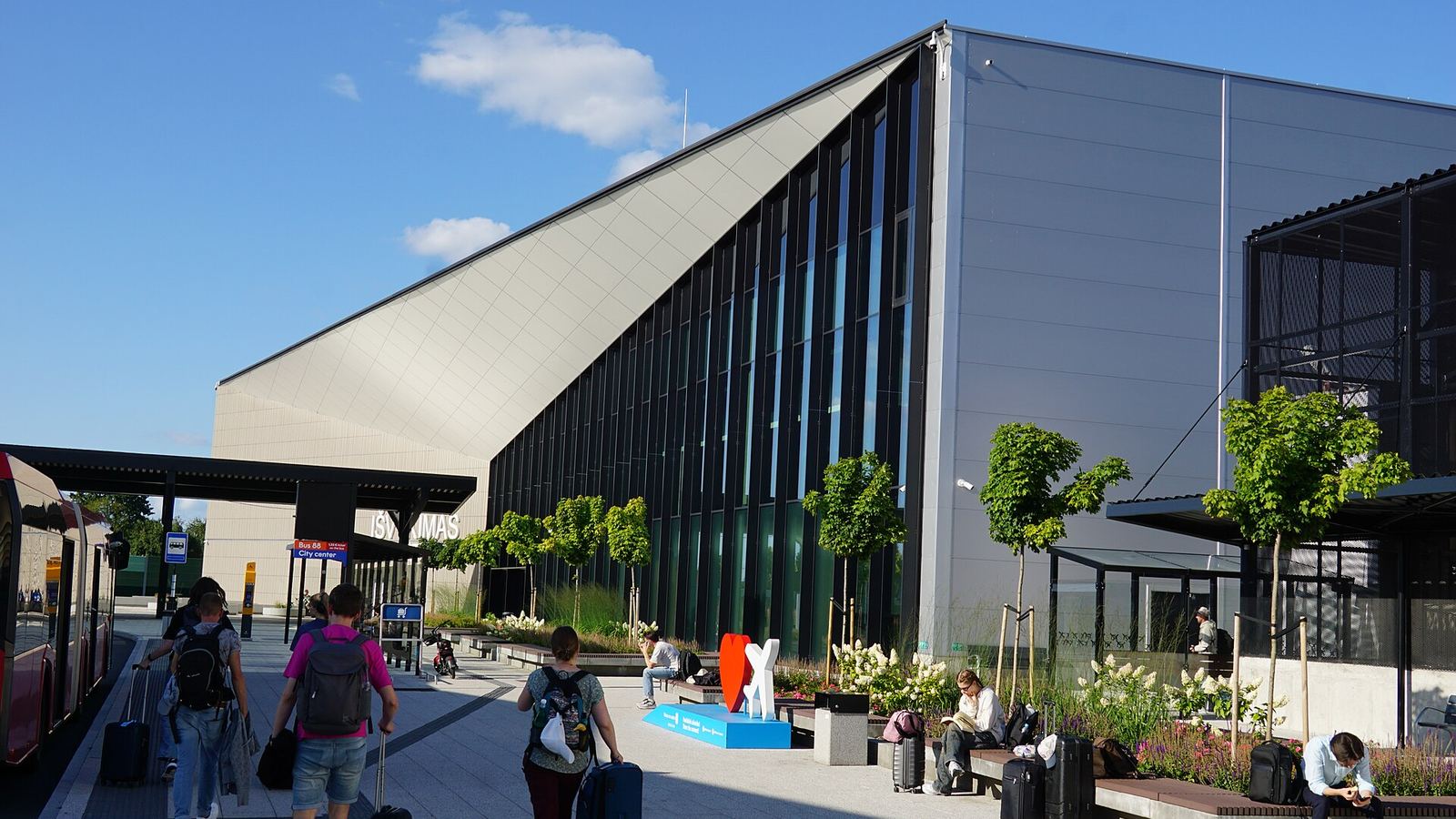
Vilnius Airport is unusually convenient and slightly split in two. Since February 2025 departures happen in a large new building, while arriving passengers still walk out into the older terminal, the columned 1950s hall that has been the face of the airport for seventy years and stays in service until a replacement arrives around 2028. That matters practically rather than aesthetically: the carrier kiosks, the post office counter and the exits to the train platform and the bus stop are all on the arrivals side, in the older, smaller building, and the shiny retail you saw on the way out of your departure airport is not what greets you here. The good news is the geography. The city centre is about six kilometres away, the railway platform sits directly beneath the terminal, and a ride into town costs a euro.
What This Guide Covers
Jump to the section most relevant to you
The Carrier Kiosks in the Arrivals Hall
All three Lithuanian networks keep a presence in the arrivals hall, which is more than most airports of this size manage. Telia, Bite and Tele2 each run a kiosk, and there is a branch of Lietuvos pastas, the national post office, which also sells prepaid starter packs. Between them you can walk off a flight and be holding a Lithuanian number inside a few minutes, assuming you land during working hours.
What to expect at the counter
Typical opening is roughly 07:00 to 22:00, and staffing on the kiosks can be thinner at weekends, so a late evening arrival should not count on finding anyone there. Lithuania has no compulsory prepaid registration law, but airport counters commonly ask to see a passport as their own policy, so have it out rather than packed. Payment by card is universal. Ask which of the cheap prepaid brands the kiosk is actually selling: Telia's counter sells Ezys, Bite's sells Pildyk and Tele2's sells Labas, and those brands are the ones with the sensible bundle pricing.
The honest assessment of the kiosk route is that it works, it costs little, and it takes time you may not want to spend. A weekly Pildyk bundle is around six euros and a Labas month around seven and a half, which is cheap by any standard. What you are trading is the twenty minutes at the counter after a flight and the risk that the hour you land is not an hour anyone is working. For a long stay that trade is clearly worth it. For three nights it usually is not, which is the whole argument for arriving with a profile already active.
Two Buildings, and Why It Changes Your First Ten Minutes
The new departures terminal opened to passengers on 4 February 2025 after a construction programme that finished the previous autumn. It adds 14,400 square metres, raises the airport's throughput from around 1,200 to about 2,400 passengers an hour, and brought the first two air bridges to Vilnius, so boarding no longer always means a bus across the apron. Check-in and self-service bag drop sit on the ground floor, with security and the Schengen gates above.
Arrivals were not part of that project. Passengers landing at VNO still come through the original terminal, and a dedicated new arrivals building is not expected to open until the end of 2028, with the conversion of the older structures running through the meantime. This is why arriving and departing at Vilnius feel like two different airports.
The arrivals-side orientation, in order
You clear passport control and baggage into a compact hall. The carrier kiosks and the post office counter are here, along with the car rental desks, which is a longer row than the size of the building suggests: Hertz, Avis, Europcar, Budget, Sixt, Enterprise, National and Alamo all keep positions. Straight out of the doors and to the left is the bus stop for route 88. Follow the train signage instead and a three to five minute walk brings you to the railway platform directly below the terminal. The Bolt pickup zone sits near the intercity coach stops. Everything is within about two minutes of everything else.
One consequence of the split worth planning around: a lot of the food, seating and phone charging at this airport is airside in the new departures building, so a long wait on the arrivals side is less comfortable than you might expect. If you are meeting someone off a later flight, the city is twenty minutes away and considerably more pleasant.
Free WiFi Vilnius Airport, and Its Session Limit
The airport runs an open network called Free WiFi Vilnius Airport, and it is free in the ordinary sense of the word. There is a catch that catches people, though, and it is not bandwidth.
Connecting, and the limit to know about
1. Open your WiFi list and pick Free WiFi Vilnius Airport. No password.
2. The welcome portal normally opens by itself. If it does not, load any plain website and it will appear.
3. Accept and you are online, in both the arrivals and departures buildings.
4. Here is the part to plan for: access comes in two-hour sessions, with three sessions per registered user. That is six hours in total, which is generous for a normal transit and awkward if you are sitting out a long delay or a night connection.
5. If the portal will not cooperate, the airport publishes an IT support line and an email address for exactly this problem, which is a more useful fallback than most airports offer.
For someone arriving without a data plan, six hours is plenty to buy and install an eSIM, and that is genuinely the best use of it. What it is not is a way to travel: the network reaches the terminals and stops, and the first place you will want maps is the bus stop outside. The session structure also means the WiFi is at its least helpful precisely when you need it most, during an overnight disruption, since the sessions run out while you are still there.
Getting into Vilnius, and What It Costs
Six kilometres is a short hop, and the airport is served better than its size warrants. Four realistic options, and none of them is expensive.
| Option | Where it goes | Time | Fare |
|---|---|---|---|
| Train | Vilnius railway station, then a 10 to 15 minute walk to the Old Town | 7 to 8 minutes | 1 EUR |
| Bus 88 | Railway station, then on toward the Old Town and Europa Square | 15 to 20 minutes | 1.00 to 1.25 EUR by app or card, 1.50 EUR tapping a bank card |
| Night buses 88N and 3G | Same corridor, with the 3G routed via Lukiskes Square | 20 to 25 minutes | 1.00 to 1.25 EUR |
| Bolt or taxi | Door to door anywhere in the centre | 10 to 15 minutes | Around 6 to 10 EUR, or 8 to 13 EUR into the Old Town |
The train is the quickest and the most charming: the platform is underneath the terminal, the run into the central station takes seven or eight minutes, and a ticket is a single euro bought from the conductor or in the rail operator's app. The limitation is frequency. There are only about sixteen departures a day, roughly every one to two hours, with the first around half past five in the morning and the last in the early evening, so a good share of arrivals miss it entirely.
Bus 88 is the workhorse and runs every ten to fifteen minutes from about six in the morning to eleven at night. After that, the 88N and the 3G cover the small hours at roughly half-hourly intervals, which makes VNO one of the easier European airports to arrive at on a two in the morning flight without paying for a taxi.
Data on the way in
There is no onboard WiFi to rely on, and none is needed. The corridor from the airport into the centre is comprehensively covered on all three Lithuanian networks, so an active profile gives you live bus tracking in the Trafi app, a Bolt booking from the kerb, and a map for the walk from the railway station across to the Gates of Dawn. This is a short journey, but it is the one where you are most likely to be standing on an unfamiliar pavement wondering which direction to walk in.
Sorting It Out at Home Against Sorting It Out Here
Both routes work at this airport, which is not true everywhere. Here is the comparison stripped of sales talk.
Profile active before you land
Buying at the airport
Note that the right-hand column is not a list of failures. Lithuanian prepaid bundles are among the cheapest in Europe and the local card genuinely beats an eSIM on price and on cross-border usefulness, which is unusual and which the Lithuania SIM card guide works through in euros. The eSIM case here rests on time and certainty rather than on money, and how much those are worth depends entirely on how long you are staying.
If you do go the eSIM route, the practical sequence is short. Buy while you still have a connection at home, complete the installation so the profile is sitting in your settings, and choose the option that starts the clock on first use in the destination country rather than at purchase. Turn the line on once the aircraft is on stand at Vilnius and give it a minute to find Telia, Bite or Tele2.
Kiosk Bundles Against eSIM Pricing at VNO
What each route costs, converted at roughly 1.10 dollars to the euro so the columns can be read together.
| Where | What you get | Price |
|---|---|---|
| Airport kiosk, weekly bundle | Unlimited domestic data, calls and texts, 7 days | About 6 EUR plus the card, near 7 USD |
| Airport kiosk, monthly bundle | Unlimited domestic data, 200 minutes, 30 days | About 7.50 EUR, near 8.25 USD |
| Airport kiosk, EU-heavy bundle | Unlimited at home plus roughly 21.5 GB across the EU | About 16.90 EUR, near 18.60 USD |
| Travel eSIM, 1 GB | 7 days, data only | 4 USD, near 3.60 EUR |
| Travel eSIM, 5 GB | 30 days, data only | 14 USD, near 12.70 EUR |
| Travel eSIM, 10 GB | 30 days, data only | 22 USD, near 20 EUR |
Unusually for an airport comparison, the counter is not gouging you. Vilnius kiosks sell the same bundles the city shops do, and on raw euros per gigabyte the local card wins comfortably. The eSIM advantage is narrower and more specific: a small plan bought for a short trip costs about the same as a weekly local bundle, arrives without an errand, and works at four in the morning when nothing at the airport is staffed.
The short version
Under a week, buy an eSIM and walk straight to the train or the bus. Over three weeks, or if you want a Lithuanian number, use the kiosks in arrivals and enjoy some of the cheapest mobile pricing in the European Union. Anywhere in between, it is a genuine coin toss, and the deciding factor is usually your arrival time. Provider comparisons are on the Lithuania eSIM guide, unlimited plans are covered in our Holafly review, and the eSIM Finder turns a trip length into a plan size.
Frequently Asked Questions
Which carriers have counters at VNO, and when are they open?
Telia, Bite and Tele2 all keep kiosks in the arrivals hall, and there is a Lietuvos pastas post office counter that also sells prepaid starter packs. Opening is broadly 07:00 to 22:00, with weekend staffing less predictable, so a late arrival should assume they are shut. Ask which discount brand each counter sells, since Ezys, Pildyk and Labas are the names with the sensible bundle pricing rather than the operator brands above them.
Why does arrivals look so much older than departures at this airport?
Because it is. The new departures terminal opened on 4 February 2025, adding 14,400 square metres, two air bridges and roughly double the hourly throughput. Arrivals were not part of that project and still use the original columned terminal from the 1950s, with a purpose-built arrivals building not due until around the end of 2028. Everything an arriving passenger needs is in the older hall, which is small but very quick to cross.
How does the airport WiFi work and is there a time limit?
The network is called Free WiFi Vilnius Airport and needs no password. A welcome portal opens on connection, you accept, and you are online across both buildings. The limit is unusual: access runs in two-hour sessions with three sessions allowed per registered user, so six hours total. That is comfortable for a normal arrival and restrictive during a long delay, which is worth knowing before you plan an overnight around it.
Is the train from the airport worth waiting for, or should I take the bus?
Depends entirely on the timetable. The train is genuinely excellent when it lines up: the platform sits directly below the terminal, the run to the central station takes seven or eight minutes, and it costs one euro. But there are only around sixteen departures a day, roughly every one to two hours, with the last in the early evening. If the next one is more than fifteen minutes off, bus 88 leaves every ten to fifteen minutes for about the same money and takes fifteen to twenty.
I land at 2am. What are my options for getting into the city?
Better than at most airports this size. Night buses 88N and 3G cover the small hours at roughly half-hourly intervals from about 23:30 to 05:30 for the same one euro or so, with the 3G taking a different route via Lukiskes Square. Bolt operates through the night and will run six to ten euros to the centre, or eight to thirteen into the Old Town. What is not available is any SIM counter, which is the strongest single argument for arriving with a data plan already working.