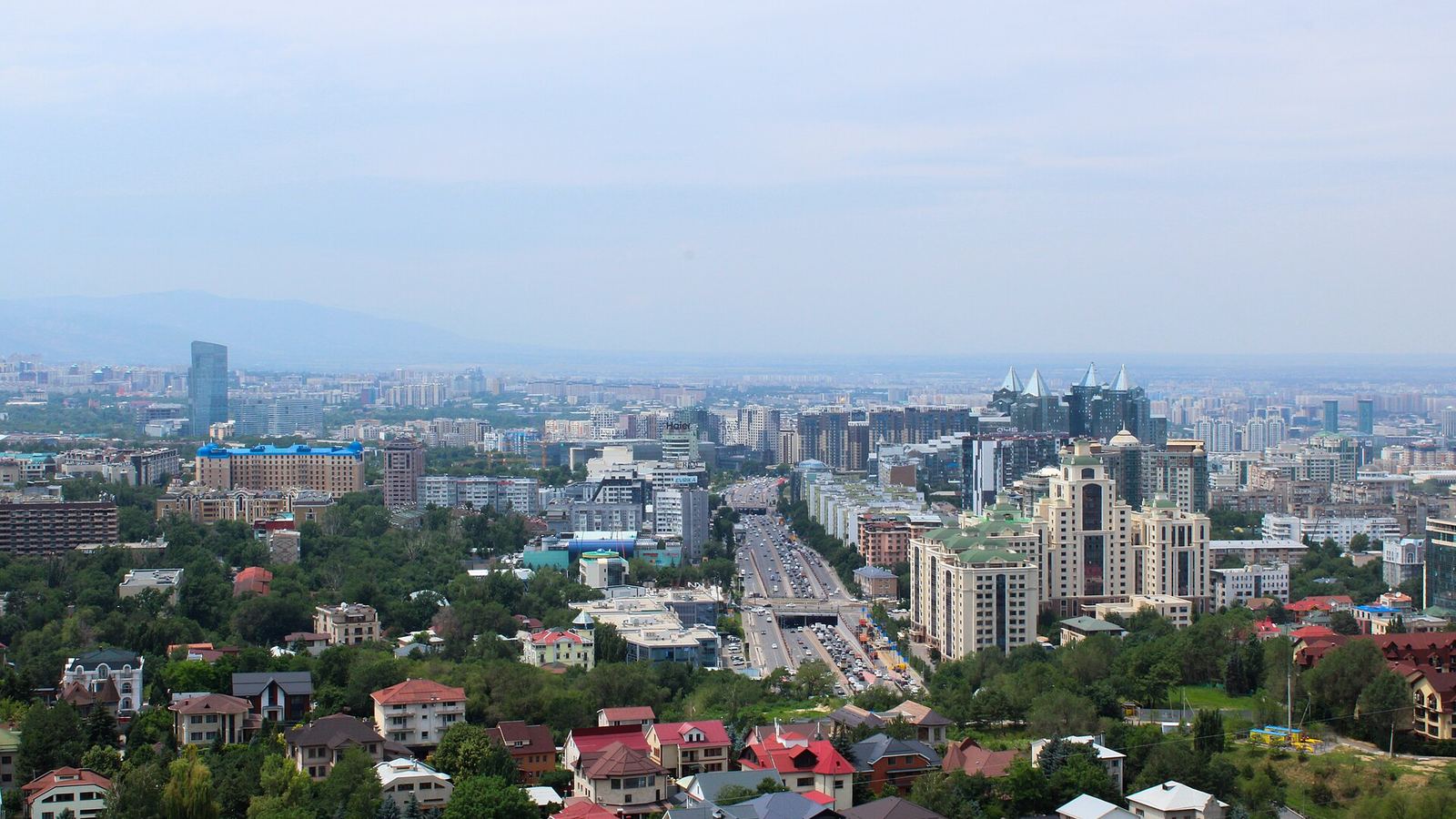
Almaty stopped being Kazakhstan's political capital in 1997, when the government decamped some 1,200 kilometres north to the city now called Astana, and it has spent the three decades since being everything else: the commercial centre, the university town, the airline hub, and the place almost every visitor actually lands. Around 2.2 million people live here and the network built for them is genuinely good, with 4G across the whole grid, 5G in the centre, and coverage that survives the metro tunnels. The complication in Almaty is vertical rather than horizontal. The city climbs from roughly 700 metres at its northern edge to 1,700 at Medeu, and the signal thins as you go up, which matters because nearly everything worth doing here is uphill.
What This Guide Covers
Jump to the section most relevant to you
Almaty Mobile Coverage and the Three Networks
Almaty is comfortably the best-connected place in Kazakhstan, and for ordinary travel purposes all three operators are fine inside the city. Kcell, Beeline and Tele2 each blanket the grid with 4G and each has 5G lit in the central districts, though 5G here is a young network rather than a mature one and most travel eSIMs land on 4G regardless. Expect 25 to 60 Mbps in everyday use, which handles maps, video calls, Yandex Go and photographing a Cyrillic menu into a translation app without complaint.
The city's layout helps. Almaty is a grid on a slope, laid out on wide avenues with long sightlines, and there is very little of the dense old-town canyon effect that swallows signal in European cities. What does interfere is the mountain wall to the south: as the ground rises toward the Trans-Ili Alatau, cells thin out and the terrain starts casting shadows.
Which network is under your eSIM
Airalo connects through Kcell, Nomad through Beeline, and Holafly through Tele2 with Beeline as a second network. Inside Almaty that distinction barely registers. It starts to matter the moment you head up Dostyk Avenue toward the mountains or east on the Kuldzha road, which is covered further down this page and in the Kazakhstan eSIM guide.
The Metro, the Buses and the Onay Card
Almaty's metro is a single line of eleven stations running 13.4 kilometres from Raiymbek Batyr in the north to Bauyrzhan Momyshuly in the west, opened in 2011 after a construction saga that began in Soviet times. It is spotlessly kept, decorated station by station in marble and mosaic, and it has mobile coverage in the platforms and the running tunnels, so your data keeps working between stops rather than dropping out the moment the doors close.
A ride costs 120 tenge, which is about a quarter, and the same fare applies on the buses and trolleybuses that do most of the city's heavy lifting. Payment runs through the Onay system. A physical Onay card costs 500 tenge, of which 420 is a refundable deposit and the rest lands on your balance immediately, and you can buy one at metro ticket offices, machines and the small kiosks outside stations. The Onay app will do the same job by QR code or NFC at the same fare, which is the better option if your phone has data from the moment you arrive.
The app-or-card question, decided by your connection
The Onay app is the cleaner route, but it needs data to load and top up, and topping up on a moving bus over a shared connection is not a plan. If you land with a working eSIM, use the app. If you land offline, buy the plastic card at a metro cashier with cash and keep 2,000 tenge on it. Some of the newer city buses advertise free WiFi on board, but it is slow enough that regular users ignore it.
Neighbourhood Notes: the Golden Square, Medeu, Bostandyk
Coverage is strong everywhere a visitor is likely to stay, but the three districts most people move between behave slightly differently.
The Golden Square
The grid of central blocks bounded roughly by Abay Avenue, Gogol Street, Zheltoksan and Nauryzbai Batyr, holding most of the hotels, restaurants and coffee shops, plus Panfilov Park with its wooden Zenkov Cathedral and the Green Bazaar just below. This is the densest network build in the country: fast, consistent, and the one part of Almaty where 5G shows up reliably on a compatible handset. Zhibek Zholy, the pedestrian street locals call the Arbat, is thick with cafes offering free WiFi if you want it.
Medeu district and the upper city
Everything above Al-Farabi Avenue, climbing Dostyk toward the Kok Tobe cable car and eventually the skating rink at Medeu. Coverage is still good here but noticeably less dense, and the terrain begins to matter: side streets tucked behind a rise can drop to a single bar while a road fifty metres higher is fine. Worth knowing if you are staying in one of the guesthouses up the hill and relying on mobile data.
Bostandyk and the Esentai corridor
The modern western half of the city around Esentai Tower, Mega Almaty and the office blocks along Al-Farabi. This is where Almaty looks most like a business capital, and the network reflects it, with heavy capacity for the daytime population. Signal here is as good as the centre and the malls are the most dependable indoor WiFi in the city.
The short version: there is no visitor-relevant dead zone inside the city limits. Almaty's coverage problems all begin where the tarmac starts to climb.
Free WiFi in Almaty, and the SMS Problem
Almaty has a reasonable amount of free public WiFi. The city's smart-city programme put open access points along the pedestrianised stretch of Panfilova Street, the big malls including Dostyk Plaza and Mega Almaty run open networks, the newer buses carry hotspots, cafes across the centre offer it as standard, and Almaty Central Park has coverage in parts.
There is a catch that trips up more visitors than anything else on this page. A great many Kazakh public networks, including the one at the airport, will not let you online until you enter a mobile number and type back a code sent by SMS. If your home line is switched off or not roaming, no code arrives, and the free WiFi you can see is free WiFi you cannot use. Cafe networks are usually simpler, often just a password written on the receipt, but the pattern is common enough to plan around.
What that means in practice
Public WiFi in Almaty works well as a supplement and badly as a strategy. It cannot help you the first time you need it, which is standing in an arrivals hall trying to get online, and it does not follow you up Dostyk Avenue or into a taxi. Install a Kazakhstan eSIM before you fly and the SMS gate stops being your problem, because you will already be connected when you meet it. Our eSIM Finder will match a plan to your trip length.
Going Uphill: Kok Tobe, Medeu, Shymbulak, Big Almaty Lake
Almaty's great pleasure is that the mountains start at the end of the bus route. Its connectivity story is that coverage weakens roughly in step with altitude, and the four classic ascents behave quite differently.
| Where | Altitude | Getting there | Coverage |
|---|---|---|---|
| Kok Tobe | About 1,100 m | Cable car from Dostyk Avenue, near 3,000 KZT one way and 5,000 return | Excellent. The city's television tower stands on the summit, which tells you most of what you need to know |
| Medeu | 1,691 m | Bus 12 from the city, or a short taxi ride up the gorge | Good across the rink and the car park, patchier on the 842 steps up the dam |
| Shymbulak | 2,200 m at the base, about 3,200 m at Talgar Pass | Gondola in stages from Medeu, roughly 4,000 KZT one way and 6,500 return to the upper station | Workable at the base village, intermittent on the upper stages and on the ridge |
| Big Almaty Lake | About 2,510 m | Road up the Big Almaty gorge past the checkpoint, taxi or organised trip | Poor. Signal fades above the checkpoint and the lake basin is effectively offline |
Two practical notes. The Big Almaty Lake road runs toward the Kyrgyz frontier and parts of the upper valley sit inside a border zone with permit requirements, so this is a poor place to be improvising with no data and no plan. And the gondola up to Shymbulak crosses several ridges: if you are meeting someone at the top, agree the meeting point at the bottom rather than trusting a message to land halfway up.
Day Trips: Charyn, Kolsai, Turgen
The classic excursions from Almaty are long. Not European long, Kazakh long: Charyn Canyon is about 200 kilometres east and takes three hours each way, and the Kolsai lakes are closer to 330 kilometres. These are the trips where the choice of network stops being academic.
| Trip | Distance | Coverage on the way |
|---|---|---|
| Charyn Canyon | About 200 km east, three hours | Reasonable along the Kuldzha road as far as Chundzha, a bar or two at the rim car park, nothing once you walk down into the Valley of Castles |
| Kolsai lakes and Lake Kaindy | About 330 km, four to five hours | Patchy in Saty village, none at Kaindy in its drowned spruce forest, and long empty stretches on the approach |
| Turgen gorge | About 80 km east, ninety minutes | Fine as far as Turgen village, fading fast up the gorge road toward the waterfalls |
Download the whole southeast of the country to your phone before you leave Almaty. Offline maps are not a nice-to-have on these routes, they are the plan, and no provider on the market changes that. If you are self-driving rather than joining a tour, the case for Holafly's two-network access or a large Airalo bucket on Kcell gets much stronger, because a car with live navigation covers ground that a car without it does not.
One more thing worth knowing before you set off: guesthouses in Saty and the other mountain villages frequently have no usable internet at all, so tell someone your plan before you go quiet.
Frequently Asked Questions
Does mobile data keep working on the Almaty metro?
Yes. The single line runs 13.4 kilometres through eleven stations and carries mobile coverage on the platforms and inside the running tunnels, so maps and messages keep working between stops. That is worth more than it sounds, because the metro is the fastest way to move north to south through the city and the stations are far enough apart that you will want to check where you are getting off.
How do I pay for Almaty buses without a Kazakh bank card?
Buy a physical Onay card. It costs 500 tenge, of which 420 is a refundable deposit, and you load it with cash at metro cashiers, ticket machines or the kiosks outside stations. Every ride on the metro, the buses and the trolleybuses is 120 tenge. The Onay app does the same by QR or NFC and is more convenient, but it needs a working data connection, so it is the better option only if you arrive already online.
Will I have a signal at Shymbulak or Big Almaty Lake?
At Shymbulak, mostly. The base village at 2,200 metres holds a usable connection and the lower gondola stages are generally fine, with gaps higher up toward Talgar Pass. Big Almaty Lake is a different matter: coverage fades above the checkpoint on the gorge road and the lake basin at around 2,510 metres is effectively offline on every network. Sort out your route and your ride home before you drive up there.
How much data does a week in Almaty use?
For a typical week of maps, messaging, Yandex Go, translation and social media, most travellers land somewhere between 3 and 5 GB, which a $11 to $16 eSIM covers with room to spare. Add a couple of gigabytes if you are running navigation on a full-day drive to Charyn or Kolsai, since live routing on empty roads uses far more than the same hours spent walking around the Golden Square.
Can I use Yandex Go in Almaty on a travel eSIM?
Yes, and it is the main reason to arrive with data. Yandex Go is the local ride-hailing app and it works on any data connection, but the account has to be verified by SMS, so register it at home on your own number before you travel rather than trying to set it up in the arrivals hall. Once the account exists, an eSIM is all you need. Fares inside the city are usually a few hundred to a couple of thousand tenge.