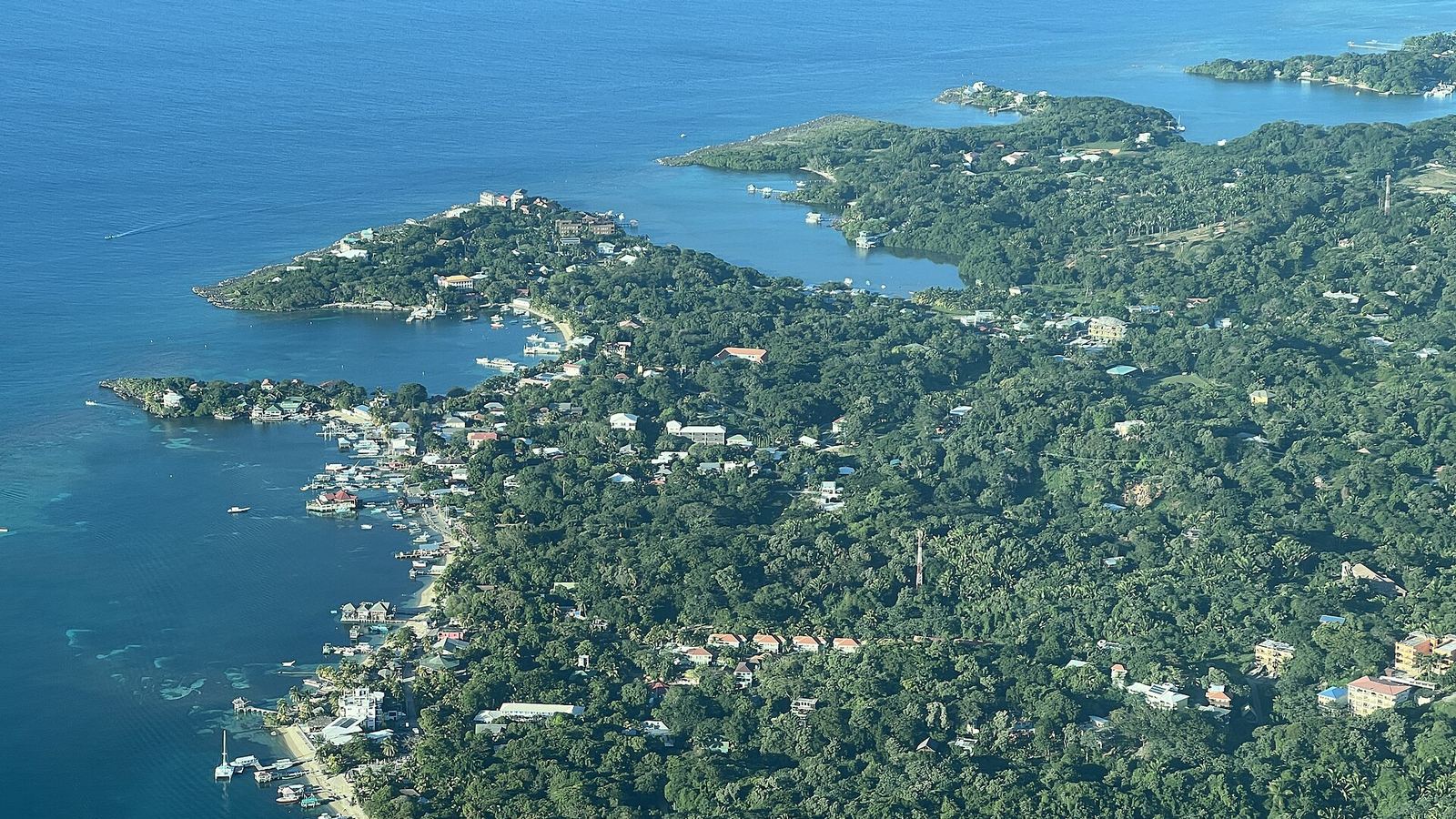
Roatan is not one coverage story, it is two, and the dividing line runs roughly through Coxen Hole. The island stretches around sixty kilometres from the western tip to Punta Gorda and is barely eight across at its widest, so everything strings out along a single spine of road. Tigo has the firmer grip on the western half, which is where West End, West Bay, Sandy Bay and nearly every dive shop on the island sit. Claro is the name residents give for the eastern half, out past French Harbour toward Oak Ridge. Both operators are perfectly usable in the middle, and both thin out badly at the far ends. That split matters because the travel eSIM brands have already picked sides on your behalf: Airalo and Holafly connect through Tigo, while Nomad's Honduras plan lands on Claro. Work out which end of the island your accommodation is on before you buy, and read our Honduras SIM card guide if you would rather sort it out at a counter in Coxen Hole.
What This Guide Covers
Jump to the section most relevant to you
How the Two Networks Divide Roatan
Ask anyone who has lived on Roatan for a few years which network to use and the answer arrives as a geography lesson rather than a brand recommendation. Tigo is described as the west end network, Claro as the east end network, and the honest version of that is a spectrum rather than a border: both operators have masts along the developed western third and their footprints overlap generously around Coxen Hole. The difference shows up as reliability under load and as how far you can drift from the road before the bars start disappearing.
In everyday practice, a working 4G connection on either network covers West End, West Bay, Sandy Bay, Coxen Hole and French Harbour without drama. Speeds are ordinary rather than impressive, which is the correct expectation for an island served by a submarine link and a modest number of towers. Video calls hold up in the evenings, maps and messaging never struggle, and an evening when half the island is streaming will feel slower than a morning when it is not. There is no 5G on Roatan, or anywhere else in Honduras, in 2026.
The mistake to avoid before you fly
Booking a dive week at West End and then buying a Honduras eSIM without checking which operator it uses is the one genuinely avoidable error here. It will not leave you offline, since Claro does reach West End, but it puts you on the weaker of the two networks in precisely the part of the island where you are spending every night. If your base is French Harbour, Oak Ridge or anywhere further east, the same logic inverts and Claro is the better bet.
Where both networks agree is at the edges. The road east beyond Oak Ridge toward Camp Bay and Port Royal gets thin quickly, and the mangrove channels and the small cays off the eastern shore are effectively unserved. If your plan involves a day out toward Punta Gorda or a boat trip to the eastern side, treat the phone as a camera rather than a connection for those hours.
West End and West Bay Against Coxen Hole and French Harbour
Roatan's settlements have different characters and different data behaviour, and the four that matter to most visitors sit within a twenty five minute drive of each other along the main road.
West End
The sandy strip along Half Moon Bay where the dive shops, the bars and most of the budget and mid range rooms are. This is the densest concentration of visitors on the island and the connection reflects it: reliable 4G, good enough for a video call from a balcony, and noticeably slower between roughly seven and ten in the evening when everyone is back from the water and online at once. Tigo is the one to be on here. Almost every dive operation and restaurant offers WiFi, and it ranges from genuinely fast to decorative.
West Bay
The postcard beach at the island's western tip, ten minutes by water taxi from West End for a few dollars, or a longer loop by road. Resort territory, more spread out, and coverage that is solid on the beach and along the front but weaker in the hillside developments behind it where the buildings sit between you and the nearest mast. Resort WiFi is generally the better connection here, and generally the one you have already paid for.
Coxen Hole
The administrative capital, the cruise ship stop and the place you go to deal with anything official. Not a place many visitors sleep, but the one with the banks, the pharmacies and the phone shops, and the overlap zone where both networks are comfortable. If you are buying a local SIM on Roatan, this is the closest option to the airport.
French Harbour
The working town, home of the fishing fleet, the Megaplaza mall and a growing number of longer stay rentals. Claro is at least as strong as Tigo here and often better, which makes it the sensible base for anyone who bought a Claro backed plan. It is also the practical shopping stop for anyone staying a while, since both operators have branches in the same building.
The pattern worth internalising is that Roatan's signal follows its road and its money. Anywhere with hotels, restaurants and a paved approach has 4G. The undeveloped stretches between the towns, the interior ridge and the far east are a different matter, and no eSIM you can buy changes that.
Signal on the Reef and on a Dive Boat
Here is the answer nobody advertises: your data drops on the water, and it drops sooner than you expect. The Mesoamerican Barrier Reef runs remarkably close to Roatan's north shore, which is the entire reason the diving here is what it is, and it means a mooring off Half Moon Bay or Sandy Bay is often still within reach of the masts behind the treeline. You will frequently see a bar or two on the surface interval at the closer sites. What you should not plan around is that continuing.
Once a boat runs any distance, and particularly once it crosses to the south side for the sites near Brick Bay and French Harbour, or heads east along the north shore, the connection becomes intermittent and then stops. The drop is not gradual in a useful way. You will have three bars, then one, then a message that fails to send and sits there for forty minutes. Roatan's dive boats mostly work within thirty minutes of their dock, so a two tank morning typically means one to three hours with no reliable data even on the shorter runs.
Practical habits for a dive week
Send it from the dock. Anything that has to leave, leave it before you board rather than on the surface interval. Download before you go. Music, podcasts and any dive site briefing you want to reread do not stream over open water. Do not rely on messaging for pickups. If a driver or a friend is meeting the boat, agree the time and place on land, because a text sent from the mooring may arrive an hour after you have already walked home. Tell people the shape of your day. Family at home who expect a reply within minutes will worry about a four hour silence that is completely normal here.
None of this is a reason to buy a different plan, because no consumer network reaches out over the wall. It is a reason to stop treating an unanswered message as a problem. The Sandy Bay and West End marine reserve that became the Roatan Marine Park in 1989 now protects something like seventeen miles of coastline, and almost all of the diving that reserve exists for happens in places where a phone is a paperweight in a dry bag.
Sandy Bay, the Road Spine and Getting Around
Roatan has one main paved road and it does most of the work. It runs from the western end through West End and Sandy Bay, past the airport into Coxen Hole, on through French Harbour and Oak Ridge, and eventually degrades toward Punta Gorda and the eastern communities. Coverage follows it faithfully. Drive the western two thirds and you will barely notice a gap; carry on east and the interruptions get longer.
Sandy Bay sits between Coxen Hole and West End and is the quieter alternative to both, with the botanical gardens, several long standing dive resorts and a stretch of the marine reserve that carries its name. Signal here is solid on the coastal side and gets flaky as soon as a road climbs the ridge inland, which is worth knowing if you have booked something up a hill for the view. The view is excellent. The bars are fewer.
| Journey | How | Roughly | Data en route |
|---|---|---|---|
| Coxen Hole to West End | Taxi, zone fare | 15 USD per person, two minimum | Continuous |
| Coxen Hole to Sandy Bay | Taxi, zone fare | 10 USD per person, two minimum | Continuous |
| Coxen Hole to French Harbour | Taxi, zone fare | 20 USD per cab, up to four | Continuous, Claro firmer |
| West End to West Bay | Water taxi | About 3 USD one way | Holds most of the way |
| Anywhere on the main road | Colectivo minibus | A dollar or two | Continuous, slow at peaks |
Two notes on the fares. Roatan's taxi association publishes zone prices and the airport runs are effectively fixed, but shared colectivos on the main road cost a fraction of a private cab and are how most islanders move around. And US dollars circulate freely in the Bay Islands alongside lempiras, so you do not need to hunt for local currency before you can pay for a ride, which is one fewer thing to do in your first hour.
The Ferry to La Ceiba and the Signal Mid Channel
Roatan sits about fifty kilometres off the Honduran north coast, and the Galaxy Wave catamaran is the alternative to flying. It runs from the Dixon Cove terminal, which is between Coxen Hole and French Harbour rather than anywhere near West End, across to La Ceiba in something close to an hour and a quarter. There are two sailings a day in each direction: departures from Roatan at seven in the morning and two in the afternoon, and from La Ceiba at half past nine and half past four.
| Ticket | Adult one way | Child 5 to 10 |
|---|---|---|
| Regular class | 31 USD | 13 USD |
| First class | 35 USD | 17 USD |
The connectivity story on the crossing is simple and slightly annoying. You keep a signal for the first few minutes out of Dixon Cove, lose it somewhere in the middle of the channel, and pick the mainland up again on the approach to La Ceiba. Expect roughly forty to fifty minutes of nothing in between, on either network, and plan accordingly: download the podcast, screenshot the address of wherever you are going, and warn anyone waiting for you that you will surface when the coast does.
The other thing worth saying about the ferry is that the crossing has a reputation. It is an open water run in a catamaran and the middle of the channel can be rough enough that the crew hand out bags without being asked. If that sounds like you, the afternoon sailing is not obviously calmer than the morning one, and the seasickness tablet taken forty minutes before boarding is more useful than anything on your phone. On a bad crossing, being offline is the least of it.
Utila and Guanaja by Comparison
Roatan is the largest and by a wide margin the best connected of the Bay Islands, and it is useful to know what you are giving up if you island hop. Both of its neighbours are served by the same two operators and neither behaves like Roatan.
Utila, the smaller and cheaper dive island to the southwest, has workable 4G in and around the town where nearly everyone stays. It slows conspicuously under load, which on an island whose economy is dive courses means the evenings when the open water students are all uploading their photos. Away from town, out along the road toward Pumpkin Hill or over on the cays, it thins fast. For a two week course this is fine. For remote work it is a gamble, and the dive schools' own WiFi is often the more reliable option.
Guanaja is the outlier. The main settlement is Bonacca, a dense cay just off the main island, and it holds a signal reasonably well. The rest of Guanaja, which has almost no roads and is reached by boat, is patchy to absent. It is the one Bay Island where you should genuinely plan to be out of contact for stretches and tell people so before you go.
If you are hopping islands
Buy your data before you leave Roatan, because it is the only one of the three with real phone shops and a reliable choice of both networks. A travel eSIM covers all three on the same profile, since coverage is national rather than per island, so the practical question is only whether the network you chose reaches where you are going. Tigo and Claro both serve Utila town and Bonacca. Neither serves the empty parts of Guanaja, and no plan you can buy will change that.
One last point for anyone weighing the islands against the mainland. If your Honduras is going to include Copan, the north coast or the capital as well as a dive week, our Honduras eSIM guide works through how the two networks behave inland, and the Roatan airport page covers what to expect at the terminal itself.
Frequently Asked Questions
Which network should I be on if I am staying at West End?
Tigo. Islanders have described the split the same way for years: Tigo covers the west end of Roatan more convincingly and Claro is the stronger name at the east end, with a comfortable overlap around Coxen Hole in the middle. West End, West Bay and Sandy Bay are all firmly in Tigo territory. That matters when you pick an eSIM, because Airalo and Holafly both connect through Tigo while Nomad's Honduras plan runs on Claro. Claro is not unusable at West End, it is simply the second choice in the part of the island where most visitors sleep.
Will I have any signal while I am out on a dive boat?
Near the shore, sometimes. Further out, no. The reef sits close enough to the north shore that a mooring off Half Moon Bay or Sandy Bay often still catches a bar or two from the towers behind the treeline, so quick messages on a surface interval do occasionally go through. The moment the boat runs any distance, or crosses to the southern sites near Brick Bay, it stops. Treat a dive morning as three offline hours and send anything important from the dock before you board. Nobody's plan performs better than anybody else's out there, because none of the towers reach.
How much data does a week on Roatan actually use?
Less than most people budget for. A dive week burns very little because the days themselves are spent on a boat or underwater with the phone stowed, and the evenings are usually spent on guesthouse or dive shop WiFi in West End. Three gigabytes covers a typical week comfortably if you are mostly messaging, navigating and posting photos. Five gigabytes gives you room to make video calls home most evenings without watching the counter. The people who run out are the ones streaming video on mobile data in the evenings rather than the ones diving all day.
Do I lose signal on the catamaran across to La Ceiba?
For most of the middle, yes. The Galaxy Wave takes about an hour and a quarter from Dixon Cove to La Ceiba, and you can expect roughly forty to fifty minutes of that with nothing usable on either network, holding a connection out of the terminal and picking the mainland up on the approach. Download whatever you want to read or listen to before you board, and take a screenshot of the address you are heading to on the other side. It is also worth knowing the terminal is between Coxen Hole and French Harbour, nowhere near West End, so allow for the drive.
Is the WiFi in West End good enough to work from?
For email, calls and ordinary browsing, usually. For anything that needs a stable upload, be careful. Restaurants, bars and dive shops along the Half Moon Bay strip almost all advertise WiFi and the quality ranges from genuinely quick to barely functional, often within the same block. Evenings are the worst window because the whole strip is online at once. If you have work that cannot slip, keep mobile data as the fallback rather than the other way around, and do the heavy uploads in the morning while everyone else is on a boat.