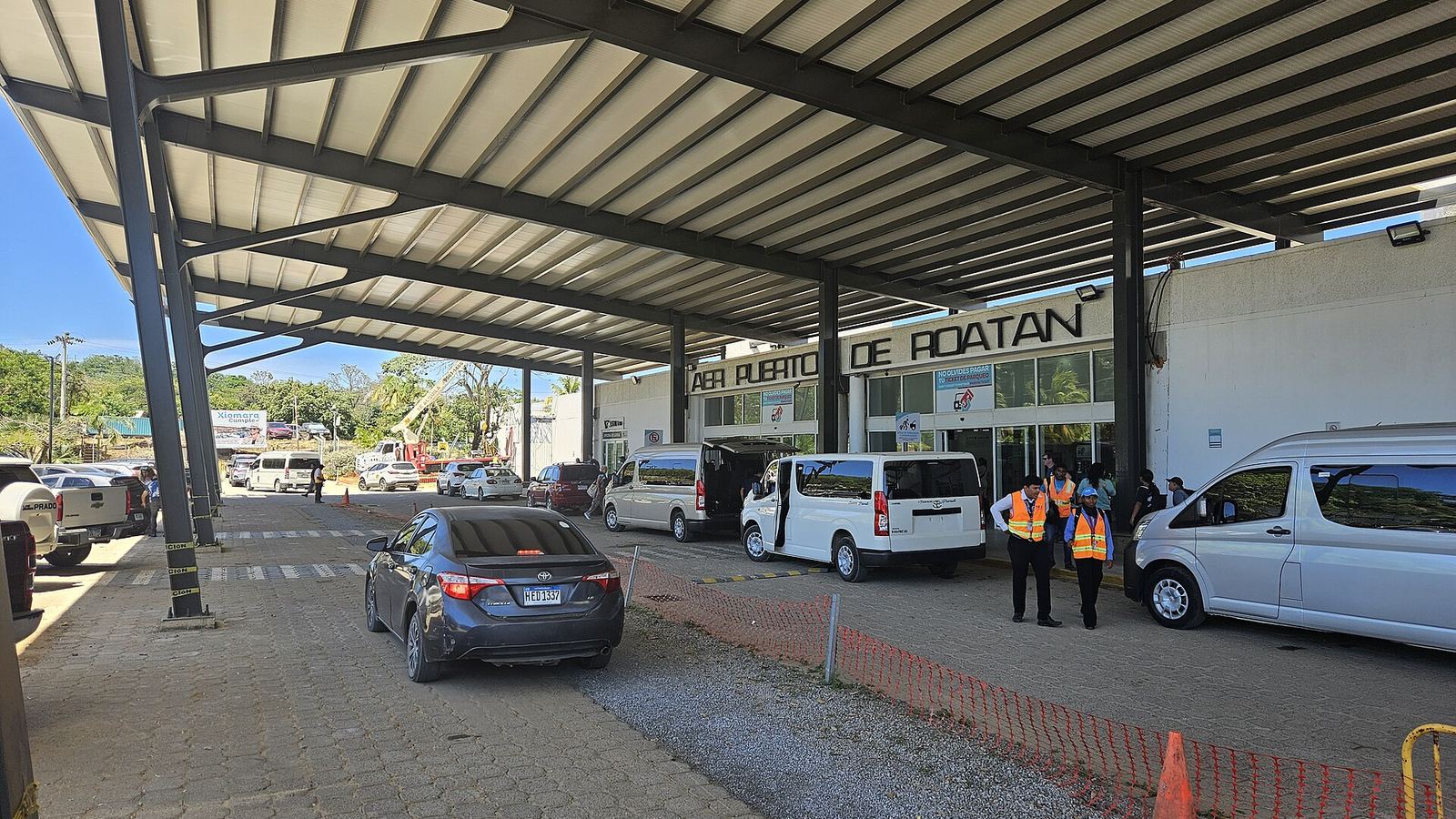
There is no phone counter at Juan Manuel Galvez International, and that single fact decides how you should handle data on arrival. RTB is a compact single terminal airport built for a runway of 2,090 metres, and it handled a little over 550,000 passengers in 2023, which is busy for the Bay Islands and small by the standards of anywhere with direct flights from Miami, Dallas, Atlanta and Houston. The concessionaire InterAirports lists ATMs, a bar, a gift shop, an information desk and car rental among the facilities. Mobile operators are not on that list. No Tigo desk, no Claro desk, no vending machine dispensing tourist SIMs, nothing airside and nothing in the arrivals hall. The nearest place to buy a local card is a Claro branch in Coxen Hole a few minutes down the road, or the Tigo and Claro stores at the Megaplaza mall in French Harbour, both of which are in the opposite direction from West End. That is why a profile bought at home is not just convenient here, it is the only way to walk out of this particular terminal already connected.
What This Guide Covers
Jump to the section most relevant to you
What Is Actually in the Terminal
RTB is one building. Departures and arrivals sit under the same roof with a single security channel, and the whole thing was last given a serious upgrade in 2013 when InterAirports expanded the check in area, enlarged the waiting hall and added a cafe and coffee shop. A runway extension programme has been discussed since 2022 with an eventual ambition of three million passengers a year and long haul aircraft, but what you will walk through in 2026 is the modest terminal, not the plan.
The facilities list, and the gap in it
What is here: ATMs, a bar, a gift shop, an information desk, car hire counters, parking and some food and drink. What is not here: any mobile operator presence whatsoever. Travellers arriving from Central American capitals often expect the Tigo or Claro booth they saw at San Pedro Sula or Toncontin and there simply is not one on Roatan. The gift shop does not carry SIM cards either, and neither do the car rental desks, which is the second thing people try.
The practical consequence is a decision you make at home rather than at the carousel. Either you arrive with an eSIM already installed and switch it on, or you accept being offline until you have reached your accommodation and can get on its WiFi, or you build a detour into Coxen Hole into your first hour. The third option is a genuine choice if you are staying a fortnight and want a Honduran number, and our Honduras SIM card guide covers what the counter charges. For a week of diving it is an hour you will not get back.
One more terminal detail worth planning around. InterAirports advises being here ninety minutes to two hours ahead for a domestic departure and three hours for an international one. On a busy cruise or high season morning, the departures hall is small enough that those numbers are not padding, and the queue for security can run out of the door.
Clearing Arrivals and Walking Out
Arrivals at RTB is short by design. Aircraft park on the apron, you walk down steps and across the tarmac in whatever the Caribbean weather is doing, and you are inside the hall within a couple of minutes of the door opening. From there it is immigration, baggage, customs and out, and on a quiet afternoon the whole sequence takes twenty minutes.
Immigration
Straightforward for most nationalities, with Honduras part of the CA-4 arrangement alongside Guatemala, El Salvador and Nicaragua. Have your onward or return details reachable, which is easier if your data is already working, and be ready to name where you are staying.
Baggage
A single belt. Divers travelling with kit should expect their bags among the last off, since the heavy gear tends to be loaded deep. This is usually the longest wait in the building.
Customs and the exit
Bags may be scanned on the way out. Beyond that door is a compact meeting area and then the taxi rank, and it is busy when two international flights land close together, which is common in the middle of the day.
The taxi rank
Airport fares are set by zone rather than negotiated, which removes the usual haggling. Say your destination clearly, confirm the price before the bags go in, and note that US dollars are accepted everywhere in the Bay Islands.
If you have arranged a transfer with a dive shop or hotel, this is where having a working line pays for itself, because the meeting area is small and the driver holding your name may already have gone to park. A message saying you are through customs solves that in ten seconds and is impossible without data.
The Airport WiFi and What It Really Covers
RTB advertises wireless internet and there is generally something to connect to in the terminal, though it is not a marketed, branded service with a memorable network name and a splash page the way larger Central American airports run. Treat it as a convenience that may or may not be behaving on the day rather than as part of your plan.
What it will comfortably do is let you tell someone you have landed and check a booking confirmation. What it will not do is hold up while you download a map of the island, load a rideshare app or make a video call, and it has no bearing at all on the thirty minutes you spend in a taxi afterwards. The gap between the terminal and your accommodation is exactly where visitors to Roatan tend to feel the absence of data, because that is when they want to confirm a pickup, find the entrance to a resort down an unmarked track, or check what they agreed to pay.
Getting the most from the terminal connection
Do the essentials first. Confirm your transfer and send the arrival message before you try anything heavier. Screenshot everything. Your accommodation's address, the map of the last kilometre, the confirmation number and the dive shop's phone number all survive a dead connection as images and none of them survive as open browser tabs. Do not queue for it. If the terminal WiFi is not connecting within a minute, it is not going to, and standing in the hall waiting is time better spent in the taxi. Check your eSIM has attached. If you installed one before travelling, look for the operator name in your status bar rather than assuming, and toggle airplane mode once if it has not caught.
Departures is the friendlier half of the building for connectivity, since the seating is near the cafe and people linger there for an hour or two. If you have a long wait for an afternoon flight to San Pedro Sula, that is a reasonable place to do the uploads you have been putting off all week.
The Short Run to West End and West Bay
The airport sits just outside Coxen Hole on the western third of the island, which means the places most visitors are heading are genuinely close. West End is a fifteen minute drive on the main road. West Bay, at the island's western tip, is under eight miles by road although the last stretch is slower than the distance suggests. Nothing about this transfer is arduous, which is exactly why people underestimate how much they want data during it.
| Destination | Zone | Typical fare | Time |
|---|---|---|---|
| Coxen Hole | A | About 20 USD per cab, up to four | 5 minutes |
| Sandy Bay | B | About 10 USD per person, two minimum | 10 minutes |
| West End | C | About 15 USD per person, two minimum | 15 minutes |
| West Bay | C | About 15 USD per person, two minimum | 25 minutes |
| French Harbour | A | About 20 USD per cab, up to four | 20 minutes |
Two things to know about those numbers. Airport departures use the association's fixed rates rather than a negotiation, so the price you are quoted at the rank is the price, and it is per person on the western zones rather than per vehicle. Shared colectivo minibuses run the main road for a fraction of that, but they are not really an airport service and are awkward with dive luggage. Coverage along the whole route is continuous on both networks, so once you are online you stay online for the entire transfer.
If your accommodation is on the eastern half of the island, past French Harbour toward Oak Ridge, the drive is longer and the network question changes. That is Claro's stronger territory, and our Roatan coverage guide goes through how the island splits between the two operators.
Arriving on the Hop from San Pedro Sula
A large share of arrivals at RTB come from the mainland rather than from North America. Aerolineas Sosa and CM Airlines both run the short leg from San Pedro Sula, a flight of around forty five minutes, with something like twenty one weekly departures from CM Airlines and fourteen from Sosa in a normal season. Fares start somewhere near eighty dollars one way and climb from there. There are also links to Tegucigalpa and to La Ceiba, the latter being the shortest hop of the lot.
This routing has a connectivity advantage worth using. If you are flying in via San Pedro Sula or Tegucigalpa, you are passing through airports that do have mobile operator counters, which the island does not. Anyone determined to have a local Tigo or Claro card can buy and register one on the mainland during a connection rather than making a separate trip once they land on Roatan. Whether a layover leaves you time for that depends on the schedule, but it is the only leg of a Roatan trip where the option exists inside an airport.
Ferry as the alternative
The other way onto Roatan is the Galaxy Wave catamaran from La Ceiba, about an hour and a quarter across to the Dixon Cove terminal between Coxen Hole and French Harbour, at 31 dollars one way in regular class or 35 in first. It is a real alternative to the domestic flight and often cheaper, but note that the crossing itself has a long dead zone mid channel and the terminal is nowhere near West End. If you arrive that way, you are looking at a taxi from Dixon Cove rather than from the airport.
One planning note for connections. Domestic departures from RTB want you at the terminal ninety minutes to two hours ahead, and the building is small enough that a bunched schedule genuinely queues. If you are flying out to San Pedro Sula to connect onward internationally, do not build the tight version of that itinerary.
Why Landing Already Connected Matters More Here
At most airports the argument for sorting data in advance is about saving money and skipping a queue. At RTB the queue does not exist, because the counter does not exist, so the argument is simply about whether you want a working phone on your first afternoon or not. Here is the comparison laid out honestly, including the option of not bothering.
| Approach | What it costs | Online when | Worth it if |
|---|---|---|---|
| eSIM bought before flying | 9.50 to 13 USD for 3 to 5 GB | The moment you land | Almost any trip of two weeks or less |
| Local card in Coxen Hole | About 9.25 USD plus a detour | After a shop visit and a passport scan | Long stays, or you want a Honduran number |
| Local card at Megaplaza | Same, plus a longer drive east | Later still | You are staying near French Harbour anyway |
| Nothing, live on WiFi | Free | Once you reach your room | Resort stay with a transfer already booked |
| Home carrier roaming | Often 10 to 15 USD a day | Immediately | Almost nobody, at those rates |
What arriving online actually buys you
Where the case is weaker
If you do buy ahead, buy the right network. Airalo and Holafly connect through Tigo, which is the stronger operator on the western end of the island where the airport, Coxen Hole, Sandy Bay, West End and West Bay all sit. Nomad's Honduras plan runs on Claro and is better value in bulk but is the second choice for this side. Full prices for all three are on our Honduras eSIM guide.
Frequently Asked Questions
Is there anywhere at Roatan Airport to pick up a local SIM?
No. Juan Manuel Galvez International has no mobile operator presence at all, in arrivals or airside. The facilities the airport lists are ATMs, a bar, a gift shop, an information desk, car rental and parking, and neither the gift shop nor the rental desks sell SIM cards. The closest place to buy one is the Claro store in Coxen Hole, a few minutes from the terminal near the municipal building, and the fuller option is the Megaplaza mall at French Harbour where both Tigo and Claro have branches. Both are in the opposite direction from West End.
Can I get online in the terminal itself while I sort something out?
Usually, though not dependably. The airport does offer wireless internet and there is generally a network to join, but it is not a branded, heavily promoted service and its behaviour varies with the day and the crowd. It is fine for sending a message that you have landed or reopening a booking confirmation. It is not something to rely on for downloading maps, loading a transfer app or making a call, and it obviously ends at the terminal. If it does not connect within a minute, move on rather than standing in the hall trying.
How much should the taxi from RTB to West End cost?
Around fifteen US dollars per person with a two person minimum, under the island taxi association's zone system, which puts West End and West Bay in the same band. Coxen Hole and French Harbour are charged per cab instead, at roughly twenty dollars for up to four passengers, and Sandy Bay sits between at about ten dollars a head. Airport fares are set rather than negotiated, which makes this one of the easier transfers anywhere in Central America. Dollars are accepted throughout the Bay Islands, so you do not need lempiras before you can pay.
If I connect through San Pedro Sula, should I buy a SIM there instead?
It is the one sensible opportunity if you want a local card. The mainland airports do have operator counters and Roatan's does not, so a connection at San Pedro Sula or Tegucigalpa is the only point in a typical itinerary where buying a Honduran SIM happens inside an airport rather than as an errand. Bring your passport, since prepaid lines are registered against identity documents. Whether it fits depends on your layover, and the flight from San Pedro Sula to Roatan is only about forty five minutes, so a tight connection leaves no room for it.
Which eSIM should I have switched on when I land at RTB?
One that runs on Tigo, because the airport and everywhere most visitors go from it sit on the western half of the island where Tigo is the firmer network. Airalo's Honduras plans and Holafly's unlimited product both connect through Tigo. Nomad's Honduras plan runs on Claro, which is a good network nationally and the better one east of Coxen Hole, but it is not the one to pick for a West End dive week. Three gigabytes over a week at 9.50 dollars or five over a month at 13 covers a normal island trip comfortably.