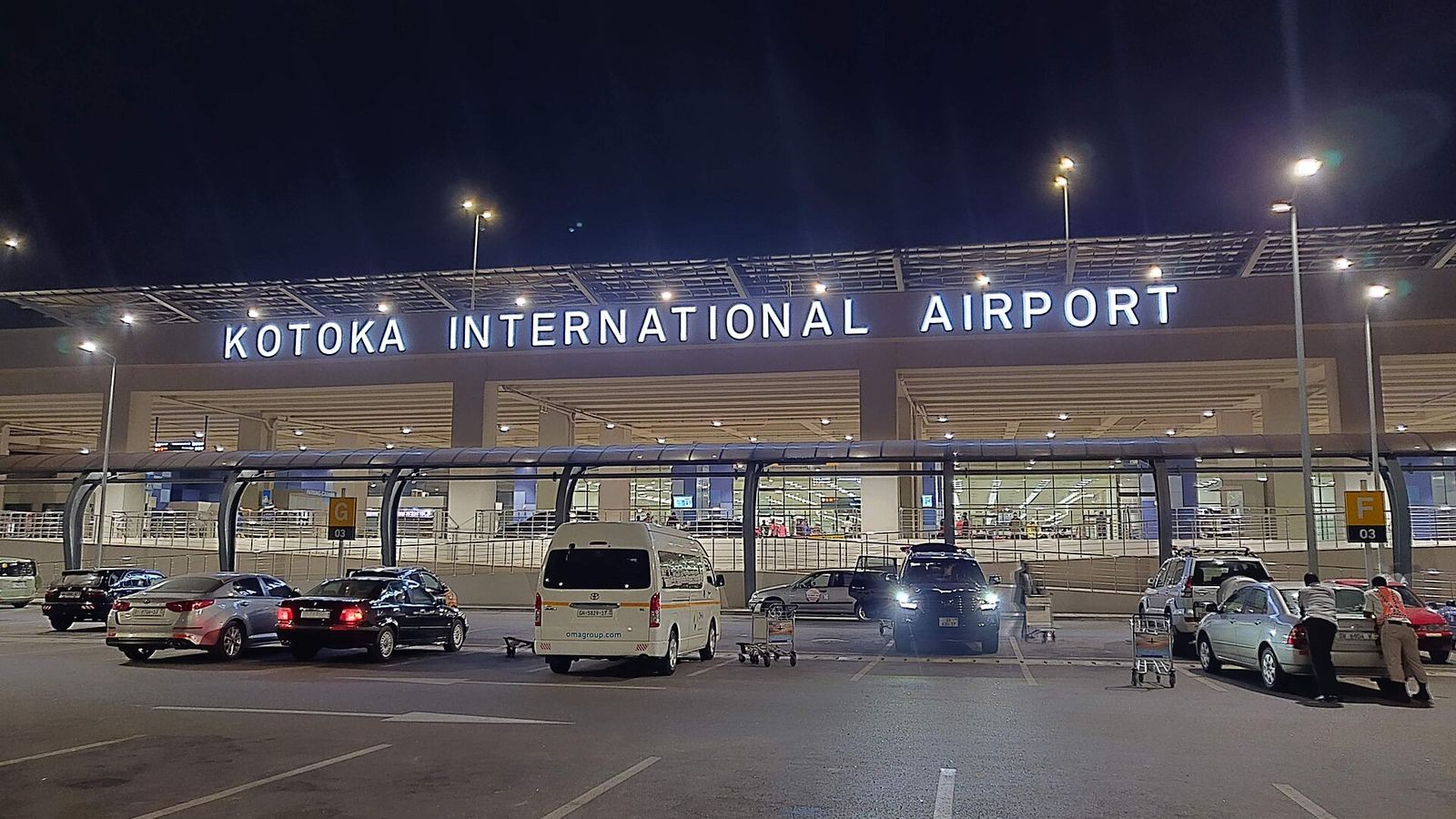
Accra's airport changed its name on 23 February 2026, reverting from Kotoka International to Accra International and undoing a 1969 decision that had honoured the general whose coup deposed Kwame Nkrumah. Nothing else moved. It is still ACC, still a single international terminal, and still an airport where a large share of the long-haul traffic lands well after most of the retail has shut. That is the whole connectivity story here in one sentence. If you arrive on an afternoon flight from Lagos or Abidjan, walking to a carrier booth in the arrivals hall and buying a local SIM is easy and cheap. If you arrive at half past midnight from London, Dubai or New York, which an enormous number of visitors to Ghana do, you may find the counters dark, a WiFi network that works when it feels like it, and a decision to make about a ride at the kerb with no way to check what it should cost.
What This Guide Covers
Jump to the section most relevant to you
The Carrier Booths in Terminal 3, and When They Close
All international flights use Terminal 3, opened in 2018 with six air bridges, room for aircraft up to an A380 and a nominal capacity of five million passengers a year, expandable to around six and a half. It handled a record 3.62 million passengers in 2025. Terminal 2 handles domestic flights to Kumasi, Tamale and Takoradi, and Terminal 1 is out of service pending redevelopment. So arrivals logistics are simple: everyone comes through the same hall.
Past immigration and customs you will find booths for MTN, Telecel and AT, along with currency exchange, bank ATMs and car hire desks. The MTN position is the most consistently staffed of the three, which matters because MTN is the network no international eSIM brand can sell you. Setup takes five to ten minutes and the price premium over a city shop is small.
Bring the actual passport, and expect fingerprints
Ghana ties every mobile line to the national biometric identity system, so the purchase is not a cash-over-the-counter transaction. The agent needs your physical passport, not a photo of it, and will take your photograph and scan your fingerprints on the spot before the line activates. Registered on a passport rather than a Ghana Card, a visitor's line runs for about thirty days and is then switched off. Anyone wanting to keep a Ghanaian number longer, which describes a lot of diaspora travellers who return each year, needs a Non-Citizen Ghana Card from the National Identification Authority.
The scheduling problem is real and worth planning around. These are retail counters keeping retail hours, commonly shut by around 11pm and in some reports earlier, while Accra's intercontinental arrivals cluster in the small hours. A traveller landing at 1am has no counter to visit and will be buying a SIM the following day in town, which is fine if the ride into the city is already sorted and awkward if it is not.
KIA Free WiFi: What It Is Called and What It Delivers
The network to look for is KIA FREE WIFI, a name that outlived the rebrand by some margin. Ghana Airports Company provides it at no charge across the terminals and there is no purchase requirement or paid tier to negotiate. Join it, follow whatever the splash screen asks, and you are online.
The honest assessment is that it is inconsistent. It is reliably good enough to send a message saying you have landed, look up a hotel address or start a WhatsApp call, and it is not something to plan a working session or a large download around. Reception across the arrivals hall varies noticeably depending on where you stand and how many aircraft have disgorged at once. Treat it as a safety net rather than a service.
Using it as an escape hatch
If you have arrived without a plan, the terminal WiFi is enough to buy and activate a travel eSIM from the arrivals hall, which takes a few minutes and gets you out of the building with a working line. That is a genuinely useful fallback at an airport where the SIM booths keep evening hours and a good share of the flights do not. It is also worth doing before you walk out rather than after, because the connection ends at the terminal and the kerb is where you need to be checking a fare.
One other arrivals detail: yellow fever vaccination certificates are checked on entry to Ghana, and the health desk sits before immigration. Have the certificate accessible in paper form rather than buried in a phone that is currently hunting for a network, because that queue is not the moment to be troubleshooting a WiFi login.
Into the City, and What It Costs at Different Hours
The terminal sits about nine to ten kilometres north of central Accra, which sounds like nothing and behaves like anything between fifteen minutes and an hour depending entirely on when you land. There is no rail link, no airport bus worth recommending to a first-time visitor and no metro, so every option is a road option.
| Route | Cost | Time | Notes |
|---|---|---|---|
| Uber, Bolt or Yango | GH¢30 to GH¢90 typical, more to outer suburbs or in surge | 20 to 30 min off-peak | Fixed in-app price. Drivers cannot pull up to the arrivals door, so the app sends you to a designated pickup point in the car park. |
| Airport taxi | Negotiated, materially higher than the app price | 20 to 30 min | No meters. Agree the fare before loading bags. This is the option you fall back on when you have no data. |
| Pre-booked transfer | Fixed, quoted in advance | 20 to 30 min | The most reliable choice for a late landing, since the driver waits regardless of how delayed the flight is. |
| Hotel shuttle | Often included at the larger hotels | Varies | Worth asking about when booking, particularly for a first night in the city. |
Traffic is the variable that dominates everything. The same nine kilometres takes 45 to 60 minutes in the evening rush, when the Ring Road and the Spintex approaches seize up, and 15 to 20 minutes at midnight when the city is quiet. If you have a choice of arrival slot, a late one is genuinely faster into town.
The late-night trap, and how to get around it
After about 11pm the ride-hailing apps get thin. Waits of 15 to 25 minutes are common, cancellations happen, and surge pricing can push an app fare up to what a taxi driver was asking anyway. Meanwhile the SIM booths have closed. The combination is why so many first-time visitors end up paying two or three times the going rate for a lift into Osu on their first night. Two things fix it: an eSIM already active on the handset so you can at least see the app price and negotiate from a position of knowledge, or a transfer booked in advance so the decision is already made before you land.
Walking Out of Terminal 3 With a Line That Works
An international eSIM is not the cheap way to get data in Ghana and there is no point pretending otherwise. MTN will sell a resident 10 GB for about 50 cedi, somewhere near four dollars. What the eSIM buys is the first ninety minutes of the trip, which at this particular airport is worth more than it is at most.
Arguments for sorting it out beforehand
Arguments against
The pattern most repeat visitors settle into is to fly in with an eSIM handling the arrival and the ride, then walk into an MTN service centre on day two if the trip warrants a local line, which it usually does for anyone staying more than a fortnight or heading upcountry. The Ghana eSIM guide covers which provider connects to which operator, which is the part that decides how far your plan will actually get you.
Airport Counter Versus a Travel eSIM
Laid side by side, the local SIM wins comprehensively on money and the eSIM wins on everything to do with time and hassle. Which of those you should care about depends mostly on how long you are staying and what time your aircraft touches down.
| Local SIM at Terminal 3 | Travel eSIM | |
|---|---|---|
| Typical cost | A few cedi for the SIM plus roughly GH¢50 for 10 GB over 30 days, near 4.26 USD | Roughly 14 to 16.50 USD for 5 GB over 30 days, more for unlimited |
| Working when | After immigration, the queue and the biometric capture | As soon as you switch the handset out of flight mode |
| Available at 1am | Usually not, counters commonly close by around 11pm | Yes, hours are irrelevant |
| Paperwork | Physical passport, photograph and fingerprints | None |
| Networks you can reach | All three, MTN included | AT on Airalo and Nomad, Telecel and AT on Holafly |
| Ghanaian number and MoMo | Yes, and the wallet that goes with it | No, data only |
| How long it lasts | About 30 days on a passport registration, longer with a Non-Citizen Ghana Card | As long as the plan you bought |
| Suits | Long stays, upcountry travel, anyone who wants to pay by mobile money | Short trips, night arrivals, group travel, onward regional flights |
Put a number on it and the choice gets easier. The saving from queueing for a local SIM instead of landing connected is roughly ten to twelve dollars. Being talked into an airport taxi at 1am because you could not open an app costs about the same or more, on the first ride alone. Get both calls right and Accra is an inexpensive city to arrive in; get both wrong and you have spent your data budget before leaving the car park. If you want to see how the capital behaves once you are actually in it, the Accra city guide covers coverage by neighbourhood, tro-tros and the mobile money problem in detail.
Frequently Asked Questions
Has Kotoka International Airport really been renamed?
Yes. On 23 February 2026 it reverted to Accra International Airport, reversing the 1969 decision that named it after Lieutenant General Emmanuel Kwasi Kotoka, whose coup had removed Kwame Nkrumah's government. The IATA code is unchanged at ACC and the ICAO code remains DGAA, so bookings, luggage tags and maps are unaffected. Locals, taxi drivers and a great many signs will keep saying Kotoka for years, and the free WiFi network is still broadcasting under the old initials.
Can I still buy a SIM if I land in the middle of the night?
Probably not at the airport. The MTN, Telecel and AT booths in the Terminal 3 arrivals hall keep normal retail hours and are typically closed by around 11pm, which sits badly with the number of intercontinental flights arriving into Accra after midnight. Your options at that hour are the free terminal WiFi, an eSIM you activate on the spot, or waiting until morning and visiting a service centre in the city. The first ride into town is the part that suffers if you do nothing.
What is the airport WiFi called and is it any good?
It broadcasts as KIA FREE WIFI, provided at no charge by Ghana Airports Company across the terminals with no purchase or paid tier involved. Quality is variable rather than bad: fine for messaging, a hotel lookup or activating an eSIM, unreliable for anything heavier, and noticeably weaker when several widebodies have landed together. It reaches the arrivals hall well enough to be useful while you sort yourself out, and that is the extent of what you should expect from it.
How much should a ride from the airport into Osu cost?
Book it through Uber, Bolt or Yango and a typical run into the central districts sits in the GH¢30 to GH¢90 band, with the price fixed in the app before you accept and Yango often coming in slightly cheaper. Airport taxis have no meters and quote considerably higher, particularly late at night when the apps get scarce and surge pricing kicks in. Drivers cannot collect from the arrivals door, so the app will direct you to a designated pickup point in the car park.
Will an eSIM bought for Ghana keep working if I fly on to Lagos or Lomé?
Not unless the plan explicitly says so. West Africa has no shared roaming arrangement equivalent to the European one, so a Ghana-only eSIM stops at the border and a Ghanaian prepaid card does the same. If your itinerary continues to Nigeria, Togo or Ivory Coast, buy a regional Africa plan that lists each country by name rather than hoping a neighbouring network picks you up. Expect a gap at the land crossings themselves while the handset searches for a network it is permitted to use.