Ghana is the country where the usual eSIM shopping logic breaks, because the network that genuinely covers Ghana is the one you cannot buy from a travel brand. MTN carries roughly four fifths of the country's mobile data subscriptions and reports 99.2 percent 4G population coverage, and none of the three big international eSIM names sells a plan that rides it. Airalo and Nomad both connect through AT, the smallest of the three operators, while Holafly lists Telecel alongside AT. That reframes the whole decision: the question is not which brand wins a feature comparison, it is how much of your itinerary sits in places where only MTN has built. For a trip shaped around Accra, Kumasi, Cape Coast and Elmina, the honest answer is almost none of it, and Nomad is the cheapest sensible way to land connected. Push north toward Mole or deep into the Volta hills and you should be carrying an MTN card as well. The second trap catches nearly every first-time visitor: a data-only eSIM gives you no Ghanaian number, no Ghanaian number means no mobile money wallet, and MoMo is how an enormous share of Ghanaian commerce settles. Size the plan against your actual route with the eSIM Finder.
Quick Pick: the Best eSIM for Ghana
Nomad (Ghana 10 GB / 30 days): The lowest cost per gigabyte on the same AT footprint Airalo uses, thirty-day validity even on the small tiers, and cheap enough that you can still buy a local MTN card for MoMo and upcountry days without the trip budget noticing.
Our picks
Best overall: Nomad. Lowest per GB: Nomad. Unlimited: Holafly. Or use the eSIM Finder.
Ghana eSIM Plans Compared
Indicative pricing. Tap through for live rates.
| Provider | Plan | Data | Duration | Price | Network |
|---|---|---|---|---|---|
| Airalo | Ghana 1GB | 1 GB | 7 days | $5 | AT (AirtelTigo) |
| Airalo | Ghana 3GB | 3 GB | 30 days | $11 | AT (AirtelTigo) |
| Airalo | Ghana 5GB | 5 GB | 30 days | $16 | AT (AirtelTigo) |
| Airalo | Ghana 10GB | 10 GB | 30 days | $26 | AT (AirtelTigo) |
| Airalo | Ghana 20GB | 20 GB | 30 days | $37 | AT (AirtelTigo) |
| Nomad | Ghana 1GB | 1 GB | 7 days | $4 | AT (AirtelTigo) |
| Nomad | Ghana 5GB | 5 GB | 30 days | $14 | AT (AirtelTigo) |
| Nomad | Ghana 10GB | 10 GB | 30 days | $22 | AT (AirtelTigo) |
| Nomad | Ghana 20GB | 20 GB | 30 days | $32 | AT (AirtelTigo) |
| Holafly | Unlimited 5-day | Unlimited | 5 days | $19 | Telecel / AT |
| Holafly | Unlimited 7-day | Unlimited | 7 days | $27 | Telecel / AT |
| Holafly | Unlimited 10-day | Unlimited | 10 days | $34 | Telecel / AT |
| Holafly | Unlimited 15-day | Unlimited | 15 days | $47 | Telecel / AT |
| Holafly | Unlimited 30-day | Unlimited | 30 days | $69 | Telecel / AT |
Airalo Ghana Plans
Airalo: The Widest Plan Ladder, on the Smallest Network
Ghana packages riding AT, with three-day options that suit a short West Africa stopover
Airalo's advantage in Ghana is granularity rather than network. Its ladder runs from 1 GB over three days at around 4.50 dollars up to 20 GB over a month near 49 dollars, with 5 GB for a week near 15.50 and 10 GB for thirty days near 29. That three-day tier is genuinely useful here, because Accra has become a common stopover on West African routings and a two-night layover does not justify a month of data.
What you are buying, though, is a line on AT, the operator that ran up more than 150 million dollars of tower debt and had its subscriber base moved onto Telecel infrastructure under regulatory direction. In Accra, Tema, Kumasi and along the castle coast that causes no practical problem. It becomes a live concern if your plans involve Mole, the upper Volta valleys or the roads off the northern highways, where MTN is often the only mast in range and Airalo cannot reach it.
Strengths
Weaknesses
Holafly Ghana Plans
Holafly: The Only One That Names Telecel
Unlimited data across Ghana's second network, priced for people who will not count gigabytes
Holafly is the only one of the three that puts Telecel on its Ghana product page, and given AT's condition that is not a trivial distinction. Telecel is the network absorbing AT's subscribers, spending on upgrades to carry them, and holding real depth through Accra, Tema, Kumasi and Takoradi. If you want the strongest network a travel eSIM can actually reach in Ghana, this is it.
The price is the argument against. Ghana is a country where MTN sells 10 GB over thirty days for about 50 cedi, close to four dollars, so paying triple digits for a month of unlimited roaming data takes some justifying. It justifies itself for a specific traveller: someone filming a heritage trip, uploading to a following every evening, running hotspot for a family group, or working from Accra for a fortnight and unwilling to think about allowances. For a sightseeing week it is comfortably more than you need.
Strengths
Weaknesses
Nomad Ghana Plans
Nomad eSIM: The Value Pick, and the One Most Ghana Trips Want
Thirty-day validity on every tier at the lowest cost per gigabyte in the Ghana market
Nomad and Airalo sell access to the same Ghanaian network, so the comparison collapses to price, and Nomad wins it clearly. Its 5 GB month runs near 14 dollars against roughly 16.50, its 10 GB month near 24 against 29, and its 20 GB month near 34 against 49. On the largest tier that is a gap of fifteen dollars for identical coverage, which is more than a Bolt from the airport into Osu and back.
The other quiet advantage is validity. Nomad puts thirty days on its 3 GB tier at around nine dollars, so a light user on a two-week trip who leans on hotel and cafe WiFi is not forced up a tier just to get the days. That fits how a lot of Ghana travel actually works, with long WiFi-covered evenings in Osu or East Legon and short bursts of navigation and ride-hailing in between. Where Nomad does not help is the same place none of these do: it rides AT, so the far north still wants an MTN card in the second SIM slot.
Strengths
Weaknesses
Mobile Networks in Ghana
Ghana runs three mobile operators and the gap between first and third place is one of the widest in the region. At the close of the fourth quarter of 2025 the country held 42.87 million mobile voice subscriptions and 28.70 million mobile data subscriptions, spread across a population of roughly 34 million, so most Ghanaians who use data carry more than one line. Which operator holds those lines is where it gets lopsided.
MTN Ghana held 72.92 percent of voice subscriptions and 79.68 percent of data subscriptions at the end of 2025, and its data share had climbed past 81 percent by February 2026. It reports 4G population coverage of 99.2 percent, which is not marketing gloss so much as the reason MTN is the only network many Ghanaians outside the southern cities have ever bothered with. It is also the payments rail: MTN MoMo is the wallet that shopkeepers, tro-tro mates in some corridors, tour operators and market traders quote first. No mainstream travel eSIM connects to it, and that single fact drives most of the advice on this page.
Telecel Ghana is the network many older guides still call Vodafone. Telecel Group completed its purchase of a 70 percent stake in February 2023, the Ghanaian state kept 30 percent through the local holding company, and the rebrand finished on 12 March 2024. It sits around 20 percent of voice lines and 15 to 16 percent of data, and it is a genuinely capable network across Accra, Tema, Kumasi, Takoradi and the coastal belt. Outside that band it thins faster than MTN does, but for a visitor whose Ghana is cities and the castle coast, Telecel is not a compromise.
AT, the operator formed when Airtel and Tigo merged and taken into state ownership in 2021, is the one to understand before you buy anything. It holds under 7 percent of voice lines and roughly 4 percent of data, and by September 2025 its debt to tower operator ATC Ghana had passed 150 million dollars, threatening a shutdown for more than three million subscribers. The regulator's answer was to order a national roaming arrangement putting AT customers onto Telecel's radio network. That migration was described as 98 percent complete within weeks, Telecel's chief executive said the remaining AT subscribers would be on its network by the first quarter of 2026, and Telecel earmarked 50 million dollars for upgrades to carry them. Government ministers insist this is a restructuring rather than a merger and that regulatory approvals are still outstanding. Travellers should care for one reason: both Airalo and Nomad sell their Ghana plans on AT.
Ghana's shared 5G experiment, and why it stalled
Ghana tried something almost nobody else has attempted at national scale. Rather than licensing 5G spectrum to each operator, it handed exclusive wholesale rights to Next-Gen InfraCo, a joint venture backed by Nokia, Radisys and Tech Mahindra, which was to build one shared 4G and 5G network that every carrier would then resell. The theory was elegant and the execution was not. NGIC switched on in late 2024, no operator had leased capacity from it by January 2025, and when the regulator finally cleared it for full commercial service on 3 March 2026 it had just 49 live 5G sites across Accra, Kumasi and Tamale. Its own target had already been cut from nationwide coverage to 1,200 sites by 2027. In July 2026 the authority stripped out the exclusivity clause, and MTN and Telecel confirmed they will bid for 3.5 GHz and 26 GHz spectrum in an auction due before the end of the year. Ghana still talks about 70 percent 5G population coverage by 2027. For a 2026 trip, plan on 4G and treat any 5G bar as a novelty.
Coverage Across Ghana
Coverage where travelers actually go:
| Area | Coverage | Notes |
|---|---|---|
| Accra, Tema & Kotoka arrivals | Excellent | All three networks are dense across the capital. Speeds sag in the late-afternoon crush when everyone is stuck on the Spintex Road at once. |
| Kumasi & the Ashanti corridor | Excellent | The N6 between Accra and Kumasi is well built out on MTN and Telecel, including through Nkawkaw and the Kwahu escarpment towns. |
| Cape Coast, Elmina & the N1 coast | Very Good | The castles, the seafront and the road through Winneba and Mankessim are solid on every operator. This is the reassuring part of a heritage itinerary. |
| Kakum, Aburi & the forest edges | Good | Signal holds at the Kakum visitor centre and along the Aburi ridge, then drops out under canopy on the walkway itself and on the forest trails. |
| Volta Region & Lake Volta | Mixed | Ho, Akosombo and the lakeside towns are fine. Wli Falls, the Afadja approach and the ferry crossings go quiet on anything but MTN. |
| Mole, Larabanga & the far north | Patchy | Realistically an MTN-only zone. Tamale is covered properly, but the last stretch to Mole and the villages off the Wa road are not a place to be on an AT-based plan. |
How to Choose the Right Plan
Start by drawing the northern edge of your trip. If Ghana means Accra, the Cape Coast and Elmina castles, Kakum, Aburi and perhaps Kumasi, then every option on this page covers you and the decision is purely financial: take Nomad and pocket the difference, or take Airalo if you want a three-day tier for a stopover. If your route reaches Mole National Park, Bolgatanga, the Wa road or the far side of Lake Volta, no travel eSIM is sufficient on its own and you should plan on an MTN card bought in Accra or Tamale. Holafly is the pick for people who will not ration data and want Telecel named rather than AT, accepting that it costs several times what any Ghanaian pays. Then settle the payment question separately from the data question, because they are not the same question here: if you expect to be buying from market traders, tipping drivers or splitting costs with Ghanaian friends, a MoMo wallet needs a registered local number, and the eSIM in your phone will not provide one no matter how much you spent on it.
Frequently Asked Questions
Can I buy a travel eSIM that runs on MTN in Ghana?
Not from the three brands most travellers reach for. Airalo names AT as the operator behind its Ghana packages, Nomad does the same, and Holafly lists Telecel with AT alongside it. MTN sells its own eSIM profiles domestically, but activating one usually means presenting yourself at an MTN service centre with a passport rather than scanning a code from home. So if you specifically need MTN, plan on a physical card bought after you land. For most visitors staying in the southern half of the country that is an optional extra rather than a necessity.
Will a travel eSIM let me pay for things with MoMo?
No, and this catches almost everyone. Mobile money in Ghana is tied to a Ghanaian mobile number, and travel eSIMs are data-only products with no local number attached. Ghana processed around 954 million mobile money transactions worth GH¢492.9 billion in a single month in mid-2026, with roughly 534,000 active agents nationwide, so this is not a fringe payment method you can shrug off. If you want a MoMo wallet, you need a registered local SIM, which means the Ghana Card registration process. The workable compromise is an eSIM for data plus a local MTN line for payments.
How long does a tourist SIM actually stay alive in Ghana?
Thirty days, then it stops. Ghana ties every SIM to the national biometric Ghana Card, and a visitor registering on a passport gets a line that runs for about a month before deactivation. Staying longer, or wanting to keep the same number across repeat visits, means applying for the Non-Citizen Ghana Card. Anyone in Ghana beyond 90 days is expected to hold one anyway. That deadline is the strongest practical argument for a travel eSIM on a short trip: there is nothing to register and nothing to expire.
Is it worth chasing 5G on a Ghana trip in 2026?
No. Ghana's 5G was built as a single shared wholesale network under Next-Gen InfraCo rather than by the carriers themselves, and that model underdelivered badly, reaching only 49 operational sites by March 2026 across Accra, Kumasi and Tamale. The exclusivity was removed in July 2026 and MTN and Telecel are expected to bid for their own spectrum before the year ends, which should change things from 2027 onward. For now, buy for 4G reliability. Ghanaian 4G is quick enough for everything a traveller does.
Does the Cape Coast and Elmina castle run need a better plan than Accra does?
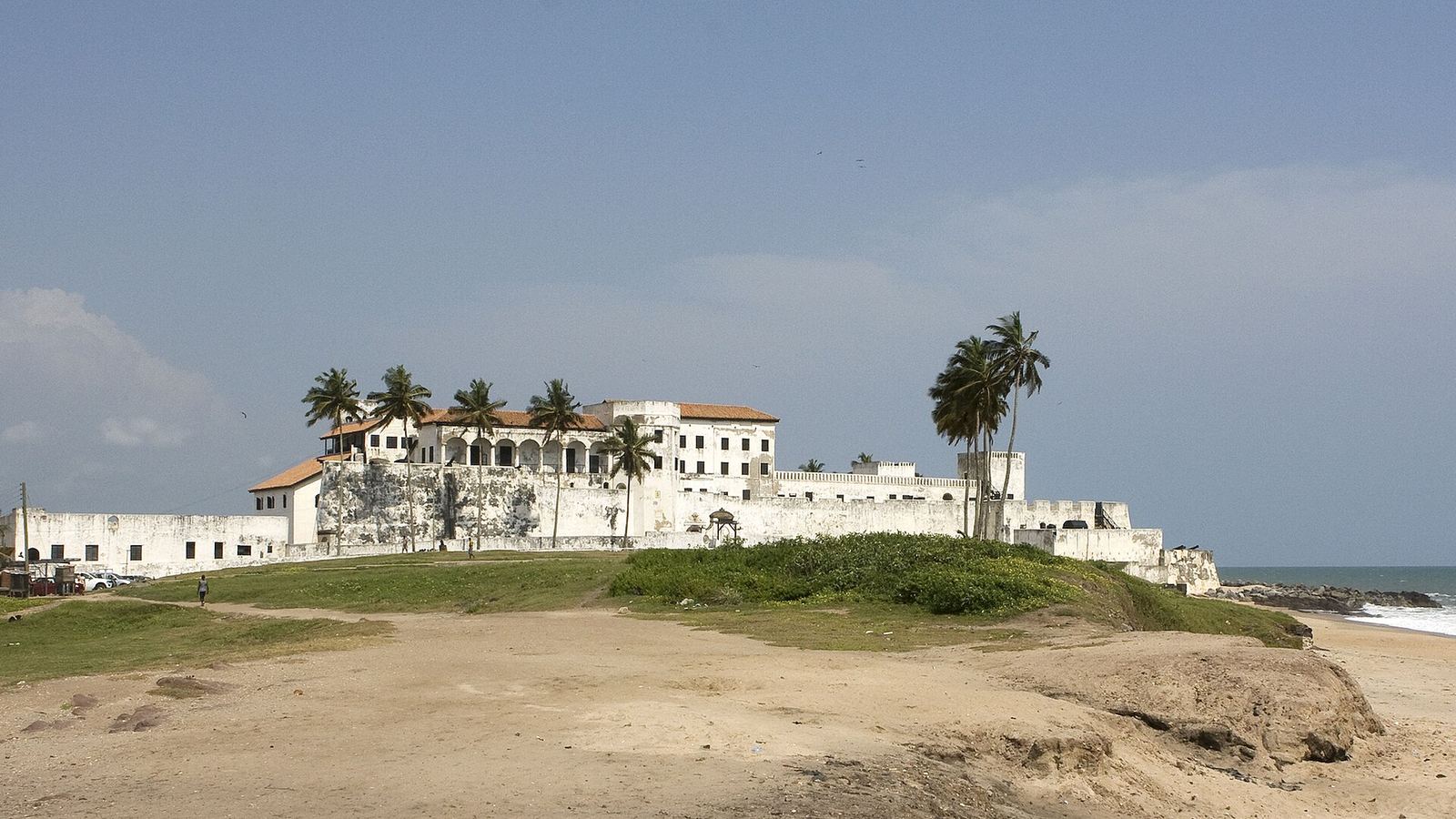
No, and that is genuinely good news for anyone on a heritage itinerary. The N1 coastal road through Winneba and Mankessim, the town of Cape Coast, Elmina and the Kakum visitor centre are all properly covered on every network, so an AT-based eSIM handles the whole day out. Coverage does fall away on the canopy walkway itself, where the forest does what forests do to a signal, and on the smaller fishing-village roads west of Elmina. Load your route before you leave Accra and it will not matter.
Will a Ghana eSIM work if I add Togo, Ivory Coast or Nigeria to the trip?
Only if you deliberately bought coverage for them. West Africa has no roaming union comparable to the EU arrangement, so a Ghana-only plan stops at Aflao or Elubo and a local Ghanaian card does the same. If your route runs on to Lomé or Abidjan, buy a regional Africa plan that names each country rather than assuming a neighbouring signal will be picked up. Expect a dead patch at the border posts themselves while the handset hunts for a network it is allowed to use.