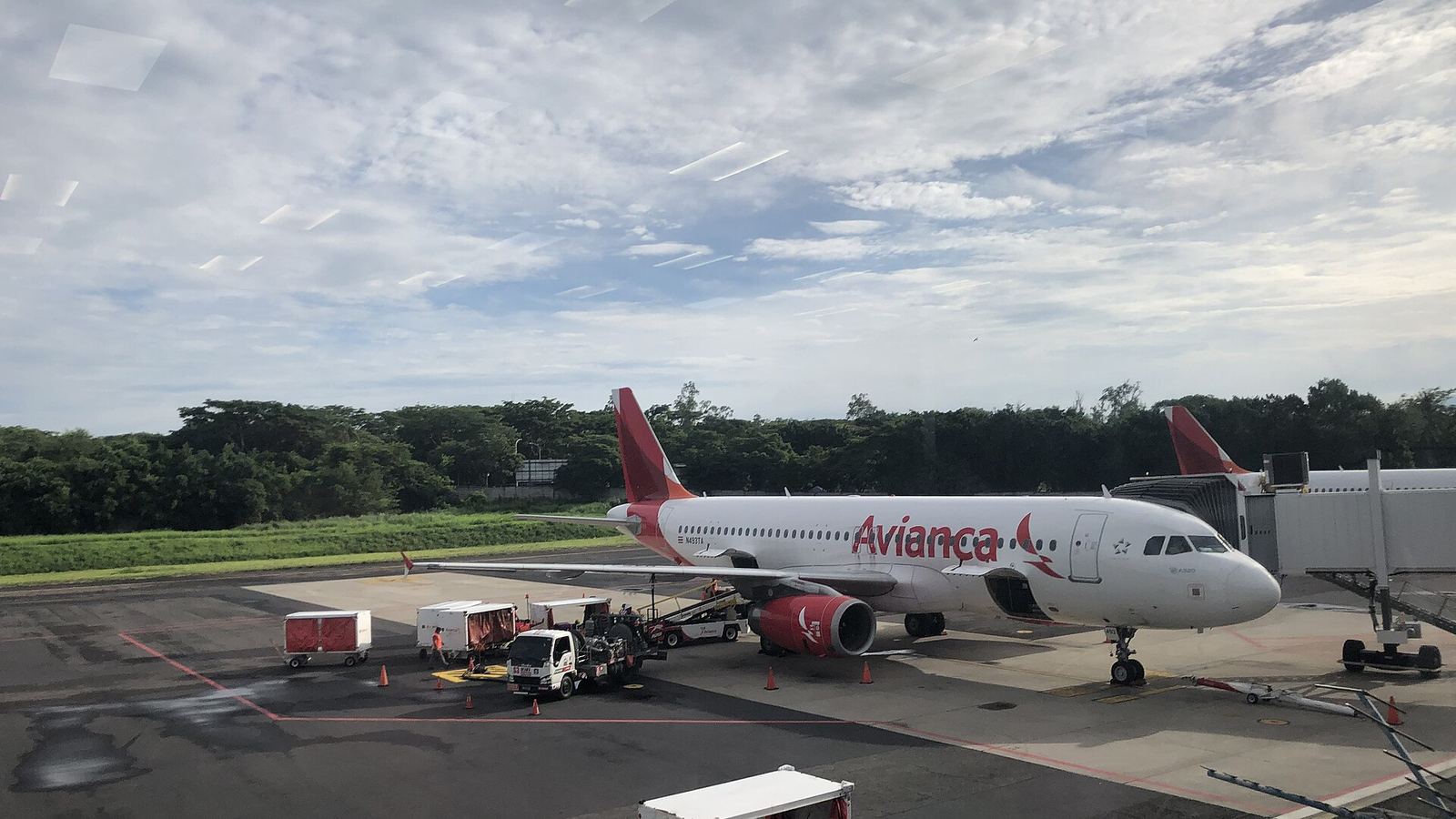
Saint Oscar Arnulfo Romero y Galdamez International, still called Comalapa by half the country and coded SAL by everyone else, is not near San Salvador. It sits at San Luis Talpa in the department of La Paz, 42 kilometres from the capital on a four-lane motorway that in real conditions takes about 45 minutes. That single fact reshapes the arrival-day data question. In a city where the airport is twenty minutes out you can reasonably shrug and sort a SIM in town. Here, if you land at nine in the evening on one of the many United States services that arrive after dark, you are looking at three quarters of an hour in an unfamiliar car followed by a hotel, and the carrier kiosks in arrivals may already have closed behind you. The airport moved 5.3 million passengers in 2024 and has two terminals and nineteen aircraft stands, so it is a real airport with real facilities. It is just a long way from where you are going.
What This Guide Covers
Jump to the section most relevant to you
What You Can Buy in the Arrivals Hall
Both of the operators worth having sell here. Tigo and Claro run official counters in the arrivals hall just past customs, on the route everyone walks between the baggage belts and the doors, so you do not have to go looking. Staff can register a line and activate a data pack on the spot, which takes ten to fifteen minutes if there is nobody in front of you and rather longer if two wide-body arrivals have landed together.
The problem is the clock rather than the queue. Counter hours at SAL thin out badly late in the evening, and coverage after about ten at night is unreliable. Check your scheduled landing time against that before you build a plan around it. A disproportionate share of the traffic here is Avianca El Salvador, which uses the airport as its main hub and accounted for roughly 36 percent of capacity, and Volaris El Salvador at about 16 percent, with a heavy weighting toward North American routes that arrive in the evening.
Bring the passport regardless
Sources disagree about whether prepaid registration is legally compulsory for foreign visitors here, and travellers report both being asked and not being asked. The airport kiosks take the formal route and will register you, so the document question is settled for you at this particular counter. It is in your hand from immigration anyway, so this is not the obstacle. The opening hours are.
Prices at the kiosks are the ordinary national ones rather than an airport markup, which is unusual and worth saying plainly. Tigo will sell 4 GB over sixteen days for seven dollars and Claro does 5 GB over thirty for ten. No travel eSIM comes close to that. If the counter is open and you are not exhausted, buying there is genuinely the cheapest way to leave this building connected.
The Free Terminal WiFi
SAL provides open wireless inside the terminals and does not require a Salvadoran number to get onto it, which removes the usual chicken-and-egg problem of needing a local SIM to authenticate to the network that would let you buy a local SIM. Join it from the gate area or the arrivals hall, accept whatever splash page appears, and you have enough bandwidth to message home, check a booking or download an eSIM profile you bought earlier.
Two limits are worth planning around. The first is that a shared airport network at the end of a bank of evening arrivals is slow in exactly the way you would expect, so an eSIM install attempted there can stall halfway and leave you unsure whether it worked. The second is that the useful part of your journey starts outside: the ride to the capital runs for the better part of an hour through countryside, and the road to the beaches runs through more of it. Whatever the WiFi does for you inside the building, it does nothing for the part where you are trying to find a driver or check an address.
If you are relying on the free network
- Do anything that needs bandwidth before you clear customs, in the quieter part of the terminal, rather than in the arrivals crowd.
- Take screenshots of your hotel address, your booking reference and your driver's details so they survive the connection dropping.
- Do not sign into a bank or enter card details on it. Buy the eSIM at home on your own broadband and the question never comes up.
- Send the message telling people you landed while you are still inside. It is the one thing that reliably works.
The 42 Kilometre Run Into San Salvador
The Autopista a Comalapa is a four-lane road and a straightforward drive. Optimistic sources put the journey at half an hour, which is what it takes at three in the morning with nothing on the road; 45 minutes is the honest figure for a normal arrival, and more than that if you are heading into the western districts at rush hour.
Three ways to make it, in ascending order of cost. Taxis Acacya runs a scheduled shared shuttle at around five dollars a head, with departures from the airport in the middle of the day and afternoon and from its lot in the city in the morning; it is far and away the cheapest option if your flight happens to fit the timetable, and useless if it does not. Ride-hailing works at the airport and runs roughly sixteen to twenty-two dollars for the trip, which is what most visitors end up paying. A negotiated taxi from the rank will be higher, commonly in the twenty-five to thirty-five dollar range.
Coverage along the route is fine. This is a main national highway through populated country and every network holds a signal for essentially the whole run, so if you are using an app car you can watch the route, message your hotel and change the destination on the way without difficulty. The reason to care about data here is not that the road is a dead zone. It is that summoning the car in the first place, and confirming where you are going in Spanish, both happen at the moment you step out of the terminal.
Or Skip the City and Drive to the Surf
A growing share of arrivals never go to San Salvador at all, and for them the airport's location stops being an inconvenience and becomes an advantage. SAL sits on the coastal plain, not up in the highlands with the capital. The Costa del Sol beaches are a short run east. El Tunco, El Sunzal and El Zonte, the Costa del Balsamo cluster that draws most of the surf traffic, are west along the CA-2 Litoral highway and reachable in about the same time as the city, sometimes less.
That road has had serious money spent on it. The Surf City programme took a 113.9 million dollar loan from the Central American Bank for Economic Integration to widen the Litoral through La Libertad and Tamanique, rebuild 8.67 kilometres of it to four lanes, build the Pacific Corridor interchange where the Litoral meets the Acajutla highway, and put wastewater treatment into El Palmarcito. A second phase launched on 3 April 2025 turned east, with 41 million dollars for a 13 kilometre scenic road linking eleven beaches across Usulutan and San Miguel, complete with a bike lane and viewpoints, opening up the coast around El Cuco and Playa Las Flores.
| Where you are heading | Roughly how far | Signal on the way |
|---|---|---|
| San Salvador city | 42 km north on the Autopista a Comalapa | Continuous on every network |
| Costa del Sol | Short run east along the coast | Good on the road, thinner at the beach ends |
| El Tunco and El Sunzal | West on the CA-2 Litoral, comparable to the city run | Strong, 20 to 60 Mbps on Tigo and Claro |
| El Zonte | A little beyond El Tunco on the same road | Good for a village that size, better than you would guess |
| El Cuco and Playa Las Flores | Far east, several hours | Variable, and the argument for a Tigo-based plan |
Note the practical consequence for buying a SIM. If you drive straight from the terminal to a surf town, the carrier stores you would have used in a San Salvador mall are now an hour behind you, and the coastal villages mostly sell top-up credit rather than new lines. Either buy at the kiosk before you leave the airport, or arrive with an eSIM already on the phone.
Why the Decision Is Better Made in Advance
Nothing about this airport is difficult. The question is only whether you want to be making choices about mobile operators at the end of a long flight, in a hall where the counter may or may not be staffed, with a 45 minute drive still in front of you.
Arriving with an eSIM already installed
Waiting for the kiosk instead
The split that suits most people is to buy the smallest eSIM going, use it for the landing and the drive, and then buy a local pack properly the next day when you are rested and near a mall. Airalo's single gigabyte at 5.50 dollars is built for exactly that job. Our Holafly review covers the unlimited alternative, and the eSIM Finder will tell you what size you need for the rest of the trip.
Kiosk Prices Against eSIM Prices
Because El Salvador uses the US dollar, this comparison needs no conversion and no hedging. These are 2026 figures, the counter prices from Tigo and Claro and the eSIM prices from the providers' own El Salvador pages.
| What you buy | Data | Valid for | Price | Network |
|---|---|---|---|---|
| Tigo pack at the kiosk | 4 GB | 8 days | 4 USD | Tigo |
| Tigo pack at the kiosk | 4 GB | 16 days | 7 USD | Tigo |
| Claro pack at the kiosk | 5 GB plus 2 GB for video apps | 30 days | 10 USD | Claro |
| Airalo eSIM | 1 GB | 3 days | 5.50 USD | Movistar |
| Nomad eSIM | 5 GB | 30 days | 21 USD | Claro |
| Nomad eSIM | 20 GB | 30 days | 29 USD | Claro |
| Holafly eSIM | Unlimited, 1 GB a day tethering | 7 days | 36.50 USD | Tigo, Claro, Movistar |
The gap is not subtle. Claro's ten dollar monthly pack carries seven gigabytes of usable allowance where Nomad charges twenty-one for five, and Tigo's seven dollar pack covers a fortnight for a third of that. What the eSIM sells you at those prices is timing and certainty: it is working at the aircraft door, it does not care whether the counter is staffed, and it does not need fifteen minutes of your first evening. Whether that is worth the premium is a judgement about your own arrival rather than a question with a general answer, and on a late flight heading straight to the coast it is an easy yes.
Frequently Asked Questions
How long does the drive to San Salvador really take from SAL?
Budget 45 minutes. The airport is 42 kilometres from the capital on a four-lane motorway, and some references quote 30 minutes for that, which is achievable on an empty road in the small hours. In daylight, with traffic building toward the western districts, three quarters of an hour is the realistic figure and an hour is not unusual. It is a comfortable drive on a good road, so the length of it only matters for planning: if your data plan is to buy a SIM somewhere in town, that is a decision you are deferring by the better part of an hour.
Are the Tigo and Claro counters open when late flights come in?
Often not. This is the single most useful thing to know about arriving here. The kiosks sit past customs on the way out and are convenient during the day, but staffing becomes unreliable after roughly ten at night, and a large share of the North American arrivals land in the evening. If your flight is one of those, treat the counter as a bonus rather than a plan. Either install an eSIM before you travel or accept that you will buy your local card in a mall the following morning, which is fine as long as you are not arriving somewhere that needs you online immediately.
Can I get to El Tunco directly from the airport without going through the capital?
Yes, and it is the better route if the coast is your destination. The airport sits on the coastal plain at San Luis Talpa, so the surf towns west along the CA-2 Litoral are reachable without touching San Salvador at all, in broadly the same time as the drive to the city. That highway has been widened and rebuilt in stages under the Surf City programme, including 8.67 kilometres through La Libertad and Tamanique funded by a 113.9 million dollar regional development loan. Coverage along it is good throughout, with Tigo and Claro both running 20 to 60 Mbps on the La Libertad stretch.
Does the terminal WiFi need a Salvadoran phone number to log in?
No, which is more helpful than it sounds. Plenty of Latin American airports gate their free network behind an SMS code, which is impossible if the reason you are on the network is that you have no local line yet. Here you can simply join and accept the terms. It is fast enough for messaging, checking a booking or finishing an eSIM installation, though it slows noticeably when several arrivals land together. Do anything bandwidth-hungry in the quieter part of the terminal, and do not enter card details on it.
Which terminal do international arrivals use, and does it change anything?
For connectivity purposes, no. The airport has Terminal 1, with fourteen stands served by boarding bridges, and a Terminal 2 that opened in February 2022 adding five more including one with double bridges, for nineteen passenger positions in total after two rounds of gate expansion. Everything funnels into the same immigration and customs process and out through the same arrivals hall, which is where the carrier kiosks are. So unlike some airports where a particular terminal has no SIM counter at all, at SAL the question of where you park does not affect what you can buy.