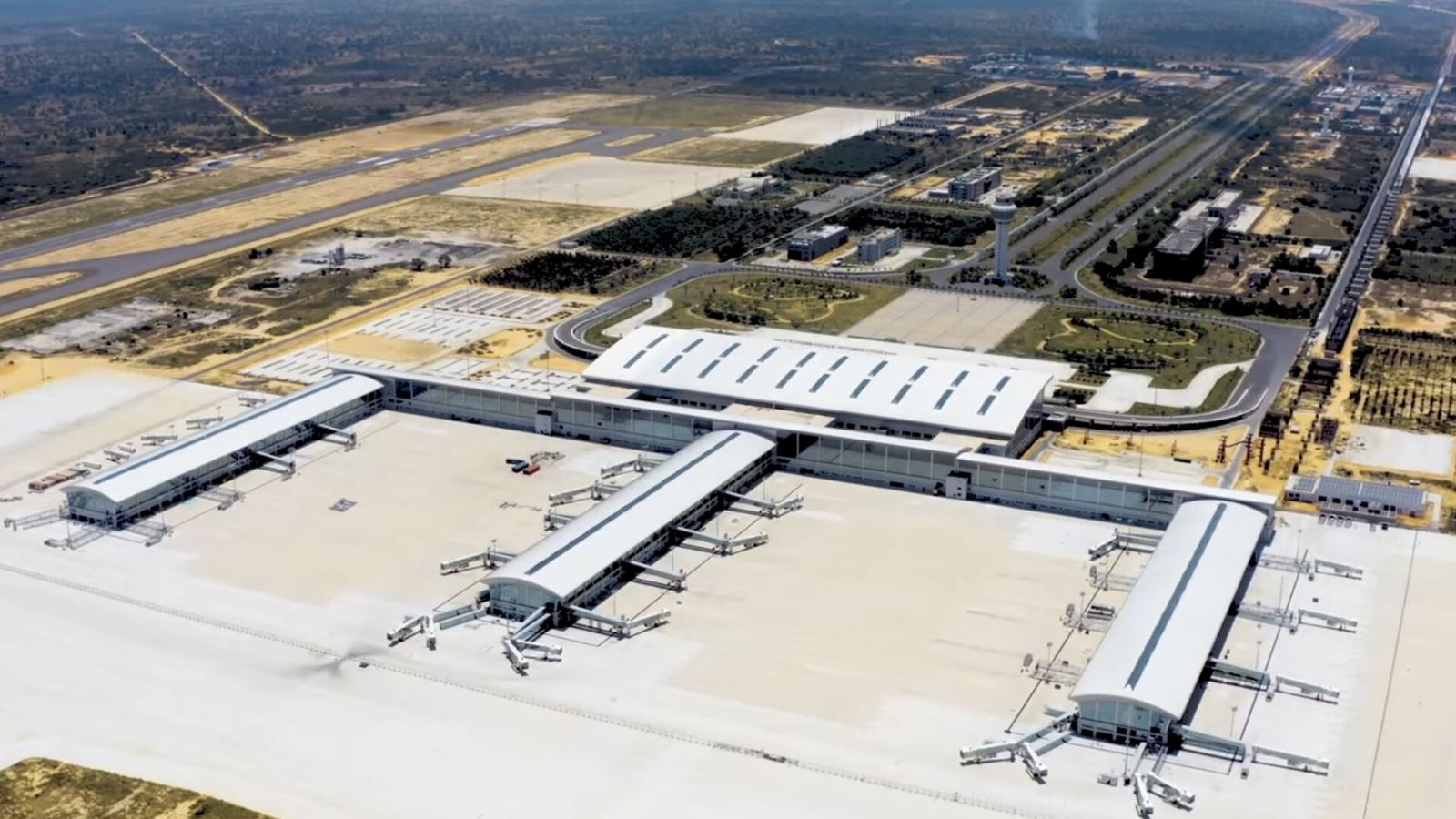
If you fly into Luanda in 2026 you land at Dr Antonio Agostinho Neto International Airport (IATA code NBJ), not at the old 4 de Fevereiro (LAD), which closed to commercial traffic on 2 March 2026. The new airport sits in Icolo e Bengo province, roughly 40 km east of the Marginal, so the old habit of landing, grabbing a taxi and sorting out a SIM card in town within half an hour no longer works. The transfer is long, the city's phone shops keep office hours, and the only travel eSIM on sale for Angola, Nomad, runs on Africell. A plan installed before departure is the simplest way to book a ride, message your hotel and follow the route on a map from the moment you clear customs.
What This Guide Covers
Jump to the section most relevant to you
From 4 de Fevereiro to Agostinho Neto
Angola spent more than a decade building its new capital airport, and the move happened in stages. The president opened it in November 2023, domestic passenger flights started in late 2024, and the international transfer followed through 2025 and early 2026. TAAG, the national airline, moved its flights across on 19 October 2025. Emirates followed from 1 November, TAP and Air France in November, and Qatar Airways and Ethiopian Airlines in December. Royal Air Maroc, Turkish Airlines and ASKY completed their moves at the start of February 2026, and Airlink's Johannesburg service was the last to go, on 1 March. The day after, 4 de Fevereiro closed to commercial traffic.
Why this page carries the Luanda name
Travellers still search for Luanda airport, and many booking sites and old blog posts still describe 4 de Fevereiro, which sat in the city a few kilometres from the centre. Everything below refers to NBJ, the airport actually in use. If a driver, a hotel or an old forum thread mentions a short ride from the airport, they are describing the closed terminal.
The scale is very different from the old one. NBJ has two parallel runways of 4,000 m and 3,800 m, a separate cargo terminal, and a design capacity of 15 million passengers a year, far beyond current traffic. Large terminals with few flights tend to have quiet arrivals halls, which matters for anyone hoping a shop will be open when they land.
What You Can Count On in the Arrivals Hall
We could not verify, from operator or airport sources, that Unitel or Africell runs a staffed, branded counter inside NBJ's international arrivals area in October 2026. Unitel's store finder lists a branch simply named Aeroporto under Luanda, with the standard hours of 08:00 to 17:00 on weekdays and 08:30 to 12:30 on Saturdays, but it does not say which airport, and the name predates the move. Africell's online store locator loads its list dynamically, and we could not confirm an airport branch from it. Plan on the assumption that there is nothing to buy until you reach the city.
About the people selling SIMs near the baggage belts
Travellers' reports from the old airport described informal sellers offering SIM cards and airtime after baggage claim, and recommended going to a proper shop instead. The same caution applies at NBJ. A line has to be registered to the buyer's identity document at a branded outlet, so a card handed over in a terminal corridor may be registered to someone else, or not properly registered at all, and can stop working without warning.
We also could not confirm the name or terms of a public WiFi network in the new terminal. Even if one is running, it ends at the doors, and the part of the journey where you actually need data is the 40 km drive that follows. Treat terminal WiFi as a bonus for downloading an offline map of Luanda, not as a plan.
Getting Into Luanda, and Keeping Signal on the Way
There are three realistic ways into the city, all by road. The airport rail link is listed as suspended in the October 2025 transport announcements, and we found no confirmation that it was running in October 2026.
| Option | Where it goes | Price (Oct 2025 figures) |
|---|---|---|
| TCUL airport bus | Largo das Escolas, Cacuaco or Benfica | 1,000 Kz (about $1.10) |
| TCUL bus from Zango | Zango bypass, Icolo e Bengo | 500 Kz |
| App-based taxi | Door to door | 8,000 to 15,000 Kz (about $9 to $16) |
| Private taxi | Door to door | Up to 25,000 Kz depending on destination |
| Free circular | Airport to the EN230 Catete road | Free |
According to Ver Angola's report on the transport plan, around 35 TCUL buses serve the airport between 05:00 and midnight, with ten semi-express departures a day, and ANTT, the land transport authority, made the shuttle circulars to the EN230 free. Those are the published figures from the launch period; check fares on the day, because kwanza prices move.
Data on the drive
The app taxis are the ones that need a phone: you book, share your location and follow the driver on the map. With Luanda traffic, budget a long ride to Ingombota, Miramar or Talatona, especially at the evening peak. Nomad's eSIM uses Africell, which is strongest inside the city, and we could not confirm its signal on every stretch of the road from Icolo e Bengo. Load the route on an offline map before you leave the terminal, and send your hotel your flight number and a pickup point before you board.
Nomad Before You Fly, or a Shop in Town
Here are the realistic options for a visitor arriving at NBJ, using operator prices at about 920 kwanzas to the dollar.
| Option | What you get | Price | When it works |
|---|---|---|---|
| Nomad 1 GB | 1 GB, 7 days, Africell | $9 | From landing |
| Nomad 3 GB | 3 GB, 30 days, Africell | $19 | From landing |
| Africell local eSIM | 10 GB, 30 days | 6,600 Kz (about $7) | After a shop visit in town |
| Unitel Net Mensal | 15 GB, 31 days | 10,000 Kz (about $11) | After a shop visit in town |
| Home roaming | Varies by carrier | Often the dearest per GB | From landing |
On price alone the local lines win comfortably. The catch is the clock. Most Unitel branches close at 17:00 on weekdays and at 12:30 on Saturday, and the airport is a long way from all of them. A flight that lands in the evening, or on a Saturday afternoon, can leave you without a local line until the next working morning. Our Angola SIM card guide covers the shops, the passport visit and the bundle codes.
Landing Connected Versus Sorting It Out Later
Your arrival time and how long you are staying decide this more than the price of a gigabyte.
With Nomad installed before departure
Arriving with nothing and buying in town
The pattern that suits most visitors is both: a small Nomad plan for the first days, and a Unitel or Africell line from a branch in the city if the trip runs past a week. A Talatona hotel guest can walk to a mall branch the next morning; the Belas Shopping Unitel store keeps evening and Sunday hours, which makes it the easiest place to fix things on a weekend.
Connecting to Cabinda, Lubango and Soyo
Since the old airport closed to commercial traffic, domestic flights use NBJ as well, so oil-sector travellers heading on to Cabinda or Soyo, and tourists flying to Lubango or Benguela, connect in the same building. That helps and hurts. You will not need to cross the city between terminals, but a connection that misconnects can leave you waiting in a quiet terminal far from any hotel.
Signal at the other end
The Nomad eSIM's Africell network is concentrated in 6 of Angola's 21 provinces, chosen around cities and economic corridors. If your onward flight goes to a provincial city, check before you rely on the eSIM there; Unitel is the network with a national footprint and the safer choice for anything beyond Luanda. Rotational workers bound for offshore or remote sites should ask their employer what connectivity the site provides, since many rely on private or satellite links.
For a longer layover, the eSIM is enough to keep in touch with a driver or check a delayed departure, and the Angola eSIM guide lists all four Nomad plans with verified prices. The eSIM Finder will size a plan to your dates, and the Holafly review is worth reading if Angola is one stop on a longer African trip, since Holafly does not sell Angola itself.
Frequently Asked Questions
Which Luanda airport do international flights use now?
Dr Antonio Agostinho Neto International Airport, code NBJ, in Icolo e Bengo province. TAAG moved in October 2025, the foreign airlines followed over the winter, and Airlink's move on 1 March 2026 completed the transfer. The old 4 de Fevereiro airport (LAD) closed to commercial traffic on 2 March 2026.
How far is the new airport from central Luanda, and what does the ride cost?
About 40 km from the city centre. TCUL buses run to Largo das Escolas, Cacuaco and Benfica for 1,000 kwanzas between 05:00 and midnight, and app taxis were quoted at 8,000 to 15,000 kwanzas when the airport took over international flights. Allow plenty of time, especially in evening traffic.
Can I pick up a local line before leaving the terminal?
We could not confirm a staffed Unitel or Africell counter in NBJ's arrivals area. Plan to buy a line at a branded shop in the city, with your passport, during office hours. Avoid informal sellers in the terminal, because an unregistered or wrongly registered line can be cut off.
Will my Nomad eSIM connect the moment I land at NBJ?
It should connect to Africell, the only network Nomad lists for Angola, once you switch the line on after landing. Africell is strongest inside Luanda, and we could not confirm its signal on every stretch of the road from Icolo e Bengo, so download an offline map before you set off.
Does the Nomad eSIM cover a connecting flight to Lubango or Cabinda?
The plan is valid nationwide, but it only works where Africell has towers, and Africell operates in 6 of 21 provinces. For a provincial city, check coverage first, and for anything outside the main towns buy a Unitel line, which has the national footprint.