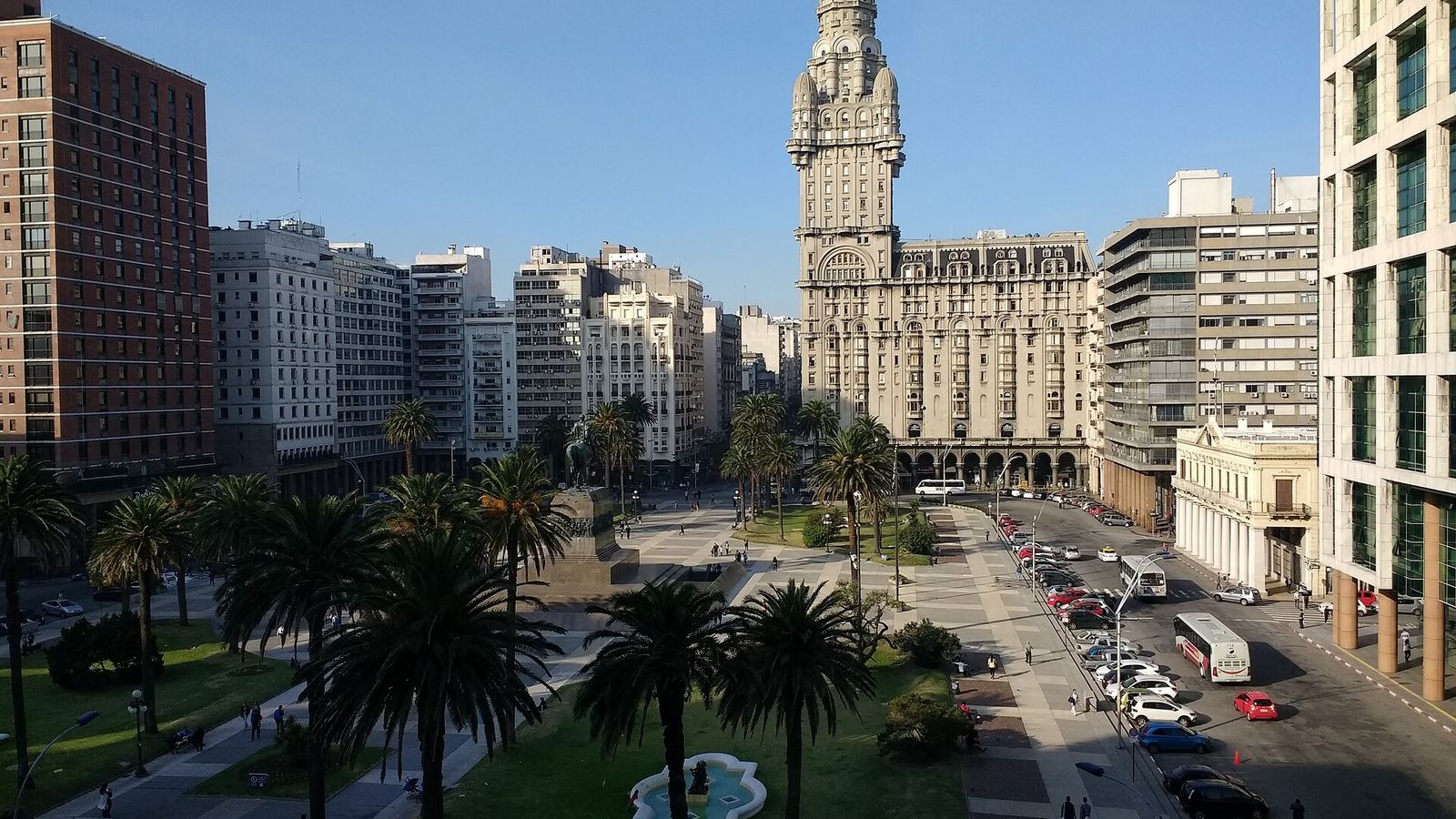
Montevideo is an easy city to be connected in and a slightly awkward one to get connected in, which is a distinction worth understanding before you land. The networks are excellent: three operators, dense 4G across the whole urban footprint, real 5G through the centre and the coastal barrios, and none of the filtering or blocking that complicates other destinations. The awkwardness is retail. There is no round-the-clock SIM vending culture here, the airport's only mobile counter keeps office hours, and a Sunday arrival in a city where Sunday genuinely is a day off means the first shop you can walk into opens on Monday. An eSIM installed before departure sidesteps that entirely, which is why it is the recommendation for anything shorter than a couple of weeks even though local prepaid data is cheaper.
What This Guide Covers
Jump to the section most relevant to you
How Well Montevideo Is Actually Covered
The capital holds about 1.3 million people, roughly a third of the country, packed into a peninsula and the coastal strip running east from it. That geography suits mobile networks: the city is low-rise for the most part, spread wide rather than tall, and all three operators have had decades to fill it in. Antel, Movistar and Claro all deliver continuous 4G from the container port at the western end through to the Carrasco suburb in the east, and 5G is live across the centre, Pocitos and Punta Carretas following the 2023 auction that gave each operator a 100 MHz block at 3.5 GHz.
In everyday use you will not think about which network your eSIM sits on. Maps load instantly, ride-hailing works, video calls hold up on the move. The differences that exist are marginal within the city limits and only start to matter once you drive out of it. What does vary noticeably is speed by hour rather than by place: the coastal barrios slow perceptibly on a warm evening when half the city is on the Rambla, which is a capacity effect rather than a coverage one.
The building that eats your signal
Ciudad Vieja's older stone buildings, the ones with metre-thick walls off Plaza Matriz and along Sarandi, are noticeably worse for indoor reception than anything built in the last fifty years. If you are staying in a converted colonial building in the old town, expect one or two bars indoors and a full signal the moment you step outside. It is a masonry problem, not a network one, and it affects all three operators equally.
Getting Around: Buses, the STM Card and Data On Board
Montevideo has no metro, no tram and no urban rail worth planning around. The city moves on buses, run by CUTCSA and a handful of cooperatives under the metropolitan transport system known as the STM, and they go everywhere. This is good news for your phone: buses run at street level, so there is no tunnel to lose signal in, and you have continuous data for the whole journey. Live arrival tracking works, and mapping apps route on the bus network competently.
Fares went up on 5 January 2026 and the current structure rewards using the card over paying the driver. A one-hour ticket costs 52 pesos with an STM card and 64 pesos in cash, and a two-hour ticket is 78 pesos on the card. At roughly 40 pesos to the dollar that is around 1.30 dollars for an hour of travel, which includes transfers within the window, so a single fare will usually carry you across the city with a change. The card itself is sold and topped up at Abitab and Redpagos counters and at various kiosks, with a 100 peso minimum reload.
Practical notes for a short stay
- Cash fares are paid to a conductor, not the driver, on many CUTCSA services. Have small notes
- The hour on a one-hour ticket is generous enough for a transfer, so tapping once often covers a full cross-city trip
- Tres Cruces is the hub for everything long distance: Punta del Este, Colonia, the Rocha coast and the interior all leave from there
- Taxis and ride-hailing both operate normally and are cheap by European or North American standards. Both need data, which is one more reason not to arrive offline
The one thing worth flagging is that Montevideo's bus system is genuinely opaque without an app. Route numbers are not intuitive, stops are not always signed with the lines that call there, and asking works better in Spanish than in English. This is a city where a working data connection changes the quality of your trip rather than merely adding convenience.
Neighbourhood Notes: Ciudad Vieja, Pocitos and Carrasco
Ciudad Vieja is the old town on the peninsula, bounded by the port on one side and Plaza Independencia on the other, and it is where most first-time visitors spend their first day. Mobile coverage across it is strong outdoors and mediocre inside the older buildings, as noted above. The Mercado del Puerto, the covered market where the parrilla grills run all afternoon, is a large iron-roofed hall and reception inside it is workable but not fast, especially at Saturday lunchtime when it is full. Peatonal Sarandi, the pedestrianised spine, is fine end to end.
Pocitos is the dense residential barrio east of the centre, high-rise apartment blocks facing a crescent beach, and it is where a lot of visitors now stay. It has the best mobile experience in the city: modern buildings, high subscriber density and therefore heavy network investment, with 5G widely available. It is also where the Rambla is at its most used, and where you will notice the evening slowdown most on a hot night.
Carrasco is the leafy, expensive suburb at the far eastern end, near the airport, with large houses, mature trees and a very different feel from the rest of the city. Coverage is good but the area is low density and spread out, so signal indoors in the bigger properties can be weaker than the map suggests. It is also a long way from everything: budget forty minutes on the bus into the centre.
The Rambla is the through-line
The waterfront promenade runs more than twenty kilometres, from Ciudad Vieja round the bay and east past Pocitos, Buceo and Malvin toward Carrasco, and walking or cycling stretches of it is what most people end up doing with their spare hours here. Coverage along the whole length is good, and there is a scattering of free public WiFi points on it as well. If you are trying to work out where you are in Montevideo, your position relative to the Rambla is usually the answer.
Free Public WiFi Across the City
Montevideo has invested in public connectivity for years and the results are unusually good for a city of its size. The municipality operates a free WiFi programme covering plazas, parks, outdoor gyms and stretches of the Rambla, with the network built out through an arrangement between the city government, Antel and the operator UNO. The access points you find on the waterfront generally appear as UNO-branded networks and ask you to register with an email address or a social login before letting you through the splash page.
Coverage counts have been quoted variously over the years, with the municipality's own page describing more than thirty points and press reporting from the build-out phase citing several hundred locations city-wide once the Rambla expansion landed. The honest summary is that there are a lot of them, they cluster in public open space rather than indoors, and they are not evenly distributed.
What the free network is and is not good for
- Good for: checking a map at a plaza, sending a message, downloading a bus route while sitting on a bench
- Not good for: anything you need to work reliably, because you must re-register through a captive portal and the signal is outdoor-only
- Not private: an open network with a splash-page login deserves the usual caution with banking apps and logins
- Not a substitute for mobile data: the points are where people sit still, and none of them help while you are walking, on a bus, or standing in the Mercado
Beyond the municipal network, ordinary Uruguayan hospitality is generous with WiFi. Cafes, hotels and restaurants almost all offer it and will hand over the password without being asked twice. Between hotel WiFi and the plaza points, a very frugal visitor could technically survive a Montevideo trip without mobile data. They would spend a lot of the trip standing still, looking for a network.
Getting Online On Arrival
Almost everyone flying into Montevideo lands at Carrasco, roughly half an hour east of the centre, and the connectivity situation there is the whole reason this page recommends sorting things out in advance. The airport has one Antel point, in the arrivals hall, and the airport's own service listing gives its hours as Monday to Friday, 07:00 to 19:00. There are no weekend hours published. Since a large share of the intercontinental arrivals reach Montevideo in the evening, and a fair number land at weekends, the counter is closed for a lot of the people who would want it.
The alternative arrival is by water. The Buquebus ferries from Buenos Aires dock at the port terminal in Ciudad Vieja, right at the edge of the old town, and the Colonia crossings connect through to Montevideo by coach. Arriving that way puts you in the centre with shops within walking distance during business hours, which is a materially better position than the airport, though the same Sunday problem applies.
The sequence that works
Buy and install the profile at home over your own WiFi, days before departure, and leave it inactive. Most plans start their clock on first connection to a Uruguayan network rather than at purchase, and Nomad in particular allows sixty days between buying and activating, so there is no penalty for organising it early. Turn on data roaming for the travel line once you land, leave your home line's roaming firmly off, and check the APN if nothing appears within a couple of minutes. You will normally attach to a network while still taxiing.
If you did arrive with nothing
Use the airport WiFi to message whoever is waiting, take a taxi or ride-hailing from the arrivals hall rank, which operates around the clock, and buy an eSIM from your hotel's WiFi that evening. That is a far better plan than waiting until Monday for an Antel shop, and it costs less than one airport taxi surcharge.
Day Trips: Punta del Este, Colonia and the Buenos Aires Ferry
Punta del Este is the obvious excursion, a couple of hours east on the Ruta Interbalnearia with frequent coaches from Tres Cruces. Coverage the whole way is continuous, and the peninsula itself is one of the best-covered pieces of ground in the country outside the capital. The exception is high summer. Between late December and the end of February the Maldonado coast absorbs an enormous seasonal population from Argentina and Brazil, and the cell sites around the peninsula, La Barra and Jose Ignacio carry loads they never see the rest of the year. Evenings in January are slow. It is congestion, not absent coverage, and there is nothing to buy that fixes it.
Colonia del Sacramento sits west along Ruta 1, a comfortable day trip by coach, and the Portuguese-founded Barrio Historico with its cobbles and lighthouse has solid 4G throughout. There is no coverage problem here at all. What there is instead is a border, because Colonia is also the ferry port for Buenos Aires.
Your Uruguay plan stops at the water
The fast Buquebus crossing from Colonia reaches Buenos Aires in roughly an hour and a quarter, and immigration for both countries is cleared at the departure terminal before boarding. What does not cross with you is your data. A Uruguay eSIM covers Uruguay only, so the moment your handset finds an Argentine tower on the far bank it has nothing to attach to. Signal also fades in the middle of the Rio de la Plata regardless of what you bought. If Buenos Aires is on the itinerary, either buy a regional Latin America plan that carries both countries or add a separate Argentina eSIM before you sail.
Piriapolis, the older and quieter resort short of Punta del Este, and the beach towns along the way make an easier half-day and have no connectivity issues worth mentioning. If you push further east into Rocha, toward La Paloma and Punta del Diablo, coverage stays workable in the towns but starts to thin out between them, and Cabo Polonio, which has no paved road and is reached by dune truck, is close to a dead zone. That is a genuine draw for some visitors rather than a problem, but download your return timetable before you go.
Frequently Asked Questions
Do I lose signal on Montevideo's buses like I would on a subway?
No, and the reason is simple: there is no subway. Montevideo moves entirely on surface buses run by CUTCSA and the metropolitan cooperatives, so you are at street level the whole way and your data never drops into a tunnel. That makes live route tracking genuinely usable, which matters here because the network is hard to navigate without an app. Fares from January 2026 are 52 pesos on an STM card or 64 in cash for one hour, transfers included.
Is the free WiFi on the Rambla good enough to skip mobile data?
Only if you plan to spend your trip sitting on benches. The municipal programme, built with Antel and the operator UNO, puts free access points in plazas, parks, outdoor gyms and along the waterfront, and they are perfectly serviceable for checking a map or sending a message. They are outdoor, fixed-location and behind a registration splash page, so they do nothing for you on a bus, in a restaurant or while walking between neighbourhoods. Treat them as a useful supplement rather than a strategy.
Which part of the city has the weakest reception?
Indoors in the old stone buildings of Ciudad Vieja, particularly the converted colonial properties around Plaza Matriz. The walls are thick enough to cut a full outdoor signal down to a bar or two, and it affects all three operators equally because it is a masonry problem rather than a network one. Step outside and you are back to full strength. Elsewhere the pattern is unremarkable: Pocitos has the best experience in the city, and Carrasco's large low-density plots are fine outdoors and occasionally soft indoors.
Should I buy my plan before flying or sort it out in Montevideo?
Before, unless you are staying several weeks. The deciding factor is not price, it is opening hours: the only mobile counter at Carrasco airport runs weekdays 07:00 to 19:00 per the airport's own listing, and Uruguayan retail generally shuts on Sundays. Land on a Saturday night and your first realistic chance to buy a local card is Monday morning. An eSIM installed at home over your own WiFi has you online before you reach passport control, and the cheapest Uruguay plan is 6 dollars for a gigabyte.
Will my Montevideo data plan work for a day trip to Buenos Aires?
It will not. The ferry crossing is an international border and a Uruguay eSIM has no coverage on the Argentine side, so you arrive in Buenos Aires with a phone that cannot attach to anything. Expect the signal to fade partway across the Rio de la Plata too. If the Buenos Aires hop is part of the plan, buy a Latin America regional plan that lists both countries or add a separate Argentina eSIM before you board. Doing this on the quayside with no data is exactly the situation to avoid.