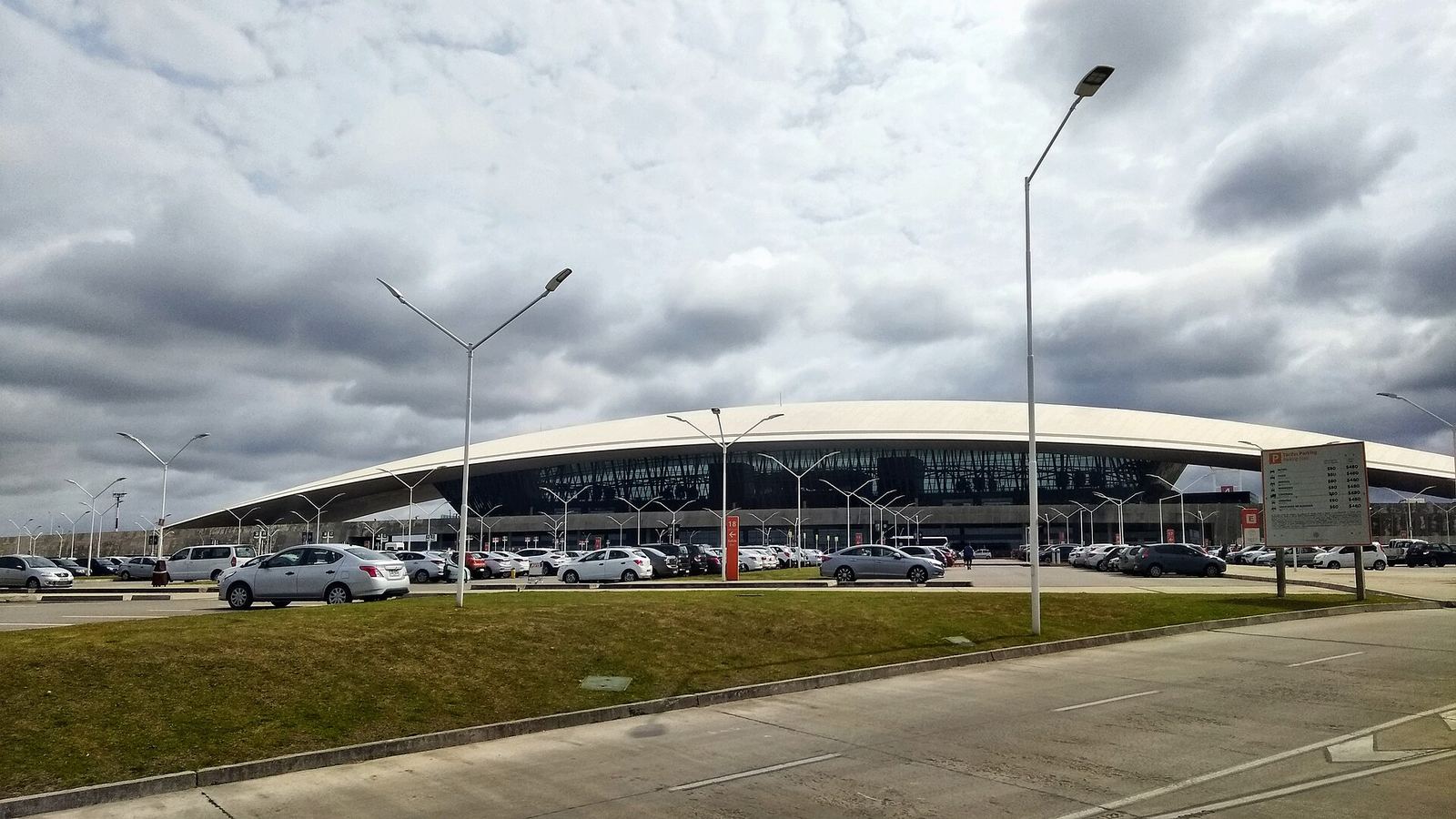
Carrasco is a small, calm, architecturally handsome airport with a single sweeping terminal, and it handles arrivals with far less fuss than most capital-city gateways in the region. It also has precisely one place to buy mobile service, and that place keeps the working hours of an office rather than an airport. The Antel point in the arrivals hall runs Monday to Friday, 07:00 to 19:00, according to the airport's own service directory, with nothing published for weekends. Long-haul arrivals into Montevideo skew heavily toward evenings, so a large share of the people who would like to buy a SIM here find the shutters down. That single scheduling detail, rather than any argument about price, is why an eSIM bought before departure is the sensible move for a Carrasco arrival.
What This Guide Covers
Jump to the section most relevant to you
Where to Buy Mobile Service Inside the Terminal
Carrasco runs as one terminal, opened in 2009, with international and domestic traffic sharing the same building and arrivals feeding into a single hall. That simplicity means there is no terminal-by-terminal hunt to do: whatever exists, you will walk past it.
The whole list, honestly
Antel holds a point in the arrivals hall, listed by the airport as operating Monday to Friday from 07:00 to 19:00. That is the only mobile operator with a presence in the terminal directory. Some third-party travel guides quote longer daily hours and mention additional SIM kiosks in the terminal; the airport's own listing supports neither. Plan for the conservative version.
What the terminal does have in abundance is everything else you might need on landing. Global Exchange runs currency exchange positions across the arrivals hall, departures and the baggage reclaim area. Luggage storage is available around the clock through the information counter in the central hall. Taxis wait in arrivals twenty-four hours. Travel agency desks operate in departures, one of them continuously. So the airport is well set up for a late arrival in every respect except the one this page is about.
Note that Movistar and Claro have no counter here at all. If you specifically want one of the private networks rather than the state operator, that is a trip into Montevideo, not an airport errand. And in either case you will need your passport, because Uruguayan operators register prepaid lines against an identity document at the point of sale.
The Terminal WiFi, and What We Could Not Confirm
Carrasco offers complimentary wireless in the terminal, as essentially every commercial airport now does, and it is enough to message whoever is meeting you and to load a ride-hailing app before you leave the building. What this guide will not do is invent a network name for you. The airport's published service directory does not list its WiFi among the passenger services it details, and we could not confirm a specific SSID or the exact login procedure from outside Uruguay. Expect to open the wireless list on arrival, pick the airport-branded network you find there, and accept a splash page.
That vagueness is itself a useful signal. Airport WiFi that the operator does not bother to document is rarely the kind you want to depend on for anything time-sensitive, and in any case it stops at the building line. The moment you step out to the taxi rank or the bus stop it is gone, and the drive into Montevideo is thirty minutes with no connection unless you brought your own.
Things worth doing on the terminal WiFi before you leave the building
- Download the offline map tile for Montevideo if you did not do it at home
- Screenshot your accommodation address in Spanish, so a driver can read it without your phone being online
- Confirm your onward booking, because coach seats to Punta del Este and Colonia sell out in high summer
- If you have an eSIM installed but not activated, switch it on here rather than in the car park
Carrasco to Montevideo: Buses, Taxis and Data En Route
The airport sits east of the city, out beyond the Carrasco suburb, and the run into the centre takes roughly half an hour in ordinary traffic. Everything about the journey happens at street level, so mobile coverage is continuous the whole way on any of the three networks. There is no tunnel, no rail line and nothing to lose signal in.
Buses
Four operators are listed by the airport as serving the terminal. COPSA and CUTCSA run the services most useful to arriving passengers, with COPSA's 700-series routes and CUTCSA's C-prefixed lines calling at the airport on their way between Montevideo and the eastern suburbs. COT runs the long-distance coaches that connect Montevideo with the rest of the country, and Turismar handles transfers and charters. Fares to the Tres Cruces terminal are quoted at around 68 pesos paid on board, a little under two US dollars, with a journey time in the region of twenty-five to thirty minutes and departures roughly every twenty minutes through the day. Tres Cruces is the right destination to aim for: it is the hub for onward coaches to Punta del Este, Colonia and the interior, and it sits close to the city centre with local buses fanning out from it.
Taxis and ride-hailing
The taxi rank in arrivals operates twenty-four hours, which makes it the default for a late landing. Remisat is the remise operator associated with the airport. Ride-hailing works normally in Montevideo and picks up at the terminal, and it is usually cheaper than a metered taxi, but it needs data to book, which is a circular problem if you arrived with none. Published estimates for the ride into the centre vary widely between sources and currencies, so treat any single figure you read online with suspicion and check in the app.
Why the transport question is really a data question
Every convenient option for getting from Carrasco into Montevideo, other than joining the taxi queue and pointing at a written address, assumes a working phone. Booking a car, checking which COPSA service is next, confirming your accommodation, all of it needs a connection. The airport WiFi covers you until the doors, and after that you are on your own.
The Case for Sorting It Out Before You Fly
Most airport guides argue that pre-installing an eSIM saves you a queue. At Carrasco the argument is different and rather stronger: on a large proportion of arrival slots there is no queue to join, because the counter is not open. Weekend landings and any weekday arrival after seven in the evening find the Antel point closed, and the next opportunity to buy locally is a shop in Montevideo during business hours.
Arriving with a plan already installed
Waiting to buy locally
The mechanics take about four minutes at home. Buy the plan, scan or tap the profile into the phone over your own WiFi, label it clearly so you do not confuse it with your home line, and then leave it alone. Uruguay plans generally begin counting from first attachment to a local network rather than from purchase, and Nomad allows a full sixty days between buying and activating, so there is no advantage in leaving it late. On the aircraft, enable data roaming on the travel line only and make sure the home line is set to no data at all, which is the mistake that produces the genuinely expensive holiday bill.
What the Counter Charges Against What an eSIM Charges
Assume for a moment that you land on a Tuesday at noon and the Antel point is open. Is buying there the better deal? On volume, yes, quite clearly. On a short trip, no. The numbers, at roughly 40 pesos to the US dollar in September 2026:
| Option | Data | Validity | Price | Per GB |
|---|---|---|---|---|
| Antel counter, small pack | 1 GB | 1 day | 150 UYU (about $3.75) | $3.75 |
| Antel counter, large pack | 40 GB | 7 days | 1,000 UYU (about $25) | $0.63 |
| Nomad eSIM | 1 GB | 7 days | $6 | $6.00 |
| Nomad eSIM | 5 GB | 30 days | $19 | $3.80 |
| Nomad eSIM | 20 GB | 30 days | $29 | $1.45 |
| Airalo eSIM | 5 GB | 30 days | $22 | $4.40 |
| Holafly eSIM | Unlimited | 7 days | $36.50 | n/a |
Read that table carefully, because it does not say what airport-SIM comparisons usually say. The big Antel pack is the cheapest data on the page by a distance and no travel brand comes close to 63 cents a gigabyte. If you are here for a fortnight and will use serious volume, the counter wins on price and it is not arguable. What the eSIM wins on is everything else: availability at any hour, no passport, no queue, and a sensible price at the small end where the counter's one-day pack is frankly bad value.
Reading the peso prices with appropriate caution
- The Antel figures come from retail and travel guides current in 2026, not from an official published tourist tariff, so treat them as the right scale rather than exact
- The exchange rate held around 40 pesos to the dollar through mid-2026, which makes the mental arithmetic easy but does move
- Pack names and allowances change more often than the underlying pricing philosophy, which has been consistently generous on volume
- Card payment is accepted at the counter, as it is nearly everywhere in Uruguay
Frequently Asked Questions
What time does the mobile counter at Carrasco actually open?
The airport's own service directory lists the Antel point in the arrivals hall as operating Monday to Friday from 07:00 to 19:00. No weekend hours are published. Various third-party travel sites claim daily hours running as late as 22:00, but that is not supported by the airport's listing and it is a bad thing to be wrong about at eleven at night with no data. If your flight lands outside those weekday hours, plan on arriving with an eSIM already working rather than expecting to buy anything in the terminal.
Is there more than one terminal to worry about at MVD?
No. Carrasco operates from a single terminal building opened in 2009, with international and domestic traffic under the same roof and one arrivals hall. That makes the layout unusually easy to navigate compared with the multi-terminal hubs elsewhere in the region. It also means there is no second building to try if the one mobile counter is closed, which is the practical downside of a small, tidy airport.
How do I reach the city if I land with no working phone?
Join the taxi queue in the arrivals hall, which operates around the clock, and hand the driver a written address. That is the one option that needs nothing from you technologically. Buses to Tres Cruces run frequently through the day at around 68 pesos paid on board, taking roughly twenty-five to thirty minutes, and are perfectly usable if you know which service you want. Ride-hailing is generally the cheapest of the three but requires data to book, which is precisely what you do not have in this scenario.
Can I buy a Movistar or Claro card at the airport instead of Antel?
Not in the terminal. Antel is the only mobile operator listed in the airport's service directory, so the private networks are a shop visit in Montevideo rather than an arrivals-hall purchase. For most visitors this does not matter, since Antel has the broadest coverage of the three and is the operator you would want anyway if your trip goes beyond the coastal strip. If you specifically want Movistar or Claro, both have branches in the central shopping centres.
Does my travel eSIM connect before I get off the plane?
Usually while taxiing, once you take the handset out of airplane mode and the travel line has data roaming enabled. Carrasco sits in well-covered territory east of the city, so there is no dead patch on the apron to worry about. If nothing appears after a couple of minutes, toggle airplane mode once and check that the travel profile is set as the data line rather than your home SIM. The other half of that setup matters just as much: your home line should have data roaming switched off entirely.