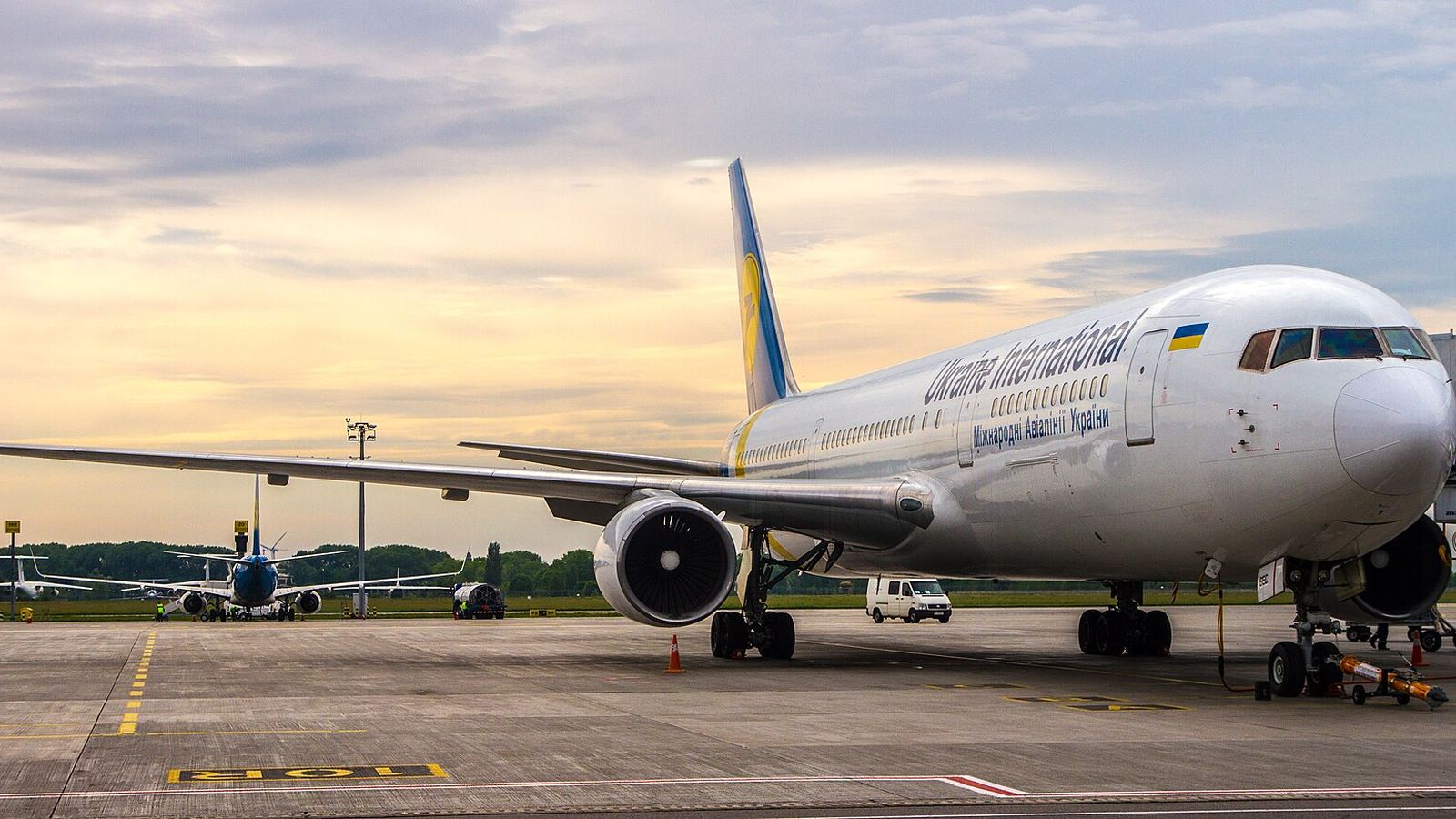
Nobody is landing at Boryspil. Ukrainian airspace has been closed to civil aviation since February 2022 and remains closed in August 2026, so KBP handles no scheduled passenger flights, its terminals are maintained rather than used, and every arrivals-hall SIM counter described on older pages is behind a locked door. If you are planning a trip to Kyiv, you are planning an overland journey: a train from Poland, Hungary, Slovakia or Moldova, or a long-distance coach. That changes the connectivity question in a specific way. There is no moment of stepping off a jet bridge and switching on a pre-installed profile, because a Ukraine-only eSIM cannot register until your phone is physically on a Ukrainian network, and that happens somewhere on a railway line in the west of the country rather than at a terminal. This page covers where KBP stands, how people get to Kyiv in the meantime, where the handover to Ukrainian service actually occurs, and what the airport will look like when it does reopen.
What This Guide Covers
Jump to the section most relevant to you
Where Boryspil Stands in 2026
Boryspil is suspended rather than abandoned. The airport has kept its infrastructure, its systems and much of its workforce ready, and its management has said publicly that it can resume civil operations once safety allows and once the state makes the decision. In March 2026 the government set up a working group specifically to plan a phased reopening of the airspace, and industry figures have put the country's aviation sector at roughly 95 percent readiness, with an estimated 45 to 50 days needed to restart flights from Boryspil or Lviv after a green light. Airlines including Ryanair, Wizz Air, LOT, the Lufthansa Group, airBaltic and KLM-Air France have all indicated they intend to return.
None of that is a date. Eurocontrol's own planning assumptions have pointed to a resumption of Ukrainian traffic as late as 2029, and the reopening depends on conditions rather than a timetable, so the honest position is that no one can tell you which month to book for.
How to read what you find online
Search results for this airport are full of pages describing terminal layouts, transfer prices and SIM kiosks in the present tense. Almost all of them were written before 2022 and have never been revised. Treat any page that offers you a Boryspil arrivals service without mentioning that the airspace is closed as an archive rather than as advice, and check flight status with an official Ukrainian source before making plans around it.
Kyiv's second airport, Zhuliany, officially Igor Sikorsky International and much closer to the centre, is in the same position and for the same reason.
How Travellers Actually Reach Kyiv Now
The default route is the railway. Ukrainian Railways runs several daytime services plus an overnight train from Przemysl Glowny, the Polish border town where most travellers arrive by train or bus from Krakow or Warsaw, through to Kyiv-Pasazhyrskyi. The journey takes about nine and three quarter hours by day and a little over ten by night, and it includes the border formalities, which are handled on board and at the frontier rather than by you queueing somewhere with your bags.
| Route | Time | Typical fare | Data en route |
|---|---|---|---|
| Przemysl Glowny to Kyiv, seated | About 9h 45m | 500 to 850 UAH | Polish networks to the border, Ukrainian afterwards |
| Przemysl Glowny to Kyiv, sleeper | About 10h 15m | 1,800 to 2,500 UAH | Same handover, usually while you are asleep |
| Chelm or Warsaw connections | Varies by service | Comparable | Same pattern via a different crossing |
| Budapest, Kosice or Chisinau | Overnight services | Varies | Handover at the southern or western frontier |
| Long-distance coach | Longer, traffic dependent | Often cheaper | Queues at road crossings can be many hours |
Rail is generally preferred over the road crossings, which can involve long waits at the border, and Ukrainian Railways has kept an unusually good punctuality record through the war. Book through the operator's own site or an established agent, and note that trains sell out well ahead in summer.
Whatever route you take, entry requirements apply: most Western nationalities enter visa free for up to 90 days in any 180, and medical insurance valid in Ukraine is expected at the border. That is a document to have on your phone, which is one more argument for arriving with a working connection.
Where Your Ukrainian Data Starts Working
This is the part that trips people up, because it is genuinely different from an airport arrival. A Ukraine-only eSIM has no network to attach to until your handset is inside Ukraine and can see Kyivstar, Vodafone Ukraine or lifecell. On the Przemysl route that means it comes to life shortly after the frontier, somewhere around Mostyska, not when you board in Poland.
Sequencing it properly
1. Buy and install the eSIM profile at home, on decent WiFi. Installation is the step that needs a good connection; activation is the step that needs Ukraine.
2. Cover the Polish leg separately. Your home plan, a Poland or Europe eSIM, or the free WiFi at Przemysl station and on the Polish trains will all do the job for the approach.
3. Once the train is moving through Ukrainian territory, enable the Ukraine line and set it as your data line. Give it a minute to register, then check which operator it landed on under network settings.
4. Confirm it works before you need it. Open a map, send a message. Doing this while there are still hours of train left is more comfortable than doing it on a platform at midnight.
Cellular coverage along the Lviv to Kyiv corridor is good, and mobile data on the train is more dependable than the onboard WiFi, which exists on some services and is best treated as a bonus. Carriages have power sockets, so this is a rare stretch of a Ukrainian trip where charging is not something you have to think about.
If your itinerary continues beyond Ukraine afterwards, look at what else your plan covers before you buy. A regional profile that spans Poland and Ukraine spares you the juggling, though it usually costs more per gigabyte than the country plan our Ukraine eSIM guide recommends.
What Comes Back When the Airport Does
It is worth knowing what Boryspil looked like in normal operation, because that is roughly what will return, and because the pre-2022 details still circulate as though nothing happened.
Terminal D is the modern international terminal and handled the overwhelming majority of flights, with Terminal F held as reserve capacity and reopened for low-cost carriers before the closure. Terminal B, the old Soviet-era building, has long been out of passenger use. Arrivals in Terminal D had the usual bank of operator desks, and Kyivstar, Vodafone Ukraine and lifecell all sold starter packs there.
The Sky Bus, in the past tense
Ground transport to the city ran on the Sky Bus, route 322, from the forecourt of Terminal D to the Pivdennyi terminal of Kyiv-Pasazhyrskyi railway station, with a useful intermediate stop at Kharkivska metro on the green line. The full run cost 100 UAH and the leg to Kharkivska 60 UAH, with departures every 15 to 25 minutes through the day and a round-the-clock service, taking about an hour and considerably longer in the evening crush. The Kyiv Boryspil Express rail shuttle covered the same journey from the station in around 40 minutes. Neither is useful to an arriving passenger today, for the simple reason that there are no arriving passengers, and both are the sort of detail that will need re-checking whenever service resumes.
The airport sits about 29 km east of the city, so this was never a short hop, and that is precisely the stretch where a phone with working data earns its keep. Nothing about that changes when flights resume.
The Counter and the eSIM, Honestly Compared
On most airport pages the argument is about price, because airport SIM counters charge tourist rates. Ukraine is the exception: local mobile tariffs here are strikingly cheap, and a Ukrainian bundle undercuts every travel eSIM on paper. The case for the eSIM rests on something else entirely.
A travel eSIM gives you
A local Ukrainian SIM gives you
For a week in Kyiv the sensible shape is a travel plan for arrival day onwards: Nomad at $14 for 5 GB or $22 for 10 GB, Airalo at $26 for 10 GB with wider network access and app top-ups, or unlimited from Holafly at $27 for seven days if you will lean hard on your phone through the power cuts. Staying a month, add a local card once you are settled, as our Ukraine SIM card guide sets out. Not sure how much you need? The eSIM Finder sizes it against your trip.
Practical Notes for an Overland Arrival
Kyiv-Pasazhyrskyi is the station you arrive at, and it is two buildings: the Central terminal on the north side and the Pivdennyi terminal on the south, joined by a covered footbridge over the tracks. Vokzalna station on the red metro line sits directly outside the Central building, which makes onward travel simple during the day.
Landing at an awkward hour
Overnight services arrive early, sometimes inside the midnight to 05:00 curfew. Travelling from the station to your accommodation on the strength of a train ticket is accepted, so keep the ticket accessible along with your passport. Book a taxi through Uklon or Bolt from the platform rather than the concourse, tell your host when you expect to arrive, and remember the metro does not run before about 05:30. If your train is late, which happens, having data is the difference between a delay and a problem.
Three things to set up before you sleep on that first night. Install the alert apps covered in our Kyiv city guide, because they are how a warning reaches you. Charge a power bank, since the next outage is not something you can schedule around. And save an offline map of the city, which costs nothing and solves the one situation where a data plan cannot help you.
Finally, the rules that have nothing to do with your data plan but apply the moment you switch it on: no drones, no photographing military sites or checkpoints, and no posting images or locations of air defence work or strike sites. Enforcement is real, and visitors are not treated as an exception.
Frequently Asked Questions
Is it possible to fly into Boryspil in 2026?
No. Ukrainian airspace has been closed to civil aviation since February 2022 and remained closed through the summer of 2026, so there are no scheduled passenger flights into Boryspil, Zhuliany or anywhere else in the country. The airport itself is maintained in a state of readiness and its management says it can restart once safety allows and the government decides, and a working group was formed in March 2026 to plan a phased reopening, but no date has been announced. Any booking site offering you a flight to KBP is selling something that does not exist.
What is the usual way into Kyiv instead?
A train from Przemysl Glowny in south-eastern Poland to Kyiv-Pasazhyrskyi, which takes about nine and three quarter hours by day or a little over ten on the overnight service, with fares roughly 500 to 850 UAH seated and 1,800 to 2,500 UAH in a sleeper. Services also run from Chelm, Budapest, Kosice and Chisinau, and long-distance coaches cover the same ground more cheaply but with unpredictable waits at road crossings. Book ahead in summer, when the trains fill up.
Will a Ukraine eSIM connect while I am still on the Polish side?
No. A country plan for Ukraine has no partner network in Poland, so it stays inactive until your phone is inside Ukraine and can register on Kyivstar, Vodafone Ukraine or lifecell. Install the profile at home while you have a solid connection, then cover the Polish leg with your home plan, a separate Europe or Poland eSIM, or the free WiFi at Przemysl station. Switch the Ukrainian line on once the train has crossed and give it a minute to attach.
Is there any connectivity worth relying on during the journey itself?
Mobile data, yes. Coverage along the corridor from the border through Lviv to Kyiv is good, and it is more dependable than the onboard WiFi, which is available on some services and unremarkable when it is. Carriages have power sockets, so you can run your phone as a hotspot for a laptop without watching the battery, which is a luxury compared with the rest of a Ukrainian trip. Download anything you will want offline before you board rather than counting on the connection through the border formalities.
When the airport does reopen, will the SIM desks there be worth using?
Only if you want a Ukrainian number. Before the closure, all three operators sold starter packs in the Terminal D arrivals hall, and local tariffs are cheap enough that the counter was never the rip-off it is in most countries. What it costs you is time and a passport registration on the day you land, and it gives you nothing during the journey. Buying a travel eSIM before you set out covers the trip in, and you can always add a local card later if the stay turns out to be a long one.