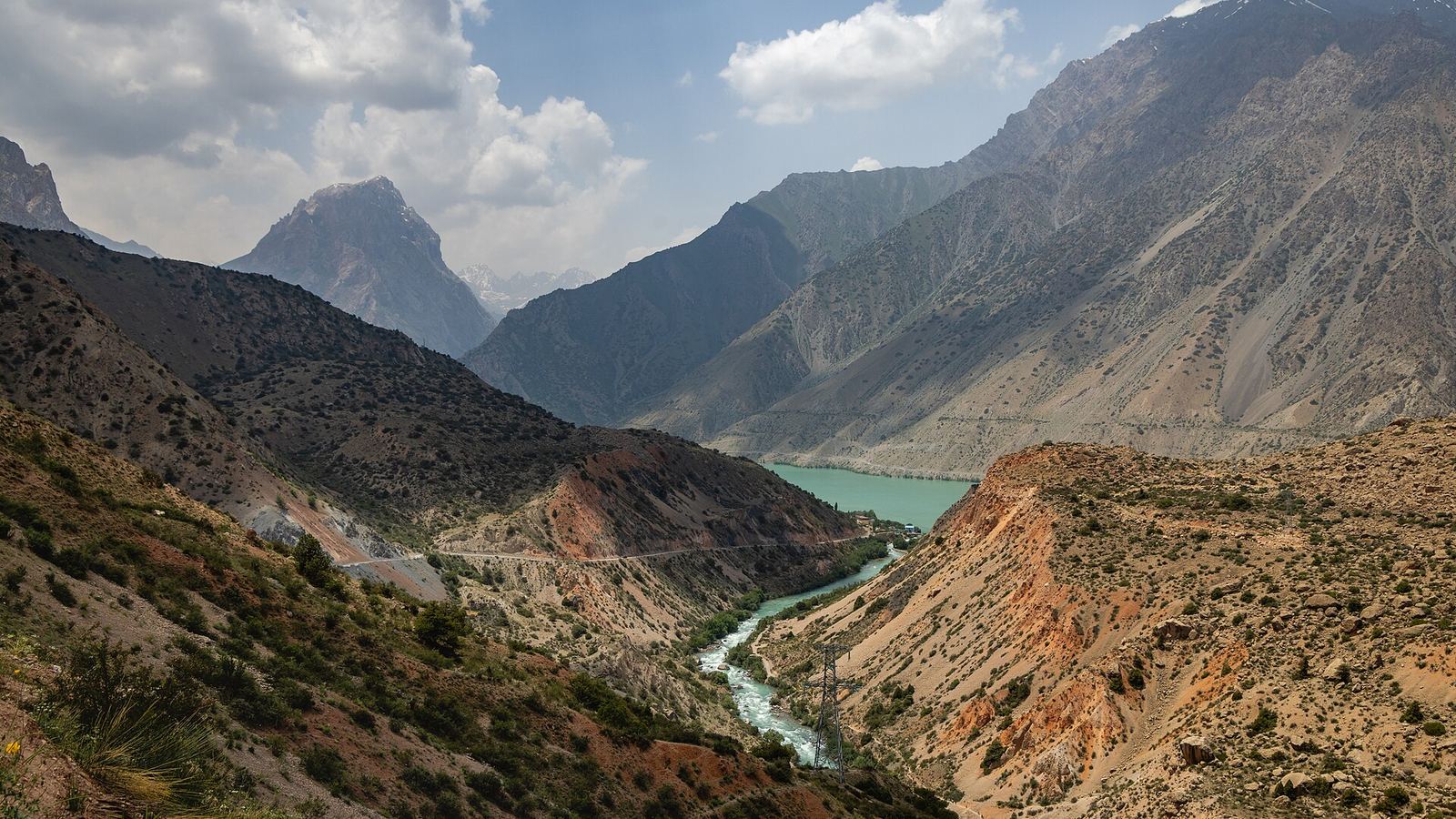
This is one of the few countries left where walking into a shop still wins the price argument outright, and it wins it by a factor of five or more. Twenty-five gigabytes on a local prepaid bundle costs less than a fifth of what five gigabytes costs from an international eSIM brand, because the eSIM brands are all buying wholesale from one carrier and marking it up in dollars while the operators are selling to people who earn somoni. The counter also gets you onto MegaFon, which nobody resells and which is the network travellers actually recommend for the mountains. What the counter costs you instead is time, a passport scan, cash in local currency, a shop that is not at the airport, and a device registration deadline that catches anyone staying past a month. Below is what each operator charges this summer, how the paperwork runs, and the split that makes sense for a two-week trip.
What This Guide Covers
Jump to the section most relevant to you
Four Networks, and Only One of Them Sells to You From Abroad
Roughly ten million active mobile connections sit on top of a population under ten million, spread across four operators in a country that is 93 percent mountain. Nobody has anything close to national coverage, and the differences between them show up exactly where a visitor notices.
Tcell is the biggest and the most visible, owned through the Aga Khan Fund for Economic Development, with shops on most commercial streets in Dushanbe and Khujand. Its reputation is urban: strong in the cities, inconsistent once the road starts climbing, and travellers reported repeated stretches through the summer of 2025 when it was barely usable in the Pamirs. MegaFon Tajikistan, three quarters owned by MegaFon of Russia with Tajiktelecom holding the remainder, is the one Pamir regulars name without hesitating, and it also topped independent speed measurement in late 2025 at about 13 Mbps down. ZET-Mobile is the old Beeline licence, rebranded in June 2019 and still legally Tacom, sitting somewhere near 800,000 users. Babilon-Mobile is the small home-grown operator, founded in 2000, and it is essentially a Dushanbe proposition.
The one that matters online is the one nobody carries
Every international eSIM brand selling this country connects through Tacom, the company behind ZET-Mobile. Airalo calls its plan family Sarez Telecom, Holafly names Tacom on the plan page, Nomad writes ZET Mobile. That is a genuinely strange situation: the network you can buy from your sofa is the third largest, not the one with the best mountain record. It is the strongest single argument for adding a physical MegaFon card to whatever you arrive with, and it costs so little in somoni that the decision is barely financial.
What a Tourist Actually Pays, in Somoni
Bundles here are sold the way they are across the former Soviet space: a lump of data with minutes and texts attached, valid for a month, renewed by topping up. Starter packages across the operators run somewhere between 65 and 300 somoni depending on how much data is inside. Promotions rotate constantly, so treat these as the shape of the market rather than a price list.
Summer 2026 bundle pricing
MegaFon is the one to price first if you are going east: roughly 130 somoni buys about 30 GB with minutes and texts, and around 160 somoni buys about 80 GB. ZET-Mobile is the cheapest per gigabyte, with something near 25 GB for about 59 somoni and 60 GB for about 99. Tcell is the priciest of the three, near 130 somoni for about 20 GB and around 180 for 30. Babilon-Mobile starts its tariff plans near 15 somoni and its data packages near 35 somoni for 1.5 GB, which only makes sense if you are staying inside the capital. At roughly 10.7 somoni to the dollar, the MegaFon 30 GB pack is about twelve dollars.
Hold that next to the international pricing on our Tajikistan eSIM guide, where five gigabytes over a month runs from 17 dollars at the cheap end to 32 at the expensive one, and the gap stops being a rounding error. You are paying a convenience premium of several hundred percent. That premium is worth it for the first day, when you have no local cash, no shop is open, and you need a taxi. It is very hard to justify for three weeks.
Two caveats keep the local card from being an automatic yes. The advertised allowances lean on voice minutes that a visitor booking through WhatsApp will never touch, so compare on data alone. And a plan that reads 30 GB is not 30 GB of usable coverage if your route spends four days somewhere with no mast at all, which is the whole point of the country page's warning about the M41.
The Passport Rule and the Address Question
Prepaid lines are registered to an identified person here, and for a foreigner that means the passport goes across the counter and the number is tied to it. Staff will also usually ask where you are staying, so have the hotel or guesthouse name and address written down. English is rare in the shops. Russian works everywhere, Tajik works better, and a translation app plus the name of the bundle on your phone screen gets the job done.
How the purchase runs, start to finish
1. Find a branded operator shop rather than a market stall, because the stall cannot complete the registration.
2. Hand over the passport with the visa or eVisa page visible, and give your address of stay.
3. Name the bundle by its data size rather than its marketing name, and confirm the total before paying.
4. Pay in somoni. Cash is expected and card acceptance is patchy outside the largest branches.
5. Wait ten to thirty minutes for activation, and do not leave until a map has loaded on mobile data.
Budget half an hour, and go in the morning rather than at the end of the day, since a queue plus a slow activation on a Friday afternoon is how people end up leaving without a working line. Everyone in a group needs to appear in person for their own number, so a family of four is four registrations, not one.
The other thing worth knowing before you commit: your number is now attached to your passport in a country whose international traffic all passes through a single state gateway, and whose regulator has cut mobile service across an entire region during unrest. That is not a reason to avoid buying one. It is a reason to keep your important messaging on a second line you control, and to expect that a nationwide restriction, if one arrives, applies to the local card and the eSIM alike.
The 30 Day IMEI Rule That Catches Long Stays
This is the detail most guides miss, and it is the one that turns a working phone into a paperweight in week five. Since October 2023 every handset brought into the country from abroad has to have its IMEI, the fifteen digit serial that identifies the device itself, entered into a state database. Visitors get a grace period: thirty days of using a local SIM with an unregistered foreign device, after which the network stops recognising the handset.
What to do if you are staying past a month
Registration happens through the IMEI.tj service and the fee is around 50 somoni per device, roughly four and a half dollars. Dial the code that displays your IMEI, or read it off the SIM tray or the settings screen, and expect to give passport details alongside it. The important nuance for anyone reading a travel site: this applies to the device on a domestic line. An international eSIM keeps working past the thirty day mark regardless, because your traffic is arriving as a visitor on a wholesale agreement rather than as a locally registered subscriber. For a long overland trip or a work posting, that is a genuine argument for holding both.
Two practical corollaries. If you are here for two weeks, ignore all of this, because you will be gone before the clock runs out. If you are here for a season, register on arrival rather than on day twenty-nine, since the office visit is trivial when it is not urgent and miserable when your line has already gone dark in Khujand.
Local Bundles and Travel eSIMs, Side by Side
| Option | What you get | Price | Suits |
|---|---|---|---|
| ZET-Mobile bundle | About 25 GB with minutes, 30 days | Around 59 TJS | The cheapest data in the country if you stay west |
| ZET-Mobile large | About 60 GB with minutes, 30 days | Around 99 TJS | A month based in the capital |
| MegaFon bundle | About 30 GB with minutes, 30 days | Around 130 TJS | Anyone whose route includes Khorog or Murghab |
| MegaFon large | About 80 GB with minutes, 30 days | Around 160 TJS | Long stays and heavy tethering |
| Tcell bundle | About 20 GB with minutes, 30 days | Around 130 TJS | City trips where shop coverage matters most |
| Travel eSIM, cheapest | 5 GB, 30 days, data only | About 17 USD, near 180 TJS | Arrival day and short stopovers |
| Travel eSIM, unlimited | Unlimited, 7 days, 1 GB a day of hotspot | About 71 USD, near 760 TJS | Working stays where a counter is unacceptable |
Read the right hand column rather than the middle one. The local cards are not merely cheaper, they are a different category of purchase: for the price of the smallest eSIM plan you can buy a bundle with five times the data and a number that Tajik drivers can ring. What you cannot buy locally is a working phone at the moment you land, which is precisely the gap the eSIM fills. Almost nobody needs to choose between them for the whole trip.
So Which One Do You Actually Buy?
The split below is what the pricing and the coverage map jointly recommend, rather than what is most profitable to say.
Get a local card when
Stick with an eSIM when
For most independent travellers the answer is both, in sequence, and the sequence matters more than the brands. Land with an eSIM already active so the arrival is frictionless, then treat a MegaFon shop as an errand for the first full morning, the same way you would treat changing money. Total outlay for the pair is under thirty dollars, which is less than one unlimited week from Holafly and buys you two networks instead of one. If you want a second opinion on the eSIM half of that, the eSIM Finder sizes it against your trip length, and the Dushanbe Airport guide covers why the shop errand cannot be done in the terminal.
Frequently Asked Questions
Is the local card genuinely cheaper, or just marginally so?
Genuinely, and by an unusual margin. A ZET-Mobile bundle of roughly 25 GB sells for about 59 somoni, near five and a half dollars, while the cheapest international eSIM for the same country asks 17 dollars for five gigabytes. That is not a discount, it is a different market: operators price for local wages while eSIM brands buy wholesale and resell in dollars. The trade is time, a passport scan and somoni in hand, so the calculation turns on how long you are staying rather than on the headline numbers.
Can I sort this out at the airport when I land?
No. Dushanbe International has no operator counter, landside or airside, at any hour, despite a large MegaFon advertisement inside the building that has misled plenty of arriving passengers. The nearest real option is a branded shop in the city the following morning, roughly fifteen minutes away by taxi. That single fact is why arriving with a working eSIM is worth the premium even if you fully intend to buy locally afterwards.
What happens to my phone after thirty days here?
If you are using a Tajik SIM, the handset needs its IMEI entered into the national database within thirty days of arriving in the country, and the network stops recognising an unregistered device after that. The registration runs through the IMEI.tj service for around 50 somoni per device. An international eSIM sidesteps the whole procedure, which is why long-stay travellers and anyone working here often carry both: the local card for cheap data and the eSIM as the line that cannot be switched off by a registration deadline.
If Khorog and Murghab are the point of my trip, which operator do I buy?
MegaFon, with no real competition on that specific question. It is the network Pamir travellers consistently report as the last one standing in GBAO towns, while Tcell has a history of extended outages out there and Babilon barely leaves the Dushanbe region. Buy it in the capital before you head east, because choice narrows sharply once you are past Kalaikhum. Understand what you are buying though: MegaFon holds up in the towns, not on the passes between them, where nothing works at all.
Will my Tajik number keep working when I cross into Uzbekistan or Kyrgyzstan?
Not at a price you would accept. Central Asia has no shared roaming arrangement of the kind that covers the European Union, so a card bought in Dushanbe reverts to international rates at Oybek on the way to Tashkent or at Kyzyl-Art on the road to Osh. Anyone doing a multi-country Silk Road loop should either buy a fresh local card in each country, which is cheap and easy at the border towns, or carry a regional eSIM and accept the higher per-gigabyte cost for the convenience.