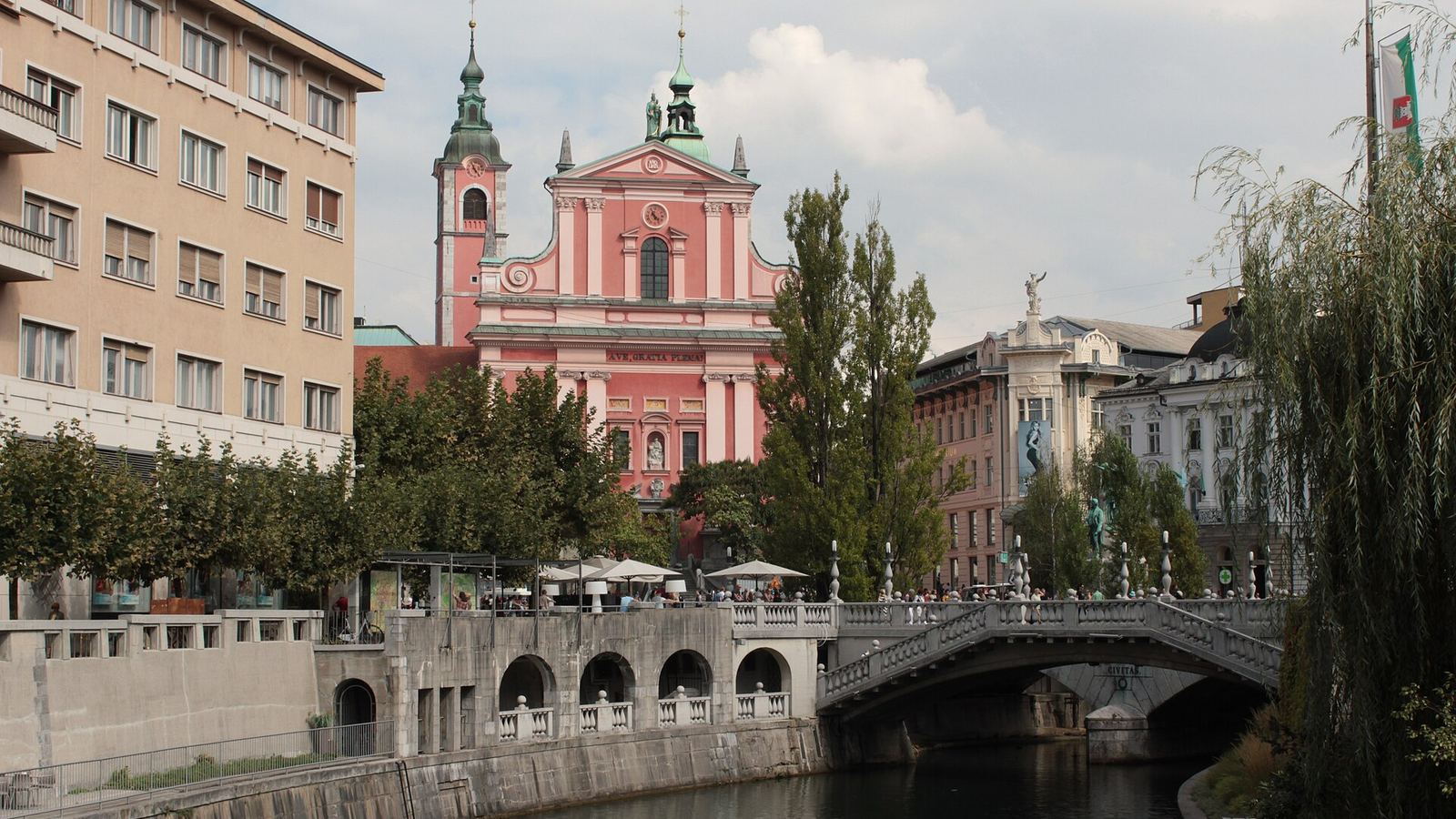
Ljubljana is a city of about 285,000 people with 20 hectares of pedestrian zone at its heart, which is the largest car-free centre in the European Union and has been closed to traffic since 2007. You can walk from the Triple Bridge to the far end of Trnovo in the time it takes to queue for a coffee in a bigger capital. All three major Slovenian networks blanket that footprint with 5G, cafe WiFi is everywhere, and honestly you could get through three days here on almost nothing. Which is exactly why people underbuy. Nobody comes to Slovenia and stays in Ljubljana, because the country is small enough that Bled is 45 minutes away, the Adriatic is a bit over an hour and the Julian Alps start on the horizon you can see from the castle. Buy for the drive, not for the square.
What This Guide Covers
Jump to the section most relevant to you
Signal Across a Capital You Can Walk Across
There is no coverage story in central Ljubljana in the sense of somewhere failing. A1 Slovenija is frequently the quickest thing on the street here, running roughly 85 percent 5G population coverage nationally with the capital obviously among the earliest builds. Telekom Slovenije pushed its own 5G footprint from 60 to 80 percent of the population in one modernisation programme and has been working toward a 99 percent target, and it is the network most locals default to. Telemach is perfectly quick across the centre as well. By the end of 2025, nearly 44 percent of all Slovenian mobile lines were already on 5G, and Ljubljana is where a large share of those sit.
The city's geography helps. Ljubljana sits in a flat basin with one hill in the middle, the castle mound, rather than a folded landscape of ridges and dead ground. The old town under the castle is a narrow ribbon of baroque buildings along the Ljubljanica, and even there you are never in a canyon of masonry the way you are in Piran or Kotor. Thick walls in the older houses along Stari trg and Gornji trg cost you a bar indoors, and the courtyards behind them cost you another, but street level is uniformly fine.
The castle ridge is a useful test
Ride the funicular up from Krekov trg or walk the path from Studentovska ulica and check your signal at the top. The Ljubljana Castle terrace has a clear line of sight north to the Kamnik Alps and west toward the Julian range, and it is where the scale of the country becomes obvious: everything you can see from up there is a day trip. It is also, in a small way, the last place your phone will behave predictably for the rest of the week, because the moment you head for that skyline the network conversation changes completely.
Buses, the Urbana Card and Kavalir
Ljubljana has no metro, no tram and no underground anything, which removes at a stroke the tunnel signal problem that dominates connectivity advice for most capitals. Public transport is buses, run by LPP, and they run above ground through a compact street grid with full coverage the entire way. You will not lose data on a bus here.
The fare system has one quirk worth understanding before you tap. A single journey costs 1.50 euros and includes 90 minutes of free transfers, but that transfer window only applies if you pay with an Urbana card, which costs 2 euros to buy and holds up to 50 euros of credit. Contactless bank cards are accepted on board too, and they are the easier option for a short visit, but paying that way means each boarding is charged separately with no free change. If you expect to make more than a handful of connecting journeys, the Urbana pays for itself quickly. Buy one at an Urbanomat machine, a kiosk or the tourist information centre.
Kavalir, the small electric thing that will pick you up
Inside the pedestrian zone the city runs free electric vehicles called Kavalir, introduced in 2009 under the CIVITAS ELAN programme. They carry five passengers, top out at 25 kilometres per hour and cost nothing. Wave one down or call the posted number and it will take you across the car-free centre, which is genuinely useful with luggage or on a hot afternoon between Prešeren Square and the market. Calling one is one of the small daily tasks in this city that assumes you have a working line, alongside e-scooter apps and the e-vignette you will need if you hire a car.
The main railway and bus stations sit side by side about a ten-minute walk north of Prešeren Square, and that is where every intercity connection begins. Coverage there is strong on all networks, which matters because Slovenian intercity buses increasingly want you to hold a ticket on a phone.
Neighborhood Notes: Center, Trnovo and Tabor
Center and the old town cover the stretch from Prešeren Square along Mestni trg, Stari trg and Gornji trg under the castle, plus the redesigned Slovenska cesta, where a 400-metre allée of 63 young ash trees replaced through traffic and cut black carbon levels by around 70 percent. Most visitors sleep somewhere in here. Signal is strong outdoors throughout, and the only soft spots are inside the older buildings on the castle side of the river, where thick walls and internal courtyards eat a bar or two. Every cafe on the riverbank has WiFi and most will give you the password unprompted.
Trnovo and Krakovo sit just south along the Gradaščica, a low-rise district of gardens, small houses and the church where Plečnik worshipped, with the architect's own house open as a museum. It is quiet, flat, five minutes from the centre on foot and comfortably covered. This is the part of Ljubljana that feels like a village inside a capital, and it is a sensible base if you want to be near the middle without being in the middle.
Tabor, Metelkova and the station end
North and east of the centre, around Tabor and the Metelkova complex, is where the hostels, the alternative culture scene and a lot of the cheaper accommodation are, all within a short walk of the railway station. Coverage is excellent, the area is flat, and being next to the station is a practical advantage if your Slovenia involves a lot of train and bus days out. It is louder at night than Trnovo, which is either the point or the problem depending on why you came.
Šiška and Bežigrad, north of the ring, are the residential districts where longer-stay visitors and apartment rentals cluster. Newer construction, wide streets and dense 5G make them the strongest ground in the city for anyone working remotely, and they are ten to fifteen minutes from the centre by bus. BTC City on the eastern edge is where the large operator shops and electronics retailers are if you decide you want a local card after all.
WiFree Ljubljana and Its 60-Minute Catch
The city runs a municipal wireless network called WiFree Ljubljana, and it reaches a great deal of the centre, the squares and the parks. The detail that guides tend to omit is the limit: ordinary users get 60 free minutes per day, refreshed each day, with unrestricted access only to the municipality's own websites beyond that. Holders of the Ljubljana Card get unlimited access for the card's duration instead, which is one of the more genuinely useful inclusions on a tourist card that also covers buses, the castle funicular, a boat cruise, bike hire and a long list of museums. Card prices have been listed anywhere from about 31 to 41 euros for 24 hours depending on the seller, so check before you commit.
Commercial WiFi is the better bet day to day. Ljubljana's cafes, bars and hotels almost universally offer it, the connections are fast, and the city's small size means you are never more than a few minutes from one. The market hall, the riverside terraces and the coffee places along Trubarjeva cesta all work fine for a video call.
What free WiFi covers here
Where it runs out
Getting Online on Your First Day
Three routes, and in Ljubljana they are closer in value than they are in most places, because Slovenian prepaid pricing is ordinary EU pricing rather than a bargain.
Option one: an eSIM bought before departure
The strongest argument for this in Slovenia is not price, it is that Ljubljana airport has no staffed carrier shop. Arrive with a plan already installed and the vending machine, the shop hours and the terminal WiFi all become irrelevant. Choose by network rather than by cost, since a Telekom Slovenije based plan behaves differently in the Alps than a plan riding the smallest operator. The Slovenia eSIM guide lists which provider sits on which network.
Option two: a local card once you are in town
Telekom Slovenije, A1 and Telemach all have branches in the centre and larger stores out at BTC City. A Telekom Slovenije tourist starter is around 8.50 euros with credit included, A1 sells 7 GB for 30 days at roughly 10 euros. You very likely will not be asked for a passport, since Slovenia has no blanket prepaid registration rule, though carry it anyway. The payoff is a Slovenian number and an EU roaming allowance that follows you to Trieste.
Option three: an eSIM now, a local card if the trip grows
What most people staying longer than a fortnight end up doing. Land connected, get a feel for how much of the country you are actually going to cross, and pick up a local line later if the answer turns out to be all of it. Running both costs very little and means a single dead network never strands you on a mountain road.
Whichever you choose, do two things before you leave the city: download the offline map for north-west Slovenia, and buy your motorway e-vignette online if you are hiring a car, because that purchase now happens through a website or app rather than at a kiosk.
Day-Trip Coverage: Bled, Bohinj, Postojna and the Coast
This is the section that decides which plan you should have bought. Ljubljana's day trips range from effectively urban to genuinely off-grid, and they are all close enough that most visitors do several.
| Day trip | Getting there | Coverage reality |
|---|---|---|
| Lake Bled | Arriva bus, around 6 EUR, 1h15 to 1h25, every 30 to 60 min. Train about 1h to Lesce-Bled, then 4 km. | Strong on all networks around the lake and in the town. Vintgar Gorge, 4 km north, is noticeably patchier in the ravine. |
| Lake Bohinj | Onward bus from Bled, roughly 40 min | Fine at Ribčev Laz and along the main shore. The side valleys and the Savica trail thin out quickly. |
| Postojna Cave | About 45 minutes by car, buses and trains from Ljubljana | Solid above ground. Underground there is nothing at all across 24 kilometres of passages. |
| Piran and the coast | Around 90 minutes to two hours by road | Good across the coastal strip. Piran's stone alleys cost you indoors, and the walls above town are the fix. |
| Soča valley and Vršič | Two to three hours, hire car realistically | Patchy to absent over the 1,611-metre pass and its 50 hairpins. Telekom Slovenije recovers soonest. |
The Bled run is the trip everyone does and it will not test anything. Bohinj, one valley further, is where the differences start to appear, and the Soča valley is where they become the whole experience. If your week includes a hire car and the words Vršič or Mangart, the network under your plan matters more than the number of gigabytes on it, which is why the unlimited Holafly option and the Telekom Slovenije based plans get the nod on the country guide over the cheapest listing.
Two things to do before you get on the bus
First, save the offline map, because the Bohinj side valleys and everything above the tree line in Triglav National Park are honest dead ground on every network. Second, book the timed entries in the city while you still have a comfortable connection: Vintgar Gorge runs slot-based admission, Postojna sells by departure time, and Bled parking machines increasingly expect an app rather than coins. The eSIM Finder will size a plan around whichever of these your week actually contains.
Frequently Asked Questions
Do I lose signal anywhere inside Ljubljana itself?
Barely. There is no metro and no tram here, so the tunnel problem that dominates connectivity advice in most capitals simply does not exist, and the city sits in a flat basin with a single hill in the middle. All three major networks run 5G across the centre. The only soft spots are indoors in the older baroque houses along Stari trg and Gornji trg under the castle, where thick walls and internal courtyards cost you a bar or two. Step onto the street or the balcony and it comes straight back.
What is the cheapest way to pay for a city bus, and does the Urbana card matter?
A single ride is 1.50 euros and it includes 90 minutes of free transfers, but that transfer window only applies when you pay with an Urbana card, which costs 2 euros and holds up to 50 euros of credit. Contactless bank cards work on board and are simpler for a short stay, but each boarding is then charged separately with no free change. Buy the Urbana at an Urbanomat, a kiosk or the tourist office if you expect to make connecting journeys. Ljubljana Card holders travel free on LPP buses regardless.
Can I get through a city break on the free municipal WiFi?
Not comfortably, because of a limit most guides skip over. WiFree Ljubljana gives ordinary users 60 minutes a day and then restricts you to the municipality's own websites, refreshing the hour each day. Ljubljana Card holders get unlimited access instead. Cafe and hotel WiFi across the centre is fast and generously shared, so you will rarely be stuck, but the things this city expects you to do on the move, calling a Kavalir, unlocking a scooter, buying a gorge slot, all happen away from a hotspot.
Which part of the city is best if I am working remotely?
Šiška or Bežigrad, north of the ring road, where the buildings are newer, the streets are wide and 5G is densest, with a ten to fifteen minute bus ride into the centre. Trnovo is the calmer alternative just south of the old town, low-rise and green and still walkable to everything. The old town itself is lovely and the least reliable of the three indoors, so if you are taking video calls from an apartment there, ask the host which floor and which side of the building you are on.
Is a Ljubljana plan enough for a day at Bled or in the Soča valley?
For Bled, yes on any network, since the town and lake shore are well covered and buses run every 30 to 60 minutes for around 6 euros. For Bohinj it is mostly fine along the main shore and thinner in the side valleys. For the Soča valley and the Vršič Pass it is not, and no plan really is: the pass climbs to 1,611 metres through 50 hairpins with long silent stretches on every operator. A Telekom Slovenije based plan reconnects soonest, and offline maps do the rest.