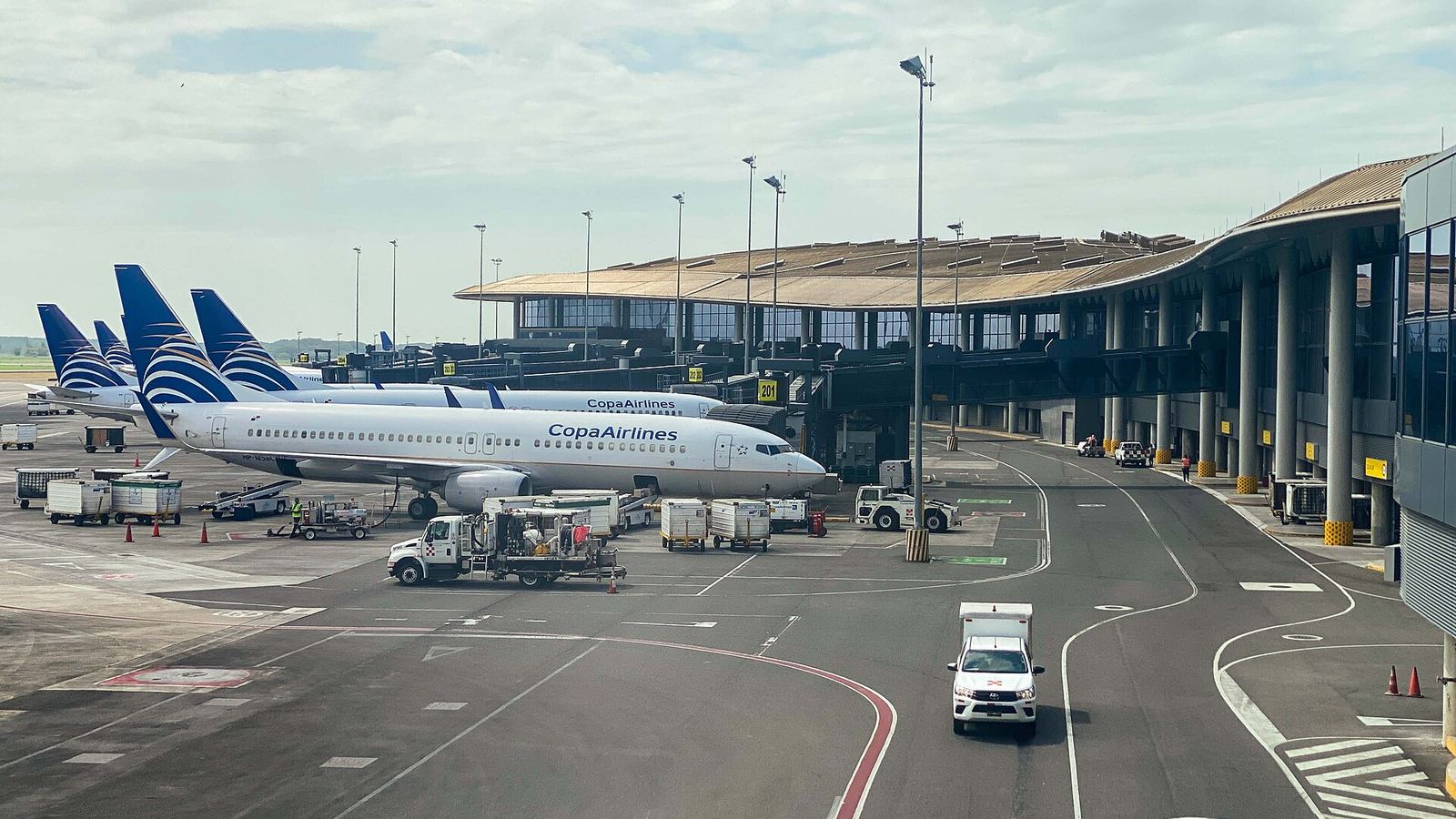
Tocumen calls itself the Hub of the Americas and handles the traffic to prove it, but it is a noticeably less friendly airport to arrive at without a connection than its size suggests. There is no row of carrier branches in arrivals. What you get is vending machines and reseller kiosks, an airport WiFi network that gives you one hour and then asks for a card, and a ride-hailing rule that makes hailing a car harder than it should be. None of that is a disaster, and all of it is easier if the phone in your pocket is already online when the aircraft door opens.
What This Guide Covers
Jump to the section most relevant to you
Where SIM Cards Are Actually Sold at Tocumen
Set your expectations correctly: Tocumen does not offer the arrivals-hall carrier shops you find at some Latin American hubs. Connectivity here is sold through self-service vending machines and reseller kiosks, principally Travel Data Global, which sells Claro-branded SIM cards. You will find them in the Arrival Hall near gates 130 and 131, in the transit area near gates 138 and 139, and on the North Pier. Electronics retailers in the terminal, including Xiaomi, also stock SIMs.
There is a wrinkle worth understanding. The kiosks sell Claro-branded product, but Claro Panama was acquired by +Movil for 200 million dollars and those subscribers and that spectrum now sit with the +Movil network. The branding on the packaging is lagging the market. In practice you are buying onto one of the country's two real networks, which is fine, but it is a good illustration of why airport connectivity decisions made under time pressure tend to be worse than ones made at home.
Two terminals, one decision
Tocumen runs the original Terminal 1 and Terminal 2, which opened in 2019, connected airside. Which one you land in depends on your carrier, and the SIM points are not evenly distributed between them, so a passenger arriving into T2 may have further to walk to find one than a passenger in T1. If your flight lands late, the vending machines are the fallback rather than a staffed counter, and a vending machine cannot help you when the activation does not take.
Panama uses the US dollar alongside the balboa at parity, so at least there is no exchange-rate arithmetic layered on top. Prices are quoted in dollars and read as dollars.
The Airport WiFi and Its One-Hour Limit
The network is called Airport_Tocumen and the free tier is metered rather than open: one hour at up to 10 Mbps, after which it wants payment. The paid tiers run roughly 4 dollars for an hour, 6 dollars for two hours, 10 dollars for four hours and 15 dollars for a full day.
Sit with those numbers for a second, because they change the economics of the whole arrival. Fifteen dollars for a day of airport WiFi is more than a lot of week-long travel eSIM plans cost, and four dollars for a single hour is more than some entire multi-gigabyte packages. If you are on a long layover at Tocumen, which many people are given how much connecting traffic passes through, the airport's own WiFi pricing is one of the strongest arguments for having an eSIM there is.
Use the free hour deliberately
If you have landed without a plan, the free hour is enough to do something useful with. Join Airport_Tocumen, buy a travel eSIM, install and activate it, and walk out with a real connection before the meter runs out. That is a better use of the hour than scrolling and then discovering at minute 61 that continuing costs four dollars. It is also the reason Tocumen itself now publishes an eSIM information page, which tells you something about how often passengers hit this wall.
Getting Into Panama City, and Why the Kerb Rule Matters
Tocumen sits about 24 kilometres east of the centre and there are three realistic ways in, separated by a factor of forty in price.
| Route | Cost | Time | Notes |
|---|---|---|---|
| Metro (Line 2 branch) | About 0.85 USD all in | 60 to 75 min | Aeropuerto station is a five-minute walk from the terminal. Transfer at San Miguelito for Line 1 into the centre. Needs a 2 dollar card. |
| Uber | 15 to 25 USD | 25 to 40 min | Cheapest door to door, but see the pickup rule below. |
| Licensed yellow taxi | 30 to 35 USD fixed | 25 to 40 min | Fixed rates to city-centre hotels. Cash only, in US dollars. |
The pickup rule is the thing to know in advance. Ride-hailing pickups are banned at the terminal arrivals kerb. To take an Uber you have to cross the pedestrian bridge to the visitor parking lot and board there. That is entirely manageable if you know about it and your phone works. It is a miserable discovery to make while standing outside arrivals with a dead SIM, watching drivers cancel because they cannot find you and the taxi rank quoting double.
The metro is genuinely the bargain
The Line 2 branch to the airport opened in March 2023, with one intermediate stop at ITSE. Line 2 costs 50 cents and Line 1 costs 35, so the full run into the centre with a transfer at San Miguelito comes to well under a dollar. You do need a Metro, MetroBus or RapiPass card first, at 2 dollars from a station machine, because the turnstiles do not take bank cards or cash. Trains run every three to eight minutes and are air conditioned. With luggage and in rush hour it is a slog; solo with a rucksack it is unbeatable value.
The Case for Landing With Data Already Running
Tocumen is an unusually clear illustration of why a few dollars spent before departure pays for itself. Three separate costs at this airport are avoidable purely by having a live connection when you land.
What arriving connected saves you
What it costs you
The choice of provider matters slightly less here than in some countries, because Panama only has two networks that count and both are strong across the capital and the airport corridor. Airalo and Nomad ride +Movil, Holafly rides Tigo. The Panama eSIM guide goes through the trade in detail, including the parts of the country where none of them help.
Airport Connectivity Options, Priced Honestly
Laying the options side by side makes the ranking unusually clear at this particular airport, mostly because the WiFi is metered.
| Airport WiFi | Kiosk SIM at PTY | Travel eSIM | |
|---|---|---|---|
| Cost | Free for 1 hour, then 4 to 15 USD | Varies by kiosk, generally cheap per GB | Roughly 5 to 15 USD for a typical trip |
| Working when | After you join, in the terminal only | After you find the kiosk and activate | Before the doors open |
| Works outside the terminal | No | Yes | Yes |
| Lets you book an Uber | Not from the parking lot | Yes | Yes |
| Panamanian number | No | Yes | Usually not |
| Best for | A short layover and nothing else | Long stays and anyone wanting a local number | Most visitors on trips under a month |
One number frames the whole page: a full day of Tocumen's own WiFi costs 15 dollars and stops at the terminal door, while a travel eSIM covering your entire trip often costs less and works in Casco Viejo, on the metro and up in Boquete. Sizing that plan is what the eSIM Finder is for, and the Panama City guide covers what your signal does once you are in town.
Frequently Asked Questions
Is there a carrier shop in arrivals at Tocumen?
Not in the sense of a staffed +Movil or Tigo branch. Connectivity at PTY is sold through self-service vending machines and reseller kiosks such as Travel Data Global, which stocks Claro-branded SIMs, plus electronics shops including Xiaomi. The main points are in the Arrival Hall near gates 130 and 131, in the transit area near gates 138 and 139, and on the North Pier. It works, but it is less convenient than airports where the operators themselves run counters.
How long is the free airport WiFi and what happens after?
One hour at up to 10 Mbps on the network called Airport_Tocumen, after which continuing costs money: roughly 4 dollars for an hour, 6 for two hours, 10 for four hours and 15 for a full day. Given that a whole travel eSIM plan for a Panama trip frequently costs less than that day rate, the metered WiFi is a strong argument for sorting connectivity out before you fly, especially if you have a long connection here.
Can I take an Uber from outside the terminal?
Not from the arrivals kerb. Ride-hailing pickups are prohibited there, so you must walk across the pedestrian bridge to the visitor parking lot and be collected from that side. Knowing this beforehand turns it into a five-minute walk. Discovering it on arrival with no data, while drivers cancel because they cannot reach you, is how people end up paying 30 to 35 dollars for a yellow taxi instead of 15 to 25 for an Uber.
Is the metro from the airport worth using?
For a solo traveller with light luggage, absolutely. The Line 2 branch to Aeropuerto station opened in March 2023 and the station is a five-minute walk from the terminal. Line 2 is 50 cents and Line 1 is 35, so the whole journey into the centre with a transfer at San Miguelito costs under a dollar against 15 to 35 for a car. You need a Metro, MetroBus or RapiPass card first at 2 dollars, since the gates take neither cash nor bank cards. Budget 60 to 75 minutes.
Will my Panama eSIM work if I am connecting on to Colombia or Costa Rica?
Not on a Panama-only plan. Tocumen is a major connecting hub and a lot of people passing through are heading elsewhere in the region the same week, so it is worth checking what you actually bought. Airalo and Nomad both sell Latin America regional plans covering multiple countries, which is the sensible purchase for a multi-stop trip. A single-country plan and a hopeful attitude at the border is not.