Islamabad is the easiest city in Pakistan to stay connected in and the one where the gap between the city and the hills behind it is most abrupt. The capital was drawn from scratch on a grid of lettered sectors in the 1960s, which means low density, wide avenues and cell sites with clear lines of sight, and LTE across the whole built area is genuinely good. Twenty minutes up Margalla Road, on a trail under the deodars, it is gone. The practical answer for a visitor is a roaming eSIM rather than a local SIM, not because the data is better but because the Pakistan Telecommunication Authority does not check the IMEI of a handset that stays on an international profile, and it very much does check one that takes a Jazz or Zong card.
What This Guide Covers
Jump to the section most relevant to you
Coverage Across the Sectors
Islamabad's address system is its own kind of coverage map. The city runs on a lettered and numbered grid, and the sectors a visitor spends time in are almost all in the F and G series, arranged in two long rows below the Margalla Hills. Density is low, buildings are short, and the result is that Jazz, Zong, Telenor and Ufone all deliver solid LTE more or less everywhere south of Margalla Road.
Expect something in the high teens to around thirty Mbps in ordinary use across the Blue Area, the diplomatic enclave in G-5, the university and hospital belt in H sectors, and the residential F and G sectors. That is unremarkable by regional standards and entirely sufficient for maps, ride-hailing, WhatsApp calls and uploading photographs. Congestion is not really an Islamabad problem the way it is in Karachi, because the city was built for two million people rather than twenty.
Where the grid stops working
The northern edge of every F sector runs into the Margalla Hills National Park, and that boundary is where coverage changes character. Daman-e-Koh, the terraced viewpoint above the city, holds a usable signal because it looks straight down at the transmitters. So does Pir Sohawa, higher up the ridge road, though less reliably. The trails between them do not. Trail 3 out of F-6 and Trail 5 up toward Pir Sohawa both drop into wooded ravines where the hillside is between you and the city, and the signal simply stops. This is a forty minute walk from a capital city with excellent coverage, and it surprises people every weekend.
The Metrobus, and Why Ride-Hailing Eats Data Here
Islamabad and Rawalpindi are functionally one metropolitan area joined by a dedicated busway. The red line of the Rawalpindi-Islamabad Metrobus runs 22.5 km from Pak Secretariat at the eastern end of the capital down to Saddar in Rawalpindi, calling at 24 stations, from around 6:15 in the morning until ten at night. The flat fare is 30 rupees, which is about eleven US cents. Buses are enclosed and air conditioned and the corridor is elevated or at grade the whole way, so mobile data holds up throughout the ride.
A separate branch runs out to the airport along the Srinagar Highway from the Peshawar Morr interchange. That leg is zoned rather than flat-fare and lands somewhere between 40 and 90 rupees depending on where you board, and it takes the better part of an hour end to end. The Islamabad Airport guide covers the arrivals hall and the alternatives to that bus with luggage.
The ride-hailing situation, which has changed
Do not arrive expecting the apps you know. Uber shut down its own operation in Pakistan, and Careem, which it owned, has since wound down ride-hailing here too. What remains, and what everyone in Islamabad actually uses, is inDrive and Yango, plus Bykea for motorbike rides and small deliveries. inDrive in particular works on live bidding: you name a fare, drivers counter, and you go back and forth. That is a chatty, connection-hungry process compared with a fixed-price app, and it is the single biggest reason visitors here burn more data than they expected. Budget for it when you size a plan, which the eSIM Finder will do from your trip length. Install at least two of the apps before you travel.
Taxis without an app exist and are negotiated in cash. Rates from the city out to the airport run in the low thousands of rupees, which is worth knowing as a sanity check when a bidding app quotes you something wild.
Blue Area, F-6 and F-7, and Saidpur Village
Three parts of the capital cover most of what a visitor does, and they behave slightly differently.
Blue Area
The commercial spine along Jinnah Avenue, running between the G-6 and F-6 sectors, and the closest thing Islamabad has to a downtown. Banks, airline offices, the taller buildings in the city and most of the business hotels. Coverage is the best in the capital, with several operators clustering capacity along the avenue. This is also where your bank card is most likely to be accepted, which is not true of much of the country.
F-6 and F-7
The two most walkable residential sectors, sitting directly beneath the hills. Kohsar Market in F-6 and Jinnah Super in F-7 are the cafe and restaurant clusters, and both are dense with reliable WiFi if you need it. Signal is strong throughout, though it can thin slightly on the northernmost streets of F-6 and F-7 where the ground starts to rise toward the park boundary.
Saidpur Village
A restored Mughal-era village tucked into a fold of the Margallas above F-6, now a run of restaurants and a couple of small temples and a mosque. It sits in a valley rather than on an open slope, so a phone that showed four bars in F-7 can drop to one or two here. Nothing dramatic, but worth knowing if you are meeting someone and relying on a live location pin.
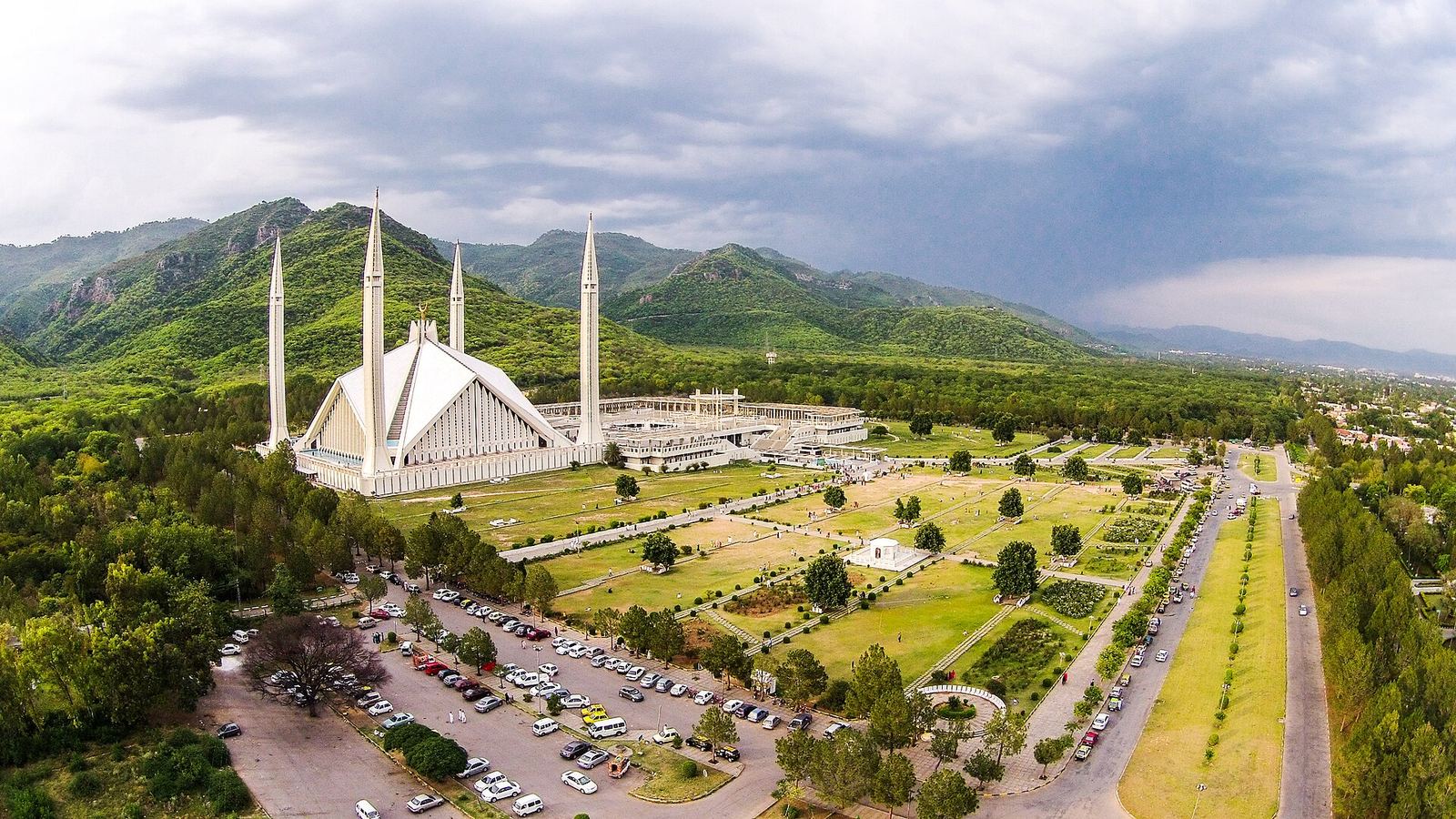
Two landmarks outside that trio are worth a coverage note. The Faisal Mosque in E-8, with its tent-shaped roof at the foot of the hills, has good signal across the vast marble courtyard. The Pakistan Monument and Lok Virsa on the Shakarparian ridge to the south are fine as well, sitting high and open. Rawal Lake, on the eastern edge, is patchier along the far shore.
Free WiFi in Islamabad, Honestly Assessed
Public WiFi here is best understood as a bonus rather than infrastructure. Various municipal free WiFi initiatives have been announced for parks, markets and the Metrobus corridor over the years, and their reliability has been uneven enough that no resident plans around them. What does work is commercial.
- Hotels. Business hotels along Jinnah Avenue and in the F sectors run proper fixed-line connections, which is what long-stay visitors lean on between unlimited mobile plans such as those in the Holafly review, and these are the most valuable thing on this page during a mobile data suspension, because fixed lines usually keep running when cellular data does not.
- Cafes. Kohsar Market in F-6, Jinnah Super in F-7 and the coffee chains inside Centaurus Mall in F-8 all offer WiFi to customers, usually with a password on the receipt.
- Malls. Centaurus and the newer retail complexes have guest networks, generally requiring a phone number for an SMS code, which is awkward if your travel eSIM is data only.
The SMS verification trap
This is worth flagging because it bites specifically in Pakistan. A great many guest WiFi portals here, and a great many Pakistani apps and delivery services, verify you by texting a code to a local mobile number. A travel eSIM is data only and has no Pakistani number, so those doors stay shut. Your home number will still receive international SMS if you leave your physical SIM active with roaming for texts only, which costs nothing on most plans and solves the problem for banking codes. For Pakistani services that specifically demand a local number, there is no workaround short of buying a local SIM, and that carries the device registration consequences covered in the Pakistan SIM card guide.
What to Do When Mobile Data Is Switched Off
Islamabad sees administrative suspensions of mobile internet more often than most capital cities. They cluster around large protests converging on the capital, major religious processions, and occasional security operations, and they typically hit the whole district at once, on every operator. A second SIM does not help. Neither does a different eSIM provider, because they all ride the same four physical networks.
Practical preparation
Download the Islamabad and Rawalpindi map area for offline use before you need it, and do the same for Murree if you are heading up there. Screenshot your hotel address in both English and Urdu, since a driver may not read the former. Note the hotel's landline. Agree a fallback meeting point with anyone you are travelling with rather than assuming you can coordinate live. Keep enough cash for a day, because a card terminal in a shop often runs over the same mobile data that has just gone away.
The blackouts are usually measured in hours rather than days in the capital itself, unlike parts of the country where suspensions have run for a week or more. Fixed-line broadband at hotels and offices normally stays up throughout, which is why it is worth knowing your hotel's WiFi password before you leave the building each morning rather than after.
Day Trips: Murree, Taxila and Khewra
Islamabad is a good base, and the three standard excursions differ sharply in how connected they keep you.
| Destination | Distance | Coverage | Notes |
|---|---|---|---|
| Murree | About 60 km northeast | Good, then patchy | Solid along the Murree Expressway and around Mall Road. The forested slopes below the ridge, and the Patriata chairlift area beyond, drop out repeatedly. |
| Taxila | About 35 km northwest | Good | The Gandharan sites and museum sit along the Grand Trunk Road corridor with dependable LTE. Fine for looking things up as you walk between Sirkap and the Dharmarajika stupa. |
| Khewra Salt Mine | About 160 km south | Good outside, none inside | Strong along the M2 motorway the whole way down. Once the little train takes you into the tunnels there is no signal at all, which is entirely expected in a salt mine. |
Murree is the one to plan for. The Expressway climbs from around 500 metres at Islamabad to over 2,000 at the hill station, and in winter the same route can be closed or crawling with snow traffic. Being unable to check road conditions because you have lost signal on a wooded switchback is a genuinely bad afternoon. Cache the map before you set off.
If your trip continues north from here rather than back to the capital, the calculus changes completely. The Karakoram Highway toward Gilgit and Hunza is not a day trip and not a place where any commercial network is dependable. Which physical operator your provider rides starts to matter enormously at that point, and the Pakistan eSIM guide sets out that mapping provider by provider.
Frequently Asked Questions
How fast is mobile data in the capital, realistically?
Expect somewhere in the high teens to around thirty Mbps on LTE across the F and G sectors, the Blue Area and the diplomatic enclave. That is enough for maps, video calls and uploads without thinking about it, and it is consistent because Islamabad is a low-density planned city rather than a congested one. Pakistan only auctioned next-generation spectrum in March 2026 and commercial 5G is arriving slowly, so do not choose a plan on the strength of a 5G badge.
Will I have signal walking the Margalla Hills trails?
At the viewpoints yes, on the trails often not. Daman-e-Koh and Pir Sohawa look straight down at the city's transmitters and generally hold a usable signal. Trail 3 from F-6 and Trail 5 heading up toward Pir Sohawa both dip into wooded ravines where the hillside blocks everything, and the drop is sudden rather than gradual. Download the trail offline and tell someone your route, because this is a serious hill immediately behind a capital city.
Which apps do I actually need to get around Islamabad?
inDrive and Yango for cars, and Bykea if you are comfortable on the back of a motorbike. Uber left Pakistan and Careem has wound down its ride-hailing here, so the apps most visitors arrive with are useless. inDrive works by live negotiation, which means the app stays open and connected while you and the driver trade offers, so budget a little more data than you would for a fixed-fare service.
Can I use a travel eSIM to sign up for local delivery apps?
Usually not, because most Pakistani services verify you with an SMS code sent to a local number and a travel eSIM carries no number at all. Keeping your home SIM active for incoming texts covers international codes such as your bank's, but not a Pakistani platform that insists on a Pakistani mobile. If local apps matter to your trip, the answer is a local SIM in a spare handset rather than in your main phone.
Is the Metrobus a reasonable way to reach Rawalpindi?
Yes, and it is absurdly cheap. The red line runs 22.5 km from Pak Secretariat to Saddar in Rawalpindi across 24 stations for a flat 30 rupees, roughly a tenth of a dollar, with buses from about 6:15 in the morning to ten at night. The corridor is elevated or at grade rather than tunnelled, so your data holds throughout the journey and you can navigate to whatever you are looking for around Raja Bazaar as you approach.