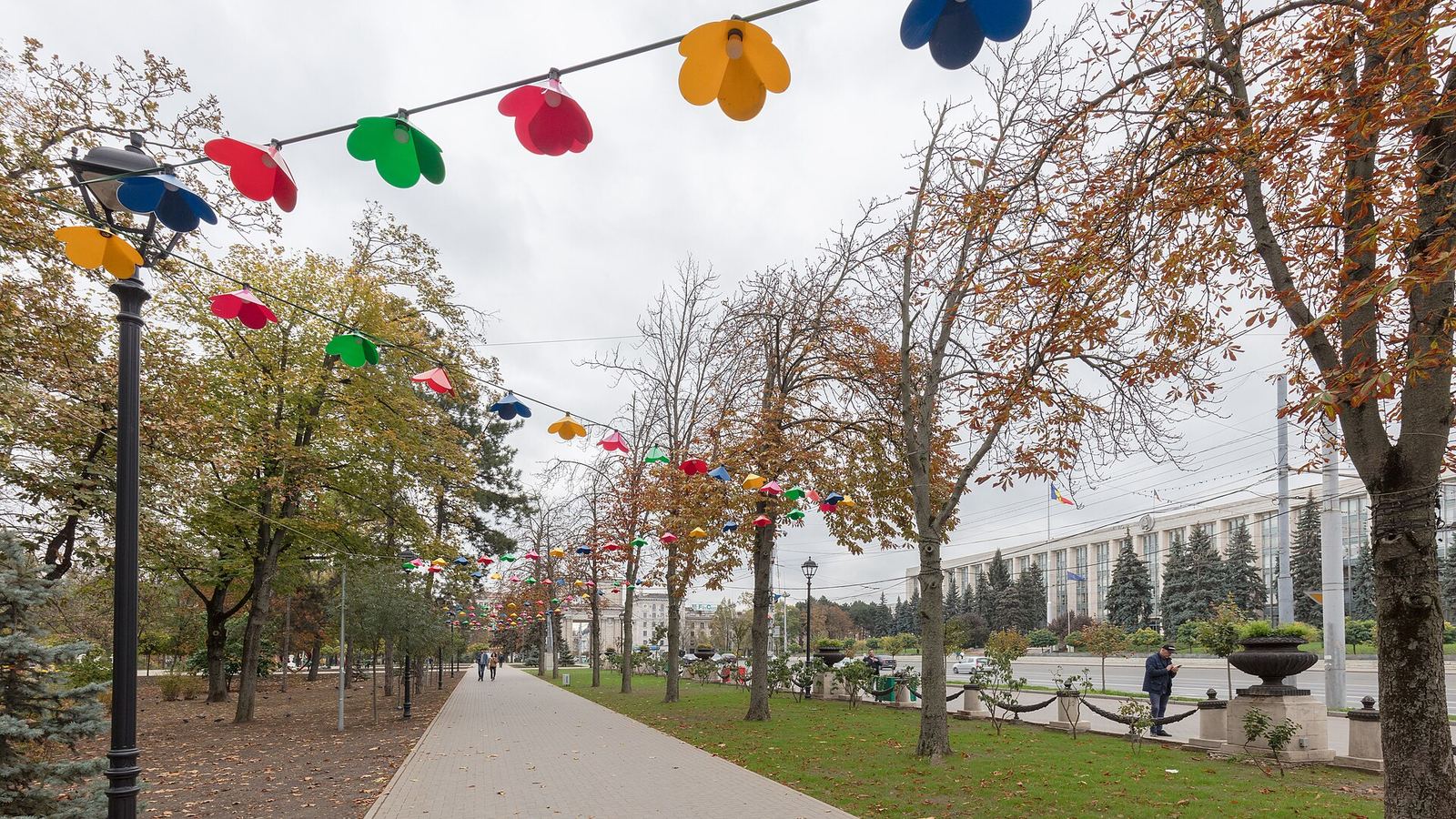
Chisinau is an unusually forgiving city to be connected in. It has no metro, so there is no tunnel network to lose signal in, the built environment is low and wide rather than dense and vertical, and all three Moldovan operators cover the centre thoroughly with 4G and increasingly with 5G. A traveller with almost any working data plan will spend the week without thinking about it. The interesting parts of this page are the two places where that stops being true: seventy metres down inside the wine galleries at Cricova and Milestii Mici, and an hour east on the far bank of the Dniester, where a different telecoms system begins and yours ends.
What This Guide Covers
Jump to the section most relevant to you
How Mobile Coverage Behaves Across Chisinau
The capital holds around 700,000 people and sprawls comfortably over the hills above the Bic river, which is good news for radio. Orange Moldova, Moldcell and Moldtelecom's Unite brand all blanket the built-up area with 4G, and all three have 5G live in at least parts of the city, Orange having been first to switch it on. Typical speeds on a travel eSIM riding Orange sit in the tens of megabits, which is far more than mapping, translation and video calls demand.
Where you notice differences is at the margins. The Soviet-era apartment blocks in the outer districts are built of thick precast concrete panels, and indoor reception on an upper floor facing away from the nearest mast can drop a bar or two. The wooded slopes down towards Valea Morilor lake and the dips along the Bic can go quiet in a way the flat centre never does. Neither is a problem you plan around; both are worth knowing when your phone suddenly stalls in a stairwell.
The absence that helps you
Chisinau has no underground railway. Plans for a metro have circulated since the Soviet period and none was ever built, so the transport system runs entirely at street level on trolleybuses, buses and minibuses. For a visitor that means no cellular blackouts between stations, no station WiFi to fumble with, and continuous data on every journey you make inside the city. It is the opposite of the usual capital-city advice, and it removes a whole category of connectivity problems.
Trolleybuses, Rutieras and Data on the Move
Chisinau runs one of the larger trolleybus networks in the region, with overhead wires threading most of the main arteries and a fleet that now includes battery-assisted vehicles able to run beyond the wires. Alongside them are city buses and the rutiera, the shared minibus that stops wherever you ask it to and forms the backbone of how the city actually moves.
Fares and payment in 2026
A single ride costs 7 lei on trolleybuses, buses and minibuses alike, following the increase that took effect on 1 May 2026. Before that it was 6 lei, and before July 2022 it was an almost unbelievable 2 lei, so any guidebook or blog post quoting those figures is out of date. A monthly pass runs about 234 lei and pays for itself somewhere around the fortieth journey. Most vehicles still want cash and a conductor will come to you on trolleybuses, though contactless card acceptance is being piloted on a handful of routes. Carry small notes.
Data on board is a non-issue. Because nothing goes underground, your eSIM keeps a normal signal for the entire journey, whether you are riding trolleybus 30 out along Dacia to the airport or crossing town on a rutiera. That reliability matters more than it sounds, because Chisinau stops are not consistently announced and the route numbering rewards anyone who can watch their position on a live map. Bolt and Yandex Go both operate here and quote a fixed fare before you accept, which is the simplest option late at night and the reason many visitors want working data more than they want a bus timetable.
District Notes: Centru, Botanica and Riscani
Chisinau divides into five administrative sectors, and three of them account for almost everything a visitor does.
Centru
The spine is Bulevardul Stefan cel Mare si Sfant, which runs past the Government House, the Triumphal Arch, the Nativity Cathedral in its park, and the Great National Assembly Square. This is the densest concentration of masts in the country and the fastest data you will find in Moldova, along with the operator flagship stores and most of the cafes with reliable WiFi. If your plan works anywhere, it works here.
Botanica
South of the centre, laid out in wide Soviet-planned blocks around Valea Trandafirilor park and the botanical garden. Outdoor coverage is uniformly good and the park is a pleasant place to work outside. Indoor reception in the older nine-storey blocks can be noticeably weaker than the street outside, which surprises people who booked an apartment rather than a hotel.
Riscani
North-east across the Bic, a mix of residential blocks, the Rasarit district and the approach roads towards Orhei and Balti. Coverage is solid throughout and this is where several long-distance departures leave from, so it is worth having live data if you are catching an early minibus north rather than trusting a printed departure board.
Two more sectors complete the map. Buiucani spreads west past the circus building and the Valea Morilor lake, and Ciocana runs east towards the industrial edge of town. Both are fine on all three networks; neither is somewhere most visitors spend an afternoon.
Free WiFi in Chisinau, and Where It Is Genuinely Good
Moldova punches well above its weight on fixed internet, with fibre reaching a large share of households, and that quality flows through into the WiFi you can use for free around the capital.
The city's central parks are the pleasant surprise. Stefan cel Mare Park, the oldest in the country and the one that opens off the main boulevard, offers free WiFi and a set of benches with built-in power sockets, which makes it a legitimate outdoor office rather than just a nice place to sit. Several other city parks carry the same free service. Beyond the parks, the two big domestic restaurant chains, La Placinte and Andy's Pizza, both have dependable connections and are everywhere, and the shopping centres including Shopping MallDova and Unic offer guest networks.
Using it well
Treat cafe and park WiFi as your bulk-download layer rather than your connection. Before a day trip, use it to pull down offline maps of the whole country, your accommodation details, your return transport times and anything you would otherwise look up on the move. That habit costs nothing in Chisinau and is the single thing that saves a day in the wine cellars or across the Dniester, where no amount of plan choice will produce a signal. Avoid banking or password entry on open networks as you would anywhere.
What free WiFi will not do is cover the walk between places, and Chisinau is a walking city with long boulevards and inconsistent street numbering. That gap is the entire argument for a working data plan here, rather than any dramatic coverage problem. The Moldova eSIM guide compares the options on price and on which network each one rides.
Day Trips: Wine Cellars, Orheiul Vechi and Going Offline
Moldova's headline attractions sit within an hour of the capital, and two of the three are underground. This is where a page about data stops being theoretical.
| Day trip | Distance from Chisinau | Signal |
|---|---|---|
| Cricova | About 14 km north | Fine at the surface entrance, gone in the galleries. Around 120 km of limestone tunnels, toured by electric train, with streets named after wines and a constant temperature near 12 degrees. |
| Milestii Mici | About 20 km south | The same story on a larger scale. Roughly 200 km of galleries hold the Guinness-recognised largest wine collection in the world. You drive through it, and you do so with no bars. |
| Orheiul Vechi | About 60 km north-east | Good on the ridge and in Butuceni village, patchier down in the Raut gorge and inside the cave monastery cut into the cliff face. |
| Purcari and the south-east | About 110 km | Reliable along the road and at the estate, thinning between villages on the back lanes towards the Dniester. |
The wine cellars deserve a specific warning that has nothing to do with which provider you chose. Tens of kilometres of tunnel dozens of metres beneath limestone will defeat any mobile network on earth, and both Cricova and Milestii Mici are large enough that groups genuinely do get separated inside them. Agree a meeting point at the surface before you descend, keep your tour vehicle's number written down rather than stored in a chat you cannot open, and do not plan to call your driver from the middle of the collection.
Both cellars also want booking in advance, often by phone or messaging app, and weekend slots go early. Sorting that from a cafe in Chisinau the day before, while you still have a connection, is a better plan than trying to arrange it at the gate.
The Tiraspol Day Trip, Planned for No Signal
The most-taken day trip out of Chisinau is also the one that turns your phone into a camera. Minibuses to Tiraspol leave regularly from the central bus station beside Piata Centrala and take roughly an hour and a half to two hours including the boundary stop, where a passport check produces a migration card usually valid for around ten hours. Keep it; you hand it back on the way out.
Somewhere on that road your data stops being dependable. Transnistria runs its own operator, Interdnestrcom, which has no roaming relationship with the Moldovan networks, so neither a local prepaid card nor a travel eSIM has anything to attach to once you are properly inside. Bender, which sits on the western bank and is the first Transnistrian-controlled town you reach, tends to hold a right-bank signal longer than Tiraspol does. Expect a phone that hunts, finds something briefly, then gives up.
The pre-crossing checklist
Do all of this on Chisinau WiFi the night before, not at the bus station. Download an offline map covering Bender and Tiraspol. Screenshot your return minibus times and the address of the departure point. Save your accommodation address as an image rather than a link. Bring cash in lei or euros to change into Transnistrian rubles, since foreign bank cards are not accepted. And tell someone your rough plan, because you will not be checking in from the other side.
Cafes, hotels and restaurants in Tiraspol do have WiFi, and it is generally fine, so you will not be cut off all day. You will simply be offline between buildings, which is exactly the pattern travellers find disorienting after a week of seamless coverage in the capital. Our Moldova SIM card guide goes deeper into how the two telecoms systems came to be separate, and the eSIM Finder will size a plan for the Moldovan side of your trip.
Frequently Asked Questions
Does my phone keep a signal on Chisinau's trolleybuses and minibuses?
Yes, without exception. The capital has no metro and never built one, so every route in the city runs at street level where coverage is continuous on all three Moldovan networks. You can watch your position on a live map for the whole ride, which is genuinely useful because stops are not always announced and rutiera routes take some learning. A single fare is 7 lei as of May 2026 and most vehicles still want cash.
Why did my data die at Cricova, and could a different provider have prevented it?
No provider could have prevented it. Cricova's galleries run around 120 kilometres through limestone dozens of metres below the surface, and Milestii Mici is larger still at roughly 200 kilometres. Mobile signal does not travel through that much rock regardless of which network you chose or how much you paid. Take the practical precautions instead: agree a surface meeting point, write down your driver's number on paper, and finish any booking or messaging before you go down.
Which part of Chisinau has the fastest mobile data?
The stretch of Bulevardul Stefan cel Mare si Sfant between the Government House and the Great National Assembly Square, which has the densest mast coverage in the country and the earliest 5G. Botanica and Riscani are perfectly good outdoors but can feel weaker inside the older concrete apartment blocks, particularly on upper floors facing away from the street. If you are testing a new eSIM on arrival, do it on the main boulevard where a failure means the eSIM rather than the location.
Is the free WiFi in the city parks worth using?
More than you would guess. Stefan cel Mare Park, just off the main boulevard, offers free WiFi and benches fitted with power outlets, and several other central parks carry the same service. It is a reasonable place to work for an hour and an ideal place to bulk-download offline maps before a day trip. La Placinte and Andy's Pizza branches across the city are the dependable indoor fallback, and the shopping centres run guest networks.
Can I use a Moldovan plan for a day in Tiraspol and Bender?
Only in patches. The region is served by Interdnestrcom, which has no roaming arrangement with Orange, Moldcell or Unite, so a Chisinau-bought SIM and a travel eSIM both struggle equally. Bender holds a right-bank signal better than Tiraspol because of where it sits on the river. Prepare as if you will be offline: offline maps, screenshotted return times and addresses, and cash for Transnistrian rubles. Venue WiFi on the other side is widely available and generally decent.