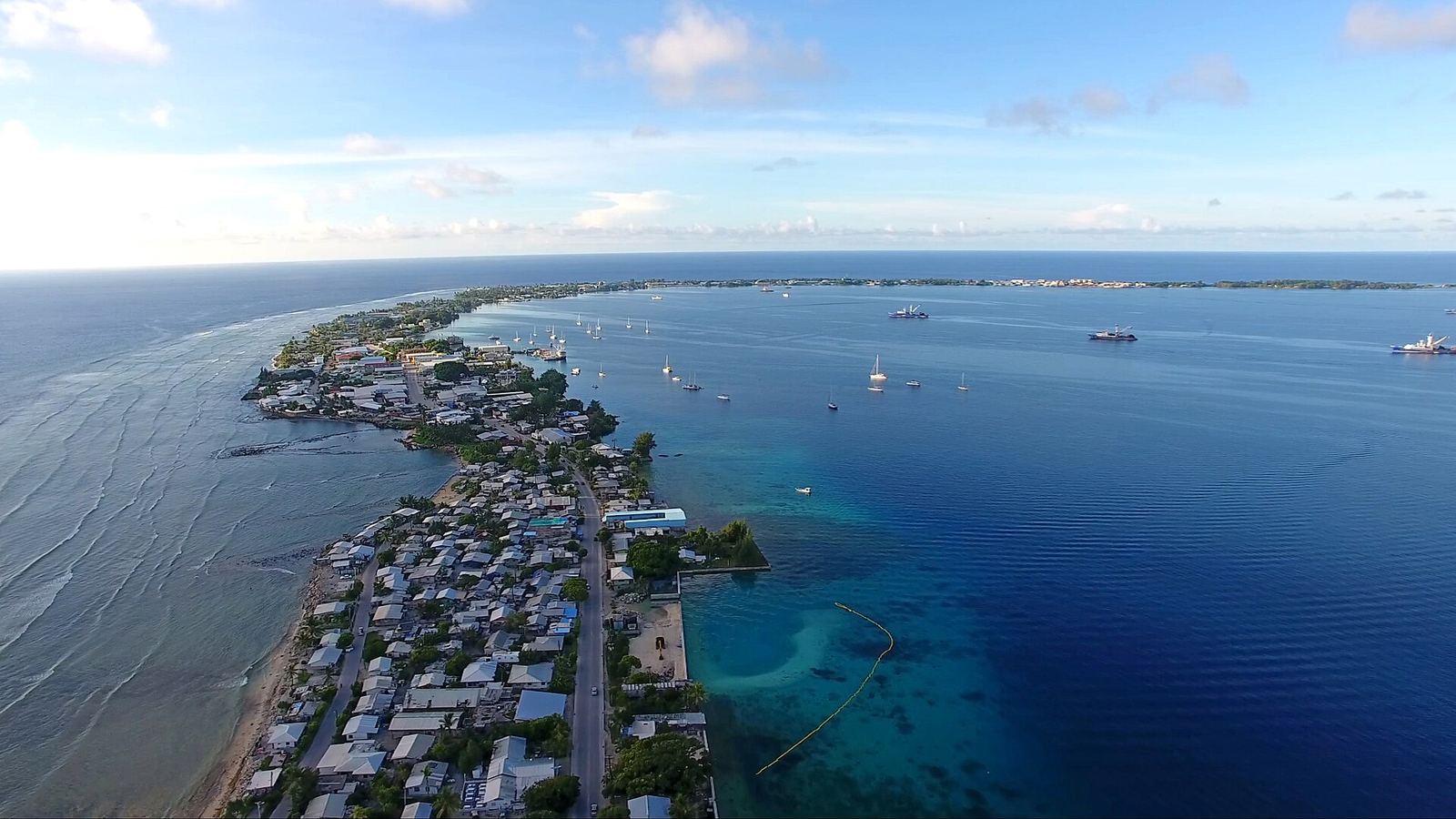
The Compact of Free Association does nothing whatsoever for your phone. That is the fact to settle before anything else, because almost everything else about the Marshall Islands points the other way: prices are in US dollars, the post office moves US mail, and the amended Compact signed in Honolulu in October 2023 runs the defence and migration relationship with Washington out to 2044. Travellers read all that and assume their carrier comes along. It does not. The country dials +692, sits outside the North American Numbering Plan, and is not sold as a roaming destination by the three carriers most visitors arrive on. Verizon names the Marshall Islands on its list of countries TravelPass does not cover. AT&T's International Day Pass destination list runs from Mali to Myanmar without it. T-Mobile's published roaming destinations skip it as well. Land with data roaming switched on and you are billed at pay-per-use rates with no day cap to stop the meter, which is how visitors here end up with four-figure invoices. There is no travel eSIM to fall back on either: Airalo, Holafly and Nomad all return a dead page for the country in 2026, and the Oceania regional bundles are built around Australia, New Zealand and Fiji rather than Micronesia. What actually works is a prepaid line from NTA, the only operator, bought over a counter in Majuro. It is priced in dollars, so for once you can compare it against your roaming bill with no currency arithmetic at all. If your route carries on to a Pacific country where a reseller does have a product, the eSIM Finder will point you at it.
What This Guide Covers
Jump to the section most relevant to you
Getting Online in Marshall Islands
No travel eSIM provider currently sells a plan for Marshall Islands, so the realistic options are a local SIM on arrival, roaming from your home carrier, or satellite.
A local SIM on arrival
NTA sells prepaid SIMs in Majuro.
Majuro and Ebeye have service. The outer atolls do not.
Satellite, if you need to stay reachable
Cellular coverage in Marshall Islands stops well short of where visitors go. A satellite communicator is the only thing that works everywhere, and it is what most people who travel here regularly carry.
Garmin inReach Mini 2
Two-way messaging and SOS over Iridium, which reaches the whole Pacific including atolls with no cellular network of any kind.
Visit Garmin inReach Mini 2 →ZOLEO
Cheaper hardware than the Garmin, pairs to your phone, and hands back over to WiFi or cell automatically wherever either one exists.
Visit ZOLEO →Mobile Networks in Marshall Islands
The National Telecommunications Authority, universally just NTA, is the mobile network here. It is also the fixed-line operator, the main internet provider and the television carrier, which tells you how small a market this is: roughly 42,000 people spread over 24 inhabited atolls and a couple of million square kilometres of ocean. The Nitijela ended NTA's statutory monopoly in 2022, and the practical result so far has been Starlink rather than a second mobile carrier, so on the mobile side there is still exactly one network to connect to.
What a line costs. NTA restructured its prepaid line-up at the start of 2026, retiring the old $25 interim voice-and-data plan on 1 February. The menu now reads: Free Call at $30 a month for unlimited national voice and SMS with no data attached; Lite Data at $10 for 5 GB, designed to bolt onto a voice plan; 4G Plus at $50 for up to 50 GB; and 4G Max at $70 with no data cap. Most visitors want either the $10 data add-on or, for a working trip, the $50 tier. The SIM itself runs around $15 with registration adding roughly $10, and NTA registers every card against a passport, so bring yours. Note what those numbers mean in context. A month of unlimited voice and 5 GB of data costs $40, which is four days of a typical US carrier day pass, and the day pass does not work here anyway.
Where you buy it. Not at the airport. There is no SIM counter at Amata Kabua International, so plan on the NTA office in Delap, near the Capitol building on Majuro, or the NTA office on Ebeye. Opening hours are ordinary business hours, Monday to Saturday, which matters because the Island Hopper and the Nauru Airlines services do not always land inside them. Your first night will be a hotel WiFi night either way, and nothing about arriving in Majuro requires you to have a local number in hand.
The network itself. NTA launched LTE on band 28 at 700 MHz in 2017, sitting above legacy 2G and 3G service. Band 28 is well supported on handsets sold anywhere, so a modern unlocked phone registers without drama. What limits you is geography, not radio compatibility. The mobile network reaches Majuro and Ebeye properly and then a short list of outer-island sites including Jaluit, Wotje, Kili and Rongelap. Everything else is off the map. A $10 million US Treasury grant is funding a 4G-to-5G upgrade for Majuro and Ebeye plus first 4G service for some remote atolls, but treat that as a plan for the future rather than something to book a trip around.
Why Majuro is fast and the rest is not. International capacity arrives on HANTRU-1, a 2,917 km fibre system running from Guam via Pohnpei to the Reagan Test Site on Kwajalein, then to Ebeye and on to Majuro, live since 2010. Those two population centres are the only places in the country sitting on that cable. Everywhere else depends on satellite, which since 2025 increasingly means Starlink; a ground station at Laura, at the far western end of Majuro Atoll, is due to be operational during 2026. The fragility is real: a cut on the Ebeye segment in early 2025 knocked the island off fibre, and NTA kept services running on Starlink until it was repaired.
The Island Hopper paradox
United's flight 154 crosses from Honolulu to Guam with stops at Majuro, Kwajalein, Kosrae, Pohnpei and Chuuk. Your American phone works at both ends of that route and at no point in the middle. It even fails at Kwajalein, where the aircraft parks on a United States Army airfield: Bucholz sits inside US Army Garrison Kwajalein Atoll, entry needs sponsored authorisation orders, and passengers without them do not leave the aircraft. If you are on the full hop, download everything you need in Honolulu.
Coverage Across Marshall Islands
Coverage where travelers actually go:
| Area | Coverage | Notes |
|---|---|---|
| Majuro (Delap, Uliga, Djarrit) | Good | The capital strip holds solid 4G along the single main road, covering the hotels, the ministries, the NTA office and the port. |
| Laura and western Majuro Atoll | Usable | Signal thins along the 30 mile atoll road out to Laura beach. Workable at the village end, unreliable in between. |
| Ebeye, Kwajalein Atoll | Usable | The second population centre and the only other place on the fibre. Coverage is real but capacity is tighter than Majuro's. |
| Kwajalein Island (USAG-KA) | Restricted access | A US Army installation with its own separate communications. You cannot set foot here without sponsored entry orders, so plan around Ebeye. |
| Jaluit, Wotje, Kili, Rongelap | Basic | The handful of outer atolls with a mobile site at all. Expect enough for messages near the settlement and nothing beyond it. |
| Arno, Maloelap, Mili, Bikini and boat legs | None | Arno is 90 minutes by boat from Majuro and already outside the network. Inter-atoll crossings and dive charters are dead ground. |
How to Prepare
There is no product to compare, so the useful work all happens before you fly. Take it in this order.
Turn data roaming off before the wheels leave Honolulu. This is the single step that saves the most money on this trip. Because no major US carrier sells a day pass covering RMI, there is no $10 or $12 ceiling waiting to catch you; you fall through to per-megabyte pay-per-use, and a phone left to sync photos overnight in a Majuro hotel does not care that it is roaming. Kill background app refresh and automatic backups as well, then turn the whole radio off and live on WiFi until you have a local SIM.
Call your own carrier and get the answer in writing. Lists change, and support staff routinely confuse the Marshall Islands with Guam or the Northern Marianas, which are US territories with entirely different treatment. Ask specifically about country code 692 and ask what the per-megabyte rate is if roaming does connect. If the answer is that they do not have a rate for it, that is your cue to plan on a local SIM and nothing else.
Budget the local line honestly. Around $15 for the SIM, about $10 to register it, then $10 for 5 GB or $50 for 50 GB. Everything is in dollars, which removes the usual guesswork about whether a foreign plan is good value. For a week of maps, messaging and email in Majuro, the cheap tier is plenty. For anything involving uploads, take the $50 plan and do the heavy work on hotel or office WiFi anyway.
Plan the outer atolls as offline days, because that is what they are. Air Marshall Islands serves the outer islands on a schedule that moves, and a delayed return leg is normal rather than alarming. If your itinerary includes Bikini, Rongelap, Maloelap or an Arno overnight, leave contact details for your operator with someone at home, agree that silence is expected, and carry your bookings as files on the device rather than as links you cannot open.
Get the practical downloads done in advance. Offline maps of Majuro Atoll and Ebeye, your accommodation and flight confirmations, and anything you would normally stream. Move two-factor codes off app-based authenticators where you can, since an authenticator that needs a data connection is a poor friend on an atoll. And carry a power bank: Majuro's grid is generally steady, but outer-island power is not, and there are long days here spent nowhere near an outlet.
Frequently Asked Questions
The Marshall Islands uses US dollars and has a Compact with Washington. Why does my carrier treat it as foreign?
Because free association is a treaty relationship, not territorial status. The Marshall Islands is a sovereign United Nations member state with its own telecoms regulator, its own operator and its own +692 dialling code, and none of that is inside the North American Numbering Plan. Carriers build roaming from commercial agreements with local operators, and a country of 42,000 people generates too little traffic to be worth papering. The currency, the postal arrangement and the visa-free access for US citizens are all real, and none of them reaches your billing system.
Is there really nothing sold by Airalo, Holafly or Nomad?
Correct as of this update. Airalo's Marshall Islands URL returns a 404, Holafly has no country page for it, and Nomad has no product listed. Aggregator sites that index all three return zero plans for the country. The reason is straightforward: travel eSIMs are wholesale roaming agreements dressed up as an app, and if the roaming agreement with NTA does not exist there is nothing to resell. If you find a site advertising an RMI eSIM, check which network it claims to use before you pay, since NTA is the only one there is.
Can I get a signal on Ebeye, and how does that work if Kwajalein is a military base?
Ebeye has NTA coverage and sits on the same fibre system as Majuro, so yes. Kwajalein Island itself is US Army Garrison Kwajalein Atoll, a closed installation with its own infrastructure, and access requires sponsored entry authorisation processed in advance. Marshallese who work on the base commute from Ebeye by ferry and leave at the end of their shift. As a visitor without orders you will be on Ebeye, which is where the civilian population of about 15,000 lives and where any SIM you buy will work.
How good is the internet in Majuro if I need to work while I am there?
Better than you might expect and worse than you need for a full schedule. HANTRU-1 gives Majuro genuine fibre capacity, so email, messaging and file transfers are fine, and the better hotels and offices are usable. Upload performance over mobile is the weak point, and video calls are the thing that most often falls over. If a meeting genuinely cannot move, take it from a wired or WiFi connection rather than from LTE, and have a dial-in number as a fallback. Starlink is common enough in Majuro that asking your accommodation whether they run it is a fair question.
What happens to my phone on a trip out to Bikini or one of the northern atolls?
It becomes a camera. Bikini has no NTA mobile service, the flight out is on Air Marshall Islands and the dive operators work on satellite and radio, not cellular. The same is true of most of the Ratak and Ralik chains outside the four or five atolls with a mobile site. Charter and liveaboard operators sometimes carry a metered satellite link shared across everyone aboard; ask before you book if someone at home needs to hear from you, because the answer varies enormously between vessels.
Is a local SIM worth the hassle for a short stopover?
If you are only overnighting in Majuro between Island Hopper legs, probably not. The NTA office keeps business hours, it is a drive from the airport, and registration takes a passport and a few minutes of paperwork. Hotel WiFi will cover a single night. For anything from three days upward, or if you are moving around the atoll and want live maps and a number your hosts can call, the roughly $25 to get started plus $10 for data is money well spent and cheaper than any alternative on offer.