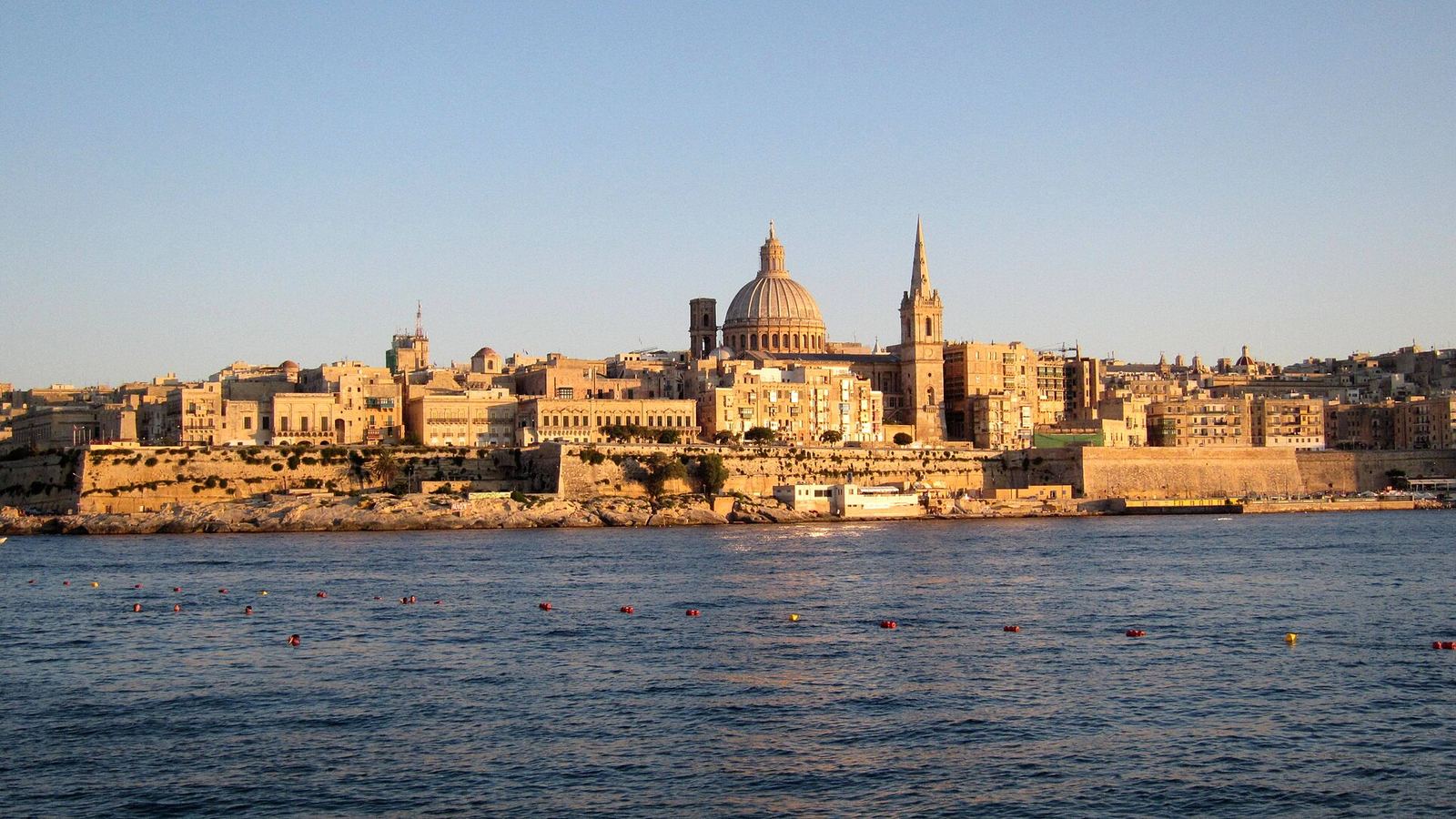
Valletta is about a kilometre long and six hundred metres wide, a grid laid on a peninsula by knights who expected to be besieged, and that history is the only thing standing between you and a flawless connection. Outdoors the city is superb: 5G along Republic Street, quick data on the Barrakka terraces, no dead corners worth naming. Step inside and the picture changes on a room-by-room basis, because the walls here are globigerina limestone measured in metres, the streets are narrow enough to be shaded at noon, and a ground-floor apartment whose single window faces an alley is effectively a Faraday cage with a nice door. Nobody warns visitors about this, so the usual sequence is a great first afternoon, a puzzled evening in the rental, and a wrong conclusion about the eSIM. The plan you buy matters far less in Valletta than knowing which side of the wall to stand on.
What This Guide Covers
Jump to the section most relevant to you
What the Fortifications Do to Your Signal
Start with the good news, because it is genuinely good. All three Maltese operators cover the peninsula thoroughly, 5G included, and the Malta Communications Authority's May 2025 drive test put Epic first in every region of the country by the widest margin it has ever recorded. Melita reached 5G here first and claims complete nationwide coverage, GO quotes better than 99 percent combined 4G and 5G reach. On Republic Street, in Great Siege Square, along Merchants Street and out on both Barrakka terraces, you will not think about connectivity once.
Now the walls. Valletta's landward front and its harbour bastions were built to absorb Ottoman cannon fire, and the same mass that did that job absorbs radio frequency energy with equal enthusiasm. Stone and masonry of this depth can strip as much as 28 dB from a cellular signal, which takes a strong connection to nothing at all rather than merely slowing it. The places where you will notice are specific and predictable: ground-floor rooms in the older townhouses, the vaulted spaces built into the bastion structure, the lower reaches of Strait Street where the buildings lean in on both sides, and anything below street level around Lascaris Wharf. The Lascaris War Rooms, carved into the rock beneath the Upper Barrakka, have no service whatsoever, which is arguably appropriate for a wartime command bunker.
A signal problem you can walk out of
The useful thing about limestone attenuation is that it is absolutely local. Unlike a genuine coverage hole, where you might drive twenty minutes before anything returns, a dead spot in Valletta is usually cured by walking to the end of the corridor. Terraces, roof levels, squares and the seaward side of any building recover almost instantly. If your accommodation is a restored palazzo and the bedroom reads one bar, the courtyard or the roof almost certainly does not. Book a call from up there rather than assuming your plan has failed.
This is also the one honest argument for a multi-network plan in a country that otherwise does not need one. When the nearest Epic cell is behind three metres of stone, the ability to fall back onto GO or Melita occasionally finds you a usable path where a single-network plan does not. It is a marginal advantage rather than a decisive one, and the Malta eSIM guide explains which providers are configured that way.
No Trains Anywhere: Buses, the Tallinja Card and the Harbour Ferries
Malta has no railway, no metro and no tram. Every scheduled public journey on both islands happens on a bus operated under the Tallinja brand, across more than 110 daytime routes, and the network is hub and spoke with the hub sitting immediately outside Valletta's City Gate at the Triton Fountain. Almost everything passes through it, which is convenient for reaching anywhere and inconvenient when you want to travel between two places that are not Valletta.
| Ticket | Price | Detail |
|---|---|---|
| Single, summer | 2.50 EUR | 14 June to 18 October. Valid two hours including transfers. |
| Single, winter | 2.00 EUR | 19 October to 13 June. Same two-hour transfer window. |
| Night routes (N) | 3.00 EUR | Charged separately from the day network. |
| Explore Card | 25.00 EUR | Seven days, counted as 168 hours from the first tap. Excludes Tallinja Direct routes. |
| Explore Card, child 4 to 10 | 7.00 EUR | Under fours travel free. |
| Explore Plus | 39.00 EUR | Adds harbour ferry trips and a Comino boat option to the seven days of bus travel. |
You can pay cash or contactless directly to the driver, and contactless is the better habit because drivers carry limited change. The Tallinja app gives live arrivals, which is the single most data-dependent thing you will do in Malta and the reason a dead phone at a bus stop in August is genuinely annoying.
The ferries are faster than the buses, and cheaper
Two harbour crossings save serious time from Valletta. The Sliema ferry takes roughly five minutes, runs about every half hour, and costs 1.50 euros single during the day or 1.75 after 19:30, with returns at 2.80 and 3.30 and a weekly pass at 10 euros. The Three Cities ferry leaves the Valletta Waterfront below the Upper Barrakka and reaches Cospicua in about ten minutes for around 1.50 euros, roughly every half hour at busy times. Both beat the equivalent bus by a wide margin, and both hold signal the whole way across since you are never more than a few hundred metres from a densely covered shore. The Barrakka Lift connects the Upper Barrakka gardens down to the waterfront if you would rather not walk the ramp.
Valletta, the Sliema Strip and the Three Cities
Valletta itself has a resident population of only a few thousand, so what feels like a capital city by day empties considerably at night. Coverage follows the grid: the streets running along the peninsula are open and quick, the cross streets that plunge down toward the water in flights of steps are shaded and narrow, and reception drops noticeably in the lowest of them. Anywhere on the two Barrakka terraces or at the Upper Barrakka viewing platform is reliable enough for a video call with the Grand Harbour behind you, which is the reason half the visitors up there are on one.
Sliema, Gzira and St Julian's are the practical opposite and the reason many visitors base themselves there. This is newer construction, concrete and glass rather than metre-deep stone, laid along an open seafront with the densest 5G on the islands. Indoor performance here matches the outdoor numbers, which it does not in the old towns. If you are working remotely or running a course, this strip is the easy choice on connectivity grounds, and the Sliema ferry puts you in Valletta faster than most people can find a parking space.
The Three Cities, where both things are true
Birgu, Senglea and Cospicua give you the fortified atmosphere without Valletta's crowds, and their connectivity behaves the same way: excellent along the marina and waterfront where the sky is open, distinctly weaker in the tight alleys of the Collachio behind Birgu and inside Fort St Angelo, where you are surrounded by the same defensive mass. The ferry landing at Cospicua is a strong signal spot, which is worth knowing if you need to sort something out before heading inland.
One pattern holds across all three areas. Whether your data works indoors in Malta depends almost entirely on the age of the building rather than on the operator or the plan. A 2015 apartment block in Gzira and a 1650 townhouse in Birgu will give you wildly different experiences on identical eSIMs.
Free WiFi in Valletta and How Far It Carries
Malta runs a national public WiFi scheme through the Malta Communications Authority, and it is unusually extensive for a country this size. The network broadcasts as MCAfreeWiFi across more than 400 hotspots on Malta and Gozo: public gardens, village squares, local council offices, schools and government buildings. In Valletta that includes the Upper and Lower Barrakka Gardens and the National Library on Triq ir-Repubblika. Around 7,500 people use it on an average day.
Getting onto MCAfreeWiFi
1. Select MCAfreeWiFi from your device's list of networks.
2. A splash page appears with the terms of use.
3. Accept them and enter your age, gender and nationality. There is no charge and no phone number required.
4. You are connected, at up to around 35 Mbit/s down, which is comfortably enough for maps, messaging and a video call from a garden bench.
Alongside it, Melita operates a free wireless network for its own subscribers spanning more than 20 zones including parts of Valletta, Sliema, St Julian's, Gzira, Mosta, Paola and Birzebbuga. If you end up buying a Melita SIM, you inherit that footprint and it stretches your bundle considerably along the coast.
What private premises offer beats all of it. Malta has 100 percent gigabit-capable fixed broadband coverage, the best figure in the European Union, and the consequence is that essentially every cafe, restaurant, apartment and language school hands out a fast connection without being asked. If you want to know how much mobile data your particular itinerary actually needs once all that is factored in, the eSIM Finder will size it.
What the free layer covers well
Where it abandons you
Getting Online on Your First Day
Three routes lead to a working line in Valletta, and Malta's particular circumstances push harder toward one of them than most destinations do.
Option one: an eSIM bought before departure
The strongest argument for this in Malta is not price, it is opening hours. Epic runs the only phone shop inside the airport and it trades from 11:00 to 19:00, which leaves a large slice of the low-cost flight schedule with nothing available on arrival. Landing connected means you open a ride app at the kerb, catch the X4 into Valletta with live times on your screen, and never think about it again.
Option two: a local pack from a city shop
GO has a branch on South Street inside Valletta and another on Tower Road in Sliema; Epic and Melita hold prominent positions along the same Sliema seafront. Bring your passport, because Maltese law requires every line to be registered against identification and there is no way to skip it. GO's tourist pack at 9.99 euros carries 10 GB, 200 EU and UK minutes and 200 SMS over 28 days, which is the best value on the islands.
Option three: both, in that order
The approach that suits Malta best. Arrive on a small eSIM, spend a day or two using the country's very generous free WiFi, and only buy a local pack if the stay turns out to be long. Language-school students and anyone on a Nomad Residence Permit should absolutely end up with a Maltese number; someone here for five nights almost certainly should not bother.
Whichever you choose, download an offline map of the islands. Not because coverage fails outdoors, it does not, but because you will spend part of your trip in stone rooms, boat cabins and underground chambers where nothing loads, and Valletta's street grid is confusing enough from inside it.
Day-Trip Coverage: Mdina, Gozo, Comino and the South
Malta is 27 kilometres long, so nothing is really a day trip in the usual sense. What varies enormously is what happens to your phone when you get there.
| Trip | Getting there | Coverage reality |
|---|---|---|
| Mdina and Rabat | Around 35 minutes by bus from the Valletta terminus | Fine on the ramparts and in Pjazza San Publju. Palazzo interiors and the Rabat catacombs are far weaker or dead. |
| Gozo by car ferry | X1 bus to Cirkewwa, then about 25 minutes at sea | Signal holds for nearly the whole crossing with a soft patch mid-channel. No passenger WiFi on board. |
| Gozo by fast ferry | About 45 minutes from Lascaris Wharf, around 7.50 EUR one way | Coastal the whole way, so coverage is steadier than the open-water leg suggests. |
| Comino and the Blue Lagoon | Boats from Cirkewwa, Sliema or Bugibba | Usable at the landing and the lagoon, badly congested on summer afternoons, thin toward Santa Marija. |
| Marsaxlokk | Direct bus, best on Sunday for the market | Strong throughout the harbour and along the luzzu quay. |
| Blue Grotto | Bus to Wied iz-Zurrieq, about 15 km from Valletta | Good on the clifftop and at the quay. Nothing inside the sea caves for the 20 to 25 minutes you are in them. |
Two of these deserve a warning rather than a table row. The Blue Grotto boat costs around 10 euros for an adult and 5 for a child, it is cash only at the kiosk, and there is no card machine at the quay, so arriving with a working phone and no coins does not help you. And the Hypogeum at Hal Saflieni, carved three levels down into the limestone around five thousand years ago, admits only 80 visitors a day in groups of roughly ten across four 45-minute slots between 09:00 and 12:00. Tickets are 40 euros through Heritage Malta and typically need booking two to three months ahead, with a small number of 50 euro last-minute tickets sold the previous day from Fort St Elmo and the Gozo Museum of Archaeology until midday. There is no signal down there and no photography either, so the hour is genuinely offline.
The Gozo ferry fare works backwards
On the Cirkewwa to Mgarr route you do not pay to leave Malta. Tickets are sold on the return leg at Mgarr, so a foot passenger buys the whole round trip there for roughly 4.65 euros. Crossings run about every 30 minutes through the day and every 45 minutes overnight, all year round, and the boat takes around 25 minutes. Bring something to read, because there is no passenger WiFi and the on-board mobile signal, while workable, is not what it is on shore.
Frequently Asked Questions
Why does my phone die indoors in Valletta when the coverage map says 5G?
Because the map is measuring the outside of the building. Valletta was constructed as a fortress from globigerina limestone, with walls frequently a metre or more thick, and masonry at that depth can strip up to 28 dB from a cellular signal, which is enough to take a full-strength connection to nothing. Narrow shaded streets and deep courtyards compound it. The good news is that it is a very local effect: a terrace, a roof, a square or the seaward side of the same building normally restores service within a few steps. No provider fixes this, though a plan spread across more than one Maltese network occasionally finds a path where a single-network plan cannot.
What does a bus cost and is the Explore Card worth it?
A single is 2.50 euros between 14 June and 18 October and 2.00 euros for the rest of the year, valid two hours with transfers included; night routes are 3.00 euros. The Explore Card gives seven days, counted as 168 hours from your first tap, for 25 euros adult and 7 euros for children aged four to ten. Work out your break-even honestly: at summer prices it pays off from roughly the eleventh journey. Since Malta's hub and spoke network routes almost everything through the Valletta terminus, anyone doing more than one outing a day usually clears that easily.
Is the harbour ferry better than the bus for reaching Sliema?
Considerably, on both time and money. The Sliema crossing takes about five minutes against a bus ride that loops around Marsamxett harbour, and it costs 1.50 euros single during the day, 1.75 after 19:30, with a weekly pass at 10 euros. Boats run roughly every half hour. The Three Cities ferry from the Valletta Waterfront to Cospicua does the same job in about ten minutes for around 1.50 euros. Both hold a solid signal across the water, and the Barrakka Lift saves you the climb back up to the Upper Barrakka gardens.
Can I use my phone on the boat to Comino?
On the water, yes, since you are rarely far from a covered shore. At the Blue Lagoon itself, expect it to be usable but sluggish, particularly on a July or August afternoon when several hundred day trippers are all sharing the same cell. Walk away from the main landing toward Santa Marija Bay or the towers and it thins out quickly. None of the Comino boats or the Gozo Channel ferries carry passenger WiFi as of 2026, so download whatever you want to look at before you board, and agree a meeting point with your group rather than relying on messages.
Is Sliema a better base than Valletta if I need to work?
For connectivity, clearly yes. Sliema, Gzira and St Julian's are built from modern concrete and glass along an open seafront and carry the densest 5G on the islands, so what your phone does indoors matches what it does outside. Valletta's older stock does not behave that way, and a ground-floor room in a converted townhouse can be genuinely difficult. Valletta is the better place to stay for atmosphere and for being inside the sights at dawn; the ferry means you are only five minutes and 1.50 euros away from it either way.