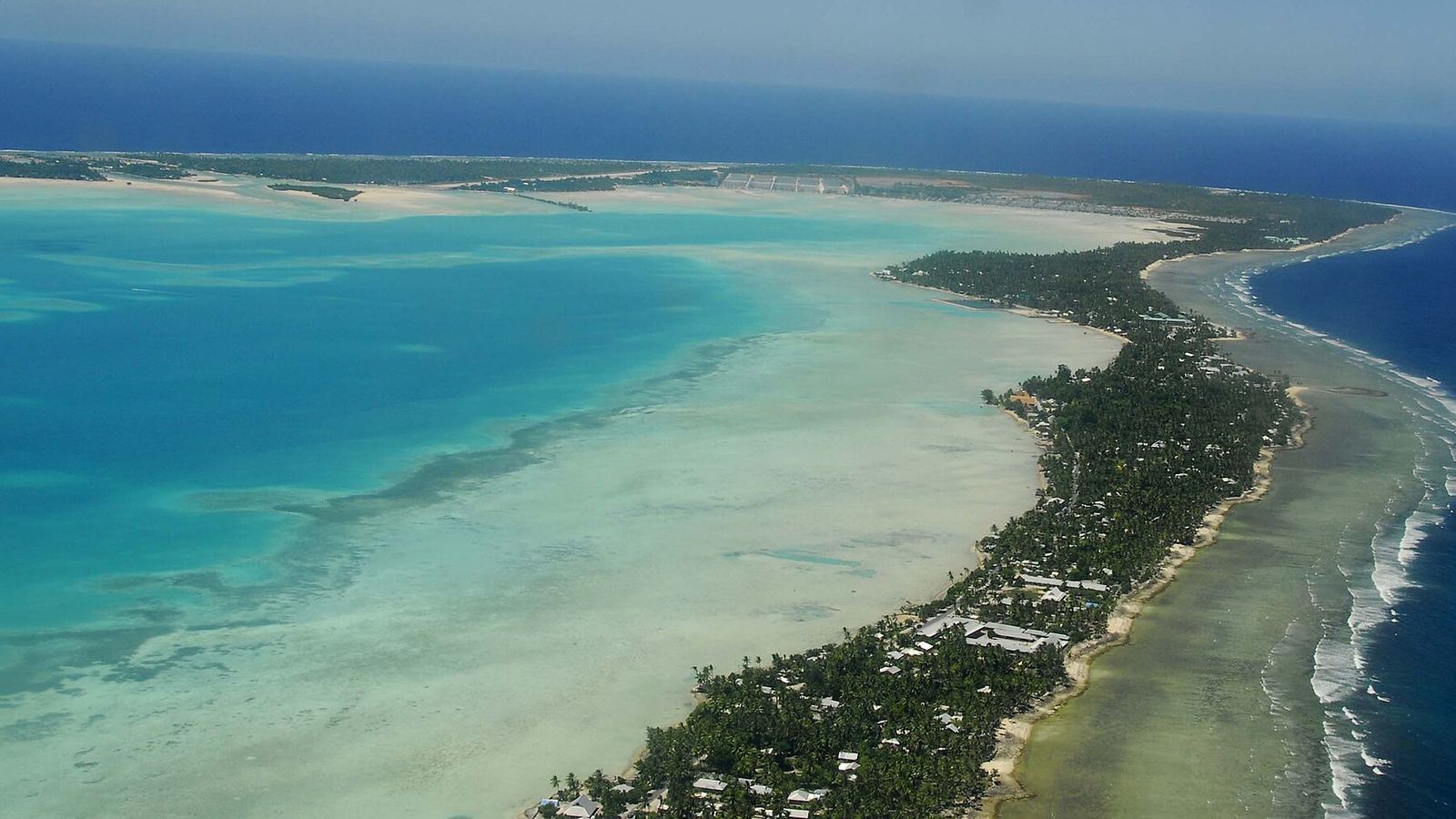
None of the three travel eSIM sellers we track has a Kiribati plan. Airalo and Holafly both return a hard 404 for the country, Nomad serves an empty shell page with no destination record behind it, and no Pacific regional bundle we have checked stretches this far east. So there is no plan to rank on this page and no reason to pretend otherwise. What you actually do is buy a local prepaid SIM in person, with your passport, after you land, and treat accommodation WiFi as the thing that carries most of your trip. The other point worth absorbing before you book anything: Kiribati is 33 atolls scattered over roughly 3.5 million square kilometres of ocean and three separate time zones, so there is no single answer to what the signal is like here. South Tarawa in the Gilberts and Kiritimati in the Line Islands, 3,300 km apart, are the only two places with proper undersea fibre behind them. Everywhere else runs on satellite backhaul or on nothing at all. Work out which Kiribati your itinerary is actually going to before you plan the rest of this, and if you are routing through the region, the eSIM Finder covers the neighbours where a travel eSIM does work.
What This Guide Covers
Jump to the section most relevant to you
Getting Online in Kiribati
No travel eSIM provider currently sells a plan for Kiribati, so the realistic options are a local SIM on arrival, roaming from your home carrier, or satellite.
A local SIM on arrival
ATHKL sells prepaid SIMs in Tarawa.
Coverage is concentrated on South Tarawa. The outer islands have little to none.
Satellite, if you need to stay reachable
Cellular coverage in Kiribati stops well short of where visitors go. A satellite communicator is the only thing that works everywhere, and it is what most people who travel here regularly carry.
Garmin inReach Mini 2
Two-way messaging and SOS over Iridium, which reaches the whole Pacific including atolls with no cellular network of any kind.
Visit Garmin inReach Mini 2 →ZOLEO
Cheaper hardware than the Garmin, pairs to your phone, and hands back over to WiFi or cell automatically wherever either one exists.
Visit ZOLEO →Mobile Networks in Kiribati
Kiribati has two licensed mobile operators, which is one more than most visitors expect and one fewer than the country needs for real price competition. The one that matters is Vodafone Kiribati. It was the state carrier Telecom Services Kiribati Limited until 2015, when the Fijian group Amalgamated Telecom Holdings bought it for about AUD 7.5 million and re-registered it as Amalgamated Telecom Holdings (Kiribati) Limited, or ATHKL. You will still see the ATHKL name on company paperwork, on eSIM resellers' network lists and on the shop email address. The Vodafone sign over the door in Bairiki is a brand licence held by the Fijian parent, not a branch of global Vodafone, and that distinction has a practical consequence: a Vodafone account from home buys you no privileges here at all.
The second licensee is Ocean Link, which switched on mobile service across South Tarawa in November 2018 and sells under the OceanCell name, alongside an OceanNet fixed and wireless internet product and an OceanTalk voice service. It is a real alternative in the capital and it does reach a number of outer islands, but travellers who have carried both SIMs report it thinning out faster once you leave the main road. Unless you have a specific reason, the visitor default is Vodafone.
What the network is made of. Vodafone Kiribati publishes its own site count, and it is small enough to be worth quoting exactly: 33 base stations nationally, of which 13 are 4G/LTE, five are 4G+, all 33 carry 3G and 23 still carry 2G. The 2G and 3G layers sit on 900 MHz and LTE sits on 1800 MHz, which is band 3 and universal on international handsets, so registration is not the problem. There is no 5G anywhere in the country and none announced. The operator says it reaches about 87 per cent of the population and is building toward 95 per cent, but population coverage in an atoll nation means the villages, not the lagoon, the reef flats or the water in between. One recurring oddity worth knowing: visitors regularly report iPhones parking on 3G here while Android handsets on the same SIM pick up LTE, and upload speeds under 2 Mbps are normal on either. Do not plan on sending anything large.
The cable is the story of 2026. For most of its history Tarawa's entire internet arrived by satellite, which is why the country's reputation for connectivity is so poor and so out of date. NEC completed and handed over the East Micronesia Cable System on 15 May 2026: roughly 2,250 km of fibre running from Tarawa to Nauru and on via Kosrae to Pohnpei, paid for jointly by Australia, Japan and the United States. The shore end landed at Tarawa in July 2025 and the system went into service on the island in June 2026. It is provisioned at an initial 100 Gbps per country against a design capacity of ten times that in aggregate, which for a nation of about 130,000 people is a step change rather than an increment. The landing station and the wholesale capacity are run by BwebwerikiNet Limited, the state-owned open-access carrier that leases to both operators rather than competing with them.
Kiritimati is on a different cable and a different clock. Christmas Island never sat on the Tarawa network's backhaul. It has its own 377 km spur dropped off the Southern Cross NEXT transpacific trunk into a landing station at Tabwakea, again owned by BwebwerikiNet. The marine work was finished back in 2022, but commissioning dragged on for years, which is why so much of what you will read about the island online is contradictory. Alongside it, a Starlink community gateway was brought into service at the end of 2025 to lift the islands that fibre will not reach for a long time. The net position for a traveller in 2026 is simple to state: Tarawa and Kiritimati have genuine backhaul, everywhere else is satellite-fed or unserved, and Kiritimati also runs on UTC+14 against Tarawa's UTC+12, so the two halves of the same country are two calendar days apart from some of your contacts.
Buying the SIM. Bring your passport, because you cannot buy without it, the shop takes a copy, and the limit is one SIM per passport. Registration costs about AUD 10 with either operator, and Kiribati uses the Australian dollar, so there is no separate currency to work out. There is a small Vodafone counter at Bonriki International Airport on Tarawa that opens for international arrivals just outside customs, and both operators have shops on Main Street in Bairiki. Data comes as bundles you subscribe to by dialling *111#, and a traveller pricing check in early 2026 put Vodafone at around AUD 5 for 1 GB over seven days, AUD 10 for 3 GB over seven days with calls and texts, and AUD 20 for 6 GB over 30 days, with Ocean Link asking AUD 8.50 for 2 GB, AUD 18.50 for 3 GB and AUD 27.50 for 5 GB. Those are the cheapest data prices in this part of the Pacific by a distance, and they are the reason the missing travel eSIM matters less than it sounds.
Two eSIM options do exist, and neither is what you think
Vodafone Kiribati sells its own eSIM profiles, but only face to face in its own outlets, only with photo ID, only one active profile at a time, and at AUD 20 for the profile on top of whatever data you buy. That is worse value than the plastic SIM for a short visit. Separately, the niche reseller aloSIM does list a Kiribati product, a single 1 GB seven-day plan at USD 9.50 running on ATHKL and explicitly capped at 3G. It exists, it is honest about the technology, and it costs roughly twice the local price for a slower connection, so buy it only if arriving already connected is worth that premium to you. We do not sell it and we are not linking it.
Coverage Across Kiribati
Coverage where travelers actually go:
| Area | Coverage | Notes |
|---|---|---|
| South Tarawa (Betio to Bonriki) | Usable | The strip from Betio through Bairiki and Bikenibeu holds most of the country's 4G sites, and the new cable landed here. Best connectivity in Kiribati. |
| Bonriki International Airport | Usable | Covered, and the Vodafone counter just past customs opens for international arrivals. Sort your SIM here rather than in town. |
| Kiritimati (Christmas Island) | Usable near the villages | Signal clusters around London, Tabwakea, Banana and Poland. Its own cable spur and a separate time zone. Nothing across the salt flats or the far lagoon. |
| North Tarawa | Patchy | A causeway and a boat ride from the capital, and the drop is quick. Expect a bar in the villages and nothing between them. |
| Outer Gilbert Islands | Patchy | Abaiang, Marakei, Abemama, Nonouti, Beru, Tabiteuea, Nikunau, Onotoa, Tamana and Arorae have sites, but on satellite backhaul with 2G or 3G only in most places. |
| Phoenix and remaining Line Islands | None | Kanton, Tabuaeran and Teraina have no visitor-usable mobile service. If your boat is going there, you are off the grid until it comes back. |
How to Prepare
There is no plan to compare here, so the useful work is deciding what you buy, when you buy it, and what you accept about being out of reach. Do it in this order.
First, be clear about which Kiribati you are visiting. The Gilberts and the Line Islands are the same passport and almost nothing else. If you are flying into Tarawa for work, government business or a scheduled ferry onward, you are going to the one place with a proper city network. If you are flying into Cassidy on Kiritimati to fish, you are going to a single road, a handful of villages, a lodge and a lagoon system where your phone is mostly a camera. A trip that adds an outer island is a third case again. Plan the connectivity for the leg you will actually spend time on, not for the country as a whole.
Buy the SIM at Bonriki, not tomorrow. The airport counter exists precisely because international arrivals are infrequent and it opens for them. Getting it done there costs you ten minutes while you are already holding your passport, and it saves a trip into Bairiki during shop hours that may not line up with your schedule. Ask for the bundle to be subscribed while you are standing there, and check the balance before you walk out.
Subscribe to a bundle before you switch data on, every time. This is the one line item that catches people out. Vodafone Kiribati bills data outside a bundle at AUD 0.99 per megabyte, against roughly one cent per megabyte inside one. That is a hundredfold difference and it will eat a prepaid balance in the time it takes an email client to sync in the background. Leave the phone in flight mode until the confirmation SMS for your bundle arrives, then turn cellular data back on.
Assume WiFi does most of the work. On Tarawa the hotels and guesthouses are the practical backbone for anything heavier than messaging, and they are noticeably better since the cable came into service. On Kiritimati the picture is unusual: the main fishing lodge runs on Starlink and advertises speeds that comfortably beat anything the mobile network offers, so the fastest connection on that island is likely to be the one at your dinner table. Ask your lodge or hotel what they run on before you assume anything, because the honest answers vary enormously from one property to the next.
Do not build your trip on roaming. Vodafone Kiribati does hold international roaming agreements, but Kiribati is a small enough market that it falls outside the flat-rate day-pass country lists most travellers assume they are covered by, and where it connects at all it is billed as pay as you go. Check your own carrier's country list by name before you leave, expect the answer to be either no or expensive, and either way turn data roaming off before the aircraft doors close.
Prepare properly for the offline stretches, because they are long. Download offline maps for Tarawa and Kiritimati, load your bookings, insurance and flight details onto the device as files rather than as links, and write your accommodation and airline contacts on paper. Domestic flights and inter-island boats here change without much notice and you will not always be able to check. Tell people at home that silence is expected, and give them your dates in their own time zone rather than yours, because a country running from UTC+12 to UTC+14 confuses everybody at least once.
Frequently Asked Questions
Can I arrive in Kiribati already connected?
Not through the big sellers. Airalo, Nomad and Holafly have no Kiribati product, and we checked all three live rather than trusting a coverage list. The one reseller we found that does list the country is aloSIM, with a single 1 GB seven-day plan for USD 9.50 running on ATHKL and marked 3G only. It works out at roughly double the local price for a slower connection, so it buys you convenience at the gate and nothing else. Vodafone Kiribati also issues its own eSIM profiles, but only in person in its shops and only with photo ID, so that is not an arrive-connected option either.
Has the new undersea cable actually changed anything for visitors?
On Tarawa, yes, and more than you would expect. Until 2026 the island's entire internet came off satellite, with the latency and the cost that implies. The East Micronesia Cable System was handed over in May 2026 and went into service on Tarawa in June, with an initial 100 Gbps provisioned for the country. Hotel WiFi and fixed connections in the capital are the first things to feel it. Mobile speeds improve more slowly, because the constraint moves back to the radio network and there are only 18 sites in the whole country carrying 4G or better. Do not expect the capital to feel like Suva yet.
Is Kiritimati on the same network as Tarawa?
Same operators, completely different infrastructure. Christmas Island has its own 377 km fibre spur off the Southern Cross NEXT transpacific trunk landing at Tabwakea, entirely separate from the cable that serves the Gilberts. Both Vodafone Kiribati and Ocean Link run mobile service there, and coverage clusters around the villages of London, Tabwakea, Banana and Poland. It is also two hours ahead of Tarawa on UTC+14, the earliest time zone on the planet, so the two ends of the country are frequently on different calendar dates.
What happens if I just leave my home SIM roaming?
Most likely one of two things: no service at all, or a bill you did not budget for. Kiribati sits outside the flat-rate daily travel passes that the large American, British and Australian carriers publish country lists for, so the usual ten-dollars-a-day safety net generally does not apply. Where a roaming agreement does exist, it is charged per megabyte at international rates. We could not obtain a published per-megabyte figure from any carrier for this page, which is itself the answer: if the rate is not printed anywhere, do not gamble on it. Turn roaming off and spend AUD 10 on a local SIM instead.
Do I need a local SIM at all if I am staying at a lodge?
For a fishing week on Kiritimati, quite possibly not. The lodge there runs Starlink and it is the fastest connection on the island, so a guest who is on the water from dawn and back at the lodge every evening can reasonably skip the SIM. On Tarawa the calculation goes the other way: a local number is what lets you reach a guesthouse, a taxi, Air Kiribati or a boat operator when a schedule slips, and at around AUD 15 all in for registration and a week of data it is not a decision worth agonising over.
Will I have a signal on the outer islands?
Sometimes, weakly, and never rely on it. Vodafone lists sites on Abaiang, Marakei, Maiana, Abemama, Nonouti, Beru, Tabiteuea North and South, Nikunau, Onotoa, Tamana and Arorae, but those run on satellite backhaul and mostly on 2G or 3G, so a signal bar does not mean a working data connection. In the Phoenix Islands and the Line Islands beyond Kiritimati there is nothing a visitor can use. Treat any island beyond Tarawa and Kiritimati as offline, tell people so before you go, and carry your itinerary on paper.