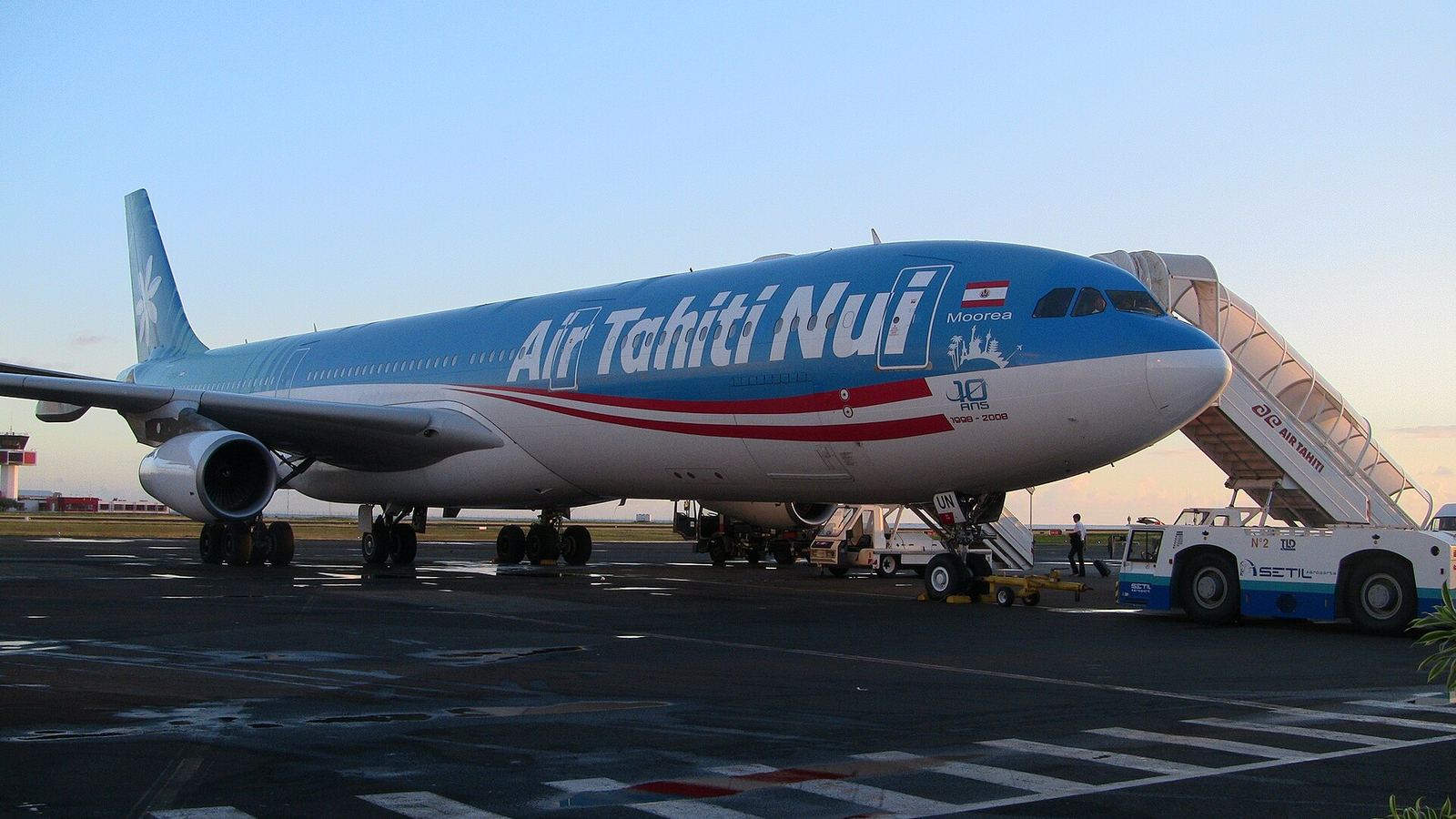
Faa'a is one of the more charming airports in the world and one of the least useful for buying a phone plan. It is a single semi-open terminal a few metres from the lagoon, warm air moving through the concourse, a ukulele trio playing arrivals, tiare flowers handed to passengers off the overnight services. It is also a building whose retail keeps ordinary Polynesian office hours while its long-haul flights, by the accident of where Tahiti sits on the map, almost all land between midnight and dawn. The result is predictable: most visitors clear customs at PPT into a terminal where the telecom counters are dark and will stay dark for another four hours. The airport is not the problem to solve. The timetable is.
What This Guide Covers
Jump to the section most relevant to you
Where SIMs Are Actually Sold Inside PPT
Faa'a operates from one terminal building split into international and domestic halves, so there is no terminal-hopping to worry about and nothing is more than a two-minute walk. There are exactly two places to buy a connection on the ground, and neither is a dedicated 24-hour telecom kiosk.
The two counters, and what they carry
Vodafone French Polynesia keeps a proper shop in the arrivals area. Coming out of international arrivals it is on your left and around the corner, and it sells the full prepaid range including tourist packs and eSIM profiles. Vini has no branded counter here. Its cards are sold from the Relay convenience store on the right-hand side, over in the food court opposite the car rental desks, alongside the magazines and the water. Ora is not sold at the airport at all, so if you want the territory's cheapest packs you are buying them downtown.
Both open on shop hours rather than flight hours, roughly 08:00 to 17:00 on weekdays with a Saturday morning and nothing on Sunday. That is worth reading twice against your arrival time. The overnight services from Los Angeles, Auckland, Tokyo, Honolulu and the connections out of Paris are scheduled to land in the small hours because of the distances involved, and a Sunday arrival means no phone retail anywhere in the territory until Monday.
The buying process is also slower than at most airports. Prepaid lines here must be registered to an identity document, so the counter takes your passport, copies it and issues the number against your name before anything works. Budget a few minutes each, and note that every traveller must front up personally for their own number.
Free WiFi in a Terminal With Half Its Walls Missing
Faa'a offers free wireless throughout the terminal with no time cap, which is the single most useful thing about arriving here without a working plan. It is also worth understanding the building, because the architecture affects how the signal behaves.
PPT is deliberately semi-open. Large sections of the concourse have louvred walls and open sides rather than sealed glazing, which is why the air smells of frangipani and why you can hear the surf on the reef from the baggage hall. It is a lovely arrival. It also means the wireless coverage feels less uniform than in a sealed terminal, and it fades quickly once you step out past the taxi rank toward the car park.
Getting online in the terminal
1. Open your WiFi list once you are inside the arrivals concourse. The airport's free network is unsecured and appears without a password.
2. Accept the terms on the portal page that loads. There is no code to collect from a desk and no purchase required.
3. Do the things that need doing before you walk out: confirm your accommodation, message home across the time difference, load your onward Air Tahiti booking.
4. If you are activating a travel eSIM you bought earlier, this is where you do it. Give it a minute to register on Vini or Vodafone before you head for a taxi.
The honest limit of it
Airport wireless gets you as far as the kerb and no further, and at PPT that boundary is unusually abrupt because of the open-sided construction. The five-kilometre ride into Papeete, the pre-dawn hunt for a pension gate in Punaauia and the wait at the domestic gate for a delayed ATR are all outside its reach. Use it to verify your connection is live, not as the connection itself.
Faa'a to Papeete: Fares, Times and the Night Tariff
Faa'a sits about five kilometres west of central Papeete along the coast, which makes this one of the shortest airport transfers you will ever do. The complication is not distance, it is the hour.
| Option | Time | Fare | Runs |
|---|---|---|---|
| Reseau Mata'ara bus | About 40 minutes with stops | Around 200 XPF | Daytime into early evening only |
| Taxi, daytime tariff | 10 to 15 minutes | Roughly 1,800 to 2,300 XPF | Rank outside arrivals, 24 hours |
| Taxi, night tariff 8pm to 6am | 10 to 15 minutes | Roughly 2,300 to 2,900 XPF | 1,000 XPF flagfall plus about 260 XPF per km |
| Pre-booked private transfer | 10 to 15 minutes | 3,000 to 5,000 XPF | Meet and greet, fixed price |
| Hotel shuttle | Varies | Often included | Must be arranged in advance |
The public bus is excellent value at around 200 CFP but it is irrelevant to most arrivals, because it stops running in the early evening and the flights you are on land long after that. So for a typical overnight arrival the realistic choice is the taxi rank, which is signposted directly outside the arrivals doors and staffed around the clock, or a transfer you booked before you left home.
Taxis here run on the territorial meter, with a flagfall around 1,000 CFP and a night rate near 260 CFP per kilometre between 8pm and 6am. Over five kilometres into town that lands somewhere between 2,300 and 2,900 CFP. Agreeing the approximate fare before you load luggage is normal and not considered rude. There are ATMs in the terminal lobby and near the domestic side that operate 24 hours, which matters because CFP cash is the smoothest way to pay at that hour.
Data on the ride in
The coast road between Faa'a and Papeete is one of the best-covered stretches in the whole territory, running through continuous urban development on all three networks. If your eSIM is live before you get in the car, you can follow the route on a map and check your accommodation's location the entire way. This is the easy part of the journey.
The Domestic Side and Your Onward Island Hop
A large share of arrivals at PPT never see Papeete at all. They clear customs, walk a few minutes to the domestic terminal in the same building complex and board an Air Tahiti ATR out to Bora Bora, Huahine, Rangiroa, Fakarava or the Marquesas. If that is you, the connectivity question changes shape entirely.
What works before you board
What does not
The practical consequence is that the departure lounge at Faa'a is the last place with a guaranteed connection until you reach your destination village, and on a Tuamotu atoll that village may itself have only one mast. Anyone flying onward should choose a Vini-based plan specifically, because it is the only network with equipment on the small islands. The Vini and Vodafone split by provider is laid out in our French Polynesia eSIM guide.
Worth noting too that the domestic side runs on Polynesian time in every sense. ATR schedules shift, weather closes atoll strips, and the thing that saves you is being reachable, which is the whole argument for arriving with a line already live.
Airport Counter Prices Against a Travel eSIM
Now the awkward part, because this comparison does not land where it usually does. At most airports the arrivals counter is the expensive option and the travel eSIM undercuts it. At Faa'a the local prepaid packs are startlingly cheap and the eSIMs are not.
| Where | What you get | Price |
|---|---|---|
| Vodafone shop, arrivals | 10 GB data only, 30 days | About 1,800 XPF, near $17 |
| Vodafone shop, arrivals | 20 GB with calls, 30 days | About 3,800 XPF, near $37 |
| Vodafone shop, arrivals | 60 GB with 600 minutes, 30 days | About 4,900 XPF, near $48 |
| Relay store, food court | Vini 20 GB with calls, 30 days | About 4,000 XPF, near $39 |
| Relay store, food court | Vini 40 GB with calls, 30 days | About 8,000 XPF, near $78 |
| Nomad eSIM, on Vini | 3 GB, 30 days, data only | $39 |
| Holafly eSIM, on Vodafone | 2 GB, 7 days, data only | $78 |
Vodafone's 10 GB pack at roughly 1,800 CFP is better value per gigabyte than anything sold online for this territory, by a wide margin. Anyone telling you the airport counter always fleeces tourists has not looked at these prices. What the table cannot show is availability: those two counters are shut for most of the hours that international flights arrive, they close entirely on Sunday, and the Relay store's stock of Vini cards is not guaranteed.
How to think about it
Buy a small eSIM before you fly to cover the arrival and the first day or two, because that is the window nothing else can fill. Then decide at leisure whether a local pack is worth a downtown shop visit; if you are staying two weeks or more on Tahiti and Moorea it almost certainly is. Our French Polynesia SIM card guide has the full price list in CFP, and the eSIM Finder will size the small starter plan.
Frequently Asked Questions
My flight gets in at 4am. Can I buy a SIM at Faa'a when I land?
No. The Vodafone shop in arrivals and the Relay store that carries Vini cards both keep ordinary retail hours, roughly 08:00 to 17:00 on weekdays with a Saturday morning and nothing on Sunday. Because of where Tahiti sits relative to Los Angeles, Auckland, Tokyo and Paris, most long-haul flights are scheduled to land overnight, so shuttered counters are the normal arrival experience rather than bad luck. Sort your data before you board the flight out.
Which counters at PPT sell what, and where exactly are they?
Vodafone French Polynesia runs a proper shop in the arrivals area, on your left and around the corner as you exit international arrivals, selling its full prepaid range. Vini has no branded desk at the airport; its cards are stocked by the Relay convenience store on the right-hand side in the food court, across from the car rental companies. Ora, the cheapest of the three networks, is not sold at Faa'a at all and has to be bought downtown.
Is the wireless in the terminal any good, given how open the building is?
It is free, has no time limit and covers the concourse well enough to activate an eSIM, message home or load a booking. The semi-open architecture, with louvred walls and open sides that let the sea air through, does make the coverage feel less even than a sealed terminal, and it drops away quickly once you pass the taxi rank toward the car park. Treat it as a place to confirm your connection is working, not as your connection.
What should the taxi into Papeete cost after a night landing?
Around 2,300 to 2,900 CFP for the five-kilometre run into the city centre. Taxis use the territorial meter, with roughly 1,000 CFP to start and about 260 CFP per kilometre on the night tariff between 8pm and 6am. The rank sits directly outside arrivals and is staffed around the clock. A pre-booked private transfer runs 3,000 to 5,000 CFP with a fixed price. The public bus is far cheaper at about 200 CFP but has long stopped for the night.
I am connecting straight onto an Air Tahiti flight. What do I need to sort at PPT?
Everything, because the departure lounge is your last guaranteed connection. There is no data in the air on an ATR, and the atoll you are heading for may be served by a single Vini mast around the village and airstrip. Download offline maps, draw CFP cash from the 24-hour machines, and message your pension or dive shop before you board. Make sure the plan you are carrying rides Vini, since Vodafone thins out fast past the Leeward Islands.