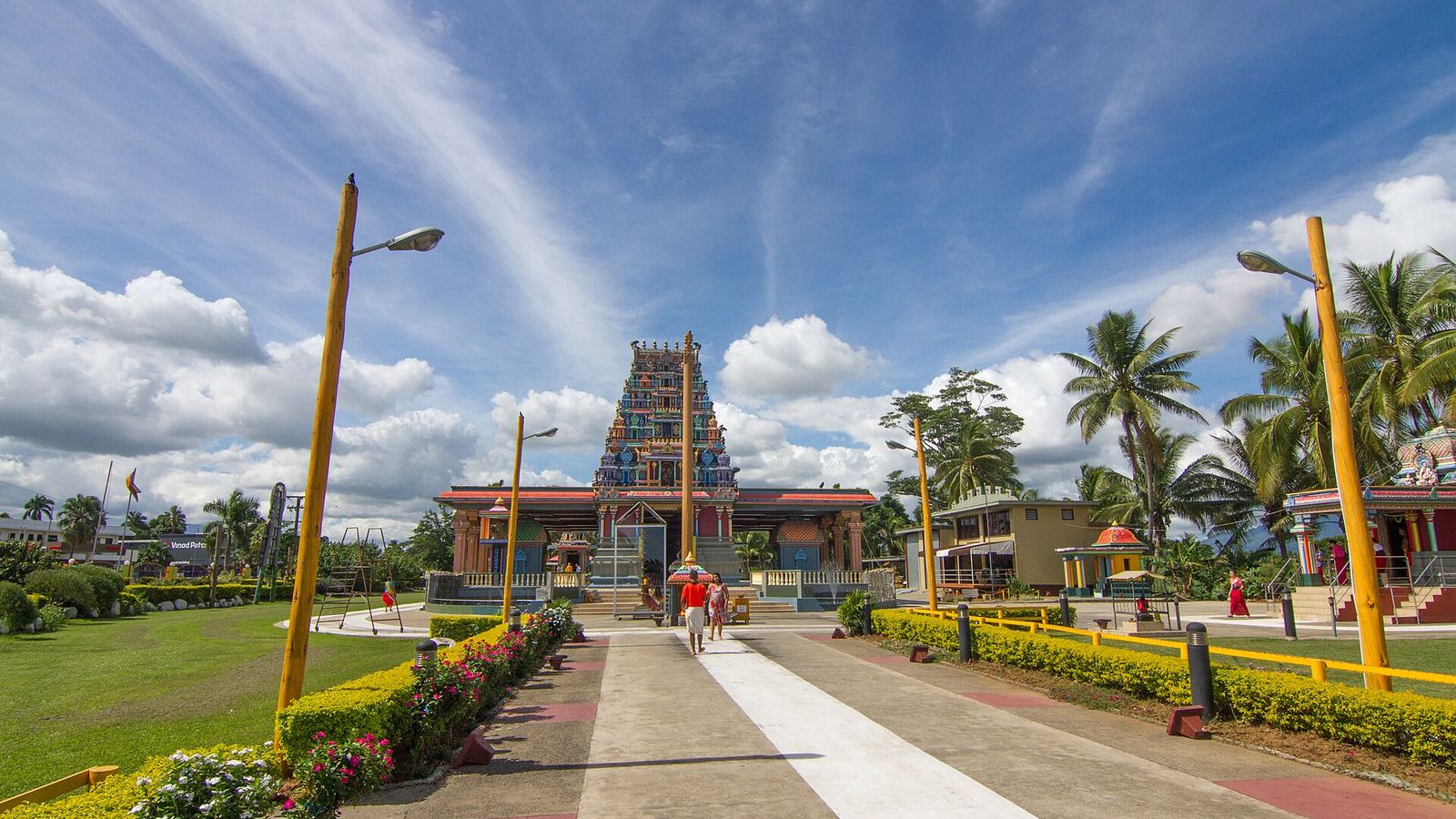
Nadi will not test your phone. It sits in the first phase of Fiji's 5G rollout alongside Suva, Lautoka and Denarau, both networks are quick across the town and the resort island, and the strip of hotels along Wailoaloa Beach and the Queens Road corridor is as well served as anywhere in the country. That is exactly the problem. Nadi is a staging post, not a destination, and the visitor who spends a comfortable first night here with 5G on the balcony draws entirely the wrong conclusion about what the rest of the trip will look like. Within 48 hours most people are on a catamaran heading northwest, where the 4G stops somewhere past the Mamanucas and does not come back. Judge your plan by that leg, not by this one, and treat the easy connectivity in Nadi as the thing that lets you sort everything else out before you leave.
What This Guide Covers
Jump to the section most relevant to you
How Well the Two Networks Cover Nadi and Denarau
Both Fijian operators treat this corner of Viti Levu as a priority, and it shows. When the country's 5G licences took effect in September 2025, the first-phase footprint named exactly four places: Suva, Nadi, Lautoka and Denarau. Nadi therefore has 5G on both Vodafone Fiji and Digicel for anyone carrying a handset that supports it, sitting on top of 4G that already blanketed the town, the airport approach and the whole causeway across to Denarau.
The practical difference between the two networks here is small enough that it should not drive your decision. Vodafone is the incumbent, holds something like 85 percent of Fijian subscribers, and is the safer default. Digicel, Telstra-owned since 2022, is genuinely competitive around Nadi and is often the better performer on the inland roads running up toward the Nausori Highlands behind the town, which is not what most people expect from the challenger network.
What Nadi does not tell you about Fiji
Five gigabits of enthusiasm on the Denarau causeway is a poor guide to the rest of the archipelago. Fiji has around 330 islands with roughly a hundred inhabited, and the resort economy sits mostly on the small ones. The Yasawa chain has no 4G at all, on either network. Vanua Levu has 4G in Savusavu and Labasa and very little between them. Sigatoka, an hour down the Coral Coast, is not even scheduled for 5G until 2027 or 2028. Nadi is the exception in Fiji, not the baseline.
One local quirk worth knowing: the Nadi area gets serious tropical downpours, and heavy rain measurably degrades higher-frequency mobile signal. If your 5G bars collapse during an afternoon storm on Denarau, nothing has broken. It will be back when the sky is.
Denarau, Nadi Town and Wailoaloa Compared
Denarau Island is a purpose-built resort peninsula joined to the mainland by a short causeway, and it is where most first-time visitors sleep. It carries the big international hotel names, a golf course, the Port Denarau marina and retail complex, and the most consistent connectivity in Fiji outside Suva. It is also, by design, insulated from the country around it. If you want fast, dependable data and a poolside bar, this is where it lives.
Nadi town is a working Fijian town about fifteen minutes inland: Main Street's souvenir shops and tailors, the Sri Siva Subramaniya temple at the southern end, the produce market, the bus stand. Coverage through the town is strong on both networks, and this is where you will find carrier branches, cheap SIM top-ups and food that costs a fraction of Denarau prices. The signal thins slightly in the residential streets climbing away from Main Street, which is a terrain effect rather than a network failure.
Wailoaloa and Newtown Beach, the middle option
Between the airport and Denarau sits the Wailoaloa and Newtown Beach strip, where the backpacker hostels and mid-range hotels cluster. It is a five to ten minute taxi from the terminal, which makes it the standard first-night stop for anyone landing at dawn and catching a boat later. Coverage here is solid on both networks and the WiFi is more likely to be genuinely free than at the resorts, because the properties are competing on price rather than bundling connectivity into a nightly rate.
The connectivity argument between them is less about signal strength than about what the accommodation charges you for. Denarau resorts commonly hand out free WiFi in the lobby and restaurant and bill for in-room access at around 5 Fijian dollars an hour, 15 for a day or 40 for three days. Hostels and small hotels in Nadi town and Wailoaloa mostly just give you the password.
Buses, the eTransport Card and the Bula Bus
Nadi's local transport is cheap and easy once you understand one rule that catches visitors out immediately: bus drivers here do not take cash. Fares are paid with an eTransport card, a stored-value card you buy and top up at machines, including at the airport. Turn up with a handful of coins and you will be standing at the roadside watching the bus leave.
| Route | Fare | Notes |
|---|---|---|
| Airport to Nadi Bus Stand | About FJ$1.50 | Local bus, eTransport card required, roughly 15 minutes. |
| Nadi to Denarau (Westbus) | About FJ$1.50 | The yellow Westbus is the only public operator serving Denarau. Runs 5am to 11pm, every 5 minutes between 6am and 7pm. |
| Bula Bus, around Denarau | FJ$12 per adult per day | Open-sided hop-on hop-off loop calling at every resort and the marina, roughly 7:30am to 11pm. Five-day pass FJ$35, under-12s free with a ticket holder. |
| Taxi, airport to Denarau | FJ$35 to FJ$45 | Often unmetered. Agree the fare in Fijian dollars before you get in. |
The whole airport-to-Denarau journey on public transport therefore costs about three Fijian dollars, roughly 1.35 US, against 35 to 45 for a taxi. That is a large enough spread to be worth the hassle if you are travelling light, and completely impractical if you have two suitcases and a pre-dawn arrival.
Coverage while you are moving
Signal along the Queens Road between the airport, Nadi town and the Denarau turn-off is continuous on both networks, so ride-hailing, maps and messaging all work throughout. The Bula Bus loop around Denarau is equally well covered. This is one of the few parts of Fiji where you can genuinely rely on being reachable the entire time you are in transit.
Port Denarau and the Moment the Signal Changes
Port Denarau Marina is the hinge of the whole Fijian tourism machine and the single most important place in this guide. Nearly every island transfer to the Mamanuca and Yasawa groups leaves from here, including the Yasawa Flyer, the high-speed catamaran run by South Sea Cruises under the Awesome Adventures banner. It departs at 8:45am daily with check-in half an hour beforehand, works north through the chain calling at resorts along the way, and is back alongside around 6pm. The current vessel is a 320-seat catamaran that entered service in August 2025, with air-conditioned cabin space, a bar and outdoor decks. Flexible hop-on hop-off passes run from about five days to fifteen.
Here is what happens to your phone on that trip. The marina itself and the first stretch out past the Denarau channel are fully covered. The Mamanuca stops, South Sea Island, Bounty, Beachcomber, Malolo and Mana, all have service, with Vodafone the steadier of the two. Somewhere past Malolo, as the boat commits to the run north, the picture starts to fray, and by the time you are in the Yasawas proper you are on 2G or 3G at best with long dead stretches between islands. There is no 4G anywhere in the Yasawa chain on either network.
The half hour before you board
1. Download offline maps of the island group you are heading to, and the resort's location pin.
2. Screenshot or save your booking confirmation, transfer voucher and any boat times, rather than relying on retrieving an email later.
3. Message anyone expecting to hear from you, and say plainly when you next expect to have signal.
4. Download whatever you want to read or watch for the crossing, which can run several hours to the northern islands.
5. Charge everything. Several outer-island properties run generators on a schedule rather than mains power.
Seaplane and helicopter transfers leave from the airport side rather than the marina and cut the journey to a matter of minutes, but the connectivity arithmetic at the other end is identical. It is the destination island that decides whether you have a signal, not how you got there.
Day Trips from Nadi and What Your Signal Does
Nadi's overland day trips are all comfortably covered, which makes them a useful contrast with the island legs. Three are worth knowing about.
Sabeto and the Garden of the Sleeping Giant. Twenty minutes north of the airport, in the foothills below the ridgeline that gives the garden its name, sit two of the region's most-booked half-day stops. The Garden of the Sleeping Giant charges around FJ$30 for adults and FJ$15 for children aged 6 to 12, and holds a collection of more than 2,000 orchids among native planting. The Sabeto Hot Springs and Mud Pool nearby runs about FJ$25 for entry, or roughly FJ$55 including a return transfer. Coverage along the Sabeto valley road is reliable, and it improves rather than degrades as you climb, because Digicel in particular has invested in the inland approaches.
The Coral Coast. The Queens Road runs south and east from Nadi through Sigatoka and the resort strip at Korolevu, and it is a straightforward drive with dependable 4G the whole way. Sigatoka is a real town with a market, a river and the sand dunes national park at its mouth. What it does not have yet is 5G, since it sits in the 2027 to 2028 phase of the rollout, so expect solid rather than spectacular speeds.
Suva. The capital is three to four hours away by road, which makes it a long day trip and a better overnight, but the contrast is instructive. Suva is Fiji's real city: government, the university, a serious museum, colonial architecture and weather that is dramatically wetter than the dry western side. It also has the deepest network infrastructure in the country, with 5G live and Nasinu and Lami queued for the 2026 phase.
The inland route worth a mention
If you head for the Nausori Highlands or take one of the interior 4WD and river trips, expect coverage to become genuinely intermittent between villages. This is the one land-based excursion out of Nadi where you should treat data as optional rather than assumed, and where a downloaded map earns its keep. Digicel tends to hold on longer here than the outer-island pattern would suggest, which is the reverse of the offshore comparison.
Getting Online Your First Day in Nadi
There are three sensible routes to a working connection here, and unusually for this site the local option is not obviously the wrong one, because the Fijian tourist bundles are startlingly generous.
Route one: an eSIM already installed
Buy and install before you leave home, keep it switched off, and turn it on once the aircraft doors open. Given how many flights land at Nadi before sunrise, arriving with data already working is worth more here than the price difference suggests. If any part of your trip involves an overnight island stay, pick a provider riding Vodafone Fiji rather than Digicel. The Fiji eSIM guide sets out which brand uses which network.
Route two: a tourist SIM from the airport counters
Vodafone and Digicel both keep 24-hour shops in the arrivals hall. Bring your passport, because Fiji registers every mobile number against an identity document through an M-PAiSA agent. Digicel's Traveler 25 gives 75 GB over seven days for FJ$25, and Vodafone hands new tourist SIMs 3 GB free for the first day. Details are in the Fiji SIM card guide.
Route three: carry both
An eSIM that works at the kerb plus a local card bought at leisure once you know your itinerary. In a country where several people usually travel on one booking and boat schedules move with the weather, having a Fijian number with real call minutes alongside a data line is genuinely useful rather than belt-and-braces.
Free WiFi in Nadi is easy to find but rarely worth building a day around. The airport terminal offers a metered free connection, Port Denarau's retail area and most cafes hand out passwords, and resort lobbies are usually complimentary even where in-room access is charged. What none of it does is follow you onto the causeway, into a taxi negotiation, or onto the deck of a catamaran heading northwest at a quarter to nine in the morning. Practical routes into town and out to the marina are covered in the Nadi Airport guide.
Frequently Asked Questions
Is Nadi a fair test of what my phone will do in Fiji?
No, and that is the single most useful thing to understand before you buy anything. Nadi and Denarau were in the first phase of Fiji's 5G rollout in September 2025, along with Suva and Lautoka, so both networks are fast here. The Yasawa chain has no 4G at all, Sigatoka is not scheduled for 5G until 2027 or later, and outer islands like Kadavu have service around one settlement and nothing elsewhere. Buy for the hardest leg of your itinerary and enjoy Nadi as the easy part.
Why would I not just take a taxi from the airport to Denarau?
Plenty of people do, and at FJ$35 to FJ$45 it is not extortionate for a group with luggage. Just be aware that many airport taxis are unmetered, so settle the fare in Fijian dollars before the boot closes. The alternative is about three dollars total: a local bus to Nadi Bus Stand for around FJ$1.50 and the yellow Westbus onward to Denarau for about the same. The catch is that Fijian buses take no cash at all, so you need an eTransport card, which you can buy and top up at machines in the airport.
Where exactly does the signal give out on the Yasawa Flyer?
Roughly when the boat commits to the run north past Malolo. Port Denarau, the channel and the Mamanuca stops at South Sea Island, Bounty, Beachcomber and Mana all hold service. After that it degrades into long silent stretches, and once you are properly in the Yasawas you are on 2G or 3G at best with better luck on western shores and around the larger resorts. The Flyer leaves the marina at 8:45am and is back around 6pm, so plan on being effectively offline for a good part of a full day.
Do the Nadi day trips need mobile data?
The popular ones do not stress it. The Sabeto valley run to the mud pools at about FJ$25 and the Garden of the Sleeping Giant at FJ$30 for adults is well covered, and the Queens Road down the Coral Coast to Sigatoka holds 4G throughout. The exception is anything heading up into the Nausori Highlands or onto the interior river trips, where coverage becomes patchy between villages. That is the one Nadi excursion worth downloading an offline map for.
Should I stay on Denarau or in Nadi town for better connectivity?
Both are strong, so choose on other grounds. Denarau has the most consistent data in western Fiji and the marina for island transfers, but its resorts often charge for in-room WiFi at around FJ$5 an hour or FJ$40 for three days while giving it away in the lobby. Nadi town and the Wailoaloa Beach strip have perfectly good coverage, cheaper food, the carrier branches for top-ups, and accommodation far more likely to simply hand you the WiFi password without a charge.