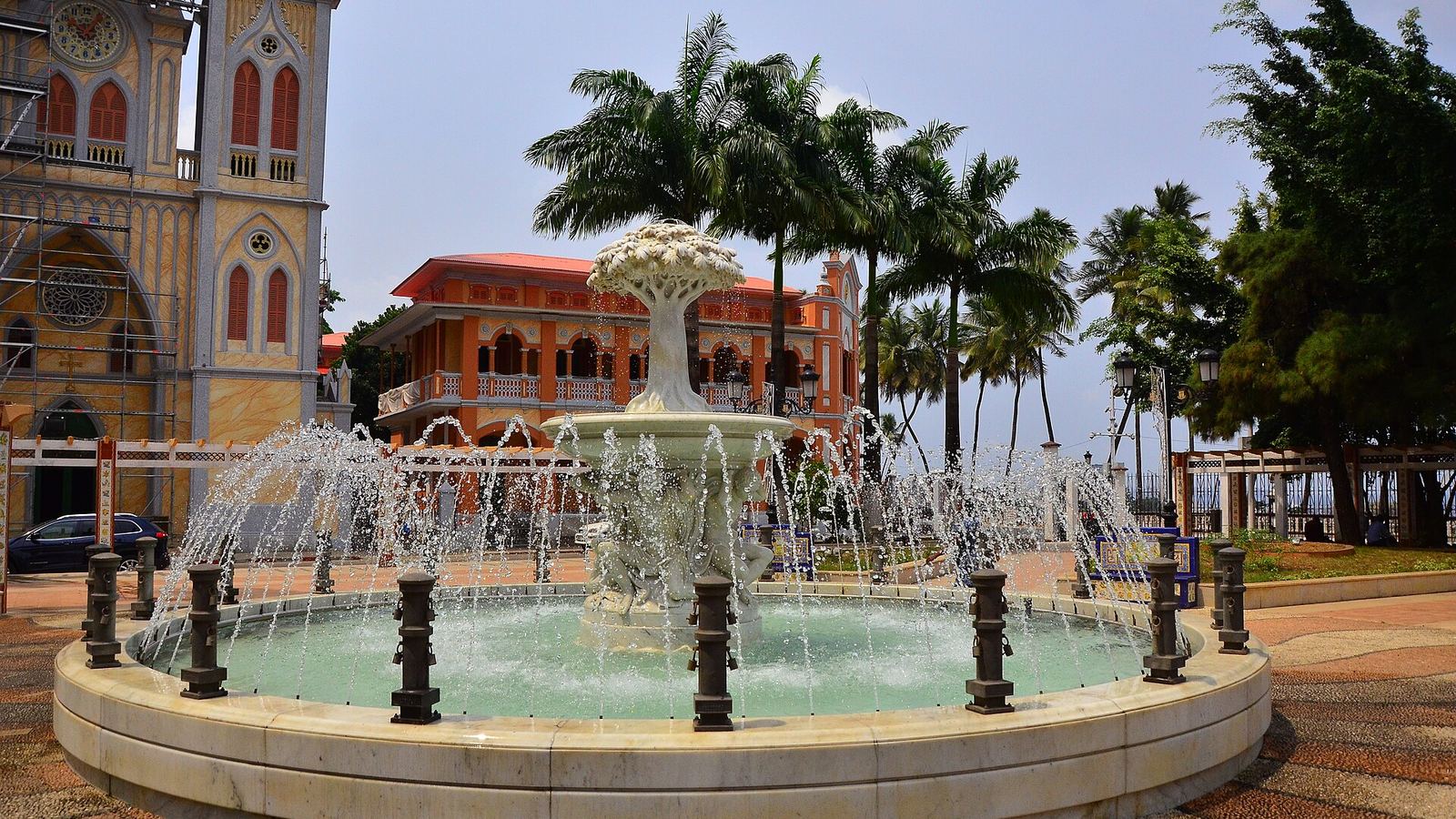
Airalo, Nomad and Holafly all return a 404 for Equatorial Guinea, and Airalo's Africa regional pack leaves it off its country list, so there is no travel eSIM on this page to recommend. That is less of a loss here than almost anywhere else on the site. GETESA, the state-owned incumbent, sells prepaid data at prices no travel eSIM could match: 4,500 CFA francs, which is under 7 euros at the fixed peg, buys a week of data, and you open the line with a passport at one of its agencies. The harder problem is geography. The country is really three places: Bioko island with the capital Malabo, the mainland region of Rio Muni around Bata, roughly 240 km away across the Gulf of Guinea, and Annobon, a small island far to the south whose internet has been switched off by government order since July 2024. Work out which of those your trip actually touches before you plan anything else. If you are continuing overland into Cameroon, the eSIM Finder covers the neighbours where a travel eSIM is sold normally.
What This Guide Covers
Jump to the section most relevant to you
Getting Online in Equatorial Guinea
No travel eSIM provider currently sells a plan for Equatorial Guinea, so the realistic options are a local SIM on arrival, roaming from your home carrier, or satellite.
A local SIM on arrival
Muni and Orange sell prepaid SIMs, with registration requirements.
Most visitors travel for business with connectivity arranged by a local host.
Mobile Networks in Equatorial Guinea
Who runs the network. GETESA, short for General de Telecomunicaciones SA, was founded in 1984 and describes itself as the country's historic operator. It is the name on most of the phones you will see in Malabo and Bata, it runs the fixed lines and ADSL as well as mobile, and it is the only operator whose prices and agency list we could read on a working website in October 2026. Alongside it sits GECOMSA, a second state-owned telecom company that the government itself says has struggled operationally. In June 2026 the vice president publicly criticised GETESA's management, ordered it to file an action plan for coverage and quality within days, and pushed to accelerate a new state operator called Telgesa that is meant to replace GECOMSA. The Telgesa plan, backed by a proposed 50 million dollar investment from EGSA Loita with the state holding 49 percent, calls for 260 towers and coverage of 90 percent of the territory, with a target of starting operations before the end of 2026. Treat that as a plan, not a network you can use on this trip.
Why the signal disappoints. An audit by the consultancy Cyberteq, presented in April 2026, found obsolete equipment, limited data speeds and frequent saturation on GETESA's network, which matches what visitors describe: full bars and a page that will not load at the busy end of the evening. On 9 July 2026 GETESA signed a six-month agreement with Huawei to upgrade the mobile and internet network, so expect works, and possibly improvement, running into early 2027. GETESA has also announced 5G and public WiFi in Malabo, Bata and Oyala, the new administrative city now called Ciudad de la Paz. None of that is switched on for visitors yet. Underneath the retail brands sits GITGE, the state body that manages telecom infrastructure and international capacity, and rights groups say it was GITGE that was ordered to cut Annobon off.
Getting a GETESA line. GETESA lists 32 agencies, with the head office on Calle Rey Boncoro in Malabo, branches at Luba, Santa Maria, Cine Rial and Los Angeles on Bioko, the main mainland office on Avenida Jose Ndemesesogo in Bata, and smaller counters as far out as Ebebiyin, Evinayong, Mongomo, Kogo, Rio Campo and even Corisco island. Opening hours are weekday business hours. Its own help page asks for a photocopy of your identity document, passport or residence card, two passport photos and 2,000 CFA francs for a mobile line, so carry photos and a printed passport copy rather than assuming the counter has a copier. Once you have the SIM, every bundle is bought by dialling *100#, balance is #222#, and customer care is 444 from a GETESA number.
| GETESA bundle | Data now | Before the promotion | Price | About |
|---|---|---|---|---|
| Daily D1 | 750 MB | 500 MB | 500 XAF | 0.76 EUR |
| Daily D2 | 1.5 GB | 1 GB | 900 XAF | 1.37 EUR |
| Weekly W1 | 3.75 GB | 2.5 GB | 2,500 XAF | 3.81 EUR |
| Weekly W2 | 7.5 GB | 5 GB | 4,500 XAF | 6.86 EUR |
| Monthly M1 | 12 GB | 8 GB | 8,000 XAF | 12.20 EUR |
| Monthly M2 | 24 GB | 16 GB | 15,000 XAF | 22.87 EUR |
Those volumes include a summer promotion that adds 50 percent more data at the same price, and it was still on GETESA's site when we checked on 12 October 2026. When it ends, the right-hand column is what you get, which is still around 1.40 euros a gigabyte on the weekly bundle. There is also a weekend double-data offer, 4 GB for 2,000 francs or 10 GB for 5,000, valid from Friday 23:00 to Monday 08:00, and a 4G router plan at 30,000 francs for 35 GB if a team needs a shared hotspot. The Central African CFA franc is pegged to the euro at 655.957, so the euro column above will not drift.
Annobon: the island that is offline on purpose
Fixed and mobile internet on Annobon were suspended from 20 July 2024 after residents protested environmental damage from blasting by a construction firm, and Starlink was told to stop serving the island from 7 August 2024. Monitoring by the Internet Society and IDEA described the shutdown as still in force more than a year later, and we found no report of it being lifted. Plan on no data at all if your itinerary includes Annobon, and expect voice calls to be unreliable too.
Coverage Across Equatorial Guinea
Coverage where travelers actually go:
| Area | Coverage | Notes |
|---|---|---|
| Malabo and the Bioko north coast | Usable, congested at peak | The best-served area in the country, from the old town around the cathedral to Sipopo and the airport road. Evenings are when the saturation the 2026 audit described shows up. |
| Luba, Moka and the Bioko south | Patchy | GETESA has an agency in Luba and the coastal road holds a signal. Up in the Moka highlands and down at the Ureca turtle beaches, plan to be offline for hours. |
| Bata and the Rio Muni coast | Usable | The mainland's commercial city has a GETESA agency and workable 4G along the seafront paseo. Coverage thins quickly south toward Mbini and Kogo. |
| Ciudad de la Paz (Oyala) and Mongomo | Patchy to usable | The planned capital in the interior is on GETESA's list for public WiFi and 5G, neither of which exists yet. Mongomo and Ebebiyin have agencies. |
| Monte Alen National Park | None to negligible | Rainforest in the centre of Rio Muni with no reliable signal inside the park. Tell someone your return time before you go in. |
| Annobon | Shut down | Internet cut by government order since July 2024, Starlink included. Treat the island as having no data whatsoever. |
How to Prepare
With no travel eSIM to buy, the decision is about sequencing: what you sort out before you fly, what you do in the first hours in Malabo, and how you cope on the mainland.
Get the visa right first, because it decides your airport. Equatorial Guinea has run an online e-visa since July 2023, and e-visa holders must enter through Malabo International Airport. If your work is in Bata, that usually means landing on Bioko and taking a domestic connection across, not flying straight into the mainland. Approval normally arrives within one to three days and the fee is widely reported as 75 dollars, but third-party sites charge more on top, so pay only on the official portal. CEMAC citizens with a national ID or biometric passport are visa-exempt; almost everyone else needs one. Approval is not a guarantee of entry, and the border officer has the final word.
Land with your phone already useful. Before departure, download offline maps for Malabo, Bata and the Bioko ring road, save hotel and contact details as files, and keep a printed copy of your e-visa approval. If your home carrier roams in Equatorial Guinea, check the per-megabyte rate before you rely on it; it is usually priced for emergencies, not for maps and messaging. Then open a GETESA line on your first working day. Bring two passport photos and a photocopy of your passport, because those are what GETESA's own help page asks for, and allow time for a queue at the Malabo head office.
Buy the weekly bundle, not the daily one. The daily packs are designed for local users topping up as they go. A visitor staying four days or more does better on the 7.5 GB weekly bundle at 4,500 francs or, for a month-long rotation, the 24 GB pack at 15,000. If the summer promotion has ended when you arrive, the volumes drop by a third and the prices stay the same, which is still far cheaper than any eSIM sold for neighbouring Cameroon or Gabon.
Plan the mainland and the islands separately. Bata and the coast work. The interior road to Mongomo and Ebebiyin, the rainforest of Monte Alen and the southern coast toward the Gabon border are long stretches with little or no signal. Corisco has a GETESA counter and a signal near the settlement, but not much else. Annobon has no internet at all. If you are crossing into Cameroon at Ebebiyin or Rio Campo, buy a local SIM on the far side rather than expecting a GETESA line to roam.
Keep the phone low-key around officialdom. Foreign ministry advisories consistently warn against photographing government buildings, the presidential palace, police and military sites, and the airport, and Malabo has plenty of all four. Ask before you photograph anything that looks official, and keep work documents off apps you might be asked to open at a checkpoint.
Frequently Asked Questions
Is there really no eSIM I can buy before flying to Malabo?
Not from the three sellers we track. Airalo, Nomad and Holafly all return a not-found page for Equatorial Guinea, and Airalo's Africa regional package does not include it. Comparison sites do list a handful of global packs from smaller resellers that claim coverage, typically at 23 to 36 dollars for a single gigabyte. We could not confirm those on the sellers' own pages, and at that price a GETESA weekly bundle gives you more than seven times the data for about a third of the money. Buy the local SIM.
What do I need to show to get a GETESA SIM?
GETESA's help page lists a photocopy of an identity document, which for a visitor means your passport, plus two passport-size photos and a 2,000 franc fee for a mobile line. Bring the photos and a printed copy from home, because agencies are not set up like airport kiosks. The head office is on Calle Rey Boncoro in Malabo and the main mainland counter is on Avenida Jose Ndemesesogo in Bata, both open weekdays. Once the line is live, dial *100# to choose a data bundle.
Can I fly straight into Bata on an e-visa?
Under the e-visa rules, holders must arrive through Malabo International Airport on Bioko. If your work is on the mainland, the usual pattern is an international flight into Malabo and a domestic hop across to Bata. That is worth knowing for connectivity too, because Malabo is where the busiest GETESA agency is. Open your line there before connecting, rather than hoping to find a quiet counter in Bata on the day you arrive.
Is the internet still cut on Annobon?
As far as we can tell, yes. Authorities suspended fixed and mobile internet on the island from 20 July 2024 after protests over damage from construction blasting, and ordered Starlink to stop serving it from 7 August 2024. Monitoring groups were still reporting the shutdown more than a year later and we found no notice that it had been lifted. If you are travelling there, arrange everything before you leave Malabo and assume no data until you are back on Bioko.
How good is mobile data in Malabo for video calls?
Unreliable at busy hours. A 2026 audit of GETESA found ageing equipment and frequent network saturation, and a six-month Huawei upgrade only began in July 2026. Messaging, email and maps generally work. Video calls are hit and miss, particularly in the evening. Large hotels have their own connections and are often better for scheduled calls, and GETESA sells dedicated TRINET fixed lines from 5 Mbps for anyone setting up an office.
Will a Cameroonian or Gabonese SIM work near the border?
You may pick up a foreign network close to Ebebiyin, Kye-Ossi or Rio Campo, but that is roaming at whatever rate your provider charges, not a plan. If you are crossing overland, buy a local SIM on the far side once you are through the border. Inside Equatorial Guinea, GETESA is the network to have, and its agencies at Ebebiyin and Rio Campo mean you can top up right up to the frontier.