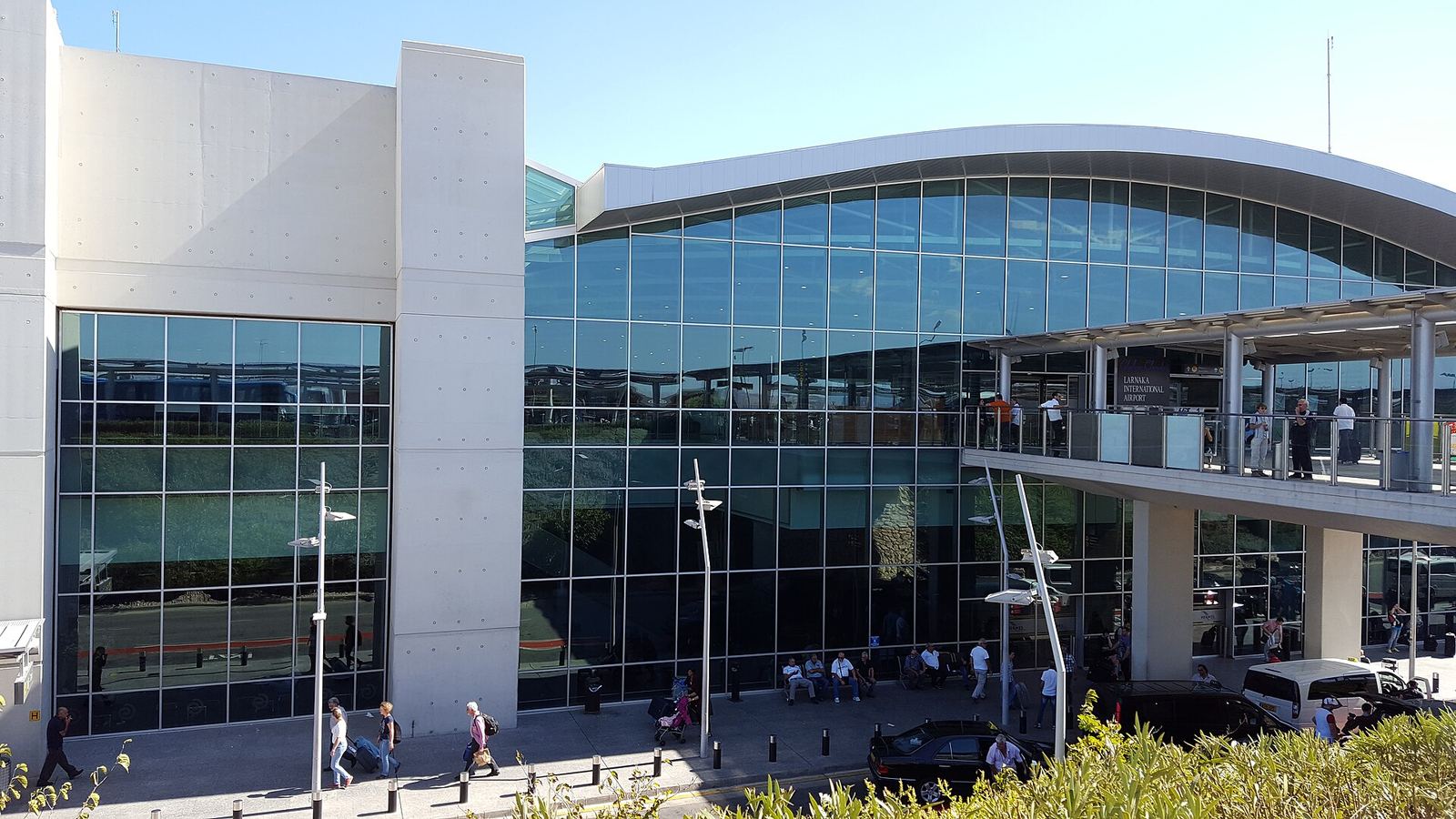
Larnaca International handles the large majority of arrivals to Cyprus and it is an unusually painless airport to land at without a working line. One terminal, arrivals on the lower level, carrier kiosks a short walk past customs, and a free WiFi network that asks nothing of you at all: no sign-up form, no email harvest, no timer counting down while you try to find your booking. Where the airport cannot help is the decision itself. Every plan those kiosks sell, and every travel eSIM sold as a Cyprus plan, covers the Republic and stops at the Green Line. If your fortnight includes a day in Famagusta or a wander through the divided old town of Nicosia, that is a decision to make before you land rather than at a counter with a queue behind you.
What This Guide Covers
Jump to the section most relevant to you
The Carrier Kiosks in Arrivals, and What They Sell
LCA is a single terminal on two working levels, departures upstairs and arrivals on the ground floor, and the flow through it is straightforward. Clear passport control and baggage reclaim and you emerge into a hall that has the car hire desks for Avis, Europcar and Sixt, ATMs and currency exchange, the taxi rank outside, and kiosks for Cyta, Epic and PrimeTel selling prepaid SIMs near the baggage area.
Unlike some airports in the region, these are not staffed around the clock. Opening hours track the flight schedule and the season, so a mid-morning arrival in July will find everything open and a late charter landing in February may not. That is worth knowing if you were relying on buying a SIM the moment you walked out, particularly since Cyprus attracts a lot of low-cost night flying from northern Europe.
Bring your passport, and expect it to be recorded
Cyprus used to sell prepaid SIMs over the counter with no questions. Law 63(I)/2024 changed that: every prepaid mobile line and eSIM on the island must now be tied to a verified identity, and the compliance deadline for existing customers was extended once from 10 November to 10 December before enforcement began. What the assistant needs to see is a passport, an EU identity card or a Cypriot residence permit, and a driving licence is not an acceptable substitute. Each line registers to its own holder, so one person cannot collect four SIMs for the family while everyone else waits by the carousel.
On price, the kiosks are genuinely good value: Cyta's soeasy Combo bundles put 50 GB with calls and texts at ten euro a month and 100 GB at fifteen, and Epic has sold a Holiday SIM with 100 GB across fifteen days for twenty euro. No international eSIM comes close on gigabytes per euro. What none of them will mention is what happens when you carry that SIM across a Green Line checkpoint.
Airport Free-Wifi: What It Is Called and What It Costs
The network to look for in your settings list is Airport Free-Wifi. Select it and you are connected. Hermes Airports, which operates both Larnaca and Paphos, provides it free of charge and without restrictions, meaning there is no time limit, no data cap, and no registration wall demanding a phone number you do not yet have. Among Mediterranean airports that is close to best in class, and it makes LCA one of the easier places to fix a connectivity problem you should have fixed at home.
That matters practically. If you arrive having forgotten to arrange data, you can join the WiFi in the arrivals hall, buy a Cyprus eSIM on your phone, install the profile and walk out with a live line without ever queueing at a kiosk. It takes a few minutes. As with any open public network, the airport does not guarantee its security, so treat it as you would any other unencrypted WiFi and keep banking apps for later.
Paphos is the other front door
A large share of package travel to Cyprus, particularly to the western resorts, lands at Paphos International rather than Larnaca. It is run by the same operator, offers the same free WiFi arrangement, and has a smaller set of carrier desks with shorter hours. If your flight is to PFO rather than LCA, assume fewer options in arrivals and plan accordingly. Flights to the northern part of the island land at Ercan instead and are routed via Turkey, which is a separate journey and a separate mobile market entirely.
Getting Out of LCA, and What Each Route Costs
There is no train, and there never will be on current infrastructure: Cyprus lost its passenger railway in 1951 and is one of only two EU states operating without one. So every route out of Larnaca Airport is on the road, and the good news is that the road network here is fast and the mobile coverage along it is continuous.
| Route | Cost | Time | Notes |
|---|---|---|---|
| Bus 425 / 429 to Larnaca | 1.50 EUR, or 2.50 after 21:00 | 15 to 25 min | To Larnaca Central Station and the Finikoudes stops. Roughly every 30 minutes, about 05:55 to 23:25. Pay the driver. |
| Shuttle to Nicosia | Around 9 to 10 EUR | 40 to 50 min | Kapnos runs the route with over 100 daily departures across its network, up to every 30 minutes at peak summer times. |
| Limassol Airport Express | 10 EUR adult, 5 EUR child | 50 to 60 min | Two stops before Limassol. The standard way west without a car. |
| Shuttle to Ayia Napa / Protaras | From about 13 EUR | 45 to 60 min | Direct Kapnos services with drops at Ayia Napa Square and along Pernera Avenue in Protaras. |
| Taxi to Larnaca centre | 15 to 20 EUR | 10 to 15 min | Metered, rank directly outside arrivals, available at all hours. |
| Hire car | Varies | Immediate | Desks in the arrivals hall. What most visitors doing more than two day trips end up with. |
The 1.50 euro town bus is the bargain and it is genuinely usable, dropping you at the central station or on the seafront within twenty-five minutes. The shuttles are the thing to book in advance if you are heading straight to Ayia Napa or Limassol on a summer evening, because seats fill and the alternative is a long private transfer at several times the price.
Why the hire car changes your data maths
Cyprus is an island people drive around rather than sit still in, and with no rail network the hire car is close to compulsory for anything ambitious. That means a phone clamped to the windscreen running live navigation for several hours a day, every day, which is a different data profile from a city break where you look at a map twice. If you are collecting keys at the arrivals desk, size your plan for constant navigation rather than for evening messaging.
Sorting It Out Before You Land, and the One Reason It Matters Here
For a lot of destinations the argument for buying data in advance is convenience and a few saved euros. In Cyprus there is a sharper reason, and it has nothing to do with the airport at all. Buying at a kiosk means buying whatever the kiosk stocks, which is a Republic plan, and it means making that choice before you have thought about whether your itinerary crosses the Green Line. Deciding at home means deciding with the map in front of you.
The case for arranging it beforehand
The case against
That last point deserves emphasis because it is the one people get wrong. An eSIM does not solve the Green Line, it just makes the boundary easier to manage. Airalo and Nomad sell Republic-only Cyprus plans with no northern equivalent. Holafly does the same but publishes the limitation openly and sells a separate northern plan on Turkcell and TT Mobil, so the full island costs two purchases. The Cyprus eSIM guide sets out which provider rides which network, and the Holafly review explains how the day-count pricing works if you decide to buy both halves.
Kiosk Counter Against a Travel eSIM
Set the two options next to each other and Cyprus produces an unusually lopsided table. The local operators win on money by a distance, because four networks fighting over an island of under a million residents have driven bundle sizes to places most of Europe does not reach. The eSIM wins on friction and on flexibility.
| Local SIM at the LCA kiosks | Travel eSIM | |
|---|---|---|
| Typical cost | 10 EUR for 50 GB monthly, or 20 EUR for a 100 GB fifteen-day holiday pack | Around 19 USD for 20 GB over 30 days, more for unlimited |
| Ready when | After the queue, the ID scan and activation | Before the seatbelt sign goes off |
| ID required | Yes, passport or EU ID under Law 63(I)/2024 | No |
| Open at 1am | Not reliably, hours follow the flight schedule | Always |
| Cypriot number | Yes | Usually not |
| North of the Green Line | Roams at up to 0.20 EUR per MB, near 200 EUR per GB | Does not work at all, which is arguably safer |
| Best for | Stays past three weeks, heavy tethering, anyone wanting a local number | Non-EU visitors, short trips, itineraries that cross the buffer zone |
Look closely at the sixth row, because it inverts the usual logic. A local SIM in the northern part of the island is expensive; a Cyprus eSIM there is simply inert. For a day trip to Famagusta, an inert profile is the better failure mode, since it cannot quietly run up a bill while you photograph the ghost quarter of Varosha. That is the whole argument for carrying a travel plan into a country where EU roaming already works, and it is why this cluster leads with the Green Line rather than with speed tests. For the city itself and its day trips, the Larnaca city guide covers what to expect, and the Cyprus SIM card guide goes deeper on the local operators.
Frequently Asked Questions
Can I count on a carrier kiosk being open when my flight lands?
Not always, and this is where Larnaca differs from airports that staff their counters around the clock. The Cyta, Epic and PrimeTel kiosks in the arrivals hall follow the flight schedule and the season, so a summer daytime arrival will find everything trading and a winter night landing may not. Cyprus takes a lot of low-cost night flying from northern Europe, so it is a realistic risk. If your arrival is late, either have a profile installed already or plan to use the terminal WiFi and buy one on the spot.
What is the WiFi network in the terminal and does it have a time limit?
It broadcasts as Airport Free-Wifi and it has no time limit, no data cap and no registration step. Hermes Airports, which runs both Larnaca and Paphos, provides it free and unrestricted to everyone in the building. That makes it genuinely useful rather than a token gesture: you can join it in arrivals, buy and install an eSIM on your phone, and leave with a working line without visiting a counter. It is an open public network, so leave the banking apps until later.
What is the cheapest way from LCA into Larnaca town?
Buses 425 and 429, at 1.50 euro for an adult single paid to the driver, rising to 2.50 euro for journeys from 21:00. They run to Larnaca Central Station and the Finikoudes stops in fifteen to twenty-five minutes, roughly every half hour between about 05:55 and 23:25. A metered taxi from the rank outside arrivals covers the same trip in ten to fifteen minutes for fifteen to twenty euro, which for a group with luggage is often the better answer.
How do I get from the airport straight to Ayia Napa or Limassol?
Both have direct shuttle services and neither needs a stop in Larnaca. The Limassol Airport Express charges ten euro for an adult and five for a child, making two stops before Limassol in around an hour. Kapnos runs direct services to Ayia Napa and Protaras from about thirteen euro, dropping at Ayia Napa Square and along Pernera Avenue. Its Nicosia route costs roughly nine to ten euro and takes forty to fifty minutes, running as often as every half hour at peak summer times.
If I buy a SIM at the airport, will it work when I visit Famagusta?
It will connect and it will cost you. North of the Green Line your phone attaches to KKTCELL or Telsim, neither of which sits inside the EU roaming framework, so a Cypriot prepaid line switches to foreign roaming at rates quoted as high as 0.20 euro per megabyte, near 200 euro for a gigabyte. A Cyprus travel eSIM simply stops working instead, which costs nothing. Either way, download your offline map before you reach the crossing and turn data roaming off on the SIM carrying your main number.