None of the three travel eSIM brands we track sells a Comoros plan. Airalo, Nomad and Holafly all return a 404 for the country, and neither Airalo's Africa regional pack nor Holafly's Africa product includes it, so there is no plan from them for us to rank. That is not the same as saying an eSIM is impossible. Ubigi, a smaller seller, lists Comoros at 7 dollars for 1 GB over seven days and 32 dollars for 10 GB over thirty, and its page names Yas as the network. The local route is far cheaper, though: Yas, the operator that used to trade as Telma Comores, sells 10 GB for thirty days at 5,000 Comorian francs, which is a little over 10 euros at the fixed euro peg. And contrary to what you will still read in older guides, the country is not a one-operator market. State-owned Comores Telecom, with its Huri mobile brand, and Yas have competed since Telma switched on at the end of 2015. The real planning question is not which eSIM to buy but which of the three islands you are going to, because Grande Comore, Anjouan and Moheli are served very differently.
What This Guide Covers
Jump to the section most relevant to you
Getting Online in Comoros
No travel eSIM provider currently sells a plan for Comoros, so the realistic options are a local SIM on arrival, roaming from your home carrier, or satellite.
A local SIM on arrival
Telma Comores and Comores Telecom sell prepaid SIMs in Moroni.
Coverage is adequate on Grande Comore and thinner on Anjouan and Moheli.
Mobile Networks in Comoros
Two networks, not one. Plenty of travel material still describes Comoros as a single-operator country, and that stopped being true a decade ago. The incumbent is Comores Telecom, the Societe Nationale des Telecommunications, which runs the fixed network, the ADSL and fibre lines, the international gateway and the Huri mobile brand from its headquarters on Place Volo-volo in Moroni. The challenger is Yas Comores, which launched as Telma Comores after winning a licence in 2015 and is part of Axian Telecom, the group behind Yas in Madagascar, Senegal, Togo and Tanzania. The old telma.km address now simply redirects to yas.km, and the shop signs have followed. Both operators sell prepaid lines to visitors, both run 3G and 4G, and both have started talking about 5G: Comores Telecom marked its twentieth anniversary in June 2025 by announcing its entry into 5G and a fixed wireless service called Nema Net, while Yas sells a 5G home box, the Yahangu. For someone holding a phone in Moroni, 4G is the realistic expectation.
What a local line costs. Yas publishes its whole data ladder in Comorian francs, and the franc is pegged to the euro at 491.968 to one, so the conversion never moves. These are the Yas Net bundles listed on its site in October 2026:
| Bundle | Data | Validity | Price | About |
|---|---|---|---|---|
| Net 500 | 1 GB | 1 day | 500 KMF | 1.02 EUR |
| Net 1000 | 2 GB | 3 days | 1,000 KMF | 2.03 EUR |
| Net 2000 | 4 GB | 7 days | 2,000 KMF | 4.07 EUR |
| Net 5000 | 10 GB | 30 days | 5,000 KMF | 10.16 EUR |
| Net 10 000 | 20 GB | 30 days | 10,000 KMF | 20.33 EUR |
That puts a month of data at roughly a euro a gigabyte, against 3.20 dollars a gigabyte on Ubigi's largest Comoros plan and 7 dollars on its smallest. Comores Telecom sells its own Huri bundles through shops and resellers; we did not find a current Huri data price list published online, so price it at the counter before you choose.
How the islands are wired. For years the archipelago leaned on satellite and on radio links between the islands. Two submarine systems changed that. The Avassa cable, laid by Huawei Marine and E-Marine and handed over to Comores Telecom in January 2017, landed at Moroni and Chindini on Grande Comore and at Mutsamudu on Anjouan, with a leg to Mayotte. FLY-LION3, laid by Orange Marine and brought into service in 2019, links Moroni with Mamoudzou on Mayotte and onward to the LION2 and EASSy systems along the East African coast. What that means for you is that Grande Comore and Anjouan sit on fibre for their international traffic. Moheli was not named as a landing point in either project, which is consistent with what visitors report: it is the quietest and thinnest of the three networks.
A local eSIM does exist, with conditions
Yas sells its own eSIM. Its consumer page says you activate it in a Yas store with an identity card or passport, and its FAQ says online purchase is coming but not live. Separately, Yas has published an online request form that asks for your passport number, a scan of the passport and a photo. We have not tested whether that form will issue a profile to a foreign applicant before arrival, so treat it as a possibility rather than a plan. A Yas eSIM is the answer for a phone with no SIM tray; for everyone else a plastic SIM from the same shop does the same job.
Mayotte is a different country for your phone. The fourth island of the archipelago is a French department, with French operators and French numbering. Plans sold for France or for Mayotte are not Comoros plans and will not attach to Yas or Huri once you cross the water, and a Comorian SIM roams in Mayotte rather than working at home rates.
Coverage Across Comoros
Coverage where travelers actually go:
| Area | Coverage | Notes |
|---|---|---|
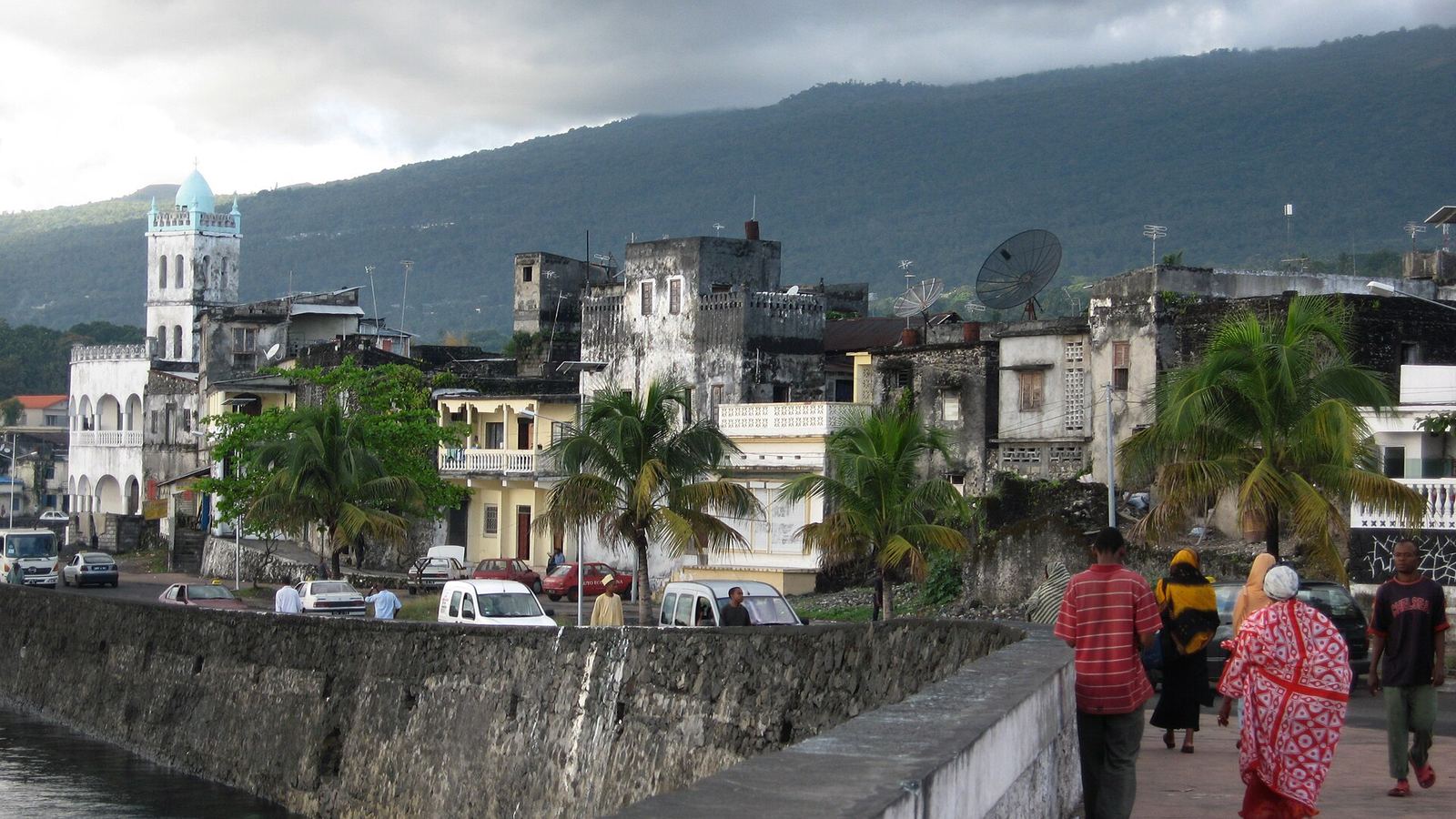
| Moroni and the west coast of Grande Comore | Good | The capital, the medina around the Old Friday Mosque and the hotel strip are where both networks are strongest and where 4G is normal rather than lucky. |
| Hahaya and Prince Said Ibrahim Airport | Usable | The airport sits about 20 km north of Moroni. Signal along the coast road is fine; expect a few weaker stretches before Mitsamiouli and the northern beaches. |
| Mount Karthala | Patchy to none | The 2,361 metre active volcano dominates the island. The lower forest trail holds a bar or two; the summit crater rim and the overnight camp should be treated as offline. |
| Anjouan (Mutsamudu and Domoni) | Usable | Mutsamudu is a cable landing town and coverage there is solid. The steep interior valleys and the road over to the east coast lose signal in folds of the hills. |
| Moheli (Fomboni and Nioumachoua) | Patchy | The smallest and least developed island. Fomboni is workable; around the marine park and the turtle beaches at Itsamia, plan on long gaps. |
| Inter-island crossings | Fading | Boats between the islands lose both networks well before mid-channel. Download tickets, contacts and maps before you sail. |
How to Prepare
Without a major-brand plan to compare, the choice comes down to timing and paperwork. Here is the order we would work through it.
Decide whether you need data the moment you land. Most arrivals come through Prince Said Ibrahim International at Hahaya, on connections through Nairobi, Addis Ababa, Dar es Salaam or Antananarivo, and most of them are met by a hotel driver or a relative. If someone is collecting you, you can manage the first hour on nothing and buy a local line in Moroni. If you are arriving alone, late, or on a visa you still need to sort at the desk, buy an Ubigi Comoros eSIM before you leave home. At 7 dollars for 1 GB over seven days it is an expensive gigabyte, but it is on Yas and it is working when the wheels touch down.
Then buy local for the rest of the stay. Take your passport to a Yas or Comores Telecom shop in Moroni and expect a registration step. Yas asks for an identity card or passport even to issue its eSIM in store, so assume the same for a plastic SIM, and let the clerk record the document before the number goes live. Once the line is live, the arithmetic is lopsided. Yas sells 10 GB for thirty days for 5,000 francs, and Ubigi's nearest equivalent is 32 dollars. Keep the eSIM installed as a backup if you like, but the local bundle should carry the trip.
Choose the network by the island. On Grande Comore either operator will do. Moheli is where the decision matters: ask your guesthouse or guide which network works best at the place you are staying, because the answer is local and it changes with each new mast. If you are moving between islands, a line on each network is cheap enough to be a sensible hedge, and dual-SIM phones make it painless.
Carry cash in francs. Bundles are bought by recharge vouchers, by USSD code or through mobile money, and card payment for top-ups is not something to count on. Euros are widely understood, the peg makes mental arithmetic easy, and you will need cash anyway for the visa at the airport and for the shared taxis that run the coast roads.
Download before you go somewhere remote. The Karthala climb, the turtle beaches on Moheli and the boat crossings are the three places where you will lose signal for hours. Save offline maps for all three islands, keep boat and flight confirmations as files on the phone, and tell whoever expects to hear from you that a quiet day on Moheli is normal.
Ignore any listing that sells you a Mayotte or France plan for Comoros. Mayotte is a short hop away and well connected, but it is a French department. A French plan will not work at home rates on Grande Comore, and the reverse is just as true.
Frequently Asked Questions
Is it true that Comoros has only one mobile operator?
No, and it has not been true since Telma Comores launched at the end of 2015. There are two networks: Comores Telecom, the state-owned incumbent whose mobile brand is Huri, and Yas Comores, the former Telma, owned by Axian Telecom. Both sell prepaid SIMs to visitors and both run 4G in the main towns. Older travel guides and some eSIM comparison pages still repeat the single-operator line, which is one reason to treat their other details with care too.
Can I buy any eSIM before flying to Moroni?
Yes, just not from Airalo, Nomad or Holafly, none of which sells the country. Ubigi lists Comoros at 7 dollars for 1 GB over seven days and 32 dollars for 10 GB over thirty, and its page names Yas as the network it connects to. Yas itself sells an eSIM, but its own FAQ says activation is in-store with your passport, so it is not something to count on before arrival. We list Ubigi because we checked its page; several other small resellers also advertise Comoros, and we have not verified them.
How much cheaper is a Yas SIM than a foreign eSIM?
A lot. Yas sells 10 GB valid for thirty days for 5,000 Comorian francs, which is 10.16 euros at the fixed peg, and 4 GB for a week for 2,000 francs. Ubigi's 10 GB plan costs 32 dollars on the same Yas network. That is roughly three times the price for an identical allowance. The foreign eSIM earns its money only in the hours before you can reach a shop, or on a phone that cannot take a physical SIM.
Will my phone work on Moheli and Anjouan as well as Grande Comore?
Mostly, with an important difference in quality. Anjouan's main town, Mutsamudu, is a landing point for the Avassa submarine cable and has dependable coverage, although the mountainous interior is patchy. Moheli is the smallest and least connected island: Fomboni works, while the marine park villages and the turtle beaches at Itsamia have long gaps. A SIM bought on Grande Comore works on all three islands, so there is no need to buy again when you cross.
Do I need a visa, and does that affect getting online?
Comoros issues visas on arrival at Prince Said Ibrahim International. The fee is commonly quoted at 30 euros or 15,000 francs, payable in cash, though you should confirm the current amount with an embassy before you travel. It affects connectivity only in timing: the visa desk, the immigration queue and the baggage hall come before any SIM shop, and there may be no open counter at all if your flight lands late. That is the strongest argument for arriving with an eSIM already active.
Is there a signal on Mount Karthala?
Only at the bottom. The trail from M'vouni or Boboni climbs through forest where you will catch a bar or two, but the upper slopes and the vast summit caldera of this 2,361 metre volcano are effectively offline. Most climbers camp near the top and come down the next day, so plan for a night without a connection, carry a paper note of your guide's number, and tell someone in Moroni when you expect to be back in range.