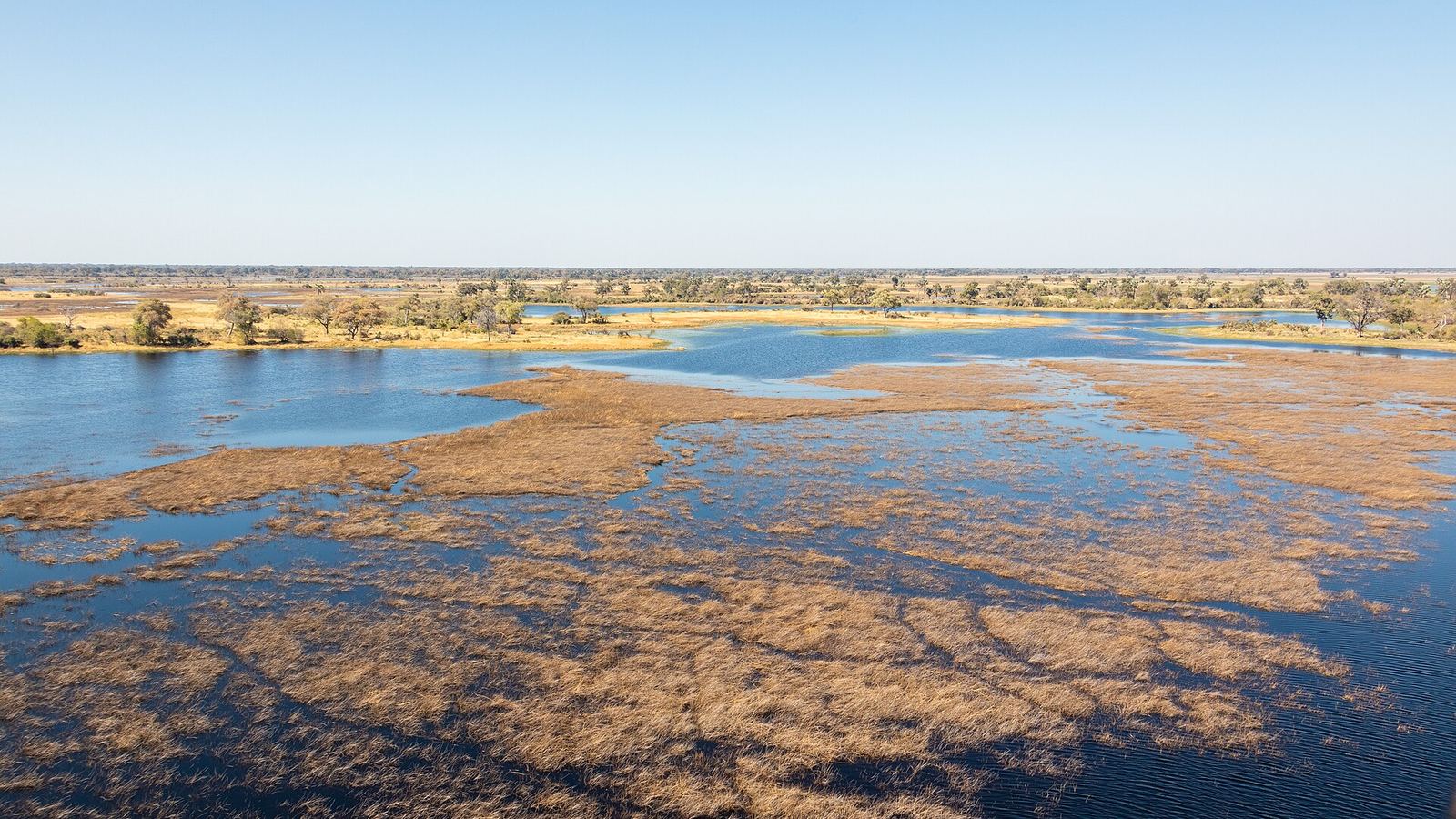
Botswana is the rare destination where the most important thing to know about your data plan is how many days of the trip it will not work. Gaborone, Maun, Kasane and Francistown have solid 4G, and the tar roads between them are mostly covered. The places you actually flew here for are not. Once a light aircraft drops you on a gravel strip in the Okavango, or a game drive vehicle passes the Sedudu gate into Chobe, the phone goes quiet, and in most camps it stays quiet until you leave. Lodge WiFi in the Delta arrives by satellite, is often limited to the main area, and is not built for uploading the day's photographs. So the honest plan is a data allowance sized for the town nights, not for the whole holiday.
On price, the three travel eSIMs that sell this country are far apart. Nomad runs on Orange Botswana and asks 24 dollars for 5 GB over a month. Airalo runs on Mascom and asks 35 dollars for the same 5 GB. Holafly sells unlimited days on either network from 19.90 dollars, which is money spent on nights in a tent with no mast for eighty kilometres. And all three are beaten on raw cost by the local operators, where BTC sells 30 GB for P199, about 14 dollars. The eSIM Finder will tell you whether the convenience is worth that gap for your dates.
Quick Pick: the Best eSIM for Botswana
Nomad (Botswana 5 GB / 30 days): Twenty-four dollars for 5 GB is under five dollars a gigabyte, against seven on Airalo, and the thirty-day validity outlasts a week of offline camps in the Delta with data left for Maun or Kasane at the other end. It rides Orange, so self-drivers on the remote northern roads should weigh Airalo's Mascom connection instead.
Our picks
Best overall: Nomad. Lowest per GB: Nomad. Unlimited: Holafly. Or use the eSIM Finder.
Botswana eSIM Plans Compared
Indicative pricing. Tap through for live rates.
| Provider | Plan | Data | Duration | Price | Network |
|---|---|---|---|---|---|
| Airalo | Botswana 1GB | 1 GB | 3 days | $8.50 | Mascom |
| Airalo | Botswana 3GB | 3 GB | 3 days | $21 | Mascom |
| Airalo | Botswana 3GB | 3 GB | 7 days | $23 | Mascom |
| Airalo | Botswana 5GB | 5 GB | 7 days | $32.50 | Mascom |
| Airalo | Botswana 5GB | 5 GB | 15 days | $33.50 | Mascom |
| Airalo | Botswana 5GB | 5 GB | 30 days | $35 | Mascom |
| Nomad | Botswana 1GB | 1 GB | 7 days | $8 | Orange Botswana |
| Nomad | Botswana 3GB | 3 GB | 30 days | $16 | Orange Botswana |
| Nomad | Botswana 5GB | 5 GB | 30 days | $24 | Orange Botswana |
| Nomad | Botswana 10GB | 10 GB | 30 days | $39 | Orange Botswana |
| Holafly | Unlimited 3-day | Unlimited | 3 days | $19.90 | Mascom / Orange Botswana |
| Holafly | Unlimited 5-day | Unlimited | 5 days | $30.90 | Mascom / Orange Botswana |
| Holafly | Unlimited 7-day | Unlimited | 7 days | $39.50 | Mascom / Orange Botswana |
| Holafly | Unlimited 10-day | Unlimited | 10 days | $46.90 | Mascom / Orange Botswana |
| Holafly | Unlimited 15-day | Unlimited | 15 days | $63.50 | Mascom / Orange Botswana |
| Holafly | Unlimited 30-day | Unlimited | 30 days | $111.90 | Mascom / Orange Botswana |
Airalo Botswana Plans
Airalo: The Mascom Option, at a Premium
Six Botswana plans on Mascom, from 1 GB up to 5 GB
Airalo connects to Mascom, the largest operator and the one with the deepest rural reach, and it prices that access firmly. The range opens with 1 GB over three days at 8.50 dollars, then 3 GB at 21 dollars for three days or 23 for seven, and 5 GB at 32.50 for seven days, 33.50 for fifteen or 35 for thirty. The best rate on the ladder is about seven dollars a gigabyte, almost one and a half times what Nomad charges.
The reason to pay it is the road. If you are hiring a 4x4 in Maun or Kasane and driving the northern circuit yourself, Mascom is the network most likely to still have a bar in the villages along the A3 and on the run up the western side of the Delta. That is a safety argument rather than a speed argument, and on that kind of trip it is worth more than the eleven-dollar difference against Nomad.
For everyone else the Airalo plan worth noticing is the smallest. At 8.50 dollars, 1 GB over three days is a neat fit for a traveller who lands in Gaborone, spends a night, and flies on to a Delta camp with no network, because that is genuinely all the data the first leg needs.
Strengths
Weaknesses
Holafly Botswana Plans
Holafly: Unlimited Data, Mostly Spent in Places With None
Unlimited Botswana plans on Mascom or Orange, from three to thirty days
Holafly's Botswana plans cost 19.90 dollars for three days, 30.90 for five, 39.50 for seven, 46.90 for ten, 63.50 for fifteen and 111.90 for thirty. The data is unlimited and the profile lists both Mascom and Orange, which makes it the only product here that is not tied to a single network.
The problem is arithmetic about the itinerary, not about the price list. A ten-day Botswana trip that includes five nights in the Delta pays 46.90 dollars for ten unlimited days, and spends half of those days beyond any mast. The same money buys Nomad's 10 GB plan with change to spare, and 10 GB is more than most people use on the town nights of a safari.
Where Holafly does earn its place is a short, connected trip: three or five days split between Gaborone and a Chobe riverfront hotel in Kasane, with a lot of video, where unlimited at 19.90 or 30.90 removes any need to watch a meter. Check the hotspot terms before relying on it, because sharing is capped at about 1 GB a day.
Strengths
Weaknesses
Nomad Botswana Plans
Nomad: Half the Price Per Gigabyte, on Orange
Four Botswana plans on Orange, from 1 GB to 10 GB
Nomad is the clear price leader in this country. Its four plans are 1 GB over seven days at 8 dollars, 3 GB over thirty days at 16, 5 GB over thirty days at 24, and 10 GB over thirty days at 39. That works out at 3.90 dollars a gigabyte at the top of the ladder and 4.80 on the 5 GB plan, against seven dollars a gigabyte on Airalo's best rate. For a month-long validity window with a safari in the middle of it, the 5 GB plan is the sweet spot: enough for town nights at both ends, and still alive after a week in camps with no signal.
The trade-off is the network. Nomad puts you on Orange, and Orange is excellent in Gaborone and good in Maun and Kasane, but it is the second network once you are between villages in the north. Fly-in travellers will never notice. A self-drive from Nata up to Kasane, or out along the panhandle, will see Orange drop out a little earlier than Mascom would.
The sixty-day activation window helps here, because Botswana trips are usually booked many months ahead and then start with a long-haul connection through Johannesburg or Addis Ababa. Buy it when you book, install it the week you leave, and the clock does not start until the phone first sees Orange.
Strengths
Weaknesses
Mobile Networks in Botswana
Three companies run mobile networks here, and for a visitor the ranking is decided by what happens north of Francistown rather than in the capital. Mascom Wireless is the largest operator and has pushed further into the villages and safari gateways than either rival; if a lodge manager in Maun or a guide in Kasane hands you a number, it is usually a Mascom line. Orange Botswana is the second network, strong in Gaborone and the south-east, present in every larger town, and generally a little thinner than Mascom along the remote stretches of the A3 and the road to Shakawe. BTC, the Botswana Telecommunications Corporation, is the old fixed-line incumbent with a mobile arm that some travellers still remember as beMOBILE; it is cheapest on data and is strongest in and around Gaborone and Francistown.
The useful twist is how the travel eSIMs split across these networks. Airalo's Botswana plans connect through Mascom. Nomad's connect through Orange. Holafly lists both Mascom and Orange, so its profile can pick whichever is stronger where you stand. In the towns that difference is invisible. On the drive from Nata to Kasane, or out toward the panhandle villages, it can decide whether you have one bar or none.
5G exists, but only in the capital, and it will not touch a safari
Mascom and Orange both switched on 5G in parts of Gaborone from 2022. BTC announced it would launch its own commercial 5G in selected Gaborone suburbs in October 2026, alongside capacity upgrades at 599 mobile sites and a budget of more than 240 million pula for the 2026/27 financial year. None of that reaches Maun, Kasane or the parks in any way a visitor will notice. Read the 4G and 5G language on eSIM product pages as a description of Gaborone, not of the Delta.
Plan the offline stretches rather than hoping they will not happen. Before the flight into a Delta camp or the drive into Moremi or Savuti, download offline maps for the whole northern region, save lodge and operator numbers as contacts, and send your onward plans to someone at home. Camps carry radios and satellite links for emergencies, so you are not cut off from help, only from your feed. Self-drivers heading into the Central Kalahari or the Makgadikgadi without a guide are in a different position and should carry a satellite communication device as standard kit.
Coverage Across Botswana
Coverage where travelers actually go:
| Area | Coverage | Notes |
|---|---|---|
| Gaborone | Excellent | All three networks blanket the city, with 5G pockets from Mascom and Orange and a BTC 5G launch scheduled for October 2026 in selected suburbs. |
| Francistown & the A1 | Very good | Solid 4G in Francistown and along most of the A1 north from Gaborone through Mahalapye and Palapye, with brief gaps between the larger villages. |
| Maun | Very good | Reliable 4G on Mascom and Orange across town, at Maun airport and along the Thamalakane riverfront lodges. The last dependable signal before the Delta. |
| Kasane & Kazungula | Very good | Strong in Kasane town and along the riverfront hotel strip, and good at the Kazungula bridge border post. Mascom is the stronger of the two here. |
| Chobe riverfront | Variable | Bars often hold for the first stretch past the Sedudu gate and on the boat cruises nearest town, then fade as drives head west toward Ihaha. Savuti and Linyanti have nothing. |
| Okavango Delta camps | None | No mobile network inside the Delta. Camps run satellite WiFi of varying generosity, often only in the main guest area. |
| Moremi Game Reserve | None | Plan on no dependable signal at South Gate, Xakanaxa, Third Bridge or across the Khwai concession. Shorobe village, on the road in from Maun, is usually the last reliable bar. |
| Makgadikgadi, Nxai Pan & Central Kalahari | None | Nata, Gweta and the A3 villages have coverage. The pans, Nxai Pan and almost all of the Central Kalahari reserve do not. |
How to Choose the Right Plan
Start by counting the nights you will spend in a town with a mast: Gaborone, Maun, Kasane, Francistown, Nata. Those nights are the whole of your data need, and on a standard fly-in safari they add up to three or four. For that pattern Nomad is the answer: 5 GB over thirty days at 24 dollars covers both ends of the trip and does not expire while you are in the Delta. If you are driving yourself through the north, choose Airalo instead, because Mascom keeps a signal further along the A3 and the panhandle roads, and on a self-drive that matters more than the extra eleven dollars. Holafly makes sense only on a short, well-connected visit, say three nights split between Gaborone and Kasane, where unlimited data for 19.90 dollars means never checking a balance. Anyone with half a day in Gaborone or Maun before heading out, and a passport in their bag, should consider a BTC or Mascom card: the money saved is real and the registration takes minutes when the shop is quiet. Whatever you buy, download offline maps of the whole north before the light aircraft leaves, because no plan sold for this country will reach you in camp.
Frequently Asked Questions
How much data do I need if most of my nights are in the Okavango?
Much less than the length of your trip suggests. Count only the nights in Gaborone, Maun and Kasane, plus the travel days between them, and size the plan for those. A typical fly-in safari spends two nights in Maun or Kasane either side of four to six camp nights with no mobile network at all. For that shape, 3 to 5 GB is plenty for messaging, maps, a few video calls and backing up photos on the last evening. Buying an unlimited plan for the whole fortnight means paying for days the phone spends in a dry bag.
Which travel eSIM connects to Mascom, and does it matter?
Airalo's Botswana product connects to Mascom, Nomad's connects to Orange, and Holafly lists both. In Gaborone, Maun and Kasane it does not matter much, because both networks are strong there. It matters on the long roads in the north: the A3 between Nata and Maun, the road from Nata to Kasane, and the panhandle villages toward Shakawe, where Mascom tends to hold a signal for longer. If you are self-driving that circuit, Airalo or Holafly is worth the premium over Nomad. If you are flying between camps, take the cheaper Nomad plan.
Is it cheaper to buy a local SIM in Botswana?
Yes, by a wide margin. BTC sells 30 GB over thirty days for P199, about 14 US dollars, and Mascom's MyMix ladder runs from P45 for a week's 2 GB up to large monthly bundles. The cheapest comparable travel eSIM is Nomad at 24 dollars for 5 GB. The cost of the local card is paperwork: you must register it with your passport in a shop before the line will work, and the shops are in town, not at the camp airstrips. If you have a spare afternoon in Gaborone or Maun, the local card wins. If you land and fly on to the Delta the same day, the eSIM wins.
Will my Botswana eSIM keep working if I cross into Zambia or Namibia?
Not on a Botswana country plan. Airalo, Nomad and Holafly all sell Botswana as a single-country product, so the line stops working at the Kazungula bridge or the Ngoma crossing. If your trip includes a day across the river, buy a separate plan for the next country or a regional Africa product, and check the destination list before you pay rather than assuming every neighbour is included.
Can I rely on lodge WiFi instead of buying any data?
For the camps, it is the only option you have, so in that sense yes. Expect WhatsApp to work, email to work slowly, and video calls and photo uploads to struggle, and expect some camps to keep the network to the main lodge area or switch it off in the evening. The weak point is the transfers. Getting from the international arrival to a charter desk, confirming a delayed light aircraft, or messaging a driver in Kasane all happen outside lodge WiFi, and those are the moments a working phone earns its cost.
Do Mascom or Orange sell a local eSIM I could use instead of a physical card?
Orange does. Its stores issue an Orange Botswana eSIM for P10, and the registration rules are the same as for a plastic card: you present your passport in person at an Orange shop. That suits a phone that only has an eSIM slot, but it is not a way to buy before you fly, because the purchase and the identity check happen over the counter in the country.