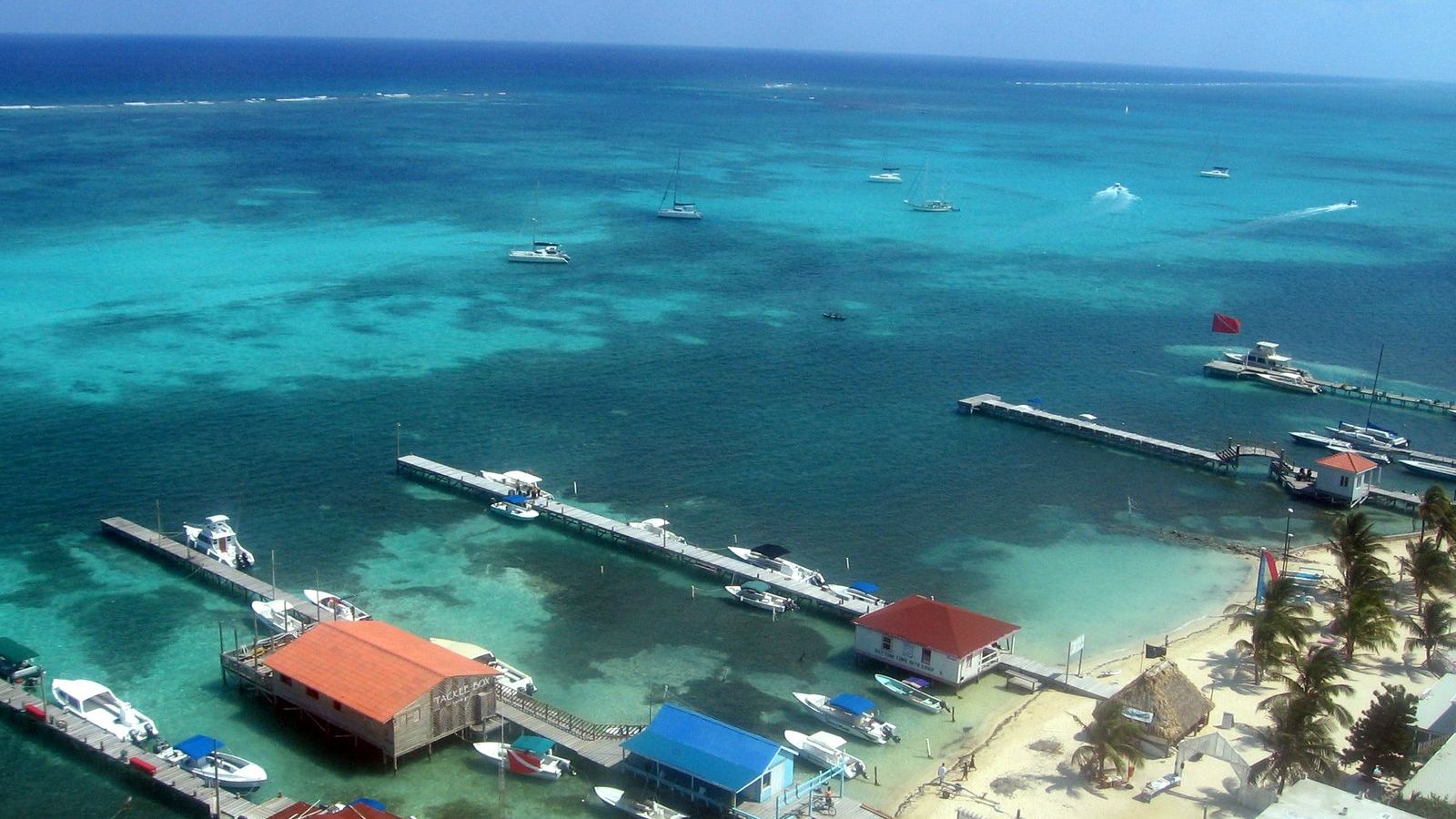
San Pedro sits at the southern tip of Ambergris Caye, a sandbar roughly forty kilometres long that runs parallel to the Belize Barrier Reef with only a few hundred metres of turquoise between the two. Almost everything a visitor does here happens within about eight kilometres of the town square, and that is exactly the stretch where mobile coverage is genuinely good. Both Belizean operators keep the town, the airstrip and the hotel strip in solid LTE, and a travel eSIM on either one behaves the way you would expect it to in a small Caribbean town. The interesting part of this page is what happens once you drive north over the bridge, cross to the west side toward Secret Beach, or get on a boat, because those are the three directions in which the signal thins out and the difference between the two networks starts to show.
What This Guide Covers
Jump to the section most relevant to you
Mobile Coverage Across Ambergris Caye
The island's coverage map, if either operator published one, would look like a stripe. Development runs along the eastern shore facing the reef, the masts follow the development, and the further you get from that stripe the more variable things become. In San Pedro town itself, along the three parallel streets that everyone still calls Front, Middle and Back even though they were formally renamed Barrier Reef Drive, Pescador Drive and Angel Coral Street, Digi and Smart both deliver reliable LTE. The same holds down the southern hotel strip toward the Marco Gonzalez end and up the first stretch north of the town.
Which network your eSIM sits on matters more here than it does in Belize City. Airalo's Belize plans ride Speednet, the operator trading as Smart, whose footprint is concentrated on the towns and the main routes. Nomad and Holafly both ride Digi, whose network reaches further into the thinly built parts of the caye. Inside the town that distinction is academic. It becomes real the moment you are north of the bridge or over on the lagoon side.
Do not expect 5G, whatever your plan says
Several eSIM product pages advertise 5G for this country. There is no commercial 5G network in Belize on either operator, and no announced launch date. What you get on the caye is LTE on 700 MHz and 1900 MHz, which in practice means comfortable video calls from a beachfront balcony in town and something more like careful messaging once you are somewhere quiet. If your handset lacks 700 MHz support you will notice it most at the edges of the island rather than in the middle of San Pedro.
Hotel and restaurant WiFi fills a good part of the gap. Most places on the strip run a connection over the island's fibre backhaul and it is usually decent in the evening, though the shared bandwidth at a busy beach bar at sunset behaves the way shared bandwidth always does. Treat it as the thing that saves your data allowance rather than as the thing you rely on for a call that matters.
Golf Carts, and Why They Change How You Use Data
There are cars on Ambergris Caye but they are outnumbered many times over by golf carts, and a rented cart is how most visitors move around for the length of their stay. This has a genuine effect on your phone. A cart has no dashboard mount, no charging port you would trust, and no roof worth the name, so navigation happens on a handset that is being rained on, sun-bleached and jolted along an unpaved road. Battery drains faster than you expect because the screen is fighting Caribbean glare at full brightness.
The practical consequence is that you should pull the map down before you set off rather than streaming it as you go. Offline maps for the whole island are a small download and they remove the two failure modes that actually catch people out: losing signal on the north road, and losing the battery entirely. A cheap suction mount and a power bank in the cart basket are the two accessories most worth their space in a suitcase for this particular island.
Three things worth doing before you collect the cart
Save the rental company's number as a contact rather than leaving it in a booking email, because you will want it when a tyre goes on the north road and you may not have the bandwidth to load a mailbox. Screenshot your accommodation's location pin. And note that carts are rented by the day with a strict return time, so a signal blackout at the far end of the island is also a scheduling problem, not just an inconvenience.
One more local quirk: the town has a one-way traffic system and a genuine rush of carts around school runs and the afternoon flights, so navigation apps that assume a car will occasionally suggest something a cart cannot do. Locals navigate by landmark rather than by street name, and after a day you will too, which is another reason the map matters less than the battery.
Past the Bridge: North Ambergris and Secret Beach
The Sir Barry Bowen Bridge crosses the Boca del Rio channel at the northern edge of town, and it is the line where the island changes character. South of it you are in a town. North of it you are on a coastal road threading between resorts, construction sites and long empty stretches, and the further you go the more the signal comes and goes. The first few kilometres past the bridge are fine on both networks. Somewhere around the middle of the north road, coverage becomes something you check rather than something you assume, and Digi generally holds on longer than Smart does.
Secret Beach is the specific case worth planning for. It sits on the western, lagoon side of the caye, reached by a rough unpaved track that branches off the coastal road, and the area was genuinely off-grid until very recently. It is not secret any more, it has bars and beach clubs and a car park full of carts, but the infrastructure has not caught up with the crowds and phone signal out there is the clearest example on the island of coverage lagging development. Expect intermittent bars, expect them to disappear entirely in the wrong spot, and expect the track to be genuinely bad after rain.
What still works out there
What will not
None of this is a reason to skip the north end, which is where the quieter beaches are. It is a reason to leave with a charged phone, a downloaded map and a rough idea of when you intend to be back, told to somebody who is staying in town.
Signal on the Water Taxi to Caye Caulker and Belize City
San Pedro Belize Express runs the main passenger boat, leaving San Pedro from six in the morning with the last southbound departure in the afternoon around half past four, and calling at Caye Caulker roughly forty-five minutes into the run before continuing to the marine terminal on North Front Street in Belize City. End to end it is about ninety minutes, seven days a week, with eight sailings in each direction on a typical day. Caribbean Sprinter runs the same corridor.
Data on the crossing is better than people expect. The route stays inside the reef and reasonably close to land for most of its length, so a phone holds a workable signal for the majority of the trip on either network. There is a softer patch in the open water between Caye Caulker and the mainland where things get thin, and the boat is loud enough that a call is unpleasant even where the bars exist. Messaging, maps and a downloaded playlist all work fine.
The fare, and why the currency confuses people
Belize Port Authority approved fares put the adult non-resident one-way between Belize City and San Pedro at BZ$69, with a lower resident rate, which is about thirty-five US dollars at the fixed two-to-one peg. Ticket windows quote in Belize dollars and accept US dollars, so a fare quoted as sixty-nine is not the disaster it first looks. Buy at the terminal window rather than from someone approaching you outside it.
The short hop to Caye Caulker is the one most visitors actually make, and it is the easiest half hour of travel in the country. Coverage there is good along the Front Street strip and around the Split, and thins toward the far northern end of that island in much the same way it does at the north end of Ambergris. If you are day-tripping, the thing worth downloading before you board is the return timetable, because the last boat back leaves earlier than a relaxed lunch suggests.
On the Reef: Hol Chan, Shark Ray Alley and Beyond
Hol Chan Marine Reserve sits about six kilometres south-east of San Pedro, at a natural cut through the barrier reef, with Shark Ray Alley just inside it. That is close enough to shore that most phones hold bars on the boat and over the snorkelling site, which surprises people who assume any reef trip means going dark. If you want the photograph of the nurse sharks sent to somebody the same afternoon, you will usually be able to send it from the boat.
Everything further out is a different story. Turneffe Atoll, Lighthouse Reef and the Great Blue Hole sit fifty to seventy kilometres offshore, well beyond any Belizean mast, and a Blue Hole day trip is a full day with no signal from the moment the caye drops below the horizon. Dive operators run their own radio and satellite communications, which is what actually matters for safety, but your handset is a camera and nothing else for the duration.
Get the trip details onto the phone, not into the cloud
Save your dive or snorkel booking as a screenshot rather than a link, note the departure dock by name rather than by map pin, and if you are meeting a boat at a hotel pier rather than the town dock, confirm it the evening before. Operators here run on WhatsApp and will confirm quickly, but only while you have signal to ask.
One practical note for anyone diving with a camera. If you are on a metered eSIM at nine or ten dollars a gigabyte, a week of underwater video backing up automatically to a cloud account is a genuinely expensive accident. Turn off automatic photo upload over cellular before you leave home, and let it run on hotel WiFi in the evening instead. This is the single most common way visitors burn a Belize data allowance in three days. If you would rather stop counting altogether for a heavy diving week, the Holafly review sets out how its unlimited plans handle tethering and speed once you are moving serious volume.
Your First Hour in San Pedro
Most people arrive one of two ways: on a fifteen-minute flight from Philip Goldson into the airstrip that sits right in the middle of town, or on the water taxi at the dock a few streets away. Either way you step out into the town centre rather than into an airport complex, and there is no arrivals hall with a SIM counter waiting for you. That is the practical case for having a profile already installed before you travel.
Have the profile on the phone before you leave home
Add it while you still have your own connection and leave the line disabled until you land. Activating one on a hotel WiFi that has decided to captive-portal you is a frustrating way to start a holiday.
Turn data roaming on for the travel line
The line is roaming by design and will sit there showing no data until you allow it. This is the step that generates most support tickets, in every country.
Decide whether you are also buying local
There is a Digi presence in town and the BZ$40 tourist pack with 25 GB is far better value than any eSIM if you are here beyond a week. Buy it on your first full morning, not at nine in the evening.
Download the island offline
Maps for the whole caye plus Caye Caulker, and the boat timetable. Both are small, and both are the things you will want exactly when you cannot fetch them.
Which brand you install deserves ten minutes before you fly, because on this island it is also a choice of network rather than only of price. The Belize country guide sets out which provider connects through Digi, which through Smart, and what each currently charges.
Frequently Asked Questions
Will my phone work out at Secret Beach?
Sometimes, and not dependably. Secret Beach is on the lagoon side of Ambergris Caye at the end of a rough unpaved track, in an area that was completely off-grid until recently and where the infrastructure has not kept pace with the beach clubs that have appeared. Expect intermittent bars, expect a Digi profile to hold on better than a Smart one, and expect nothing at all in the wrong spot. Messaging normally squeezes through where anything does. Download an offline map before you set off, take a power bank, and do not plan on making a call from the sandbar.
Is there any signal on the boat between here and Caye Caulker?
Mostly yes. The run stays inside the barrier reef and passes close to land for most of its length, so a phone holds a usable connection for the bulk of the forty-five minutes to Caye Caulker and the ninety minutes through to Belize City. The weakest stretch is the open water between Caye Caulker and the mainland. Even where the signal is good, the boat is loud enough that a voice call is unpleasant, so save anything that needs talking for when you are ashore and use the crossing for messages and downloaded music.
Do I need a local number for golf cart rental and tours?
It genuinely helps, more than in most places. Cart rental companies, dive shops and water taxi offices here work by phone and WhatsApp, and several will call rather than message when they need to move a pickup time or tell you a boat is delayed. A travel eSIM is data only and gives you no Belizean number, so calls land on your home number at international rates or not at all. WhatsApp works fine on the eSIM and covers most of it, but if you have a week of tours booked, the local tourist SIM's Belizean number is worth having as well.
How good is hotel WiFi on the island?
Reasonable in the town and along the southern hotel strip, where properties run over the island's fibre backhaul, and progressively less reliable as you head north into the resorts on the coastal road. The predictable failure is bandwidth rather than availability: a beachfront bar at sunset with forty phones on one access point behaves exactly as you would guess. Use the WiFi for large uploads in the evening, keep the cellular data for maps and messaging during the day, and switch off automatic photo backup over mobile before you arrive.
Which travel eSIM is the better choice for a stay on the caye?
For a short stay in and around the town, Airalo is the cheapest of the three that sell this country, at nine dollars for a gigabyte over three days or 26.50 for three gigabytes over a week, and its Smart network is perfectly adequate inside San Pedro. If you are staying north of the bridge or spending time on the lagoon side, Nomad and Holafly both run on Digi, which reaches further into the quiet parts of the island. And if you expect to upload video every evening, Holafly's five-day unlimited plan at 36.50 dollars beats the metered options on this particular route.