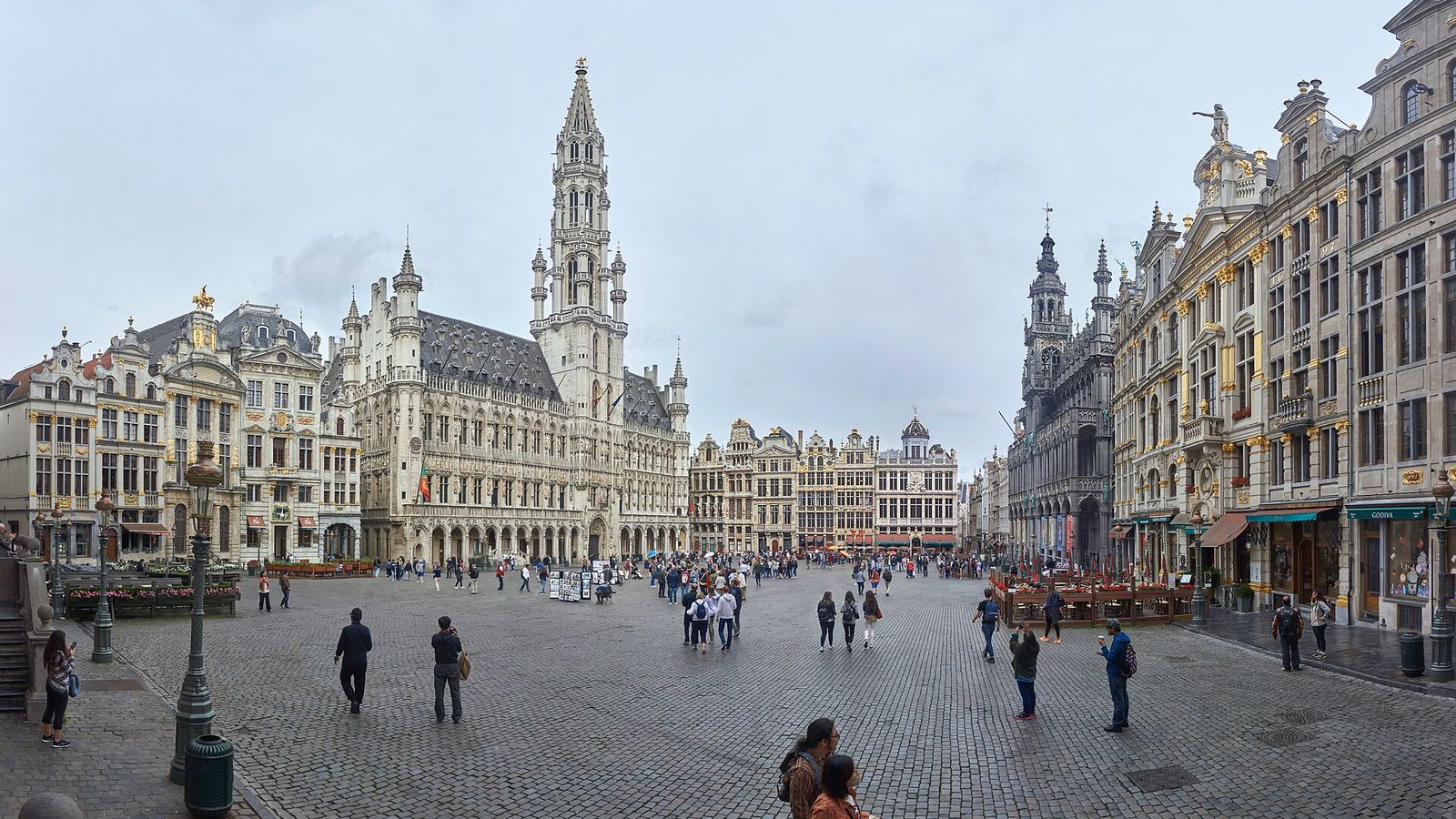
Belgium is the rare destination where the network printed on your eSIM barely changes what you get. Since 2020 Proximus and Orange Belgium have pooled their radio masts through a jointly owned company called MWingz, so the country's two biggest operators broadcast from a large slice of the same hardware. Telenet, which sells its consumer lines under the BASE brand, still runs a separate grid. For a visitor that means Airalo, which routes through Proximus and BASE, Nomad, which uses Orange Belgium and Proximus, and Holafly all put you on infrastructure that behaves much the same from the Ostend seafront to the Ardennes forest. Choose on price, plan length and whether you want a data bucket or an uncapped tap, and stop agonising over carrier logos.
Where the thinking should go instead is the shape of your route. Belgium measures barely 300 kilometres corner to corner, Brussels-Midi puts Paris an hour and twenty minutes away and Amsterdam under two hours, and almost nobody flies to Brussels to stay in Brussels. That argues for buying data sized to the whole itinerary rather than to one small country. Budget too for one local irritation that catches data-only travelers off guard: wifi.brussels, the free regional network in metro stations and public squares, requires an account tied to a working phone number and confirms it by text message, which a data-only travel eSIM has no way to receive.
Quick Pick: the Best eSIM for Belgium
Airalo (Belganet 5 GB / 30 days): About $8.50 for a month of Proximus and BASE data, enough for a week of Brussels transit apps and Bruges day trips, with hotspot sharing and EU-wide roaming built in for the Paris or Amsterdam leg.
Our picks
Best overall: Airalo. Lowest per GB: Nomad. Unlimited: Holafly. Or use the eSIM Finder.
Belgium eSIM Plans Compared
Indicative pricing. Tap through for live rates.
| Provider | Plan | Data | Duration | Price | Network |
|---|---|---|---|---|---|
| Airalo | Belgium 1GB | 1 GB | 7 days | $5 | Proximus and BASE |
| Airalo | Belgium 3GB | 3 GB | 30 days | $11 | Proximus and BASE |
| Airalo | Belgium 5GB | 5 GB | 30 days | $16 | Proximus and BASE |
| Airalo | Belgium 10GB | 10 GB | 30 days | $26 | Proximus and BASE |
| Airalo | Belgium 20GB | 20 GB | 30 days | $37 | Proximus and BASE |
| Nomad | Belgium 1GB | 1 GB | 7 days | $4 | Orange Belgium and Proximus |
| Nomad | Belgium 5GB | 5 GB | 30 days | $14 | Orange Belgium and Proximus |
| Nomad | Belgium 10GB | 10 GB | 30 days | $22 | Orange Belgium and Proximus |
| Nomad | Belgium 20GB | 20 GB | 30 days | $32 | Orange Belgium and Proximus |
| Holafly | Unlimited 5-day | Unlimited | 5 days | $19 | Proximus |
| Holafly | Unlimited 7-day | Unlimited | 7 days | $27 | Proximus |
| Holafly | Unlimited 10-day | Unlimited | 10 days | $34 | Proximus |
| Holafly | Unlimited 15-day | Unlimited | 15 days | $47 | Proximus |
| Holafly | Unlimited 30-day | Unlimited | 30 days | $69 | Proximus |
Airalo Belgium Plans
Airalo: The Default Pick, and the Cheapest Way onto Proximus
Belganet plans riding Proximus and BASE, priced low enough that a whole month costs less than a Brussels dinner
Airalo's Belgian product is branded Belganet and it is the least complicated way to get onto Proximus without walking into a shop with your passport. The pricing ladder is unusually flat: 5GB across a month runs about $8.50, 10GB about $13 and 20GB about $20, so the difference between a cautious buy and a generous one is a few dollars rather than a decision. Given how little data a compact, WiFi-saturated country like Belgium consumes, most visitors overbuy and never notice.
Two details are worth knowing. First, the daily-cap tiers, sold as unlimited with a 3GB high-speed allowance per day and 1 Mbit/s afterwards, get expensive fast at roughly $21 for a week, so they only make sense for someone genuinely hammering the connection. Second, if your Belgium days are bracketed by Paris, Cologne or Rotterdam, buy the Europe regional profile instead of the Belganet one and skip the border question entirely.
Strengths
Weaknesses
Holafly Belgium Plans
Holafly: Uncapped Data for a Working Week in the European Quarter
Flat daily pricing with nothing to meter, aimed at people whose phone is a work tool
The Holafly argument in Belgium is narrow but real. Brussels draws an enormous amount of business travel to the Commission, the Council and the Parliament, plus the trade associations and law firms packed into the streets around Place du Luxembourg, and that traveler behaves nothing like a weekend tourist. They tether a laptop for hours, sit on video calls from hotel rooms with mediocre WiFi, and push large files between meetings. Uncapped data for a week at around $25 makes obvious sense for that person.
For everyone else the maths is unflattering. A four-day chocolate-and-cathedrals trip through Brussels, Ghent and Bruges will not come close to justifying a per-day price when 5GB of metered data covers a full month for a third of the cost. Holafly also carries the standard fair-use clause, so sustained heavy use over a long stay can slow down. Buy it because you work on your phone, not because unlimited sounds safer.
Strengths
Weaknesses
Nomad Belgium Plans
Nomad eSIM: Sharpest Pricing Once Belgium Is One Stop of Several
Orange Belgium and Proximus data, with a Europe profile that undercuts almost everything
Nomad's single-country Belgian pricing sits close enough to Airalo's that flipping between the two apps is not worth your evening. Its edge shows on the regional side, where a Europe profile starts near $3 and keeps working across the continent, which suits the very common Belgian itinerary of two nights in Brussels bookended by Amsterdam and Paris. Because Nomad routes through Orange Belgium and Proximus, and those two share masts, the coverage you get is effectively the national best case.
The gaps are worth naming. Nomad has no genuinely uncapped Belgian option, since its unlimited-branded plans meter you at 2GB per day before slowing, and the entry buckets are small enough that a heavy user will be topping up. It is the right pick for a planner who knows their route and wants the lowest total spend, and the wrong pick for someone who would rather never think about a counter again.
Strengths
Weaknesses
Mobile Networks in Belgium
Belgium sells mobile service through three network owners and a crowd of resellers, but the ownership map matters more here than in almost any comparable country, because two of the three now share their masts.
Proximus is the former state operator and the performance benchmark. Belgian regulator BIPT measured its average 4G download speed at around 84.9 Mbit/s, the highest in the country, and the company has committed to roughly 99 percent nationwide 5G reach by 2030. Orange Belgium is the closest challenger, with independent testing putting it above 100 Mbit/s on average downloads in favourable conditions. The two announced a radio access network partnership in 2019 and launched the joint venture, MWingz, in April 2020 to plan, build and operate a single shared grid. The stated effect was to cut each company's individual site footprint by about 35 percent while giving the combined network roughly 20 percent more mast locations than either had alone, which is why rural Wallonia and the Ardennes are noticeably better served than they were a decade ago.
Telenet, which markets prepaid and consumer plans under the BASE name, kept its own independent network and challenged the sharing deal at the competition authority, unsuccessfully, in 2022. Ookla has credited Telenet with the best 5G availability in Belgium, meaning its customers spend the largest share of their time actually connected to a 5G cell rather than falling back to 4G. On raw speed it trails Proximus. For a traveler the honest summary is that all three deliver more than enough for maps, transit apps, video calls and photo uploads anywhere you are likely to go, and the differences show up only in speed tests rather than in daily use.
The wifi.brussels catch for data-only eSIMs
The Brussels-Capital Region runs its own free network, branded wifi.brussels, with more than 200 hotspots covering squares, main avenues, several museums and the STIB metro stations. It is genuinely useful and the account lasts a year once created, after which your phone rejoins automatically at any hotspot in the region. The obstacle is the sign-up: you have to supply a valid mobile number and type in a verification code that arrives by SMS. Travel eSIMs sell data only, so they issue no Belgian number and cannot receive that text. Some visitors get the code through on their home SIM if it is still active and roaming, and anyone with a Belgian friend or a hotel front desk can borrow a number, but the simplest answer is to not depend on wifi.brussels at all. Buy enough data that the free network is a bonus rather than a fallback. The same applies to the SNCB station WiFi at Brussels-Central, Brussels-Midi, Brussels-Nord and Brussels-Luxembourg, which asks you to sign in with a MySNCB account.
Coverage Across Belgium
Coverage where travelers actually go:
| Area | Coverage | Notes |
|---|---|---|
| Brussels & European Quarter | Excellent | Dense 5G across the centre, Ixelles, Saint-Gilles and the Commission and Parliament blocks; metro stations carry signal, deep running tunnels are patchier. |
| Antwerp, Ghent & Leuven | Excellent | Flanders is the best-served part of the country, with 5G through the historic centres and continuous data along the Antwerp and Ghent intercity lines. |
| Bruges & the coast | Very good | Solid 4G and 5G through Bruges, Ostend, Knokke and the coastal tram route; only the polders between towns thin out slightly. |
| Liege, Namur & Charleroi | Very good | The Walloon cities and the Meuse valley corridor are well covered on all three networks, with 5G in the larger centres. |
| The Ardennes | Variable | Towns such as Bouillon, Durbuy and La Roche hold a decent signal, but deep valleys and forest trails around the Semois drop out on any carrier. |
| Cross-border rail | Good with gaps | The high-speed lines toward Lille, Aachen and Rotterdam keep data flowing except in tunnels; EU roaming means nothing changes when you cross. |
How to Choose the Right Plan
Ask one question first: does your trip stop at the Belgian border? If it does, take Airalo and buy 5GB or 10GB, because Belgium is small, WiFi is everywhere indoors, and a month of Proximus and BASE data for roughly $8.50 to $13 is not worth optimising further. If Brussels is a hinge between Amsterdam, Cologne, Lille or Paris, buy Nomad's Europe profile from the outset and let the same line carry you through every station on the route. If you are flying in for meetings in the European Quarter and your laptop lives off your phone, Holafly at around $25 for a week is the only one of the three that lets you stop counting. Whichever you pick, remember that no travel eSIM will get you a Belgian number, so plan around the wifi.brussels text verification and download an offline map of the Ardennes before you drive south from Namur.
Frequently Asked Questions
Does it matter whether my eSIM uses Proximus, Orange Belgium or BASE?
Much less than in most countries. Proximus and Orange Belgium have operated a shared radio access network since 2020 through their joint venture MWingz, so a great deal of the physical mast estate serving those two brands is identical. Telenet, sold to consumers as BASE, still runs its own grid and has the strongest 5G availability figures, while Proximus posts the fastest measured 4G speeds. In practice all three will stream, navigate and video-call anywhere a visitor goes, so buy on price and plan size.
Do I have to show ID to buy a Belgian prepaid SIM?
Yes, without exception. Belgium amended Article 127 of its electronic communications law in September 2016 and gave existing customers until 7 July 2017 to identify themselves, after which unregistered prepaid cards were cut off from everything except emergency calls. Every counter now records a passport for non-EU visitors or a national identity card for EU citizens before the line will carry traffic. A travel eSIM is registered to the provider's own account, so none of that applies and you arrive with working data.
Will a Belgium plan still work when I take the train to Paris or Amsterdam?
It should, but read the fine print rather than assuming. Belgium sits inside the bloc's roam-like-at-home framework, so a Belgian prepaid card genuinely does work at no surcharge across the other member states, and most travel eSIMs sold for Belgium inherit the same behaviour. Some of the cheapest single-country tourist products are sold as national-use only, though, so if your week includes a Eurostar hop, buy a regional Europe plan up front and stop worrying about it.
How much data does a long weekend in Belgium actually burn?
Less than most people buy. Brussels is compact enough to walk, hotels and cafes hand out WiFi freely, and a typical three or four days of transit apps, restaurant lookups, messaging and a moderate number of photos lands somewhere near 2 to 4 GB. A 5 GB plan is comfortable headroom for a week. The number climbs sharply only if you tether a laptop from a hotel room in the European Quarter, stream on the train to the coast, or upload video every evening, in which case an uncapped plan removes the arithmetic.
Is coverage good enough for the Ardennes or is that a problem?
It is fine in the towns and unreliable in the hollows. Bouillon, Durbuy, La Roche-en-Ardenne and Bastogne all have usable 4G, and the shared Proximus and Orange grid reaches further into rural Wallonia than it did before the network merger. What defeats every carrier is the terrain itself: the Semois meanders through steep wooded valleys where the sky is a narrow strip, and hiking or kayaking routes lose signal for stretches. Save your offline maps in Namur or Liege before you drive south.
Can I get a Belgian phone number with a travel eSIM?
No, and it occasionally matters here. Travel eSIMs are data products, so there is no Belgian number attached and no way to receive a local SMS. That blocks the wifi.brussels sign-up, which verifies accounts by text, and it can complicate a Belgian delivery service or a booking site that insists on texting a code. If you need a number, buy a physical prepaid card from Proximus, Orange or BASE with your passport and run it alongside the eSIM, or keep your home SIM active for texts while the eSIM carries the data.