Belarus is the rare country where the three mobile brands on sale are not three mobile networks. A1, MTS Belarus and life:) all carry their 4G traffic over infrastructure built and licensed to beCloud, a state company, so the coverage map sitting behind each of them is close to identical. That takes away the usual reason to pay a premium for one eSIM over another and leaves price as the honest tie-breaker. On that basis Nomad is our pick: it is cheaper at every size it sells and it registers on A1, the largest of the three brands, with life:) behind it. Airalo earns its place if you want a small 3 GB tier that nobody else offers, and Holafly sells unlimited days to people who would rather not count gigabytes. Two facts matter more than the shortlist, though. Your foreign bank card may be declined once you are inside the country, so buy data before you travel rather than after. And a full signal bar in Belarus is not the same thing as an open internet, which the restrictions section below covers plainly. To size a plan rather than guess at one, use the eSIM Finder.
What This Guide Covers
Jump to the section most relevant to you
Quick Pick: the Best eSIM for Belarus
Nomad (Belarus 5 GB / 30 days): Cheapest at every size on offer, registering on A1 and life:) over the same state-built 4G layer that every Belarusian brand rents, so paying more here does not buy more coverage.
Our picks
Best overall: Nomad. Lowest per GB: Nomad. Unlimited: Holafly. Or use the eSIM Finder.
Belarus eSIM Plans Compared
Indicative pricing. Tap through for live rates.
| Provider | Plan | Data | Duration | Price | Network |
|---|---|---|---|---|---|
| Airalo | Belarus 1GB | 1 GB | 7 days | $5 | life:) |
| Airalo | Belarus 3GB | 3 GB | 30 days | $11 | life:) |
| Airalo | Belarus 5GB | 5 GB | 30 days | $16 | life:) |
| Airalo | Belarus 10GB | 10 GB | 30 days | $26 | life:) |
| Airalo | Belarus 20GB | 20 GB | 30 days | $37 | life:) |
| Nomad | Belarus 1GB | 1 GB | 7 days | $4 | A1 / life:) |
| Nomad | Belarus 5GB | 5 GB | 30 days | $14 | A1 / life:) |
| Nomad | Belarus 10GB | 10 GB | 30 days | $22 | A1 / life:) |
| Nomad | Belarus 20GB | 20 GB | 30 days | $32 | A1 / life:) |
| Holafly | Unlimited 5-day | Unlimited | 5 days | $19 | A1 (velcom) / MTS Belarus |
| Holafly | Unlimited 7-day | Unlimited | 7 days | $27 | A1 (velcom) / MTS Belarus |
| Holafly | Unlimited 10-day | Unlimited | 10 days | $34 | A1 (velcom) / MTS Belarus |
| Holafly | Unlimited 15-day | Unlimited | 15 days | $47 | A1 (velcom) / MTS Belarus |
| Holafly | Unlimited 30-day | Unlimited | 30 days | $69 | A1 (velcom) / MTS Belarus |
Airalo Belarus Plans
Airalo: The Small-Plan Option, and the One on life:)
Belarus plans starting at 1 GB, on life:), with a 3 GB tier no rival bothers to sell
Airalo's Belarus plans attach to life:), the smallest of the three brands by subscribers. In almost any other country that sentence would be a warning. Here it barely registers, because life:) leases the same beCloud radio network that A1 and MTS do, and the difference between them shows up in call tariffs and shop counts rather than in whether your phone works outside Minsk.
What Airalo genuinely offers that the others do not is granularity at the bottom of the range. A 3 GB month for $11 fits the way most people actually travel here, since Belarus is a country of short stays: the visa-free rule allows 30 days per entry and the average Western visitor uses a fraction of that. If a trip stretches, topping up in the app is instant and does not need a working Belarusian payment card, which is not a small point in a country where foreign cards are unpredictable.
Holafly Belarus Plans
Holafly: Unlimited Days on A1 and MTS
Flat daily pricing with no gigabyte counter, on the two largest Belarusian brands
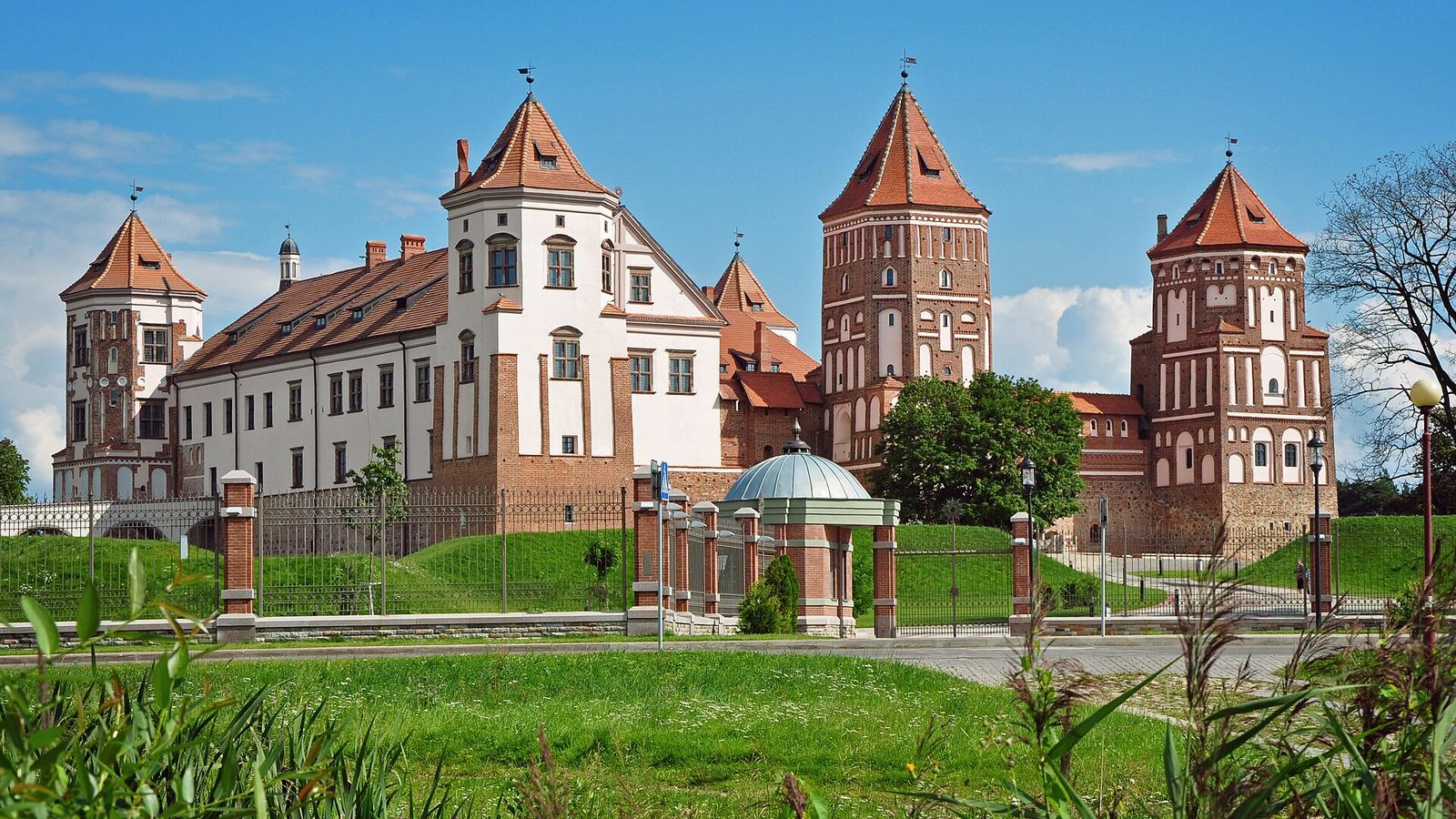
Holafly reaches A1 and MTS Belarus, the two brands with the deepest retail presence, and sells time rather than data. For a photographer uploading raw files from Mir and Niasvizh, or anyone running a laptop off a phone through a working week, that removes a running calculation and is worth paying for.
Be clear-eyed about the price, though, because Belarus is where the unlimited premium looks steepest. A week of Holafly costs several times what an A1 or MTS shop charges for a tourist bundle in Belarusian rubles, and the hotspot allowance is capped at around a gigabyte a day, so it is not the answer for feeding a tablet and a laptop at once. It earns its keep on convenience and on not wanting a mobile line registered against your passport, not on value per gigabyte.
Nomad Belarus Plans
Nomad: The Cheapest Gigabytes, on the Largest Brand
Undercuts the field at every size it sells and registers on A1 first
Nomad wins this comparison on arithmetic. It is cheaper at 1 GB, cheaper at 5 GB, cheaper at 10 GB and cheaper at 20 GB, and the saving is real money rather than rounding: a 20 GB month costs $32 against $37. Because Belarusian coverage is a shared asset rather than a competitive one, that discount is not being funded by a worse signal, which is the trade-off the same price gap usually implies elsewhere.
It also registers on A1 first, the brand with the most subscribers and the most visible shops, with life:) sitting behind it as a fallback. Tethering is unrestricted, which matters more here than the unlimited alternative's daily sharing cap if you are working from a rented flat in Minsk with unreliable building WiFi. The gap in the range is between 1 GB and 5 GB, where Airalo's 3 GB tier has no Nomad equivalent.
Mobile Networks in Belarus
Belarus has three mobile brands and, for practical purposes, one mobile network. A1 is the largest and traded as velcom until 2019, which is why older shop signs, forum threads and guidebooks still use that name. MTS Belarus is a joint venture between the state operator Beltelecom and the Russian MTS group. life:) is the smallest and consistently the cheapest of the three, and belongs to the Turkcell group. Between them they carry essentially every mobile call and megabyte in the country.
The unusual part is the layer underneath. The 4G network is not built by the brands that sell it. It was built and is run by beCloud, a state company majority held through the National Centre for Traffic Exchange, which holds the LTE licence on the 800, 1800 and 2600 MHz bands and leases capacity wholesale to all three operators. A1, MTS and life:) therefore share masts, spectrum and rural footprint. In most countries the first question to ask about a travel eSIM is which carrier it rides, because that decides whether you get a bar in the hills. In Belarus that question has an unusually flat answer, and plan structure and price do the deciding instead.
Which provider lands on which brand: Airalo's Belarus plans register on life:), Nomad's use A1 with life:) behind it, and Holafly connects through A1 and MTS Belarus. Open your network settings a minute after landing and you will see the Belarusian operator name your phone attached to, which is the quickest way to confirm the eSIM is live rather than still hunting.
Two numbers worth knowing before you buy
5G here is a pilot, not a product. There are trial sites around Minsk and a stated multi-year plan, but nobody should pick a plan on the promise of it. Assume 4G, which is genuinely good in the cities, the six oblast capitals and along the main highways. Separately, from 23 February 2026 Belarusian operators began cutting speeds to 1 Mbit/s on domestic unlimited tariffs once a subscriber passes 30 GB in a calendar month, a threshold the Ministry of Communications says only about 15 percent of users reach. That rule targets local retail plans rather than visiting eSIMs, but it tells you what the network is being managed for, and it is the single best argument against assuming a bottomless pipe on any Belarusian connection.
Coverage Across Belarus
Coverage where travelers actually go:
| Area | Coverage | Notes |
|---|---|---|
| Minsk | Excellent | Dense 4G along the full 15 km of Independence Avenue and inside the metro tunnels, where in-tunnel service has run since 2019. |
| Brest and the western border | Very good | Strong in the city and around the fortress. Terespol is where an EU number stops behaving like a domestic one. |
| Hrodna, Vitsebsk, Homiel, Mahiliou | Very good | Every town above 50,000 people has 4G, so the oblast capitals and the roads linking them are covered without drama. |
| Belavezhskaya Pushcha | Variable | Fine at the visitor centre and on the Kamianiets approach; forest tracks and the bison enclosures thin out to almost nothing. |
| Braslau Lakes and the north | Patchy | Villages and main roads hold up, but the lake islands and quiet shores go silent, and shared masts mean no operator rescues another. |
| M1 corridor and intercity trains | Good | Near continuous data from Brest through Minsk to Orsha, with brief drops in cuttings and beneath the older rail bridges. |
How to Choose the Right Plan
Because coverage is effectively a fixed quantity in Belarus, this decision is shorter than it is almost anywhere else. Pick Nomad unless you have a reason not to: it is the cheapest at every size and it lands on A1. Take Airalo if 3 GB is the shape of your trip, since that tier exists nowhere else, or if you already keep an Airalo balance from previous travel. Take Holafly only if unlimited genuinely changes how you work, and go in knowing you are paying a convenience premium that looks large against local ruble prices. Whichever you choose, install it while you still have a connection you trust and a card that will be accepted, and treat the local operator shops as a backup rather than the plan.
Internet Restrictions in Belarus
A working data connection is not the same as a working internet connection. In Belarus, independent news outlets, and mobile internet during periods of unrest are filtered or blocked.
What this means in practice
Shutdowns are targeted and episodic rather than constant. Have something installed before you travel.
NordVPN
Obfuscated servers, which is the feature that matters in places where VPN protocols themselves are detected and blocked rather than just the sites.
Visit NordVPN →Proton VPN
Has a genuinely usable free tier, so you can install and test it before you fly without paying for a year up front.
Visit Proton VPN →Frequently Asked Questions
Do I actually need a Belarusian phone number, or is data on its own enough?
Data alone covers maps, messaging apps, email and browsing perfectly well. The gap opens where an app wants to send you an SMS code. Yandex Go, which is the taxi app people actually use in Minsk since Uber operates through it here, verifies you by text, and a data-only travel eSIM has no number to receive that text. If your home line still gets SMS while roaming you are fine, because verification messages arrive on the physical SIM while data runs over the eSIM. If it does not, and you want to hail cars from your phone rather than from a hotel desk, that is the one strong argument for a local card.
Will my EU roaming allowance stretch to Belarus?
No. Belarus sits outside the European Union's roam-like-at-home area, and outside every other reciprocal arrangement a Western traveller is likely to hold. A Polish or Lithuanian number that behaved perfectly all the way to the border reverts to full international roaming rates the moment it attaches to a Belarusian mast, which for many tariffs means a per-megabyte charge rather than a daily cap. Buy something before you cross at Terespol or Kamienny Log rather than discovering the rate afterwards.
Is the internet genuinely restricted here, and what does that mean day to day?
It is restricted, and the shape of it is specific rather than blanket. Belarus maintains a register of material designated extremist that runs to roughly 10,000 entries covering websites, channels, social accounts and chats, and a range of independent news outlets are unreachable on local connections. Mainstream Western platforms and messaging apps have generally stayed accessible, which makes the picture different from a wholesale firewall. Access has been disrupted around political moments, mobile internet has been cut during periods of unrest, and a 2025 regulation created a route to disconnecting named subscribers from phone and internet service. Plan for episodic interruption rather than constant blocking, and sort out anything you depend on before you arrive.
Can I pay for things with my normal bank card once I am in the country?
Sometimes, which is the difficult part. Since 2022 foreign Visa and Mastercard have worked inconsistently in Belarus depending on which bank is acquiring the payment, so the same card can be waved through in one cafe and declined in the next. Mir and UnionPay cards work reliably, and Belarusian Belkart is domestic. The practical answer is to carry euro or dollar cash and change it into Belarusian rubles at a bank or exchange kiosk, and to buy your data connection online before you arrive while your card is still on a network that will accept it.
What do I need to know about getting there in the first place?
Citizens of 38 European states can enter visa free for up to 30 days under a decree extended to 31 December 2026, with Poles, Lithuanians, Latvians and Latvian non-citizens allowed 90 days per entry, and a 90-day total across any calendar year. Americans, Canadians and Australians are not covered and need a visa. Flying in is a connecting exercise: no EU, British or American carrier serves Minsk, and roughly ten airlines link it to about 39 destinations, so most Western visitors route through Istanbul or Dubai, or arrive overland by bus and train from Vilnius, Warsaw or Moscow.
How much data should I budget for a week in Belarus?
Three to five gigabytes covers a normal week for most people: navigation, messaging, a daily upload or two, and a lot of camera translation, because street signage, museum labels and restaurant menus outside the tourist core are in Cyrillic and travellers lean on Google Lens far harder here than in Western Europe. Double that if you are working from cafes or tethering a laptop. Hotel and cafe WiFi is widespread and decent in Minsk, so the mobile allowance is doing less of the work than the raw number suggests.