Dhaka does not test a mobile plan the way a mountain range does. There is signal everywhere, on every operator, from Uttara down to Sadarghat, and you will almost never see a blank bar. What Dhaka tests is your willingness to be without it for a moment, because this is a city where twenty million people share a road network moving at roughly five kilometres an hour, where the difference between a good afternoon and a wasted one is whether you could see live traffic before choosing a route, and where the vehicle you need is summoned by an app rather than hailed. Being offline in Kathmandu is inconvenient. Being offline in Dhaka means standing on a kerb in 34 degrees with no way to explain to anybody where you are going. The connectivity question here is not coverage. It is having something live in your hand from the moment you step outside.
What This Guide Covers
Jump to the section most relevant to you
Coverage Across Dhaka, and Where Density Bites
All four Bangladeshi operators blanket the capital with 4G and the practical differences inside the city are small. Grameenphone has the largest footprint and the most consistent indoor performance, helped by the 700 MHz spectrum it won at the January 2026 auction, which is the low band that pushes through concrete. Robi is close behind and was first to switch on commercial 5G in the country. Banglalink is perfectly serviceable across the whole city and is the network most cheap travel eSIMs ride. Teletalk exists.
The thing to calibrate is speed rather than coverage. Bangladesh averages around 41.72 Mbit/s on mobile nationally, ranking 86th in the world, and central Dhaka at six in the evening can be well below that as tens of thousands of handsets crowd the same cells. Farmgate, Motijheel and the Gulshan avenues at rush hour are the classic congestion points: the bars stay full and the throughput sags. It is fine for maps, messaging and ride-hailing. It is not a place to plan a large upload.
5G in Dhaka is a street-by-street affair
Commercial 5G only launched in Bangladesh on 1 September 2025, and Robi's initial live areas in the capital were Fakirapul, Maghbazar Chowrasta and part of the Dhaka University campus. Grameenphone has selected pockets across the city. If your phone shows 5G somewhere in Dhaka, enjoy it as a curiosity; the rest of your stay will be on 4G, and choosing a plan on 5G promises would be a mistake in this city for at least another couple of years.
Indoors, the older parts of town behave differently from the new. Gulshan and Banani towers are modern concrete and glass with strong signal on every floor. The narrow brick buildings of Old Dhaka, some of them well over a century old and packed shoulder to shoulder along lanes barely wide enough for a rickshaw, will cost you a bar or two on an upper floor set back from the street. It is never a total loss, but it is the one part of the city where a hotel WiFi password is genuinely worth asking for.
MRT Line 6, Rickshaws, and Moving Through the Slowest City on Earth
A US National Bureau of Economic Research study of traffic speeds in more than 1,200 cities across 152 countries put Dhaka last. Average vehicle speed in the city fell to roughly five kilometres an hour, down from 21 a decade and a half earlier, which is close enough to walking pace that on many trips walking genuinely is faster. Something like five million work hours are lost to congestion here every day. This is the context for every transport decision you will make.
The counterweight is MRT Line 6, the first line of the Dhaka Metro Rail, running 21.3 kilometres and 16 stations from Uttara North in the far north to Motijheel in the old commercial centre, via Mirpur 10, Shewrapara, Farmgate, Dhaka University and the Bangladesh Secretariat. It carries around 400,000 people a day and it turns a two-hour crawl into a 35-minute ride.
Fares, hours and the connectivity detail that matters
Fares are calculated at 5 taka per kilometre, with a minimum of 20 taka and a maximum of 100 taka for the full Uttara North to Motijheel run. A Rapid Pass stored-value card knocks 10 percent off. Trains run Saturday to Thursday from early morning until roughly 21:00 at the last northbound departure, with the Friday service starting only in the mid-afternoon around 15:00 because of Jumu'ah prayers, so do not build a Friday morning itinerary around it. Headways are about six minutes at peak, eight at midday and ten in the evening. And here is the useful part for anyone used to metro systems elsewhere: Line 6 is entirely elevated. There is not a metre of running tunnel on it. Your data holds the whole way, which makes the metro the single best place in Dhaka to catch up on messages, book your next ride and check where the traffic has jammed while you were moving above it.
Below the metro line, the hierarchy is ride-hailing, CNG auto-rickshaws and cycle rickshaws. Uber and Pathao both operate across the city, and Pathao's motorbike option is the local trick for beating gridlock, at a real cost in comfort and nerve. CNGs are the green three-wheelers, metered in theory and negotiated in practice. Cycle rickshaws, of which Dhaka has hundreds of thousands, remain the only sensible way to cover the last kilometre in Old Dhaka's lanes, and they are cash-only and negotiated before you sit down. Every one of those except the last needs data, and the last needs enough Bangla or enough map screenshots to point at.
Neighborhood Notes: Gulshan, Dhanmondi and Old Dhaka
Gulshan and Banani are the diplomatic and business quarter and the softest landing in the city. Gulshan 1 and Gulshan 2 circles anchor a grid of embassies, hotels, glass office towers and the restaurants where most visiting business travellers eat. Signal is excellent on all operators, indoor coverage in the newer buildings is strong, and WiFi is offered as a matter of course in every cafe and lobby. If you are working from Dhaka rather than sightseeing, this is where the infrastructure is least likely to annoy you. It is also where a hotel-to-meeting journey of three kilometres can take fifty minutes, which is the exact situation live traffic data exists for.
Dhanmondi is the older residential and cultural district southwest of the centre, built around Dhanmondi Lake and threaded with the numbered roads that everyone navigates by. Road 27, the lakeside walkways and the cluster of cafes, bookshops and coaching centres make it the closest thing Dhaka has to a browsing-in-a-cafe district. Coverage is solid throughout and the buildings are mid-rise rather than colonial, so indoor signal is rarely a problem. The lakeside paths are one of the few places in the city where you can walk for twenty minutes without negotiating traffic.
Old Dhaka is the one place to prepare in advance
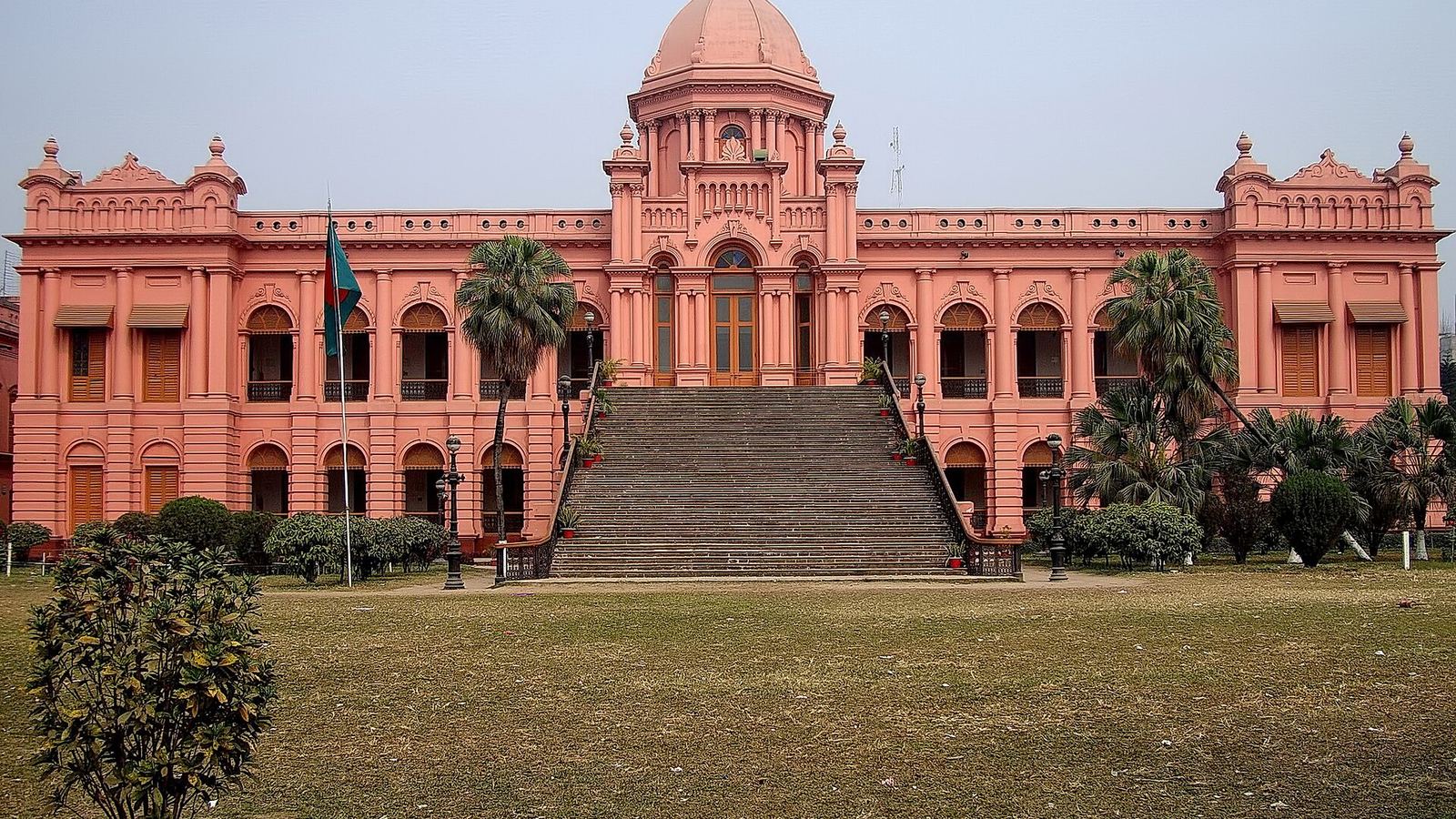
Puran Dhaka, running down to the Buriganga at Sadarghat and taking in Ahsan Manzil, Lalbagh Fort and the Armenian Church, is the reason most people come. It is also a maze of lanes where GPS drifts against tightly packed buildings, where street names are inconsistently signed and rarely in English, and where your rickshaw puller will know the landmark but not the pin. Screenshot your destination, learn the nearest big landmark by name, and expect to be pointing at a photograph rather than reading directions aloud. Signal is present, but positioning accuracy is the thing that fails you here, not bandwidth.
Two more worth knowing. Uttara, in the north near the airport, is modern, planned and well covered, and it is the metro's northern terminus, which makes it a practical base for an early flight. Motijheel and Farmgate are the dense commercial cores where cell congestion is most noticeable at peak hours; expect full bars and sluggish speeds between five and eight in the evening.
Free WiFi in Dhaka, and Why It Solves Almost Nothing
Dhaka South City Corporation ran a programme to bring around 50 public locations under free municipal WiFi, and various parks, terminals and public buildings across both city corporations carry hotspots. It exists. It is also close to irrelevant to a visitor, because it is patchy, the coverage bubble around each hotspot is small, and this is not a city you can pause in comfortably while you wait for a portal page to load.
The genuinely useful free connectivity is commercial and it is everywhere in the affluent districts. Hotels across Gulshan and Banani, the cafe chains in Dhanmondi and Gulshan, the malls at Jamuna Future Park and Bashundhara City, and every coworking space in the city offer WiFi without ceremony. Speeds are typically better than mobile, because fixed broadband in Dhaka is decent and the mobile network is the congested part.
Where free WiFi genuinely helps
Where it abandons you
The honest summary is that Dhaka WiFi is a place to work, not a way to travel. Every part of the city that is interesting to visit is a part where you will be on the move, in a vehicle, trying to establish where you are.
Getting Online Once You Are in the City
Three routes, and in Dhaka the gap between them is larger than in most capitals because of what the local option costs you in time.
Route one: arrive on a travel eSIM
Bought and installed at home, switched on after landing. You clear the arrivals hall, open Uber or Pathao at the kerb, and get into a car while everyone else is still queueing for a fingerprint scan. This is the right call for anything up to about three weeks, and the provider you pick should follow your itinerary: Banglalink-based plans are fine for a city stay, Grameenphone-based ones are worth the extra if you are leaving the capital. The Bangladesh eSIM guide lays out which is which, and the eSIM Finder will size the plan.
Route two: a local SIM from a city operator centre
Not the airport. Grameenphone, Robi and Banglalink all run centres in Gulshan 1 and 2, Banani, Dhanmondi, Uttara and Motijheel where the same biometric registration takes a fraction of the time it does in arrivals. Bring the passport itself with the visa page, a passport photo, and your hotel address. Then buy the pack that makes the whole exercise worth it: 399 taka for 30 GB over a month is around three dollars and twenty-five cents.
Route three: run both
What most people staying longer than a fortnight end up doing, and what Bangladeshis do as a matter of course. The eSIM handles the first hours and acts as insurance; the local line gives you a Bangladeshi number for the driver who cannot find you and for bKash if you end up using it. At these prices the second line costs less than a decent lunch in Gulshan.
One practical warning about the airport specifically: the free WiFi in the terminal requires an SMS one-time password sent to a working phone number, which is precisely the thing an arriving traveller without a local line does not have. Details of that trap and the transport options outside are on the Dhaka Airport guide.
Day-Trip Coverage: Sonargaon, Savar and the River
Dhaka's day trips are short in distance and long in time, which is a distinctively Bangladeshi combination. None of them will break a mobile plan, but the travel times deserve respect.
| Day trip | Distance and time | Coverage reality |
|---|---|---|
| Sonargaon and Panam Nagar | About 30 km southeast, 1.5 to 2 hours in normal traffic, closer to an hour on a Friday morning | Solid 4G on the Dhaka to Chattogram highway and in the town. Fine throughout the abandoned merchant street. |
| Savar, National Martyrs' Memorial | About 25 km northwest, 1 to 2 hours depending entirely on the Gabtoli bottleneck | Well covered the whole way. The memorial grounds and the surrounding industrial belt are dense with towers. |
| Mawa and the Padma Bridge | About 40 km southwest, roughly 1.5 hours since the bridge opened | Good along the expressway. Signal is fine on the bridge itself and at the riverside hilsa restaurants. |
| Buriganga river tour from Sadarghat | In the city, half a day | Full coverage on the water, which is genuinely useful as the terminal is chaotic and the boats are unmarked. |
The Sonargaon run is the classic and the one worth planning around data. Panam Nagar, the abandoned street of Hindu cotton merchants' mansions, is closed on Sundays, and the trip involves a stretch of the Dhaka to Chattogram highway that is either fast or catastrophic with little in between. Live traffic is the difference between leaving at seven and leaving at nine. October to March is the sensible season.
What actually eats data in Dhaka
Not video. Navigation and ride-hailing, running continuously, hour after hour, because journeys take so long and get re-routed so often. A metered plan of five to ten gigabytes will comfortably cover a week or two of that, given how much of your indoor time will be on hotel or cafe WiFi. If you plan to hotspot a laptop as well, take the larger tier; if you are on unlimited, this is the city where you will actually notice the benefit.
Frequently Asked Questions
Does my phone lose signal on the Dhaka metro?
No, and that is unusual enough to be worth stating plainly. MRT Line 6 is elevated for its entire 21.3 kilometre length from Uttara North to Motijheel, with no running tunnels anywhere on the route, so your data connection holds from platform to platform and while the train is moving. Given that the metro is the fastest way to cross the city, this makes it the best twenty minutes of your day for booking the next ride, checking traffic and answering messages while you are actually moving.
What does a metro journey cost and how do I pay?
Fares work out at 5 taka per kilometre with a floor of 20 taka and a ceiling of 100 taka for the full Uttara North to Motijheel run, so most useful hops cost between 30 and 60. Buy a single-journey ticket at the station machines or counters, or pick up a Rapid Pass stored-value card, which takes 10 percent off every fare. Remember that Friday service does not start until mid-afternoon, roughly 15:00, which catches out visitors planning a Friday morning across town.
Which part of Dhaka is easiest to work from?
Gulshan and Banani, comfortably. Modern towers mean strong indoor signal on every operator, hotel and cafe WiFi is fast and universally offered, and the coworking spaces there are set up for exactly this. Dhanmondi is the pleasant alternative if you would rather be near the lake than the embassies. Avoid relying on a mobile connection alone in Motijheel or Farmgate between five and eight in the evening, when the cells are at their most congested and speeds sag even with full bars.
Do I need data to get around Old Dhaka?
You need preparation more than bandwidth. Signal reaches the lanes around Ahsan Manzil, Lalbagh Fort and Sadarghat perfectly well, but GPS positioning drifts badly between tightly packed old buildings, street signage is sparse and rarely in English, and rickshaw pullers navigate by landmark rather than by map pin. Screenshot your destination, learn the name of the nearest big landmark, and be ready to show a photograph. That works far better than trying to read out an address.
How much data will a week in Dhaka actually use?
Less than you fear, because the drain is navigation and ride-hailing rather than streaming, and because hotel and cafe WiFi covers most of your indoor hours in the districts visitors stay in. Five gigabytes handles a normal week comfortably; ten is generous unless you are tethering a laptop daily. The exception is anyone leaving the capital regularly, where continuous maps on long road legs will push consumption up, and where the network you are riding starts to matter more than the size of the allowance.