Manama is one of the easier capitals in the world to arrive in with a working phone, and one of the least interesting to write a coverage guide about, because there is nothing to warn you off. The built-up strip from Bab al-Bahrain out through the Diplomatic Area to Seef and Bahrain Bay carries dense 5G on all three operators, the whole city fits inside a twenty-minute taxi ride, and you can walk from a souq alley into a marble mall without dropping a bar. What is worth planning is everything around the signal. Manama runs on taxis and ride-hailing rather than trains, which means your data works hardest sitting in traffic on the Shaikh Isa bin Salman road. It also permits the calling apps its neighbours block, which quietly changes what you should buy. And it sits at one end of a causeway that turns a good local plan into a dead one in the space of 25 kilometres.
What This Guide Covers
Jump to the section most relevant to you
How Manama Actually Performs
The capital is served by Batelco, part of the Beyon group since 2021, by stc Bahrain, which traded as VIVA until 2019, and by Zain Bahrain. All three run 5G over the entire urban area and there is no district a visitor reaches where that stops being true. Independent measurement across the last year put stc fastest on mobile downloads, averaging comfortably above 150 Mbps, with Batelco close behind and Zain third but perfectly usable.
What that means in practice is that the usual travel-guide advice about picking a network does not apply in Manama. The reclaimed districts, Seef, Bahrain Bay and the Financial Harbour, sit on some of the densest cell infrastructure in the Gulf. The older core around Government Avenue is equally well served, and the low-rise lanes behind the souq are close enough to multiple sites that even indoors, in a shop with a metal roller shutter half down, you keep a workable connection.
The one thing to actually check
Not the network, the allowance. Manama in August is a city you experience through car windows and mall atriums, which means far more time on a screen than you would spend in a walkable European capital. Add the video calls that are legal here, add photo uploads from the Pearling Path, and a three gigabyte plan that would have lasted a week in Lisbon runs down in four days here. Size up one tier from your instinct.
Taxis, Careem and the Bus: Data on the Move
Bahrain has no metro and no passenger rail, so the transport question in Manama is which road option you use and how much data each one costs you. All of them keep full signal, since the road network is short and thoroughly covered.
| Option | How it prices | Data you need |
|---|---|---|
| Metered taxi | 1.000 BHD to start on weekday daytimes, 1.250 BHD at night and on Friday, Saturday and holidays, then 200 fils per km for the first half of the trip and 250 fils for the second | Almost none, but keep maps open to follow the route |
| Careem or Uber | App-quoted fare agreed before you get in | Constant background data for pickup, tracking and payment |
| Public bus | 300 fils for a single bought from the driver | Live timetables and stop names, since signage is thin |
| Hire car | Fuel is cheap, parking in Seef is plentiful | Live navigation the whole way, plus causeway apps if crossing |
Ride-hailing is the default for most visitors. Careem and Uber both cover Manama, Juffair, Seef and the airport, and having the fare fixed in the app removes the one friction point of a metered taxi, which is the 50 fils a minute the meter adds while you sit in Manama's genuinely serious rush-hour traffic. Both apps also assume you are online continuously, so a plan that runs dry mid-afternoon leaves you standing on a hot kerb trying to describe your location.
A note on the Bahraini week
The weekend here is Friday and Saturday, not Saturday and Sunday. That shifts the traffic peaks, the taxi night tariff and the causeway queues, all of which start on Thursday evening. If you are working remotely from a Manama hotel, your Sunday is a normal business day locally and your Friday is not, which is worth knowing before you book calls.
Souq, Seef and Adliya: Three Districts Compared
Coverage is uniform, but how you use a phone changes a lot between the parts of Manama a visitor spends time in.
Manama Souq and Bab al-Bahrain
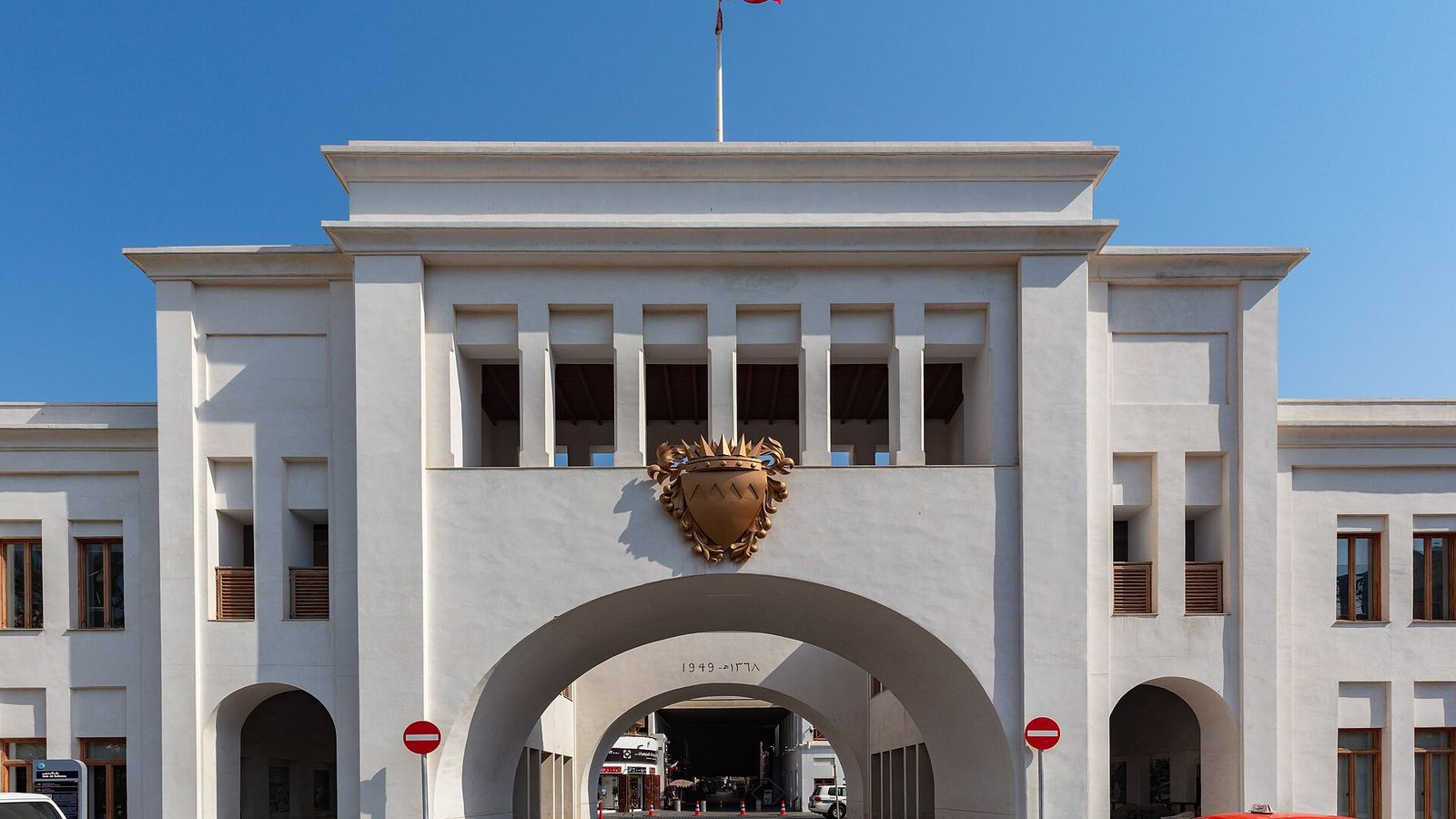
The 1949 gateway arch marks the entrance to a market that has traded on this ground since the 1920s. Parts have been pedestrianised and smartened up, parts are still narrow lanes of gold shops, spice traders and tailors. Signal holds throughout, including deep in the covered sections, and you will want it: card acceptance is inconsistent among the smaller stalls, so a banking app and a currency converter both earn their keep here. Translation apps are genuinely useful in the older lanes too.
Seef and Bahrain Bay
The reclaimed western strip, home to City Centre Bahrain and Seef Mall, which was the island's first, plus the Financial Harbour towers and the sail-shaped Bahrain World Trade Center with its three wind turbines slung between the buildings. This is the fastest ground in the country for mobile data, and also the place you are least likely to need it, since every mall floods you with free WiFi. Worth knowing if you are rationing an allowance.
Adliya and Block 338
The restaurant and gallery quarter, built around the numbered block that gives it its name, and where most visitors end up in the evening. Coverage is fine; the practical issue is that the venues are small, the addresses are block-and-road numbers rather than street names, and pinning a Careem driver to the right corner takes a live map rather than a screenshot. Juffair, a little further east, is the hotel and expat district and behaves the same way.
The short version: you will not lose signal anywhere in Manama, but the souq is where you use data for money and language, Seef is where free WiFi can carry you, and Adliya is where an offline map genuinely fails you.
Calling Apps Work Here, and That Is Not a Given
If you have arrived from Dubai, Doha, Muscat or Kuwait City, this section is the one that will surprise you. Bahrain permits voice over IP. The regulator set out that position in papers published in 2004 and again in 2007 and has never rolled it back, so WhatsApp voice and video, FaceTime, Telegram calls and the rest simply work on a Bahraini line or on a travel eSIM riding one.
What that changes about your purchase
Two things. First, the call minutes bundled into local tourist SIM packs lose most of their value, because the calls you actually want to make are free over data. That pushes the sensible visitor toward a data-only eSIM rather than a voice bundle. Second, your data budget goes up, not down. An hour of WhatsApp video is a few hundred megabytes, and travellers who have spent a week in the Emirates unable to call home tend to make up for it the moment they land here. If your trip is built around staying in touch, buy the ten gigabyte tier rather than the five.
There is a corollary worth remembering on the way out. The permission is Bahraini, not regional. Fly on to Abu Dhabi or drive to a Gulf neighbour that restricts calling apps and the behaviour reverts to whatever that country allows, regardless of which eSIM you are carrying. The freedom belongs to the jurisdiction, not to your plan.
Free WiFi Around the Capital
Manama has plenty of free WiFi and it is unusually good, largely because so much of daily life here happens inside air-conditioned buildings that all have fibre behind them.
- The malls. City Centre Bahrain and Seef Mall both run open networks across their floors, generally quick and generally requiring nothing more than accepting a terms page.
- Hotels. Juffair and Seef hotels almost universally include WiFi at no charge, and the standard is high by regional norms.
- Cafes. The independent coffee scene in Adliya and Block 338 treats WiFi as table stakes, and staff will hand you a password without being asked twice.
- Cultural sites. The Bahrain National Museum and several restored houses along the Muharraq heritage route offer connections, useful because their own audio and interpretation content is often app-based.
Where the WiFi stops mattering
Everywhere between those buildings. Manama's summer means you are rarely on foot for long, but the gaps that matter are the ones inside a moving car: hailing a ride, tracking a driver, checking whether the restaurant in a numbered Adliya block is the one on the corner or the one behind it. None of that is solved by mall WiFi. It is solved by a plan that is already active when you step outside, which is the whole argument for arranging data before you arrive rather than after.
Beyond the Capital: Forts, Pearls and the Causeway
Bahrain is small enough that everything is a day trip from Manama, and most of it is under an hour away. Coverage holds up on all of these, with one large exception.
Qal'at al-Bahrain, the Bahrain Fort, sits about ten minutes northwest along the coast and is a UNESCO site layered over four thousand years of occupation, from a Dilmun capital upward. Signal is strong across the mound and the site museum, and the sunset view back toward the Manama skyline is the photograph most people come for.
The Pearling Path in Muharraq is the other UNESCO listing, a 3.5 kilometre route stitching together seventeen restored buildings, three offshore oyster beds and Bu Maher Fort, inscribed in 2012 and awarded an Aga Khan Award in 2019. It is a walking route through a dense old town across the bridge from Manama, and you will want a live map, because the path threads between houses rather than following a boulevard.
Sakhir, thirty kilometres southwest in the desert, holds the Bahrain International Circuit and the Al Areen wildlife park, and the road out passes near the Tree of Life. Ordinary days are fine. Event days at the circuit put a six-figure crowd onto one patch of desert and every network feels it at once.
The exception, and it is a big one
The King Fahd Causeway to Saudi Arabia. Signal is continuous across all 25 kilometres, but the border sits at Passport Island in the middle of the span, and a Bahrain-only eSIM has no entitlement on the far side. Cross with one and you arrive in Al Khobar holding a phone that can see a network and use none of it. Anyone planning that drive should buy a Gulf regional plan instead, or read the Bahrain SIM card guide on how a local prepaid card behaves at capped roaming rates. Our Bahrain eSIM guide compares the regional options, and the eSIM Finder will narrow them for a multi-country Gulf trip.
Frequently Asked Questions
Is there anywhere in Manama where I will lose signal?
Not in any meaningful sense. All three Bahraini operators run 5G across the entire capital, from the covered lanes of the souq to the top floors of the Financial Harbour, and the city is compact enough that you are never far from a cell site. The only places on the island where data genuinely thins out are the Hawar Islands and boat crossings offshore. Inside Manama, treat coverage as solved and spend your planning on how many gigabytes you will actually consume.
Should I use Careem, Uber or a street taxi in Manama?
Careem and Uber both operate across Manama, Seef, Juffair and the airport, and most visitors default to them because the fare is agreed in the app before you get in. A metered taxi is fine too: it starts at 1.000 dinar on weekday daytimes and 1.250 at night or on Friday and Saturday, then charges 200 fils per kilometre for the first half of the journey and 250 for the second, plus 50 fils a minute while stationary. That waiting charge is the reason the app option tends to feel better value in rush hour.
Can I make WhatsApp video calls from a Manama hotel?
Yes, and it is one of the genuine advantages of Bahrain over most of its neighbours. The regulator has permitted voice over IP since the mid-2000s and has not reversed course, so calling apps behave normally on mobile data as well as on hotel WiFi. Plan for the data, though. Video calling is the fastest way to empty a small allowance, and travellers who have just spent a week somewhere calling apps are blocked often make several long calls in the first day here.
How much data will a four-day Manama trip use?
Around three to five gigabytes for most people, assuming maps, ride-hailing, messaging, photo uploads and normal scrolling. Push toward ten if you intend to make regular video calls, tether a laptop, or stream in the evening rather than using hotel WiFi. Because so much of a Manama day happens in cars and malls, screen time here tends to run higher than in a city you would walk around, so the tier above your instinct is usually the right buy.
Will my Manama plan still work if I take a day trip into Saudi Arabia?
Not if it is a Bahrain-only eSIM. The King Fahd Causeway crosses the border at Passport Island roughly halfway along its 25 kilometre span, and a single-country plan has nothing to offer once your handset registers on a Saudi network. Buy a Gulf or Middle East regional eSIM before you travel if that trip is planned. A Bahraini prepaid SIM does keep working over there, but at GCC roaming rates that are regulated rather than free, so check the per-megabyte figure with your operator before you drive.