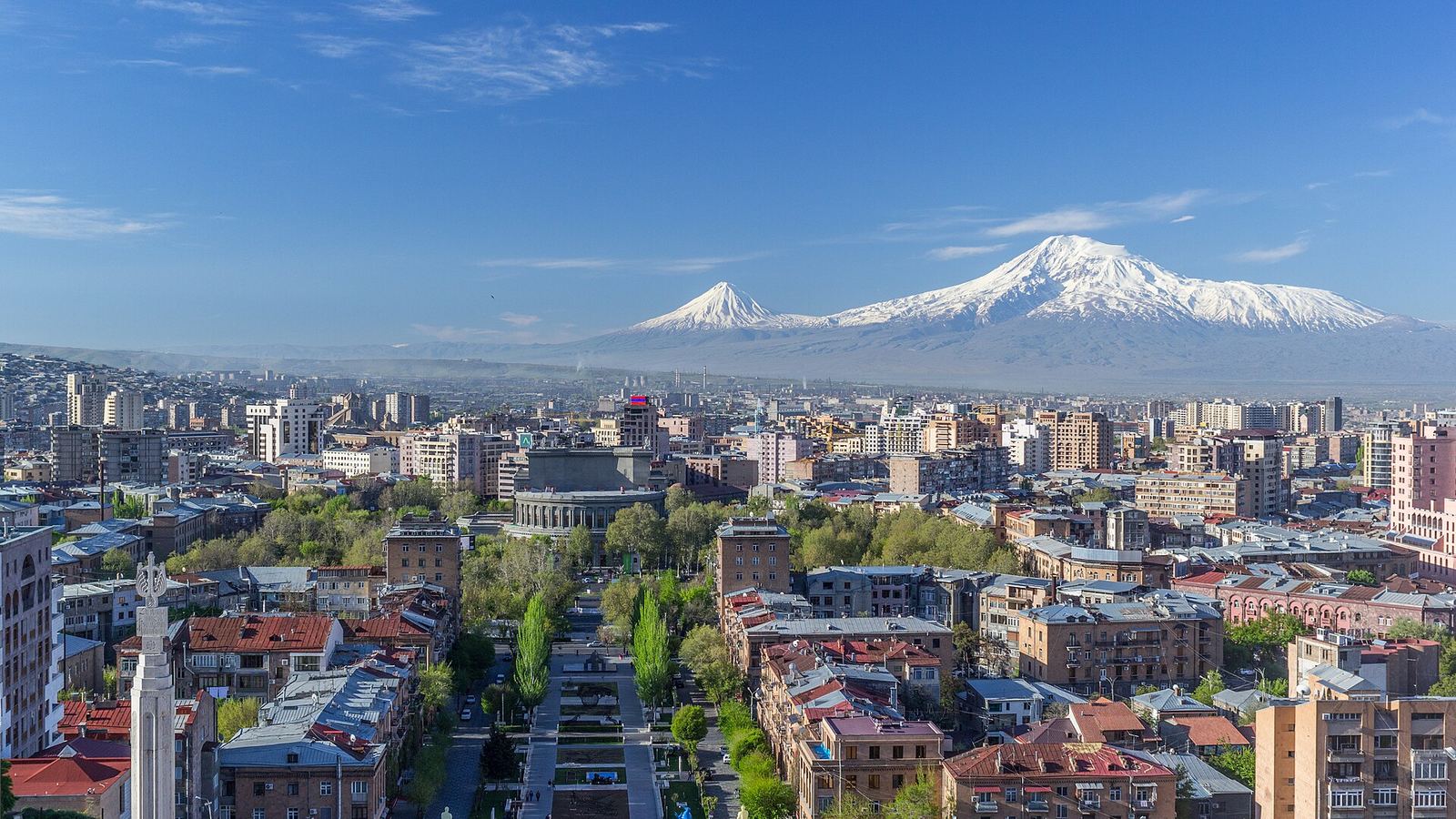
Yerevan is an easy city to be connected in and a slightly awkward one to buy a connection in. All three Armenian networks blanket the centre with 4G, Ucom has the only 5G worth the name in the country here, and speeds in Kentron are comfortably ahead of what you get in Tbilisi or Baku. The awkward part is the counter: an Armenian prepaid line has to be registered against your passport, which is ten minutes of paperwork at an operator shop and rather more than that at the airport behind a full flight. A travel eSIM skips that entirely and has you on Google Maps before you have found the bus stop, which is why most short-stay visitors end up with one even though the local card is cheaper. The city itself is compact enough to walk, so the data you actually need is smaller than you think.
What This Guide Covers
Jump to the section most relevant to you
Mobile Coverage Across Yerevan
Yerevan sits on a plateau below Mount Aragats with the city spread across a series of terraces, and the networks have built for that shape. Coverage in the central districts is dense and consistent: Kentron, Arabkir, Nork and the university quarter all hold 4G without gaps, and in ordinary use you will see speeds in the tens of megabits without trying.
The three operators are Team Telecom Armenia, formerly Beeline, along with Ucom and Viva, formerly Viva-MTS. In the city itself there is very little between them for basic browsing and navigation. Where they diverge is 5G: Ucom has pushed its 5G layer to well over 90 percent of Armenia's population and central Yerevan is where that shows up as real speed, while the others are further behind. If your travel eSIM connects through Viva, which most of them do, expect solid 4G rather than 5G and understand that this makes no practical difference to maps, messaging or a video call.
What your eSIM is riding in Yerevan
Airalo and Holafly both sell Armenia plans on Viva. Nomad's Armenia plans are listed against all three operators, which means nothing at all in the city centre and quite a lot on the drive to Tatev. For a Yerevan-only trip, pick on price and validity rather than network name, and check our Armenia eSIM guide if the itinerary later grows a mountain.
One local quirk: Yerevan's older buildings are built from thick volcanic tuff, and the stone eats indoor signal in a way glass-and-steel construction does not. In an old apartment in Kond or a basement restaurant off Abovyan you may find yourself with one bar even though the street outside is fine. Nobody's plan is at fault. Step out onto the pavement and it returns.
The Metro, the Buses and the 150 Dram Fare
Yerevan's transport was overhauled in late 2024 and the change is directly relevant to your phone, because the whole system now runs on a unified ticket you can pay for with the device in your hand.
A single ride costs 150 dram on the metro, buses and trolleybuses alike, which is under forty cents. The better buy for a day of sightseeing is the 300 dram integrated ticket, valid for 180 minutes across all three modes, so a bus to the Cascade, a metro hop to Republic Square and a trolleybus back cost you the price of two rides rather than three. Longer stays can pick up a 30-day pass for 8,800 dram.
Paying without a local card
Contactless bank cards work directly on the validators, including foreign Visa and Mastercard, which is the simplest option for a visitor and needs no data at all. The alternatives are a paper QR ticket, the transport app, or a Telcell transport card topped up at a kiosk. Tap the card you actually intend to keep using, because the fare and any transfer entitlement are tied to the card you tapped, not to you.
The metro is a single line, the Karen Demirchyan, ten stations along 13.4 kilometres, and it is the fastest way to move north to south through the city. Signal on the platforms of the central stations is generally usable, but the running tunnels between them are Soviet-era and deep, and Yeritasardakan in particular sits a long way down. Expect your data to pause between stops rather than flow the way it does under Tokyo or Moscow. Load the map before you go through the turnstile.
Above ground it is a non-issue. Buses and the newer minibuses run at street level with full signal, and the live arrival information in the transport app works fine as long as you have data, which is a reasonable argument for having a plan at all rather than relying on cafe WiFi.
Neighborhood Notes: Kentron, Kond and the Outer Districts
Yerevan is more varied than its grid suggests, and the connectivity experience shifts as you move out from the centre.
Kentron and the Cascade
The central district holds almost everything a visitor comes for: Republic Square, the Vernissage weekend market, Northern Avenue, the cafes along Tamanyan Street and the great limestone stairway of the Cascade above them. Coverage here is the best in the country, and there is a practical reason to have data at the Cascade specifically: the escalators run inside the structure past the sculpture landings, and the signal holds well enough inside that you can keep navigating between the levels of the Cafesjian collection.
Kond
The oldest surviving quarter of the city, a hillside tangle of lanes and low tuff houses that predates the Soviet plan and sits improbably close to Mashtots Avenue. Street-level 4G is fine, but this is exactly where the thick stone and the tight alleys will drop you to one bar indoors, and where a map application struggles because the lanes are not always where the map thinks they are. Have offline tiles loaded before you wander in; the walk is worth it.
Arabkir, Nork and Nor Nork
The residential districts up on the terraces north and east of the centre, full of Soviet blocks, good local restaurants and almost no tourists. Coverage is solid throughout, and the elevation actually helps rather than hurts. If your accommodation is up here rather than in Kentron you will use more data than you expect, because you will be riding buses and checking routes rather than walking everywhere.
The short version: there is no district in Yerevan where a working plan stops working. The variation is indoor rather than outdoor, and it is a function of what the walls are made of.
Free WiFi in Yerevan and Why It Is Not Enough
Yerevan has an unusually strong cafe culture for a city its size, and that is effectively its public WiFi network. Practically every cafe on Tumanyan, Pushkin and Amiryan streets has a free connection, the coffee is good, and nobody will rush you out. Hotel lobbies, the bigger malls and several central public spaces add to that.
Where the free connections show up reliably:
- Cafes across Kentron: the most dependable option, usually with the password on the receipt or the wall.
- Hotels and guesthouses: near-universal, and generally fast enough for video calls.
- Shopping centres and larger restaurants: reliable, though often behind a phone-number registration screen.
- Some public squares and parks: usable, but variable and not something to plan a day around.
The gap that catches people out
The problem is not the cafes, it is everything between them. Yerevan taxis are booked through the GG and Yandex Go apps rather than flagged down, and both need live data at the moment you want a car, which is normally when you are standing on a street corner having just left the WiFi behind. The same applies to the transport app's live arrivals and to any translation you need in a shop. That specific pattern is why a small data plan is worth having even in a city this well supplied with free connections.
Getting Online When You Land
Nearly everyone arrives through Zvartnots, about twelve kilometres west of the centre, and a decent share of the flights land between midnight and five in the morning. That timing shapes the sensible approach.
Sort the connection while you still have one
Buy the Armenia plan a day or two before departure and add the profile to your phone at home. Activation only starts the clock when the line first attaches to an Armenian network, so buying early costs you nothing.
Turn the line on after the aircraft door opens
Enable the travel line as your data line and allow roaming for it if your provider asks. You should see an Armenian operator name within a minute or two. Confirm it works before you leave the terminal, while the free airport WiFi is still available as a fallback.
Decide how you are getting into town
Bus 201 runs from the terminal to Republic Square for 300 dram, roughly every half hour through the day and hourly overnight, taking about 35 to 40 minutes. A taxi booked in the GG or Yandex Go app is usually 2,500 to 4,000 dram; agreeing a price with a driver at the kerb tends to land at 4,000 to 5,000. All of those options are easier with data already running.
Keep your home line for the codes
Leave your usual number active for SMS but with its data switched off, because Armenian card payments and bank apps will send verification codes to it while you are settling into the flat.
The alternative, buying a local card at the arrivals kiosks, is genuinely cheap and covered in detail in our Armenia SIM card guide. It just costs you the passport registration and the queue, at whatever hour your flight happened to land.
Day-Trip Coverage: Garni, Sevan and Dilijan
Yerevan makes an excellent base, and the classic day trips all sit within about two hours. Signal quality on them varies more than it does inside the city.
| Trip | Distance | Coverage | Notes |
|---|---|---|---|
| Garni and Geghard | About 30 to 40 km east | Very good | Strong at both sites. Thins on the walk down into the Azat gorge to the basalt columns of the Symphony of Stones. |
| Lake Sevan | About 65 km northeast | Good | Reliable at Sevanavank and along the resort strip. Weaker on the eastern shore roads toward Vardenis. |
| Dilijan | About 95 km north | Good | Ucom has 5G along the Yerevan to Dilijan highway. The forest tracks out to Haghartsin and Parz Lake are a different story. |
| Echmiadzin and Zvartnots ruins | About 20 km west | Excellent | Flat, populated Ararat plain with no meaningful gaps on any network. |
| Khor Virap and Areni | 60 to 110 km south | Very good | Fine along the M2 and at the monastery. The Areni cave and vineyard turnings can be patchy. |
The rule of thumb for Armenia is that the highway is connected and the valley below it is not. Nothing on this list will strand you, but the Azat gorge below Garni and the wooded side roads around Dilijan are both places where a group can lose contact with each other for twenty minutes. Download the region offline in your map app before you set off. If the day trip grows into a longer run south to Tatev, the coverage notes on our Armenia eSIM guide are worth reading first, because Syunik is a genuinely different proposition from the Ararat plain. Anyone weighing unlimited data for a week of driving will find the arithmetic in our Holafly review, and a metered plan can be sized in the eSIM Finder.
Frequently Asked Questions
Does mobile data work in the Yerevan metro?
On the platforms of the central stations, usually yes. In the tunnels between them, expect it to stall. The line is a single deep Soviet-era route of ten stations, and Yeritasardakan in particular is a long way underground, so the continuous in-tunnel coverage you get in Tokyo or Moscow is not there. The journey between any two stops is short enough that it rarely matters, but load your map or your podcast before you tap through the turnstile.
Can I pay for Yerevan buses and the metro with a foreign card?
Yes, and it is the easiest option. Since the ticketing overhaul, validators on buses, trolleybuses and metro gates accept contactless Visa and Mastercard directly at 150 dram a ride. If you expect to change vehicles, buy the 300 dram integrated ticket instead, which covers 180 minutes across all three modes. Whichever you use, tap the same card every time, because the transfer window is tied to the card rather than to you.
How much data will a few days in Yerevan actually use?
Less than most people buy. The historic centre is walkable, cafes and hotels have free WiFi almost everywhere, and the heavy items on a normal day are the GG or Yandex Go taxi app and Google Maps, neither of which is data hungry. Three or four days in the city alone rarely goes past 2GB. Buy the larger plan for the day trips and the drive south, not for Yerevan itself.
Is it better to buy an Armenian SIM in the city or use an eSIM?
Both are defensible here, which is rare. Operator shops on Abovyan Street and Mashtots Avenue sell tourist bundles from around 1,500 dram, cheaper than any travel eSIM, and they give you an Armenian number that guesthouses and drivers can call. The cost is a passport scan and about ten minutes at the counter. An eSIM is more expensive and instantaneous. Under a week, take the eSIM; over three weeks, take the card.
Will my Yerevan plan still work on a trip to Lake Sevan or Dilijan?
Yes. Both sit on well-covered highways, Sevanavank and the Sevan resort strip hold a decent signal, and Ucom has 5G along the Dilijan road. The gaps are off to the sides: the eastern shore of the lake toward Vardenis and the forest tracks north of Dilijan out to Haghartsin and Parz Lake both fade. Save the area offline in your maps before leaving the city and you will not notice the difference.