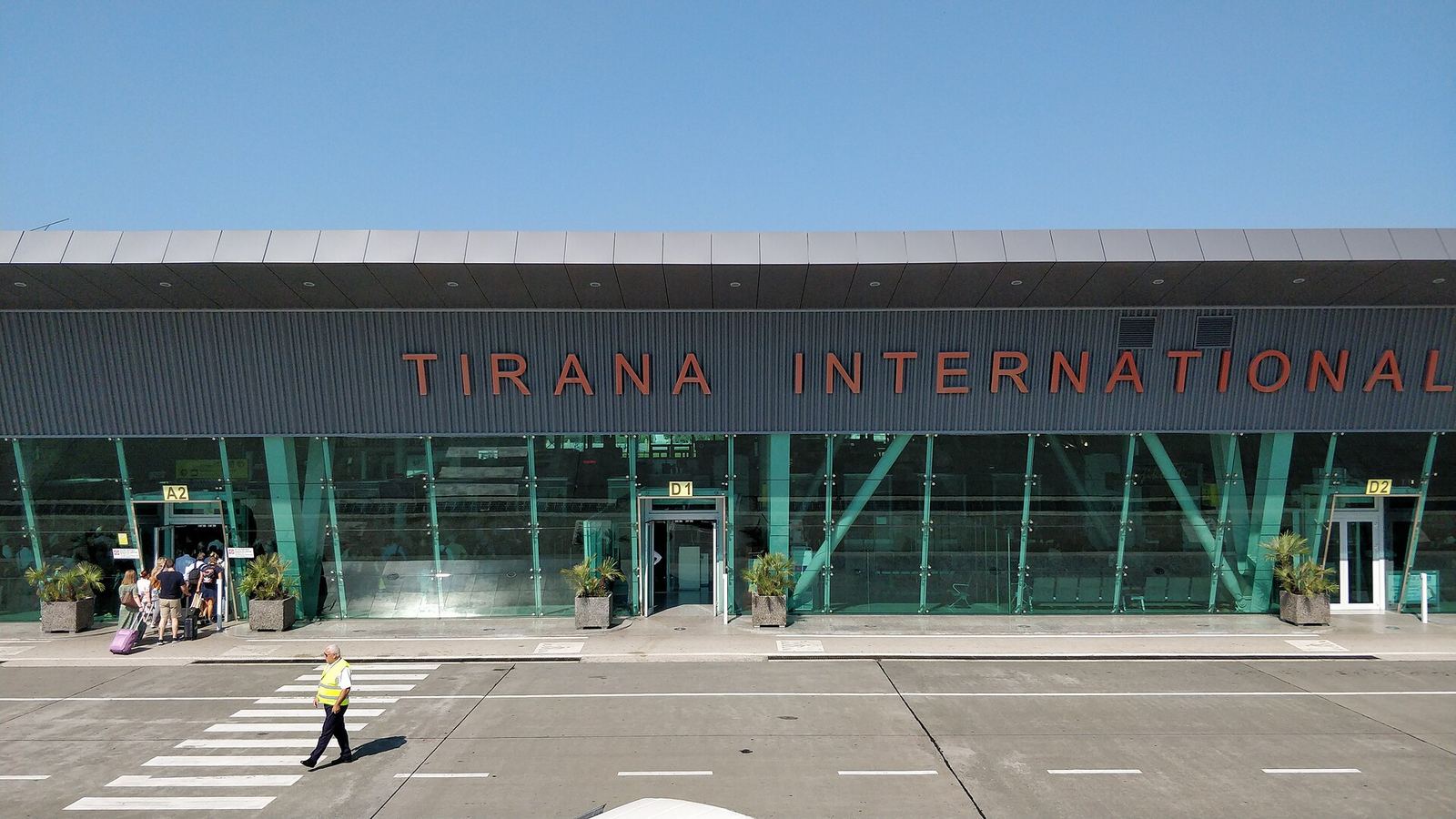
Tirana Nënë Tereza is an unusually simple airport to arrive at unconnected, largely because it is still one terminal doing everything despite handling several times the traffic it was built for. Clear passport control, collect your bag, and the Vodafone and One Albania shops are directly ahead of you as the sliding doors open, staffed at any hour and taking cards. The free WiFi wants no registration and imposes no timer. So getting online here is trivially easy. The part worth thinking about in advance is what you buy, because the tourist bundles on the shelf are built around a thousand call minutes that most visitors will never dial, and they cost meaningfully more than the data-only alternative sitting on your phone before you took off.
What This Guide Covers
Jump to the section most relevant to you
The Two Carrier Shops, and What They Charge
TIA runs a single passenger terminal, so there is no hunting between buildings. Come through the arrivals doors and both operators are in front of you within a few strides: a Vodafone Albania shop and a One Albania shop, side by side with the car hire desks, exchange counters and taxi booking. Both are staffed 24 hours to match a flight schedule that has grown steadily since the airport expanded, and both take cash or card.
Have your passport ready. Albania requires prepaid lines to be registered against an identity document before they carry traffic, and the assistant enters your details while you wait. It takes a couple of minutes with nobody in front of you and considerably longer when two summer charters have landed together.
The counter prices in 2026
Vodafone leads with a tourist pack of 40 GB and 1,000 minutes over fifteen days at around 2,300 lek, near 28 dollars, and a larger 100 GB pack with unlimited minutes over twenty-one days at around 2,900 lek. One Albania is the cheaper counter: roughly 1,800 lek for 10 GB over thirty days with unlimited minutes, and roughly 2,100 lek for 25 GB on the same terms, both including the registration fee. The card itself is usually a nominal 100 lek and is sometimes free. One point of difference: Vodafone will issue tourists an eSIM at the counter, while One deals in physical cards only.
Read those numbers next to a travel eSIM before you join the queue. Five gigabytes over a month from an international provider runs about twelve dollars, near a thousand lek, which undercuts every bundle on that shelf. The local packs are worth their price for two kinds of traveller: anyone who needs an Albanian number that a Sarandë guesthouse or a furgon driver can ring, and anyone who really will consume tens of gigabytes rather than sitting on cafe WiFi each evening.
Free TIA WiFi and What It Will Do For You
The airport publishes free wireless internet for all passengers and guests, branded simply as the TIA network, and connecting to it is refreshingly free of ceremony. No registration form, no password, no SMS code sent to a number you have not bought yet, and no ninety-minute cut-off. It reaches both the departures side and the arrivals hall including the baggage belts, so it is available exactly when you need it.
The honest caveat is throughput rather than access. This is a terminal designed for around five million passengers a year that has been extended toward eleven and is aiming higher still, and the WiFi feels that pressure at peak. Travellers regularly describe it as slow when several flights land together, which is fine for a message or a boarding pass but frustrating if you are trying to download a large map pack.
Using the WiFi as a rescue plan
Because the network is open and unlimited, TIA is a workable place to buy and install a travel eSIM on the spot if you meant to sort one out at home and did not. Sit down near the baggage belts, buy, scan the QR code, activate. Give yourself a few minutes rather than doing it while walking, since the profile download is the slowest part on a congested connection. It beats queueing for a physical card and paying twice the price for minutes you will not use.
One structural point about this particular airport. TIA sits roughly 17 kilometres northwest of central Tirana at Rinas, and there is currently no rail link, although an electrified Tirana to Durrës line with an airport station connected by covered walkway is under construction and targeted for 2027. Until that opens, everything about your onward journey happens on the forecourt, out of range of the terminal network, and it involves choosing between options that differ in price by a factor of five.
Rinas to Central Tirana, and Staying Online For It
The road runs southeast through Kashar into the city and coverage along it is solid on both networks the whole way, so whatever you have chosen will work en route. The question is which vehicle you get into, and here the price spread is dramatic.
| Route | Cost | Time | Notes |
|---|---|---|---|
| Rinas Express bus | 400 ALL | 30 to 45 min | Runs to Skanderbeg Square, hourly, 24 hours a day. Pay the conductor in cash on board. Up to an hour in peak traffic. |
| Speed Taxi app | Around 1,000 to 1,200 ALL | 25 to 35 min | The local ride-hailing app most visitors use. Needs a live data connection to book from the forecourt. |
| Official airport taxi | 2,200 to 3,000 ALL | 25 to 35 min | Fixed-rate rank outside arrivals, no app required, roughly double the app fare. |
| Pre-booked transfer | 2,500 to 4,000 ALL | 25 to 35 min | Arranged in advance, sensible for groups with luggage or a landing in the small hours. |
Uber does not operate anywhere in Albania, which surprises a lot of arrivals. The apps that fill the gap are local, Speed Taxi being the one most commonly recommended in Tirana, with Bolt also active in the capital. Both require you to be online at the moment you want a car, which is the whole reason this section exists.
The maths of the forecourt
An app booking into the centre typically runs around a thousand lek. The fixed-rate rank outside the door is roughly double that, and a driver approaching you in the hall can be more. That gap, somewhere between 1,000 and 2,000 lek on a single journey, is larger than the entire cost of a 5 GB travel eSIM for the month. Whatever else you decide about data, being able to open an app on the pavement pays for itself before you reach the ring road.
Why Albania Rewards Buying Ahead
In much of this region the counter is the bargain and buying ahead is the convenience premium. Albania inverts that, which makes the case unusually easy to state: the international product is both quicker to set up and cheaper than what is on sale in the arrivals hall, and the only things you give up are an Albanian phone number and a very large allowance.
In favour of arriving with data already live
Against
The compromise that most repeat visitors land on is to fly in on an eSIM and pick up a One Albania card in town later if the trip stretches out or the number turns out to matter. That also gives you two networks on one handset, which is worth something on the coastal road south of Vlorë. The Albania eSIM guide maps each provider to its underlying operator, which is the detail that decides how you fare once you leave the capital.
The Arrivals Counter Against a Travel eSIM
Side by side, with the lek converted at roughly 83 to the dollar so the comparison is honest.
| Local SIM at TIA | Travel eSIM | |
|---|---|---|
| Typical cost | 1,800 to 2,900 ALL, about 22 to 35 USD | About 12 USD for 5 GB over 30 days, 21 for 10 GB |
| Ready when | After the queue and the passport scan | Before you leave the aircraft |
| ID required | Yes, passport registration is mandatory | No |
| Data included | Large, 10 to 100 GB depending on pack | Whatever you sized it at |
| Calls and texts | Yes, generous minute bundles | Data only on most plans |
| Albanian number | Yes | No |
| Keeps your home number live | Only on a dual-SIM handset | Yes, the physical SIM stays put |
| Best for | Month-long stays, heavy data use, anyone needing callbacks | Ordinary one and two-week holidays, late landings, onward Balkan routes |
One last thing specific to this border. Albania is outside the EU roaming zone, so if you have driven or flown in from Greece, Italy or anywhere else in the union, your home allowance is not carrying over and international rates have already started. That catches an extraordinary number of people at exactly this airport, and it is worth checking your carrier's terms before you assume the phone in your pocket is still cheap to use. The Tirana city guide covers what happens once you are in town, where the bus system quietly assumes you have a mapping app.
Frequently Asked Questions
Will the carrier shops at TIA be open if I land at two in the morning?
Yes. Both the Vodafone and One Albania outlets in the arrivals hall are staffed around the clock, which reflects a flight schedule that has grown considerably since the terminal was extended. They sit directly in front of the sliding doors, so you will not need to look for them, and they accept cash or card. Bring your passport, because Albanian prepaid lines have to be registered against an identity document and there is no way to skip that at any hour.
Does the airport WiFi need a password or cut off after an hour?
Neither. TIA provides free wireless internet to all passengers with no registration, no password and no time limit, and it reaches the arrivals hall and baggage belts as well as departures. The real constraint is speed at busy periods, since the terminal handles far more traffic than it was originally built for. It is comfortably good enough to buy and install a travel eSIM on the spot, which is the most useful thing you can do with it.
How do I get from Rinas into central Tirana most cheaply?
The Rinas Express bus at 400 lek, which runs to Skanderbeg Square hourly, twenty-four hours a day. You buy the ticket from a conductor on board with cash. The journey takes 30 to 45 minutes in normal conditions and can stretch toward an hour when Tirana's traffic is at its worst. The airport is about 17 kilometres northwest of the centre and there is no train yet, although a rail link with an airport station is under construction for 2027.
Can I just use Uber from the airport?
No. Uber does not operate in Albania at all, which surprises a lot of arrivals standing on the forecourt. Local ride-hailing apps fill the gap, with Speed Taxi the one most often recommended in Tirana and Bolt also running here, and a booking into the centre usually lands around 1,000 to 1,200 lek. The fixed-rate rank outside arrivals charges roughly double for the same trip. Both app options assume you already have a working data connection.
I flew in from Greece. Does my European allowance still work here?
Almost certainly not. Albania is not an EU member and falls outside roam-like-at-home, so an Italian, German or Greek plan reverts to full international rates the moment it registers on an Albanian network, including while you are still inside the terminal. Some carriers sell a Western Balkans add-on for a daily fee, which is worth checking before you land. Otherwise switch data roaming off, connect to the airport WiFi, and sort out an eSIM or a local card before you leave the building.