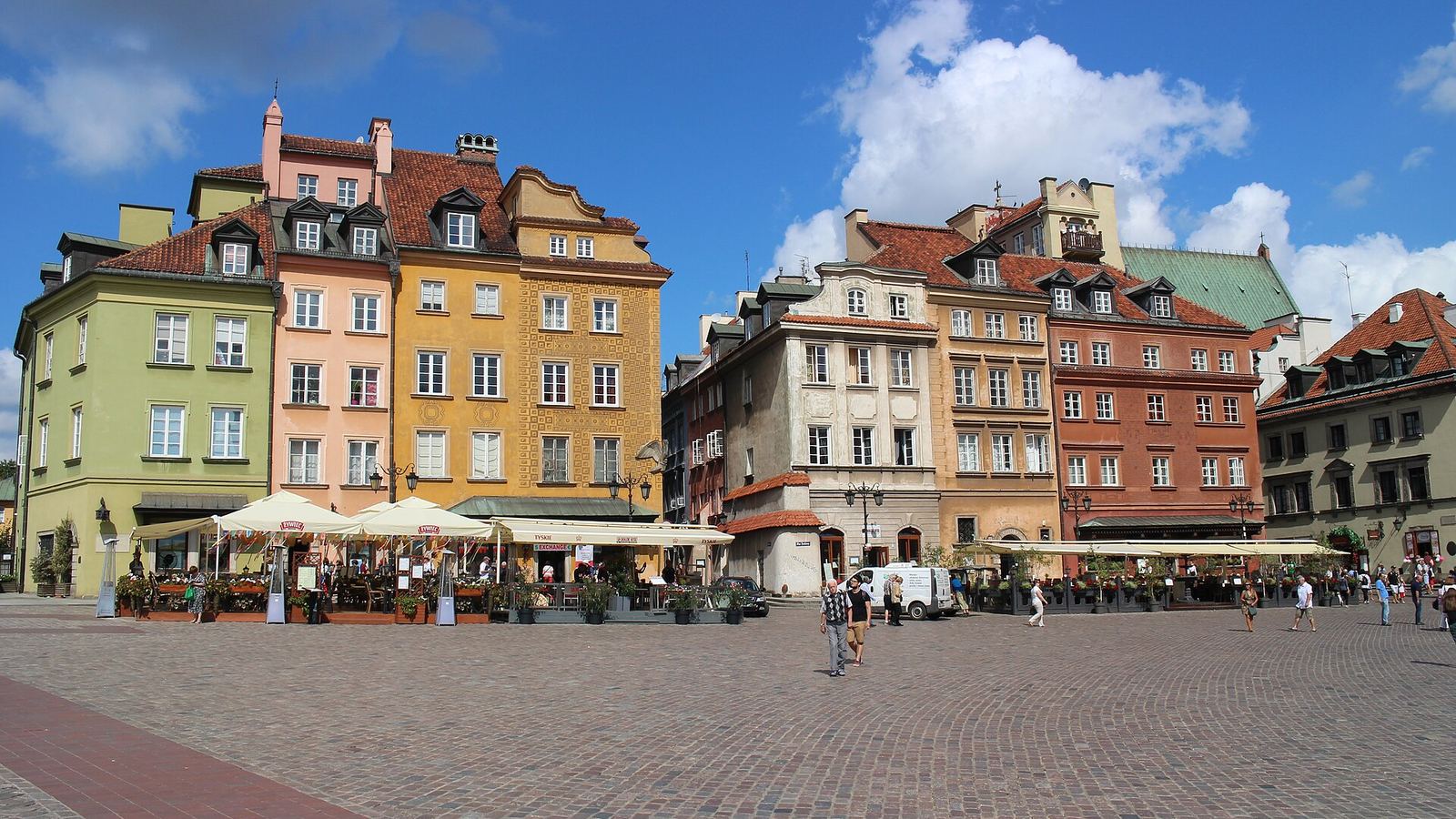
For almost every visitor, a travel eSIM is the simplest way to stay connected in Warsaw. You buy it before you fly, scan a QR code, and your phone is online the moment you land at Chopin. No kiosk to find, no SIM tray to fiddle with after a long flight. Warsaw rides four genuinely competitive networks (Play, T-Mobile, Orange, and Plus), so any reputable Poland eSIM gives you fast 4G and 5G across the city, including down in the metro tunnels. The bonus that makes a Poland eSIM unusually flexible: it roams free across the rest of the EU, so the same plan keeps working if you slip over to Berlin, Prague, or Vilnius.
What This Guide Covers
Jump to the section most relevant to you
Warsaw Mobile Coverage
Warsaw is exceptionally well covered. Four carriers compete here on roughly even terms: Play and T-Mobile lead the national rankings for coverage and 5G reach, Orange is right behind and often clocks the fastest peak speeds, and Plus is a dependable fourth. Across Srodmiescie, the Old Town, and the business towers around Rondo Daszynskiego, all four deliver strong 4G with 5G now common in the center.
In day-to-day use a Warsaw eSIM gives you a reliable 40 to 100 Mbps on 4G, and considerably more where 5G is live around the city center and major transit hubs. You will not notice which carrier your eSIM rides for ordinary travel tasks: Google Maps, the Jakdojade transit app, Bolt ride-hailing, translation, and video calls all run smoothly whether you are in the glassy heart of the city or the cobbled lanes of the rebuilt Old Town.
Which network does my eSIM use?
Most Poland travel eSIMs ride Play, T-Mobile, or Orange. For a Warsaw-focused trip, any of the four networks is excellent and the choice barely matters. If you plan a side trip into the Tatra mountains or the rural east, a plan on Play or T-Mobile has a slight edge on reach. Whichever it is, the same eSIM roams across the EU at no extra cost.
Metro, Tram, and Train Data Coverage
Here is the reassuring part for navigating Warsaw: your mobile data keeps working underground. Both metro lines carry cellular coverage in the stations and through the tunnels. Line M1 runs north to south through the city, and the newer Line M2 runs east to west under the Vistula river, linking Praga on the east bank with Wola in the west, and your eSIM stays connected the whole way.
Above ground, Warsaw's dense tram and bus network has continuous coverage, and so do the SKM commuter trains that thread through the city. You can plan a route in Jakdojade, tap into the next tram, and keep navigating without a single dropout. The whole network runs on one integrated ZTM ticket: a 20-minute single is among the cheapest options, while the 75-minute transfer ticket at around 4.40 PLN covers most cross-city journeys with changes.
Validate every ZTM ticket
Whatever ticket you buy, you must validate it on first use by tapping the yellow or red validator on board the tram or bus, or at the metro gate, otherwise it counts as fare evasion even if you paid. With a working eSIM you can also buy and activate tickets in the mobilet or Jakdojade app on the spot, which is the easiest route for visitors.
District Notes: Srodmiescie, Praga, Wola
Warsaw coverage is strong everywhere, but here is how the main visitor districts feel in practice.
Srodmiescie and the Old Town
The central district holds the reconstructed Old Town, the Royal Route, Lazienki Park, and the Palace of Culture. This is the most densely built network zone in the country, so speeds are consistently high and 5G is widespread. Even with crowds packed into the Old Town Market Square or around the palace, your eSIM holds a fast signal.
Praga
Across the Vistula on the east bank, Praga is the gritty, artsy district that survived the war largely intact, now full of galleries, vodka bars, and the Neon Museum. Coverage is solid here, helped by the M2 metro line that put a station right in the heart of it. Expect dependable 4G and 5G throughout the popular Praga Polnoc area.
Wola
West of the center, Wola has transformed into Warsaw's business district, with the skyscraper cluster around Rondo Daszynskiego and the moving POLIN Museum of the History of Polish Jews. The new towers come with heavy network investment, so this is some of the fastest 5G in the city, ideal if you need to tether a laptop.
The short version: you will not find a coverage dead zone anywhere a visitor is likely to go. Even Mokotow and the leafy southern districts hold strong signal, so wherever you base yourself in Warsaw your eSIM will keep up.
Free Public WiFi in Warsaw
Warsaw has plenty of free WiFi, but treat it as a backup rather than your main connection. The city runs free hotspots in many public spaces, and you will find reliable WiFi in most of the places travelers spend time.
Where you can count on free WiFi:
- Cafes and restaurants: nearly universal, from the chains to independent spots in Srodmiescie and Praga, usually with the password on the receipt or a table card.
- Shopping malls: Zlote Tarasy by the central station, Westfield Arkadia, and Westfield Mokotow all offer free WiFi.
- Public transport: many newer trams and buses have onboard WiFi, and major stations have hotspots.
- Museums and cultural sites: the Palace of Culture, POLIN, and the Warsaw Rising Museum typically provide visitor WiFi.
Why WiFi alone falls short
Free hotspots are useful, but the connection vanishes the second you step back onto the street, which is exactly when you want maps or the Jakdojade app to find your tram. Public WiFi is also less secure, so avoid logging into banking on it. An eSIM keeps you online continuously across the whole city, which is why most travelers use WiFi only as a fallback.
Getting Connected on Arrival at Chopin
The smoothest plan is to buy and install your eSIM at home a day or two before you fly, then switch it on when you land at Chopin (WAW). Most plans only start counting their validity from activation, not purchase, so you will not waste a day on transit.
Install before you fly
While you still have home internet, scan your provider's QR code to add the eSIM profile. Keep your home SIM in place so you can still receive messages on your usual number.
Use the airport WiFi if you need it
Chopin has free WiFi across its single terminal if you still need to download or activate anything after landing. Look for the airport's free network on your WiFi list and accept the terms to get online.
Switch over and confirm
After landing, turn on your eSIM line, set it as your data line, and enable data roaming if your provider says to. Within a minute or two you should see a Polish carrier name and a data signal. Open maps to confirm before you head for the SKM train or bus 175 into the center.
This skips the kiosk queue entirely. While other arrivals are still hunting for a SIM counter, you are already checking train times into Srodmiescie. For the full rundown of transport and prices from the airport, see our Warsaw airport guide.
Day-Trip Coverage: Krakow, Auschwitz, Gdansk
Warsaw coverage is uniformly excellent, and the good news is that the popular day trips out of the capital are well connected too, with only the mountains and deep tunnels posing any gaps.
| Destination | Coverage | Notes |
|---|---|---|
| Krakow | Excellent | Fast 4G/5G across the Old Town, Kazimierz, and Wawel; the express train down from Warsaw has good signal most of the route. |
| Auschwitz & Wieliczka | Very good | Solid signal at both sites and on the access roads; expect normal dead spots deep in the Wieliczka salt mine tunnels. |
| Gdansk & Zakopane | Good | Gdansk and the Tri-City are fully covered; Zakopane town is fine, but Tatra ridges and high trails drop out on any carrier. |
For a day trip to Krakow, the train is the easy pick and your eSIM keeps maps and ticket apps running almost the whole way. If you are heading to Zakopane and the Tatras to hike, download offline maps before you set off, since no carrier guarantees a signal on the high ridges toward Morskie Oko and Rysy. For everything else within a couple of hours of Warsaw, any well-reviewed Poland eSIM will keep you connected, and remember it roams free if your route crosses into Slovakia or Czechia.
Frequently Asked Questions
Does my data work on the Warsaw metro?
Yes. Both metro lines, M1 running north to south and M2 east to west under the Vistula, have cellular coverage in the stations and through the tunnels, so your eSIM stays connected while the train moves. You can keep navigating and messaging underground without relying on station WiFi. Trams, buses, and SKM commuter trains above ground also have continuous coverage.
Will my Warsaw eSIM still work if I take a side trip to Prague or Berlin?
Yes. Poland is in the EU, so a Poland travel eSIM roams across all 27 member states and several neighbors at no extra cost. A side trip from Warsaw to Berlin, Prague, or Vilnius draws from the same data allowance with nothing to change. If your trip is mostly multi-country from the start, a regional Europe plan is usually the better-value choice.
Is free public WiFi in Warsaw good enough on its own?
It works as a backup but not as your only plan. Warsaw has plenty of free WiFi in cafes, malls, museums, and on many trams and buses, plus city hotspots. The catch is that the signal disappears the moment you walk back onto the street, which is exactly when you need maps or the Jakdojade transit app. Public WiFi is also less secure for logins, so most travelers keep a working eSIM and use WiFi only as a fallback.
How much data do I need for a few days in Warsaw?
For a typical city break of maps, transit apps, social media, messaging, and some streaming, most travelers do well with a 3 GB to 5 GB plan. If you add day trips, stream a lot of video, or tether a laptop from a Wola cafe, step up to 10 GB or an unlimited plan so you are not rationing. Cafes and hotels across the city offer free WiFi, which eases the load on your data.
Will my eSIM keep working on a day trip to Krakow or the Tatra mountains?
Mostly yes. Krakow is fully covered with fast 4G and 5G, and the train down from Warsaw has good signal for most of the ride. The Tatras around Zakopane are different: the town and main valleys are fine, but high ridges and the trails toward Morskie Oko and Rysy can drop out on any network. For mountain hikes, pick a Play or T-Mobile based plan and download offline maps in advance.